

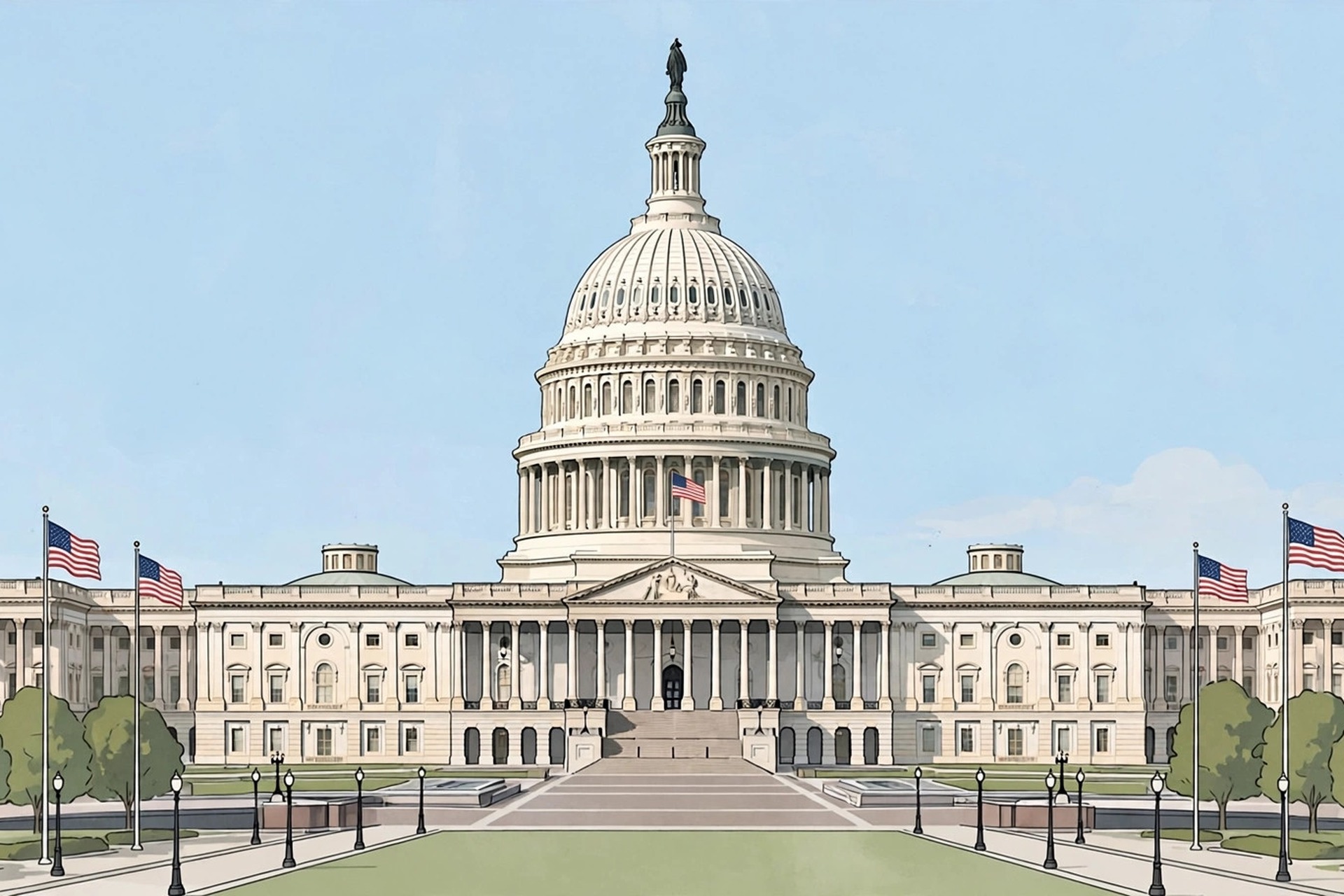
WASHINGTON — Congress returns to Washington on November 9 for a lame-duck session that will run, with a break for Thanksgiving, until around Christmas — and it returns to a pile of unfinished work that leaders in both parties spent the autumn postponing. Government funding runs out on December 11. The annual defence authorisation bill is unfinished. The farm bill expired on September 30. A surveillance authority that lapsed in June is still unresolved. And some Republicans want to use the session’s final weeks to push through a third party-line reconciliation package before a new Congress takes office on January 3, 2027.
A lame-duck session is the period between an election and the seating of the next Congress, when members who have lost their races or are retiring still vote. This year’s session carries an extra edge because it could be the last stretch of unified Republican control of Congress and the White House, depending on Tuesday’s results. Whatever voters decide on November 3, however, the current Congress keeps its powers until January 3, and President Donald Trump keeps the veto pen. No result on Tuesday changes who holds the gavels in November and December; it changes only the incentives for what gets done with them.
The session’s shape became clearer in the final days before the election, when Republican leaders began talking openly about how much they could still pass — and how much they could not. Senator Bernie Moreno of Ohio argued that Republicans should stay in Washington from November 9 until December 31 with no break at all if they lose either chamber, saying the party should use every remaining day. Senate Majority Leader John Thune of South Dakota poured cold water on the most ambitious version of that plan. Speaking to reporters in the week before the election, Thune said Republicans did not currently have the votes to take up a third reconciliation bill and the budget resolution it would require, adding that they might have them after the midterms but that they did not know whether they could defend the package against Democratic amendments designed to sink it.
Government funding deadline December 11 is the session’s forcing mechanism
The hard deadline is December 11, when the current continuing resolution — the stopgap that keeps the government funded — expires. Surface transportation programmes expire the same day. Congress must either pass full-year spending bills, assemble an omnibus combining the twelve annual appropriations bills, or pass another short-term extension. Failing to do any of those things would produce a partial government shutdown, a prospect both parties say they want to avoid but have repeatedly approached in recent years.
The central fight is over the length of whatever comes next. Republicans who expect to lose ground may want to lock in a full-year spending deal now, while they still control both chambers. Democrats who expect to gain ground have the opposite incentive: they would prefer a short stopgap that pushes the big funding decisions into 2027, when they might hold a House gavel. Because most legislation needs sixty votes to advance in the Senate, Senate Democrats hold real leverage over funding in every scenario, and the length of the stopgap is likely to become the session’s central negotiation.
Defence spending is the sharpest point of disagreement inside that negotiation. The Trump administration has sought a record defence budget of about 1.5 trillion dollars, a figure Senate Democrats have rejected. House Minority Leader Hakeem Jeffries has said publicly that he favours completing the appropriations bills during the lame-duck period rather than punting them, a position that puts him at odds with Democrats who would rather wait. The gap between those positions — settle now or defer — will decide whether December produces a full spending settlement or another temporary patch.
Defence bill, farm bill and lapsed surveillance authority compete for time
Alongside funding, the annual National Defense Authorization Act, which sets Pentagon policy, remains unfinished after stalling in the Senate in July. Congress has passed a defence authorisation bill every year for more than six decades, and leaders in both parties expect a deal after the election, but negotiations have been complicated by disputes over Iran war oversight and policy riders attached to the bill. A water resources bill, which authorises Army Corps of Engineers projects, is further along: the House passed its version by an overwhelming 415-9 vote in September, and the Senate committee approved its own version unanimously in July, leaving a bicameral negotiation to finish the job.
The farm bill presents a different kind of problem. It expired on September 30, and while crop insurance and nutrition benefits continue for now, conservation, research and rural development programmes face funding uncertainty. If Congress does not act by December 31, farm programmes would revert to permanent law written in the 1930s and 1940s, a prospect farm-state lawmakers in both parties describe as unacceptable but have nonetheless allowed to approach before. House and Senate versions of a new farm bill exist, and staff in both chambers have been negotiating behind the scenes, but the bill still needs floor time in a calendar that has little of it.
Surveillance authority is the session’s quietest unresolved item and potentially its most sensitive. Section 702 of the Foreign Intelligence Surveillance Act, which governs surveillance of foreign targets, has been lapsed since June. Intelligence officials have warned that a prolonged lapse complicates collection, while civil liberties advocates argue that any reauthorisation should come with new safeguards. The issue has repeatedly been deferred in favour of more urgent deadlines, and the lame-duck calendar gives it one more window — but only if leaders choose to spend scarce floor time on it.
Third reconciliation bill divides Republicans before the session opens
The most openly contested question is whether Republicans attempt a third reconciliation package. Reconciliation is the budget procedure that lets a bill pass the Senate with a simple majority, bypassing the filibuster, and it is therefore the only vehicle by which a party-line package could move without Democratic votes. Two reconciliation bills have already been used in this Congress. A third would need a new budget resolution, and Thune’s caution reflects a practical problem: a reconciliation bill on the floor becomes a magnet for amendments, and Democrats would use that process to force difficult votes on Republican senators.
What would go into such a package is itself a matter of debate. Proposals floated by Republicans include a debt-limit increase large enough to cover the remainder of Trump’s term, which would deny a future Democratic majority the chance to condition a borrowing increase on policy concessions; additional defence funding; farm aid; funding connected to the war with Iran; and up to 10 billion dollars for states to tighten voting rules. A debt-limit increase is the item with the clearest strategic logic for Republicans who fear losing the House: it removes a future leverage point for Democrats. But it also requires Republican unity that Thune has said is not yet demonstrated, and it would compete for the same floor time as funding, the defence bill and the farm bill.
Other items wait in the wings. More than thirty Trump nominees are awaiting Senate floor votes, and a confirmation push could crowd out legislation if leaders prioritise it. A bipartisan Senate permitting reform bill, introduced on September 30 by Senators Shelley Moore Capito, Mike Lee, Sheldon Whitehouse and Martin Heinrich, would speed up permits for energy and infrastructure projects but still needs a Senate vote and House action. A college sports bill, the Protect College Sports Act, passed the Senate 77-22 and would write college athletics rules into federal law, but it too still needs the House. A narrow tax package is also under discussion. None of these is guaranteed floor time; all of them are competing for a calendar that ends at Christmas.
How the election outcome changes the lame-duck calculation
The election does not change the lame-duck calendar, but it changes what each party wants from it. If Republicans hold both chambers, the pressure to finish pending legislation in December eases: leaders can clear funding and the defence bill, complete deals already negotiated, and save larger priorities for 2027. If Democrats win the House, Republicans face their last weeks of unified control, and the incentive to pass a debt-limit increase and any other party-line items grows stronger — but so does the difficulty, since a looming loss can fracture party discipline. If Democrats win both chambers, the incentive to act before January 3 is strongest of all, and the same unity problem applies with even greater force.
Democrats, meanwhile, face their own calculation. A party that has just won the House has reason to delay big bargains until it holds the gavel, and Senate Democrats can use the filibuster to block a full-year funding package they dislike. But Democrats also have reason to cooperate on must-pass items: a shutdown in December would be blamed, at least in part, on the party seen to be blocking a deal, and some Democratic priorities — including health care extenders and community health centre funding, which lapses on December 31 — need action in the lame-duck session regardless of who won.
None of this should be read as a prediction about Tuesday. Forecasts and polling averages published before the election point in various directions, and the result will not be known until votes are counted — in some races, not for days. What is certain is the calendar: Congress returns November 9, funding expires December 11, several programmes lapse December 31, and a new Congress convenes January 3. The lame-duck session is where the old Congress’s unfinished business meets the new Congress’s shadow, and the deals struck — or deferred — in those seven weeks will shape federal spending, defence policy and farm programmes well into 2027.
Sources
USN reviewed reporting from multiple outlets for this story. Read more from Holland & Knight (https://www.hklaw.com/en/insights/publications/2026/10/beyond-the-midterms-congress-faces-converging-year-end-deadlines), No Labels (https://nolabels.org/the-latest/the-2026-lame-duck-session-what-congress-still-has-to-pass-after-the-midterms/) and DNYUZ (https://dnyuz.com/2026/11/01/desperate-gop-bid-to-salvage-maga-agenda-clashes-with-reality-we-dont-have-the-votes/).