

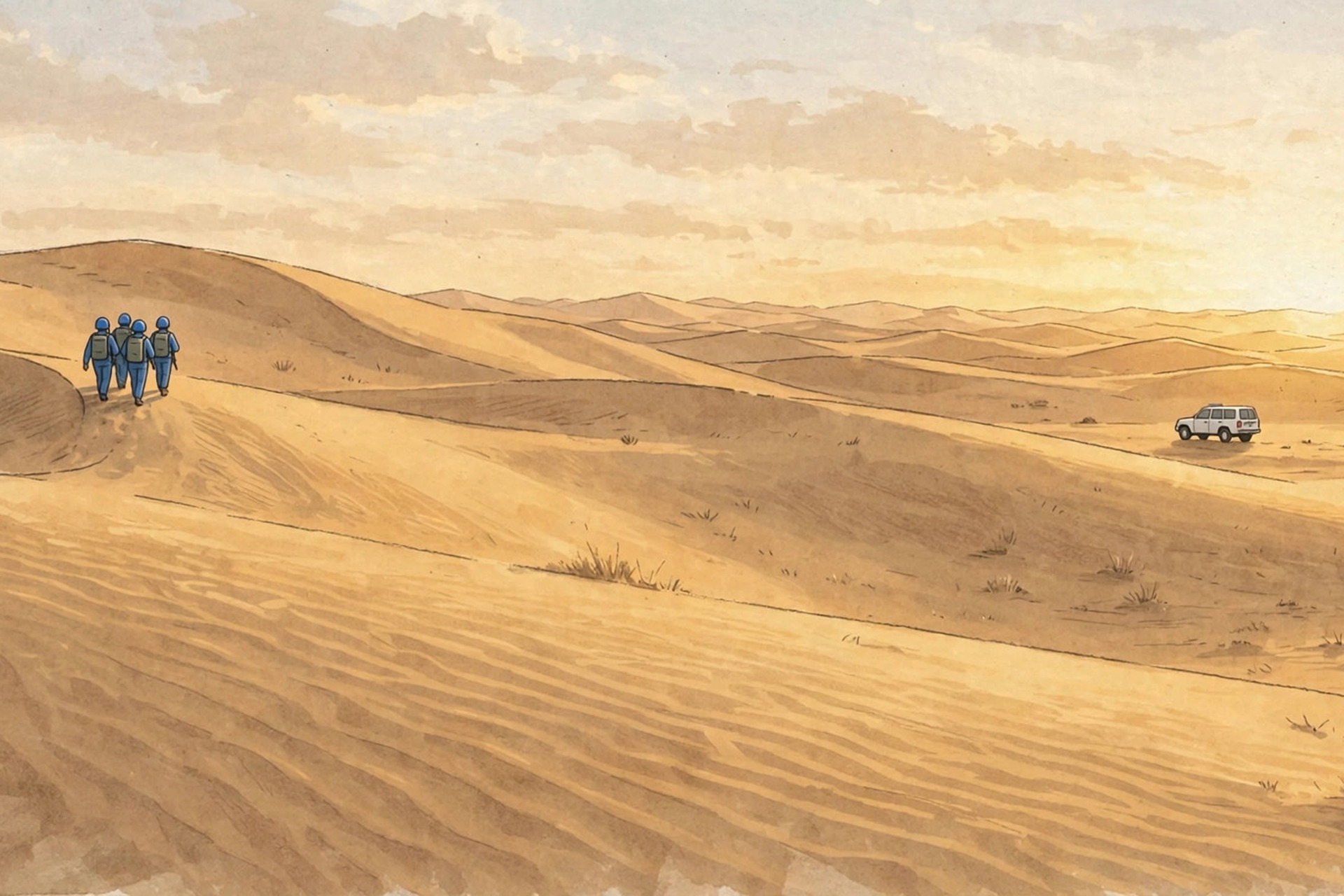
The United Nations peacekeeping mission in Western Sahara, known as MINURSO, entered its liquidation phase on November 1, after its mandate expired on October 31, 2026, without renewal. The end of the mission closes 35 years of peacekeeping in the disputed territory, dating back to a ceasefire in 1991. It does not, by itself, settle Western Sahara’s disputed status, and the United Nations says the issue remains on the Security Council’s agenda. That distinction — between the end of a mission and the end of a dispute — is essential to understanding what has happened, and what has not.
MINURSO — the United Nations Mission for the Referendum in Western Sahara — was established in 1991 to monitor a ceasefire and to organise a referendum on the territory’s future. That referendum never took place, because the parties could never agree on who would be eligible to vote. For three and a half decades, the mission remained in place, monitoring the ceasefire, reporting on conditions on the ground, and serving as a visible United Nations presence in a territory roughly the size of Britain, in north-west Africa. Its departure removes that presence at a moment when the UN itself warns of a risk of escalation.
The immediate cause of the mission’s end was a failure to agree in the Security Council on Friday, October 30. The United States drafted a resolution that would have extended the mission for a year, removed the word “referendum” from its name, and made Morocco’s autonomy proposal the only basis for further talks. That draft was backed by 11 of the Council’s 15 members, including fellow permanent members France and the United Kingdom. Russia vetoed it. A competing Russian resolution, which would have extended the mission’s existing mandate for another year, then won only three votes, with 11 abstentions — short of the nine votes needed for adoption. With neither draft adopted, the mandate simply expired.
United Nations Secretary-General Antonio Guterres confirmed the end of the mission on Sunday, November 1, and said that November 1 marked the start of the liquidation phase, with assets transported back to troop-contributing countries. A reduced team reporting to the UN Department of Operational Support will oversee the withdrawal and disposal of mission assets, coordinating the repatriation of equipment belonging to troop-contributing countries and managing UN-owned property under established disposal procedures. Guterres called on all parties to cooperate fully so that liquidation proceeds in an orderly manner and is completed as quickly as possible.
Why the UN Western Sahara mission ended without renewal
The Council’s deadlock was not a sudden accident; it was the product of a long-running disagreement about the direction of the Western Sahara file. A year earlier, in 2025, the Security Council adopted a US-drafted resolution that accepted Morocco’s plan to give the territory autonomy under Moroccan sovereignty as the “most feasible” solution to the conflict. Russia abstained in that vote. This year, Washington sought to go further: to cement the UN’s preference for the Moroccan plan, to scale back the peacekeeping force, and to drop “referendum” from the mission’s name altogether. For the United States and its supporters, that was presented as moving a 50-year-old conflict forward and as abandoning a status quo they described as unacceptable.
For Russia, the draft went too far in the opposite direction. Russia’s ambassador to the UN, Vassily Nebenzia, said at the Council meeting that Moscow opposed the draft because it favoured one side, and added: “We stress the fact that the Security Council cannot automatically predetermine matters relating to sovereignty.” That argument — that the Council should not prejudge the outcome of negotiations about sovereignty — is central to Russia’s position, and it resonated with other Council members who abstained on the competing Russian draft even though they did not vote for it. The result was a Council that could agree neither to the American plan nor to a simple extension of the status quo.
US Ambassador to the UN Mike Waltz, speaking after Friday’s vote, said it was truly unfortunate that in 2026 the veto was used to “preserve the letter R [in the Mission’s name] for referendum.” He added that Washington’s proposal would have moved the conflict forward. That framing — that the dispute was about a single letter — captures the symbolic weight of the word “referendum.” For Morocco, the reference to a referendum had become, in the words of Foreign Minister Nasser Bourita, an “anachronism.” For the Polisario Front and its supporters, the referendum was the original promise on which the ceasefire was built, and removing it would have removed the mechanism by which the Sahrawi people were supposed to decide their own future.
The vote arithmetic also matters. A Security Council resolution needs nine votes in favour and no veto from a permanent member to pass. The US draft had the votes — 11 in favour — but could not survive a Russian veto. The Russian draft had no veto against it, but could not reach nine votes, winning only three with 11 abstentions. The Council was therefore left with no adopted text at all, and the mandate expired by default rather than by a positive decision to end the mission. That is a different political outcome from a Council vote to terminate MINURSO, and it leaves the door open, in principle, to a future mandate if the Council can agree on new terms.
A 35-year mission built on a referendum that never happened
To understand why MINURSO lasted so long, it is necessary to go back to the territory’s history. Morocco has considered Western Sahara its territory since 1975, when Spain withdrew from the desert region. The Polisario Front, an Algeria-backed movement acting on behalf of the indigenous Sahrawi people, seeks to establish an independent state called the Sahrawi Republic. The two sides fought until a UN-brokered ceasefire in 1991, which was supposed to be followed by a referendum in which the people of Western Sahara would choose between integration with Morocco and independence.
That referendum was never held, because the parties disagreed fundamentally over voter eligibility: who counted as a legitimate voter, how to treat people who had moved into the territory after 1975, and how to handle the Sahrawi refugee population in Algeria. Each side accused the other of seeking to rig the electorate in its favour. As the years passed, the referendum receded as a practical prospect, but MINURSO remained, monitoring the ceasefire and providing a UN presence that, for many observers, helped prevent a return to full-scale war.
The ceasefire held, with interruptions, for nearly three decades. Hostilities resumed in 2020, and the security situation has remained fragile since then. Guterres paid tribute to MINURSO’s personnel for their work since 1991, particularly in monitoring the ceasefire and supporting efforts toward a political settlement, and he commended Special Representative Alexander Ivanko for leading the mission through difficult circumstances following the resumption of hostilities in 2020. He also honoured the 20 personnel who died while serving with MINURSO — a reminder that peacekeeping, even in a mission often described as quiet, carries real risk.
The mission’s end therefore removes not only a set of observers and vehicles, but also a channel of reporting and a buffer that both sides, whatever their public statements, had learned to live with. The UN’s own warning reflects that concern: Guterres said he remains concerned about the security situation throughout the territory and the risk of hostilities escalating, and he urged all concerned to exercise maximum restraint and to refrain from actions that could further increase tensions or undermine regional stability.
Reactions in Rabat, Algiers, and among the Polisario
Morocco welcomed the end of the mission. Its royal palace said the fact that the mission was not renewed was a “significant development” in withdrawing the Western Sahara issue from the Security Council’s consideration, and later described it as a significant development towards withdrawing the issue from consideration by the Council. Bourita said Rabat had been informed that Russia was going to block the US-drafted resolution, but saw it as an opportunity to review certain rules of the game. For Morocco, the non-renewal is presented as confirmation that the referendum framework is obsolete and that the future lies in negotiations based on its autonomy proposal.
Algeria, which backs the Polisario, took the opposite view. Its Foreign Ministry expressed “deep regret” over the non-renewal on Saturday, blaming what it called the “excessive bias” of the United States towards Morocco’s position. That language reflects Algeria’s long-standing position that the Western Sahara question is one of decolonisation and self-determination, and that any solution must preserve the Sahrawi people’s right to decide their future through a vote. From Algiers’ perspective, the Council’s failure is not a step towards a solution, but a failure to protect the process that was supposed to deliver one.
The Polisario Front said in a statement that it was “concerned at the deadlock in the Security Council meeting.” That concern is understandable: the Front’s leverage has long depended, in part, on the international community’s continued engagement through MINURSO and through the Council. Without a mission on the ground, the Front may fear that the territory will slip from international attention, or that the balance on the ground will shift in Morocco’s favour. At the same time, the Front’s own military position and its relationship with Algeria will shape how it responds to the mission’s departure, and whether the warning of escalation proves justified.
Those three reactions — welcome in Rabat, regret in Algiers, concern from the Polisario — illustrate why the mission’s end cannot be described as a settlement. A settlement would require agreement, or at least acceptance, from the parties most directly involved. What happened instead was a disagreement in New York that left a mission without a mandate. The parties’ public statements show that they interpret that outcome in opposite ways, which is itself a sign that the underlying dispute is unresolved.
What liquidation means, and what the UN will still do
Liquidation is a technical term with practical consequences. It means the mission is no longer conducting peacekeeping operations; instead, a smaller team is closing it down. Equipment belonging to troop-contributing countries will be sent back to those countries. UN-owned property will be disposed of under established procedures. Staff will be withdrawn in an orderly sequence. The process is designed to be completed as quickly as possible, but it is not instantaneous, and the UN has asked all parties to cooperate so that it proceeds without incident.
Crucially, Guterres also said that while MINURSO’s peacekeeping operations have concluded, the United Nations stands ready to continue supporting efforts to advance dialogue and pursue a peaceful resolution of the conflict. He reaffirmed the UN’s commitment to pursuing a negotiated political settlement through his Personal Envoy, Staffan de Mistura. Hespress’s reporting of the UN announcement put the same point explicitly: the termination of MINURSO’s operations does not end the UN’s diplomatic involvement in the Sahara dispute or remove the issue from the Security Council’s agenda.
That continued diplomatic role matters for several reasons. First, it preserves a UN channel for talks, even without troops on the ground. Second, it means the Council could, in future, adopt a new mandate — whether for a renewed peacekeeping presence, an observer mission, or some other form — if political conditions change. Third, it signals to the parties that the international community has not simply walked away, even if its most visible instrument in the territory has been withdrawn. Whether that signal is enough to prevent escalation is an open question, and one that will be tested in the coming weeks and months.
For civilians in Western Sahara, the practical question is simpler and more immediate: will the ceasefire hold without UN monitors to observe it? The UN’s warning suggests that question is not rhetorical. The resumption of hostilities in 2020 showed that the ceasefire is not self-sustaining, and the absence of a neutral presence may make it harder to verify claims and counter-claims about incidents on the ground. Local communities, humanitarian workers, and journalists will all face a more difficult environment for establishing what is happening, if tensions rise.
What this does not settle
It would be a mistake to report the end of MINURSO as the end of the Western Sahara dispute, or as a final determination of the territory’s status. No Council resolution has decided that status. No referendum has been held. No negotiated agreement has been signed by Morocco and the Polisario. The autonomy proposal favoured by Morocco and, in recent years, by the United States, remains a proposal — one that Morocco presents as the most feasible solution and that the Polisario rejects as incompatible with self-determination. The Council’s failure to adopt either draft last week leaves that disagreement exactly where it was, minus the peacekeeping mission that had monitored it.
The broader regional context also remains unsettled. Western Sahara sits at the intersection of Moroccan, Algerian, and wider North African and Sahelian politics, and its fate affects relations between Rabat and Algiers, which are already strained. The involvement of major powers — the United States as the author of the failed draft, Russia as the vetoing power, France and the United Kingdom as supporters of the American text — shows that the dispute is also a site of great-power competition, in which positions on Western Sahara are linked to broader relationships and rivalries. That competition makes a future Council agreement harder, not easier, to achieve.
For readers, the story to watch now is not the liquidation timetable alone, important though that is, but whether the parties exercise the restraint Guterres urged, whether de Mistura’s diplomatic efforts gain any traction without a mission on the ground, and whether the Council returns to the file with a new proposal that can command nine votes and avoid a veto. Until one of those things happens, Western Sahara will remain what it has been for decades: a disputed territory, now without the peacekeeping mission that watched over it for 35 years, and with its future still to be decided.
Sources
USN reviewed reporting from multiple outlets for this story. Read more from Al Jazeera (https://www.aljazeera.com/amp/news/2026/11/1/un-warns-of-security-risks-in-western-sahara-as-peacekeeping-mission-ends), Reuters (https://www.reuters.com/world/africa/un-peacekeeping-mission-western-sahara-ends-after-35-years-un-chief-says-2026-11-01/) and Hespress (https://en.hespress.com/148362-un-begins-liquidation-of-minurso-after-security-council-fails-to-renew-mandate.html).