

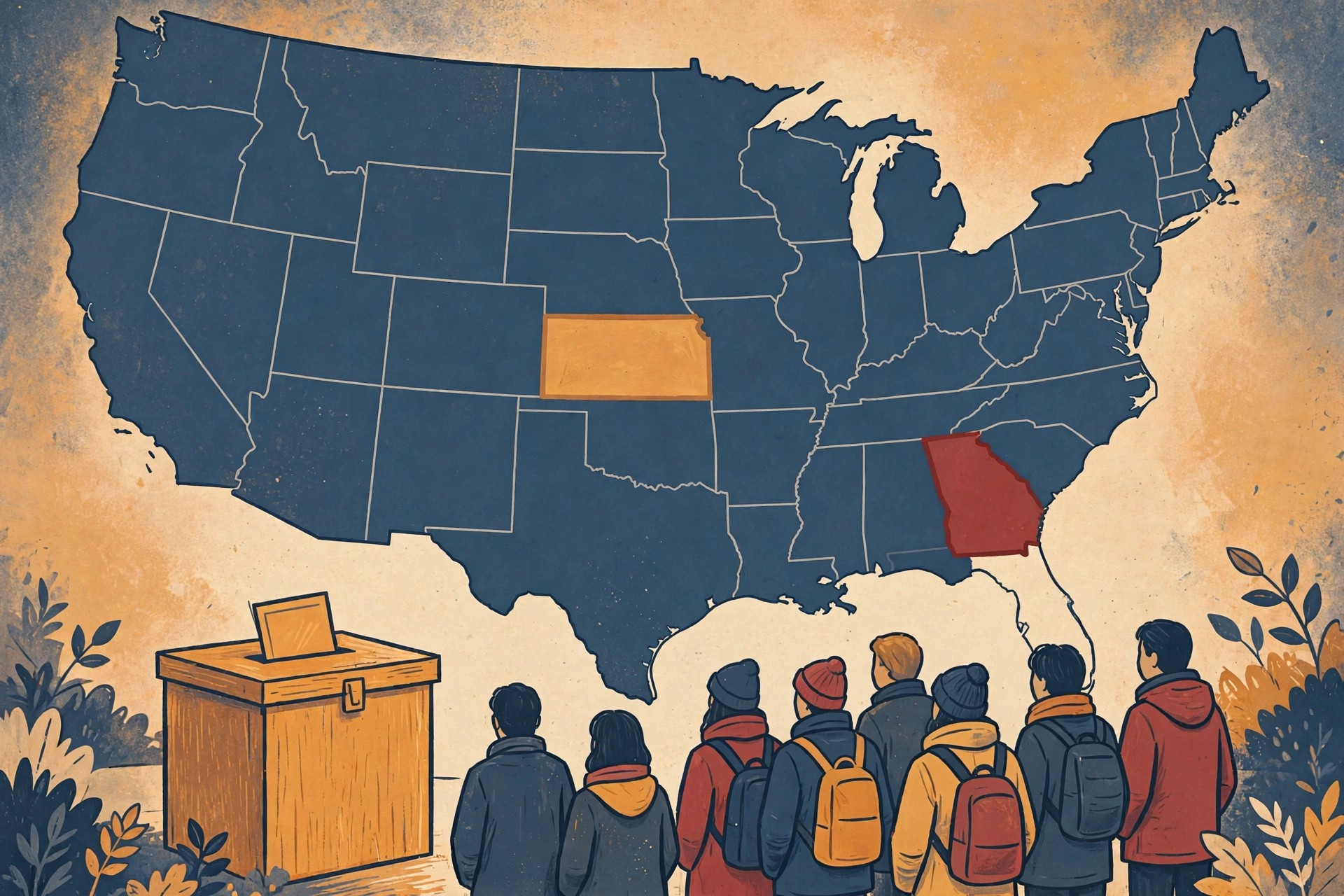
The final YouGov polls before Election Day show a dead heat in Nebraska and a clear Democratic lead in North Carolina, widening the Senate battleground beyond the seven states highlighted in the New York Times/Siena surveys. In Nebraska, independent Dan Osborn and Republican Senator Pete Ricketts are tied at 49 percent each, while in North Carolina, former Governor Roy Cooper leads Republican Michael Whatley by 11 points, 55 percent to 44 percent.
The YouGov surveys, conducted from 26 to 29 October among likely voters, cover a broader set of states than the Times/Siena polls, including Texas, Ohio, Iowa and Kansas. Together, they suggest Democrats are competitive in more states than previously thought, even if the path to a Senate majority remains narrow.
Nebraska: a tie that could decide the Senate
Nebraska is the most surprising result in the YouGov batch. Osborn, a former union leader running as an independent, has tied Ricketts, a well-funded incumbent, at 49 percent each. The result is within the margin of error, but it shows Osborn has closed a gap that many analysts thought was insurmountable earlier in the campaign.
Osborn has run as an outsider, criticising both parties and focusing on economic issues, including wages, healthcare and farm policy. Ricketts, a former governor, has run as a loyal supporter of President Donald Trump, emphasising immigration, energy and tax cuts.
If Osborn wins, he has said he would caucus with neither party, or would decide based on the issues. That could make him a pivotal vote in a closely divided Senate, regardless of which party wins the majority.
North Carolina: Cooper’s clear lead
North Carolina is a clearer story. Cooper, a former governor who is well known statewide, leads Whatley, the former chair of the Republican National Committee, by 11 points, 55 percent to 44 percent. That is a larger lead than the Times/Siena poll showed for Cooper, which put him ahead by five points.
Cooper’s lead reflects his popularity in North Carolina, where he served two terms as governor, and Whatley’s relative lack of name recognition. Whatley has run as a Trump loyalist, but he has struggled to gain traction outside the Republican base.
If Cooper wins by a margin close to the YouGov result, North Carolina would be one of the earliest states to be called on election night, and it would signal a strong night for Democrats.
Texas, Ohio and the wider battleground
The YouGov polls also confirm the Times/Siena results in Texas and Ohio, though with different margins. In Texas, former Representative James Talarico leads Republican Senator John Cornyn, though by a smaller margin than the Times/Siena poll suggested. In Ohio, former Senator Sherrod Brown leads Republican Senator Jon Husted, again by a margin that is within the range of the Times/Siena result.
In Iowa, the YouGov poll shows a close race, with Democratic state Representative Jennifer Konfrst slightly ahead of Republican Senator Joni Ernst, consistent with the Times/Siena result that put Konfrst ahead by one point.
In Kansas, the YouGov poll shows a Republican lead, though by a smaller margin than in past cycles. Kansas is not seen as a Democratic pickup opportunity, but the poll suggests Democrats are competitive even in states where they are not favoured to win.
How to read the YouGov polls
YouGov polls are conducted online, using a panel of respondents weighted to match the likely electorate. They have a margin of error of about plus or minus 3 to 4 percentage points, similar to the Times/Siena polls.
The YouGov polls were conducted over the same period as the Times/Siena polls, from 26 to 29 October, so they provide a useful cross-check. Where the two polls agree, as in Texas, Ohio and Iowa, the result is more reliable. Where they differ, as in North Carolina, where YouGov shows a larger Cooper lead, the true margin is likely somewhere in between.
Both sets of polls agree on the overall picture: Democrats are ahead in most battlegrounds, Republicans are not leading in any of the states polled by Times/Siena, and the Senate majority will depend on turnout and on races that are still within the margin of error.
What to watch on Election Day
On Tuesday, watch Nebraska first. If Osborn wins, or even if the race is close, it will signal that independent candidates can compete in deep-red states, and it could change the calculus for Senate control.
Watch North Carolina second. A Cooper win by a large margin would confirm the YouGov polling and suggest Democrats are having a strong night. A closer result would suggest the race is more competitive than YouGov indicated.
Watch Texas and Ohio third. Both are states where Democrats lead in both sets of polls, but where Republicans have strong incumbents and well-funded campaigns. Wins in both would put Democrats on a clear path to the majority.
For voters, the message of the final YouGov polls is similar to that of the Times/Siena polls: the Senate is competitive, Democrats have an edge, but the outcome is not settled. The final polls are a guide, not a guarantee, and the results on Tuesday will be decided by who turns out to vote.
Sources
USN reviewed reporting from multiple outlets for this story. Read more from YouGov, The Hill, and The New York Times.