

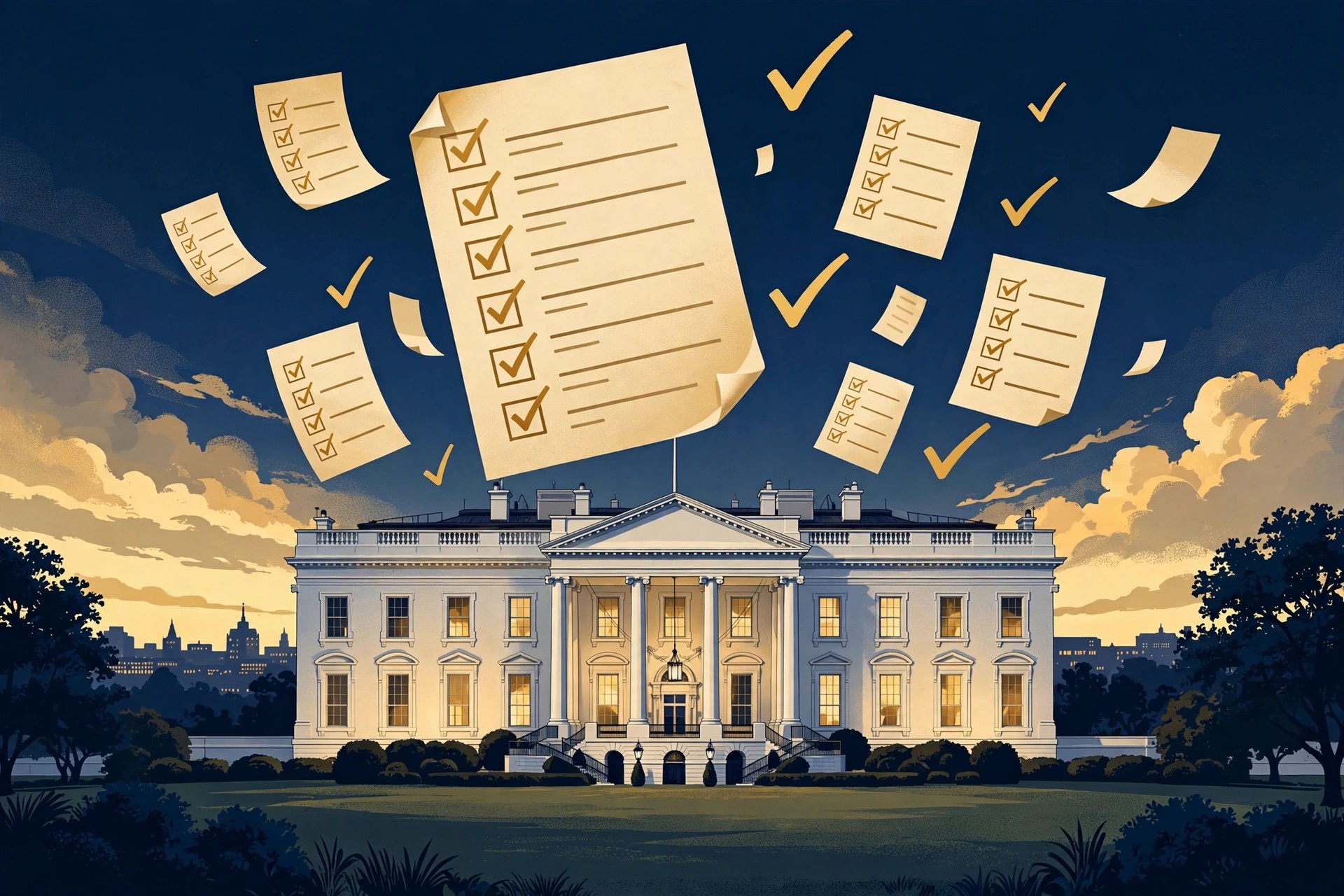
WASHINGTON — On the day before Americans voted in the 2026 midterm elections, the White House published its most ambitious piece of self-assessment yet: a list of 127 campaign promises it says President Donald Trump has kept during his second term. The document, titled “Promises Made, Promises Kept, Results Delivered,” was released on Monday, 2 November 2026, and presented as a point-by-point record of pledges made on the campaign trail and actions taken since the president returned to office. It ranges from border enforcement and deportations to tax relief, energy production, drug prices and the reshaping of federal agencies.
The timing was not accidental. The list arrived as voters prepared to decide control of Congress for the final two years of the president’s term, and as the administration sought to turn a sprawling record into a single, quotable argument: that the promises of 2024 had become the policies of 2025 and 2026. Supporters will read it as a receipt. Critics will read it as a campaign document dressed up as a record. The truth, as with most such lists, sits in the space between the headline number and the individual entries, some of which rest on legislation and executive action that are easy to verify, and others of which depend on figures, forecasts or foreign partners whose positions are more complicated than a check mark suggests.
This article explains what the White House actually claimed, which parts of the list are the most concrete, where outside reporting qualifies the administration’s account, and why a document like this matters beyond one election day. The list itself is the administration’s own characterisation of its record, and where a claim is disputed or incomplete, that dispute is part of the story, not a footnote to it.
What the White House published
The White House release organises its 127 items by theme, beginning with border security and moving through deportations, law enforcement, inflation and affordability, energy, trade and a series of cultural and institutional pledges. Each entry pairs a quoted promise, usually dated to a campaign speech or statement, with a short account of what the administration says followed. The format is designed to make comparison easy: a reader can see the original words on one side and the claimed result on the other, without needing to search through years of speeches and orders.
That structure is also the list’s main weakness as evidence. A promise and an action placed side by side can look like proof, even when the action only partly matches the promise, or when the outcome depends on forces outside the president’s control. A border crossing figure can fall for many reasons at once. A trade agreement can be announced before its details are settled. A drug price can move in the direction a president promised while still leaving most patients’ bills largely unchanged. The list does not, for the most part, pause to weigh those complications. It presents each item as settled, and leaves the weighing to readers, journalists and voters.
Even so, the sheer breadth of the document is significant. It is not a list of a handful of signature achievements. It is an attempt to claim that the administration’s programme has touched almost every part of federal policy, from the southern border to the price of a prescription, from the size of the military’s role at the border to the rules governing who may compete in women’s sports. That breadth is itself a political argument: that this presidency has not been narrow or cautious, but has tried to remake the federal government across the board.
The border and security claims at the top of the list
Border security comes first in the White House document, and it is where the administration’s numbers are most striking. The release says that in fiscal year 2026, the Border Patrol recorded just 98,708 apprehensions along the southwest border, a drop of about 95 percent from the more than 1.8 million apprehensions per year that the administration attributes to the previous administration. It also says that fiscal year 2026 was the first year in American history with no Border Patrol releases from the border into the interior of the country, and that the administration has not released a single person from the border into the interior for 17 straight months.
The release ties those figures to specific early actions: a national emergency declaration at the southern border on the president’s first day back in office, the deployment of thousands of military personnel, the resumption of border wall construction, and the reinstatement of the policy known as Remain in Mexico, under which some people seeking asylum wait outside the United States while their cases proceed. It says Customs and Border Protection has completed 250 miles of new border barrier since 20 January 2025, and that $46.5 billion was secured to build the wall as part of the tax legislation the administration calls the Working Families Tax Cuts.
On deportations, the document claims the population of people living in the country without legal authorisation has fallen by at least 2.3 million, with more than three million people leaving the country in total, including nearly 1.2 million deported or removed. It says Immigration and Customs Enforcement has carried out nearly 1.3 million arrests, more than doubled its ranks of officers and agents, and signed more than 2,500 partnerships with state and local law enforcement. It also points to the Laken Riley Act, signed as the administration’s first legislative victory of the second term, which requires detention and deportation for certain people charged with or convicted of specified crimes.
Those are the kinds of claims that can be checked against agency data, and they are likely to be the focus of the most detailed scrutiny in the coming weeks. Border apprehension figures are published by federal agencies, and analysts will test whether the comparison years are like for like, whether seasonal patterns or changes in counting explain part of the fall, and whether a drop in apprehensions at the southwest border tells the whole story about migration. The administration’s supporters will argue that the direction and scale of the change are too large to be explained away. Its critics will argue that enforcement alone does not explain the figures, and that the human consequences of the policies behind them deserve as much attention as the numbers themselves.
On crime, the release says the national murder rate fell 18.1 percent in 2025, tying the lowest rate ever recorded, and that violent crime recorded its largest annual drop on record, with further falls in the first half of 2026. In Washington itself, it says homicides fell 60 percent in 2025 and carjackings fell 68 percent, with homicides down a further 45 percent in 2026, figures it links to the deployment of the National Guard and a federal task force that it says has made more than 16,000 arrests and removed nearly 2,000 guns from the streets of the capital. Those city-level claims will be tested against local police data, and against the question of how much of any change in crime can fairly be credited to a single federal intervention.
Trump Promises Made, Promises Kept: What the Alaska Project Shows About the Claim
If the border section is the list’s strongest numerical argument, the energy and trade section contains its most revealing test case. The White House says the president lifted a freeze on natural gas exports, declared a national energy emergency on his first day, and secured a $54 billion agreement with Korea and Taiwan to build a long-stalled natural gas pipeline in Alaska. It also says the president signed a cross-border permit in April 2026 for a pipeline project that would revive large parts of the Keystone XL system, using idle pipe to carry Canadian oil to Wyoming.
The Alaska project matters because it shows how a single entry can be both a real diplomatic development and an unsettled commercial one. The Korea Times, reporting on the White House list, noted that the administration has repeatedly described Korea as committed to the Alaska project, while Seoul has maintained that its participation remains subject to a commercial viability review. In other words, the White House and the South Korean government are not yet describing the same commitment in the same terms. A framework, a pledge of interest and a financed, permitted, under-construction pipeline are different stages of the same story, and the list’s check mark tends to collapse them into one.
The same caution applies to the trade agreements the list counts as fulfilled. The White House says the president secured new or improved trade agreements with partners accounting for more than half of global economic output, including Korea, Japan, China, the European Union and Britain, using tariffs as leverage. That is a broad claim about a set of very different arrangements, some of which are formal agreements, some of which are frameworks or understandings, and some of which remain subject to further negotiation, implementation or dispute. Counting them together as a single category of “kept” promises gives a sense of scale, but it hides the variation in how finished each deal actually is.
On shipbuilding, the list points to an executive order aimed at restoring American maritime dominance and to a new office at the National Security Council intended to strengthen the shipbuilding industry. The Korea Times noted that the White House statement did not specifically mention Korean shipbuilders in connection with those efforts, even though Korea announced last year a plan to deepen its shipbuilding ties with the United States under an initiative linked to its tariff agreement with Washington. The gap is a reminder that a domestic policy action and an international partnership are not the same thing, even when they appear in the same paragraph of a press release.
Tax, culture and everyday-life pledges
Beyond borders and energy, the list reaches into the daily economics of working life. One of the most widely recognised pledges on it is No Tax on Tips, the proposal to exempt gratuities paid to service workers from federal income tax, first advanced during the 2024 campaign. The White House counts it among its fulfilled promises, and the claim will be judged by workers and employers on a practical question: whether the relief actually reaches the pay packets of people in hospitality, food service and transport, and how much of their income it covers, rather than on whether the phrase appears in a statute.
On affordability, the release says prescription drug prices have seen their sharpest drop in 63 years, that the president is the only president to actually lower prescription drug prices, and that he secured deals with 26 pharmaceutical companies representing roughly 90 percent of the American pharmaceutical market to guarantee prices comparable to those paid in other developed nations. It also points to a new direct-to-patient platform, TrumpRx.gov, designed to connect patients with discounted medicines. Drug pricing is notoriously difficult to summarise in a single figure, because list prices, negotiated prices and what patients actually pay at the pharmacy counter can move in different directions. Independent analysts will therefore look past the headline drop to ask who benefited, by how much, and for which medicines.
The list also counts the elimination of diversity, equity and inclusion programmes across federal agencies and government contracting, and rules barring transgender women and girls from competing in female sports categories, as fulfilled pledges. Those are the entries where the word “kept” carries the most political charge, because what one side of American politics regards as a restoration of fairness, the other regards as a rollback of inclusion and opportunity. The White House presents them as straightforward deliveries of campaign promises. Opponents present them as policies whose effects on federal workers, contractors, students and athletes are still being litigated in courts, workplaces and schools. The list does not resolve that disagreement. It restates the administration’s side of it, in the form of a completed task.
Two other themes run through the document and help explain its appeal to the president’s supporters. The first is speed: many entries emphasise action on day one, or within the first weeks, as evidence of resolve. The second is scale: the list repeatedly uses superlatives, describing operations, drops and investments as the largest, lowest or sharpest on record. Both themes are part of the administration’s political identity. Both also invite the same response from fact-checkers: that speed is not the same as durability, and that a record figure needs a clear, consistent measure before it can be accepted at face value.
What independent reporting adds
Independent coverage of the list has, so far, focused less on disputing every entry than on testing the most consequential ones. The Korea Times treatment is a good example: it accepted the White House framing as the news event, reported the 127 figure and the trade and Alaska claims accurately, and then added the single most important qualification, namely Seoul’s position that its Alaska participation still depends on a commercial viability review. That one sentence changes the reader’s understanding of the entry from a finished deal to a deal in progress, without needing to challenge the administration’s broader record.
Other coverage has taken a similar approach to the list as a whole, noting that the White House published it through its official channels and pointed readers to a dedicated platform for a fuller record, while observing that congressional action, formal executive orders and agency directives remain the benchmarks against which the claims will ultimately be judged. That distinction matters. A social media post or a web page can announce a policy. Only legislation, a signed order, a regulation or a funded programme can put it into lasting effect. Voters who want to know whether a promise was truly kept will, in the end, need to look beyond the list to the law and the budget behind each item.
There is also a broader question that no list of this kind can answer on its own: whether keeping a promise is the same as achieving its purpose. A border can be made harder to cross while the underlying pressures that drive migration remain. A tax break can be delivered while the cost of housing, childcare or health care continues to rise. A programme can be abolished while the debate that created it moves to a new arena. The White House list measures delivery. It does not measure whether delivery solved the problem the promise was made about. That judgement belongs to voters, and it is the judgement they were asked to make on 3 November.
Why the timing matters, and what the list does not settle
The decision to publish the list on the eve of voting was a campaign choice as much as a governing one. By putting 127 items in a single document, the White House gave its supporters a shareable summary of two years of government, and gave journalists a single source to quote, check and challenge. It also set a trap for its critics: to dispute the list in full, an opponent must work through 127 entries, while to accept it in full, a supporter need only repeat the headline number. In a fast-moving election, the headline number usually travels further than the fine print.
That is why the most useful way to read the document is not as a verdict, but as an agenda for verification. The border figures can be compared with agency releases. The tax and drug price claims can be tested against pay data and pharmacy bills. The trade and energy claims can be followed through the actual agreements, permits and financing decisions that follow. Some entries will hold up well under that scrutiny. Others will turn out to be partial, premature or contested. A few may be withdrawn or revised as circumstances change. The list will age, in other words, in the way that all such documents age: not as a monument, but as a snapshot of what an administration believed, or wanted voters to believe, about itself at a particular moment.
For the White House, the immediate purpose of the list has already been served. It framed the final day of the campaign around the administration’s record rather than around its opponents’ arguments, and it gave the president’s closing message a structure: here is what was promised, here is what was done, and here is what remains at stake. Whether voters accepted that framing is a question for the election results, not for the document itself. What the list does establish, beyond dispute, is the scale of the administration’s ambition. It did not set out to keep a few promises well. It set out to keep a great many promises at once, across almost every field of federal power, and it was willing to be judged on that breadth. The coming months, with a new Congress and a new set of legal and political constraints, will show how much of that breadth survives contact with the next phase of American politics.
Sources
USN reviewed reporting from multiple outlets for this story. Read more from The White House: https://www.whitehouse.gov/releases/2026/11/president-trumps-second-term-promises-made-promises-kept-results-delivered/, The Korea Times: https://www.koreatimes.co.kr/foreignaffairs/20261103/white-house-cites-korean-trade-deal-alaska-gas-project-among-trumps-fulfilled-pledges and Nation Press: https://www.nationpress.com/international/white-house-trump-kept-border-tax-promises.