

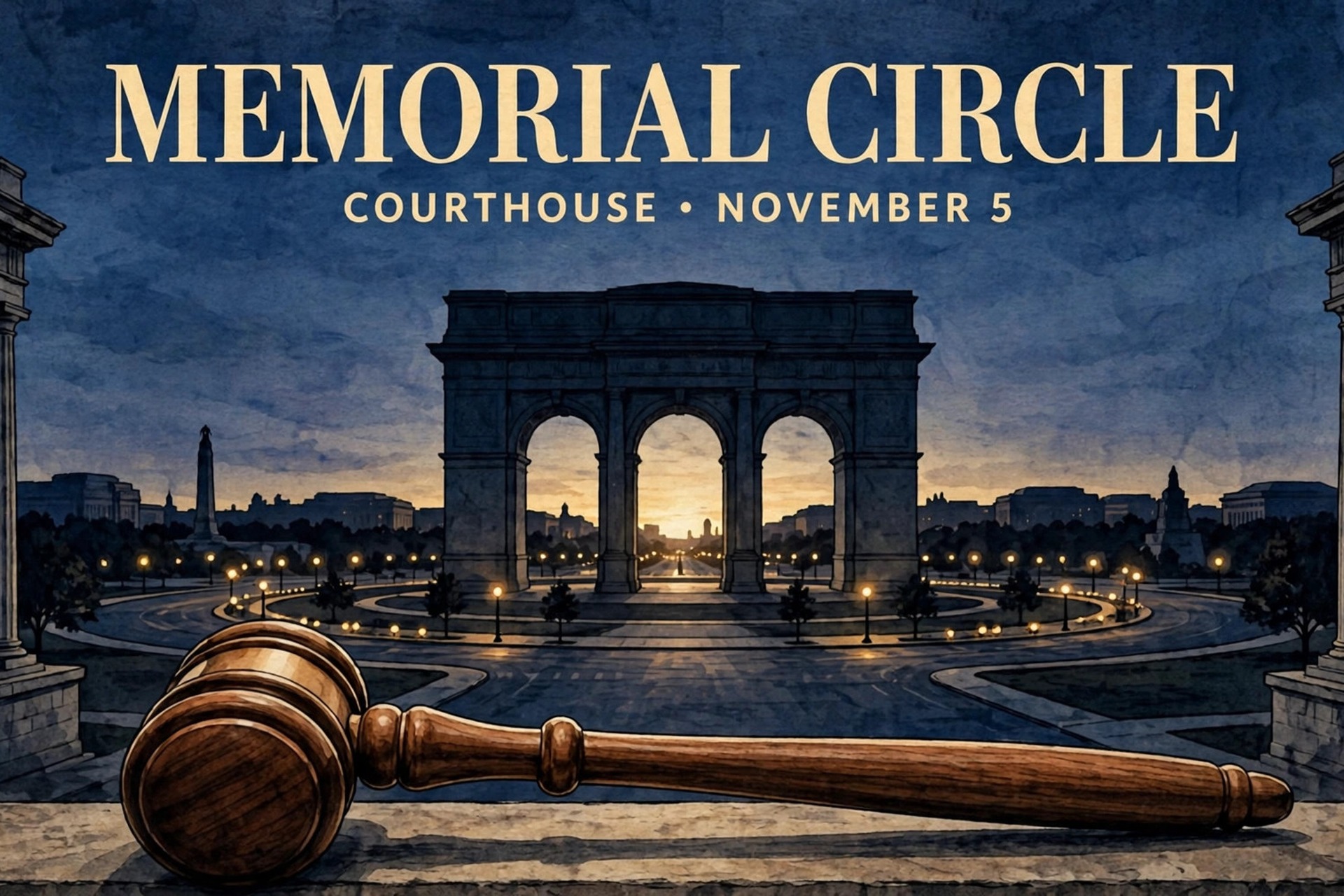
Trump Triumphal Arch Court Ruling: A Pause Built From Deadlines
A federal judge has, for now, put strict procedural brakes on any construction of President Donald Trump’s proposed triumphal arch in Washington, setting a series of rapid notification deadlines that the administration must meet before work can begin. The ruling, issued on November 2, 2026, by Judge Tanya Chutkan, does not itself decide whether the arch is lawful. It does, however, make it practically impossible for construction or demolition work to start quietly or without warning, and it ties any future work to a sequence of agency decisions and advance notices that will be visible to the courts and to the challengers. For a project that the administration has described as a high priority, the ruling changes the timeline from a question of political will to a question of procedure, paperwork and proof.
The core of the judge’s order is its notice regime. Under the deadlines set on November 2, the administration must give notice within one hour of any decision by the National Capital Planning Commission concerning the project. The same one-hour rule applies to decisions by the National Park Service and by the Department of the Interior. Separately, notice must be given within thirty minutes of any activity related to, or in preparation for, construction. That thirty-minute rule is unusually tight, and it is designed to ensure that the court and the parties challenging the project learn about preparatory work almost as soon as it happens, rather than days later when work may already be under way.
The order also addresses the substantive trigger for construction. Construction or demolition before a final agency action by the National Park Service, or without fourteen days’ notice, would violate prior court orders in the case. In practical terms, that means there are two gates, not one. First, the Park Service must take its final agency action. Second, even after that action, fourteen days’ notice must be given before work begins. A project cannot therefore move from an approval in a meeting to bulldozers on site in a single step. The fourteen-day period gives challengers time to return to court if they believe the action is unlawful, and it gives the judge time to consider whether further orders are needed.
How the Timeline Was Set: The Administration’s October Notice
The judge’s November 2 ruling came after the administration had, on October 28, set out its own view of how construction could begin. In that notice, the administration said construction could start once three conditions were satisfied: approval from the National Capital Planning Commission, which was pending and scheduled for consideration on November 5; a final decision from the Department of the Interior; and completion of the proper notification steps. On that timetable, a National Park Service notice could come as early as November 5, 2026, the same day as the Planning Commission’s pending consideration.
That timetable is important because it shows how close, in the administration’s view, the project was to breaking ground. If the Planning Commission approved the project on November 5, and if the Interior Department then took its final decision and the notification steps were completed, the path to construction would, on the administration’s account, be open. The judge’s order does not remove those steps, but it surrounds them with deadlines and consequences that make each step reviewable. The one-hour and thirty-minute notice rules mean that the challengers will not have to discover a decision or an activity after the fact. They will be told, quickly, and they will have the opportunity to act.
The distinction between the administration’s timetable and the judge’s order is therefore not a simple disagreement about a date. It is a disagreement about control. The administration’s notice described a sequence that, once completed, would permit construction. The judge’s order ensures that the court retains the ability to intervene at each stage of that sequence, and that no stage can be treated as a formality that quietly unlocks the next.
The Lawsuit: DC and Virginia Call the Project Unlawful
The legal challenge behind the November 2 order comes from the District of Columbia and Virginia, which sued on October 31, 2026, to block the arch plans. Their lawsuit calls the project, in their words, flagrantly unlawful. That phrase is an allegation made by the suing governments, not a finding by the court, and it should be read as such. Courts have not, in the orders described here, decided that the project is unlawful. They have set procedural protections while the underlying legal questions are litigated.
The governments’ allegations centre on authorisation and review. They argue that the project lacks congressional authorisation and that it has not undergone the required environmental and historic reviews. Those are two distinct legal claims, and each would, if accepted by a court, present a serious obstacle to the project. Congressional authorisation matters because major memorial and monumental construction in the capital, particularly on or near federal land and in areas governed by planning and preservation regimes, is not ordinarily something the executive branch can undertake alone. Environmental and historic reviews matter because federal projects of this scale are typically subject to statutes that require agencies to assess environmental impacts and effects on historic resources before proceeding, and to consider alternatives and mitigation.
The lawsuit also warns about practical disruption. The governments argue that three years of construction would disrupt traffic, emergency services and waterways. That warning connects the legal dispute to the daily life of the region. A monumental construction project in the capital is not an isolated building site. It affects roads used by commuters and emergency vehicles, it affects the movement of people and goods through the city, and, depending on its location and design, it can affect waterways and the infrastructure that depends on them. Those disruption claims are part of the governments’ case for why the project should not proceed without the authorisation and reviews they say are missing, and why interim court protection is needed while the case is heard.
Judge Chutkan has consolidated the District and Virginia lawsuit with an earlier suit brought by three Vietnam veterans and an architectural historian. Consolidation means that the cases will proceed together, with shared scheduling and, where appropriate, shared briefing and hearings, rather than as two parallel tracks that might produce inconsistent orders. The earlier suit, brought by individuals with a direct interest in memorial and architectural questions, and the newer suit, brought by two governments with interests in planning, traffic, emergency services and the environment, now form a single litigation front against the project. That consolidation also signals the breadth of opposition, spanning governmental and individual challengers with different but overlapping concerns.
What the Arch Would Be: A 106-Page Plan
The scale of the proposal helps explain why the dispute has become so contested. The plan, running to 106 pages, describes a structure more than twelve stories high, rising to 250 feet, topped or adorned with a winged bronze statue of Lady Liberty holding a torch with an eternal flame. The structure would also include an observation deck and offices, and its construction would involve rerouting traffic around the site.
A 250-foot arch is not a modest addition to the Washington skyline. It would be visible across a wide area, it would alter views and sightlines that are themselves part of the capital’s planned landscape, and it would introduce a new monumental focal point in a city already defined by its memorials and public buildings. The observation deck suggests a public or semi-public function, inviting visitors to experience the city from height, while the offices suggest an administrative or operational use that goes beyond a purely commemorative structure. The torch with an eternal flame evokes a long tradition of memorial symbolism, in which a continuously burning flame represents remembrance and endurance.
Traffic rerouting, mentioned in the plan, is not a footnote. In a city where traffic patterns, security perimeters and ceremonial routes are already complex, rerouting traffic for a construction period of years, and potentially permanently around a new structure, has consequences for residents, workers, visitors and emergency responders. It is one reason why planning bodies such as the National Capital Planning Commission exist: to consider not only whether a structure is architecturally or symbolically desirable, but whether it fits within the city’s physical, transportation and security systems.
The administration, for its part, calls the arch a high priority project. That characterisation reflects a view of the arch as a signature addition to the capital, a statement about national identity and presidential legacy, and a project worth pursuing despite legal and logistical obstacles. The contrast between that view and the challengers’ characterisation of the project as flagrantly unlawful captures the central tension in the case. One side sees a bold, overdue monument. The other sees an unauthorised, unreviewed intrusion into a carefully governed landscape. The court, at this stage, has not chosen between those visions. It has chosen procedure.
What the November 2 Order Means in Practice
In practice, the November 2 order means that no construction or demolition can lawfully begin until the Park Service takes final agency action and fourteen days’ notice has been given, and that every relevant agency decision and every construction-related activity must be reported within an hour or thirty minutes respectively. For the challengers, that is a meaningful protection. It prevents a scenario in which work begins over a weekend or during a gap in court supervision and becomes difficult to undo. For the administration, it is a constraint that requires careful coordination across multiple agencies, each of which must be ready to give immediate notice when it acts.
The order also means that November 5, the date of the pending Planning Commission consideration and the earliest possible date for a Park Service notice on the administration’s timetable, is now a date to watch, but not a date on which construction can automatically begin. Even a favourable Planning Commission decision on that day would be only one step in a longer sequence, subject to the one-hour notice rule, to the Interior Department’s final decision, to the Park Service’s final agency action, and to the fourteen-day notice period. Anyone expecting bulldozers on November 6 would therefore be misunderstanding the order.
The longer-term question remains unresolved. The court will eventually have to consider whether the project has the congressional authorisation the challengers say it lacks, whether the environmental and historic reviews they say are required have been or must be completed, and whether the project’s impacts on traffic, emergency services and waterways have been properly assessed. Those are substantive legal questions that will require briefing, evidence and argument, and they may take months to resolve. The November 2 order does not prejudge them. It preserves the court’s ability to decide them before construction makes them moot.
For Washington residents, for Virginia communities affected by traffic and infrastructure changes, and for everyone who cares about how the capital’s landscape is shaped, the immediate message is one of watchful waiting. The arch is not, for now, under construction. It is under judicial supervision, with deadlines measured in minutes and hours rather than months. The next steps will be visible, if the order is followed, because the order requires them to be reported almost immediately. That visibility is, for the moment, the most important feature of the case.
Sources
USN reviewed reporting from multiple outlets for this story. Read more from The Week, Al Jazeera and Law Commentary.