

US Removes South Africa and Rwanda From AGOA: What the Decision Means
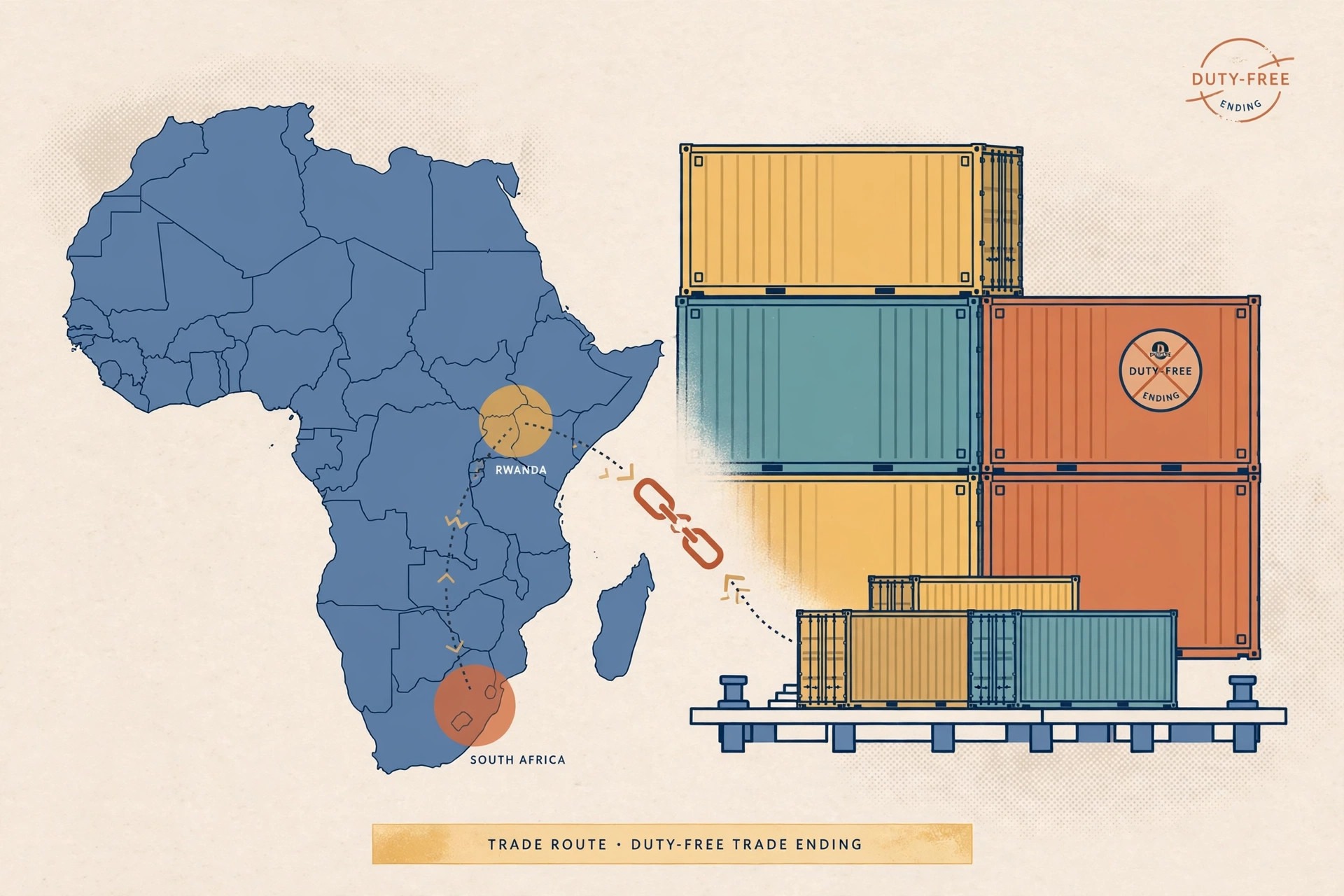
President Donald Trump will remove South Africa and Rwanda from the African Growth and Opportunity Act, known as AGOA, at the end of 2026, with the removal taking effect on January 1, 2027. The decision was announced by the Office of the United States Trade Representative on November 2, 2026, and it marks a significant change in the trade relationship between the United States and two African economies that have, for years, benefited from duty-free access to the American market for certain goods under the program. The announcement was not presented as a temporary pause or a warning. It was presented as a removal, with a fixed effective date, and with stated grounds that go to the heart of how the United States judges eligibility for the program.
AGOA itself is one of the longest-standing instruments of American trade policy toward Africa. Enacted in 2000, the program offers eligible sub-Saharan African countries duty-free access to the United States market for a defined range of goods, with reporting citing more than 1,800 products covered. The idea behind the program, from its inception, was to use trade preferences as a tool for economic development: by allowing African exporters to sell into the American market without paying the tariffs that would otherwise apply, the program aimed to encourage investment, support jobs in exporting industries, and deepen commercial ties between the United States and participating countries. Eligibility, however, was never automatic or permanent. It has always been conditional on meeting criteria set out in American law, and it has always been subject to periodic review by the American administration.
That conditional character is central to understanding the November 2 announcement. Removal from AGOA is not the same as expulsion from trade altogether, and it is not a ban on exports. It is the withdrawal of a preference. After January 1, 2027, South African and Rwandan exporters will still be able to sell goods to the United States, but they will do so without the duty-free treatment that AGOA provided. For some products, that may mean a modest increase in cost. For others, where tariffs are higher or margins are thinner, it may mean a more serious competitive disadvantage compared with exporters from countries that retain AGOA benefits or from other suppliers altogether. The practical impact will therefore vary by product, by firm and by market, and it will unfold over months as contracts are renewed and prices are renegotiated.
Why the Administration Says It Acted
The United States Trade Representative, Jamieson Greer, said that President Trump had informed Congress and both governments of the decision. The stated grounds, as communicated by the administration, were that the two countries engage in practices described as inconsistent with eligibility for the program. Those practices, in the administration’s account, include barriers that undermine American trade and investment, and practices that pose a threat to United States national security and foreign-policy interests.
It is important to be precise about the status of those grounds. They are the administration’s stated reasons for the removal. They represent the American government’s assessment of eligibility, made through its own review process. They are not, in themselves, findings by an independent tribunal, and the governments concerned may dispute the characterisation, the evidence or the conclusions drawn from it. What is not in dispute, on the basis of the announcement, is that the administration has made the decision, that it has notified Congress and the two governments, and that the effective date is January 1, 2027.
The reference to barriers undermining American trade and investment points to a familiar theme in AGOA eligibility reviews. The program’s criteria have long included expectations about market access, about the treatment of American firms and investors, and about broader economic policies that affect trade. When an administration concludes that those expectations are not being met, removal is one of the tools available to it. The reference to national security and foreign-policy interests points to a broader set of considerations, in which trade preferences are treated not only as an economic instrument but as an expression of the wider relationship between the United States and a partner country. In that framing, eligibility is not judged on trade policy alone, but on the overall alignment of interests as perceived by Washington.
For businesses and policymakers, the generality of the stated grounds also matters. An announcement that cites categories of concern, rather than a single specific measure, leaves exporters and governments to interpret which policies or practices were decisive, and what, if anything, could be changed to restore eligibility in future. That interpretive question will likely dominate discussion in both Pretoria and Kigali in the weeks ahead, as officials, industry groups and trade analysts seek to understand the full reasoning behind the decision and to assess whether a path back to eligibility exists.
South Africa: The Largest Beneficiary Faces the Largest Adjustment
South Africa is the largest beneficiary of AGOA, which means that the removal will be felt there more broadly than in any other country affected by a single eligibility decision. The scale of South Africa’s use of the program reflects the size and diversity of its economy, and the range of goods it exports to the United States. When the largest beneficiary loses its preference, the adjustment is not confined to a single sector. It touches multiple industries, supply chains and employment patterns, and it raises questions about how exporters will adapt, whether by absorbing tariff costs, by raising prices, by seeking alternative markets, or by restructuring production.
South Africa’s Trade Minister, Parks Tau, responded to the announcement by saying that Pretoria had sixty days to address American concerns before the suspension takes effect, and that the government was prepared. That response is significant for two reasons. First, it indicates that the South African government sees a window, however narrow, between the announcement and the effective date, in which engagement with Washington remains possible. Second, it signals preparedness, suggesting that Pretoria had anticipated the possibility of removal and had considered its options, rather than being caught entirely unprepared. Whether sixty days is sufficient to address concerns that have evidently built up over a longer period is a separate question, and one that will depend on the nature of the concerns, the willingness of both sides to negotiate, and the political constraints on each government.
The minister’s framing also reflects the difference between suspension and permanent exclusion. The announcement describes removal from the end of 2026, effective at the start of 2027. Trade preference programs are, by design, subject to review and change, and countries have, in the past, regained eligibility after reforms or after changes in administration policy. Nothing in the November 2 announcement, as reported, forecloses a future reassessment. But neither does it promise one. For South African exporters making decisions now, the prudent assumption must be that duty-free access will end on January 1, 2027, and that any restoration would require a new decision and a new process.
Rwanda’s position, while smaller in absolute trade volume than South Africa’s, raises similar questions on a different scale. Rwanda has used AGOA access as part of a broader strategy of export-led growth and integration into global markets. Losing that access removes a competitive advantage that, for a smaller economy, can matter disproportionately for firms that have built their business models around American market access. The announcement groups Rwanda with South Africa in the same decision, but the economic structures, export profiles and political relationships involved are distinct, and the consequences will play out differently in each country.
What Removal Is Not: Exports Continue Without the Preference
One of the most important clarifications for readers is what removal does not mean. It is not a trade ban. It does not prohibit South African or Rwandan goods from entering the United States. It does not impose sanctions in the sense of a comprehensive embargo. It removes a preference, which means that goods that previously entered duty-free will now be subject to the tariffs that apply to comparable goods from countries without AGOA benefits. That distinction matters for consumers, for importers and for the exporters themselves, because it frames the adjustment as a change in cost and competitiveness, not as a sudden halt to trade.
That distinction also matters for understanding the administration’s tool choice. Trade preferences are, by their nature, discretionary benefits. Withdrawing them is a way for an administration to signal displeasure, to exert leverage, or to enforce eligibility criteria, without taking the more drastic step of restricting trade outright. The signal, however, can still be powerful, particularly when the beneficiary is as large as South Africa. Markets, investors and trading partners read preference withdrawals as indicators of the broader direction of a bilateral relationship, and they adjust their expectations accordingly.
For American importers who have relied on duty-free South African or Rwandan goods, the change will require practical adjustments. Supply contracts, pricing and sourcing decisions made on the assumption of duty-free access will need to be revisited. Some importers may absorb the additional tariff cost, at least in the short term, to preserve supplier relationships. Others may pass costs to consumers, seek alternative suppliers, or renegotiate terms. The aggregate effect on American prices will depend on how widely the affected goods are consumed and how easily substitutes can be found, questions that cannot be answered in general terms on the day of the announcement.
What Happens Between Now and January 1, 2027
The period between the November 2 announcement and the January 1 effective date is, in trade terms, short. Sixty days, as referenced by Minister Tau, is a brief window for diplomatic engagement, for industry adjustment and for administrative preparation. Governments will need to clarify the precise tariff treatment that will apply from January 1, customs authorities will need to update their systems, and exporters will need to understand which of their products are affected and by how much.
Diplomatically, the window offers an opportunity for both governments to present their cases, to seek clarification, and, if possible, to agree on steps that could affect future eligibility decisions. Whether such engagement succeeds will depend on factors that are not visible in the announcement alone, including the history of the bilateral relationship, the domestic political considerations on both sides, and the willingness to treat the eligibility concerns as negotiable rather than as settled judgements.
Economically, the window is a period of preparation rather than a period in which the preference remains fully secure. Prudent exporters will plan on the basis that the preference ends on January 1, while also watching for any further announcements that might modify the decision. That dual posture, planning for removal while remaining open to change, is the reality of trade preference policy, where decisions are reversible but reversals are never guaranteed.
The broader significance of the decision extends beyond the two countries directly affected. Other AGOA beneficiaries will read the removal as a signal about how strictly eligibility criteria are being enforced by the current administration, and about the weight given to national security and foreign-policy considerations alongside traditional trade criteria. That signalling effect may influence policy choices in other capitals, as governments assess whether their own eligibility could be questioned and whether adjustments are needed to preserve their preferences. In that sense, a decision about two countries can shape expectations across an entire program.
For now, the facts are clear and the consequences are unfolding. From January 1, 2027, South Africa and Rwanda will no longer benefit from AGOA duty-free access. Exports will continue, but on different terms. The administration has stated its grounds. South Africa has said it is prepared and has a window to address concerns. What remains to be seen is how exporters, importers and governments adapt, and whether the decision proves to be a lasting change in the trade relationship or a phase in a longer negotiation over eligibility, market access and the future of the program itself.
Sources
USN reviewed reporting from multiple outlets for this story. Read more from La Nación, BusinessTech and Swisher Post.