

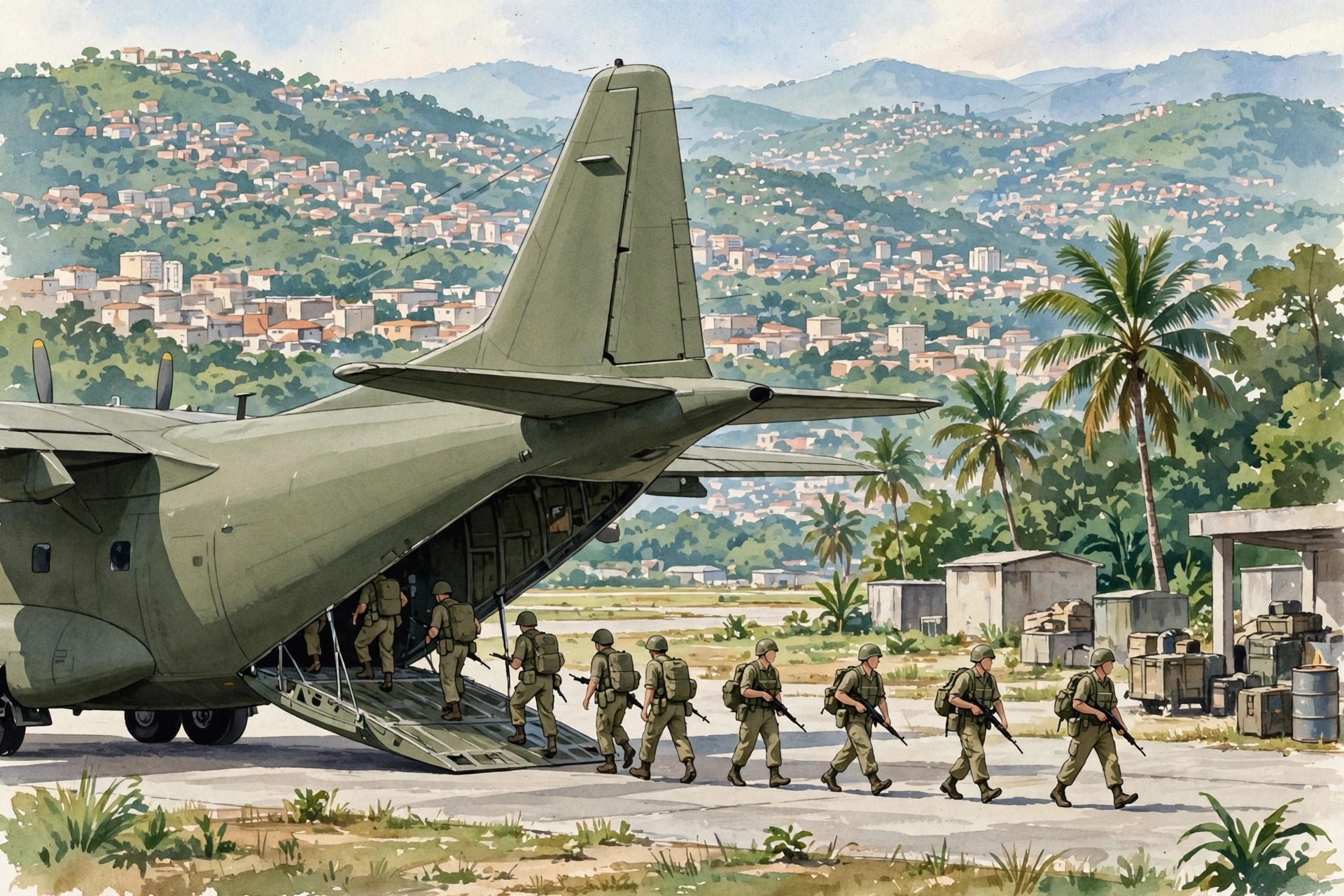
PORT-AU-PRINCE — El Salvador has rushed about 2,000 soldiers to Haiti in a matter of days, in the first major overseas deployment of President Nayib Bukele’s anti-gang campaign, after four Salvadoran members of a United Nations-backed security force went missing in a gang ambush on the outskirts of the capital. The deployment, which Salvadoran officials say is a rescue mission, has grown so fast that it now rivals the size of the international force it was sent to support, and it has raised questions that neither government has fully answered: who commands the new troops, how long they will stay, what rules govern their use of force, and whether a rescue operation is becoming something larger. At the same time, Haiti’s electoral council has postponed the country’s long-awaited elections, moving the first round from December this year to July 2027, because gang violence has made a vote impossible in much of the country.
The ambush that set all of this in motion took place on 18 October 2026, in Croix-des-Bouquets, a gang-controlled area on the outskirts of Port-au-Prince. Four Salvadoran aviation technicians who were part of the UN-backed Gang Suppression Force were travelling back to base from a market when their vehicle came under attack, according to reporting on the incident. The men jumped from a burning vehicle during the ambush and have not been accounted for since. Haitian authorities have described the technicians as abducted, and Bukele has called them hostages and pledged to bring them home unharmed. No gang has publicly claimed responsibility for holding them, and at least one gang leader has released videos denying that his group is holding the men or was involved in the attack. That uncertainty — missing, abducted or held hostage, with no confirmed captor — has hung over everything that followed.
Bukele announced a military operation to recover the missing men within days of the ambush, and the buildup was rapid. By Tuesday, 27 October, about 1,000 Salvadoran troops had arrived in Haiti, according to a security official cited by Reuters, travelling aboard flights in recent days. By Wednesday night, 28 October, about 2,000 Salvadoran soldiers were in Haiti, the same source said, and two sources with knowledge of the matter said the force would for now be capped at 2,500. El Salvador’s foreign ministry said on Wednesday that Bukele had spoken by telephone with Haitian Prime Minister Alix Didier Fils-Aimé and intended to deploy more than 2,000 troops. The Haitian prime minister’s office confirmed the call and said the two leaders had reaffirmed their engagement to reinforce bilateral coordination and operational cooperation within the framework of the Gang Suppression Force, notably to support rescue operations and respond to security challenges. On Thursday, Bukele said the deployments were nearly finished and that his government was covering 90 percent of the costs.
A rescue mission, or something bigger?
The size of the deployment is what has prompted the most scrutiny. The UN-backed Gang Suppression Force, renewed for just six months in September, has struggled for more than a year to reach its planned strength, and reporting puts its current personnel at about 2,000 — roughly the same number El Salvador has now sent on its own in about ten days. Before the ambush, El Salvador had deployed at least 124 personnel to the force, described as pilots and technicians sent to evacuate wounded personnel rather than as combatants. The new contingent is therefore not a small reinforcement. It is, in numerical terms, a second force, and experts have noted that matching in ten days what the international mission struggled to assemble over more than a year inevitably raises questions about whether the Salvadoran troops are part of a broader and longer-term operation, whatever their stated mission.
Neither government has clarified those questions in full. The Haitian prime minister’s office did not immediately answer whether the new Salvadoran forces would join the UN-backed mission or operate separately from it. El Salvador has not, in the reporting reviewed for this story, published a formal agreement governing the troops’ command structure, length of stay or rules of engagement, and analysts have pointed out that the buildup began without a signed status-of-forces agreement with Haiti. Romain Le Cour, head of the Haiti Observatory at the Global Initiative Against Transnational Organized Crime, said the troops’ rules of engagement, chain of command, objectives and duration remain opaque, and questioned what kind of coordination they might have with the Gang Suppression Force, Haitian police and the private security firm hired by Haiti’s government. That opacity matters, because Haiti has a long and painful history of foreign interventions that harmed civilians, and residents in the areas where fighting is heaviest have already reported heavy gunfire, drone strikes and possible civilian deaths since the ambush.
The United States has not publicly endorsed the Salvadoran deployment as a mission of its own, but American help has been part of the logistics. A United States military official said Pentagon C-130 transport aircraft helped move Salvadoran troops to Haiti. That assistance sits alongside a separate American-led initiative, the Shield of the Americas, a US-led anti-crime coalition launched earlier this year, which Salvadoran analysts have noted has not formally backed the Haiti operation. The distinction is worth keeping in mind: logistical help with transport is not the same as political sponsorship of the mission, and the absence of a clear public endorsement from Washington leaves the legal and political basis of the deployment resting mainly on the bilateral understanding between San Salvador and Port-au-Prince.
Why Bukele, and why now?
To understand why El Salvador, of all countries, is sending thousands of troops to the Caribbean, it helps to understand what Bukele has built at home. In office since 2019, he won huge popularity in El Salvador with a tough-on-crime crackdown that relied heavily on mass incarceration, sweeping up tens of thousands of suspected gang members and driving the country’s homicide rate down sharply. Human rights groups have criticised the crackdown for mass arrests, prolonged detention without trial and harsh prison conditions, while supporters point to the transformation of daily life in neighbourhoods once controlled by gangs. Bukele offered as early as March 2024 to help fix Haiti’s gang crisis, if the UN Security Council and Haiti’s government supported him and the deployment was fully funded by international backers. That offer went nowhere at the time. The ambush on 18 October gave him both a reason and a domestic audience for acting without waiting for that kind of backing.
At home, the mission appears popular, at least in its opening days. A CID Gallup poll published on Wednesday showed 86 percent of Salvadorans approved of the Haiti mission, although 82 percent also expressed concern for their countrymen taking part in it. Those two numbers together capture the mood: pride in a country that once exported gang violence now exporting soldiers to fight it, mixed with worry about what those soldiers will face in a country where gangs control large parts of the capital and the roads around it. Salvadoran security analysts have urged caution, warning of a risky mission without a formal agreement, UN backing or support from the American-led coalition. Their concern is not abstract. Since the 18 October ambush, the area around Croix-des-Bouquets has seen continuous armed clashes, and a rescue operation in gang-held territory is among the most dangerous missions any army can undertake.
A country where gangs set the calendar
Haiti’s gangs are not a fringe problem. They control much of Port-au-Prince and have expanded their influence beyond the capital, and they are responsible for massacres, gang rapes and widespread extortion, according to reporting on the crisis. Gang violence has killed more than 5,700 people in Haiti this year, according to United Nations figures cited by the BBC. Haiti’s unelected leaders have since 2022 called for international forces to help fight the gangs, and foreign troops have deployed since 2024 under UN-backed security missions intended to help Haitian police secure neighbourhoods and pave the way to a secure and credible vote. That vote has now been postponed again, which is itself a measure of how far gangs have set the terms of Haitian public life.
The Provisional Electoral Council said late on Wednesday that the first round of general elections will be held on 18 July 2027, with a second round on 4 October 2027, including local elections. The first round had initially been scheduled for 13 December 2026, and would have been the first presidential election in a decade. The council blamed gang violence in Haiti’s central region and in Port-au-Prince for the delay. The postponement is not a technical adjustment. Elections in Haiti have been delayed repeatedly as security has deteriorated, and each delay extends the rule of leaders who were never elected, which in turn weakens the legitimacy of the government that is asking foreign troops to help it. The new dates give the country about eight more months to create conditions in which voting is possible, but they do not by themselves create those conditions.
The private army in the background
Alongside the international mission and the new Salvadoran contingent, Haiti’s government has hired a private military company run by Erik Prince, the founder of Blackwater, to fight the gangs. That firm, Vectus Global, has since 2025 carried out controversial anti-gang drone operations, according to reporting on the conflict. The presence of a private firm, an international force and now a large bilateral contingent, all operating in the same contested neighbourhoods, is part of why experts are asking about coordination. If three different armed actors, with different commanders, different rules and different accountabilities, are fighting the same gangs in the same streets, the risk of confusion, friendly fire or civilian harm rises, even if each actor’s intentions are to restore order.
Residents, for their part, have greeted the latest arrival with scepticism as much as hope. Experts who study Haiti note that residents are sceptical of yet another foreign intervention, given a history that includes a UN peacekeeping mission blamed for introducing cholera and for sexual abuse, as well as earlier interventions that left little lasting security behind. That history does not mean the Salvadoran troops will repeat it, and it does not mean Haitians do not want help — many do, desperately, as the death toll and the displacement show. It does mean that the burden of proof is on the newcomers to show that they are different: that they protect civilians as well as hunt gangs, that they answer to someone Haitians can hold to account, and that they leave behind a Haitian police force and a Haitian state that can hold the ground they take.
What to watch next
The most immediate question is the fate of the four missing technicians. Their rescue, or the confirmation of a worse outcome, will shape how the mission is judged in El Salvador and in Haiti, and whether the deployment winds down or digs in. The second question is duration and command: whether the Salvadoran government publishes a formal agreement, clarifies whether its troops sit inside the Gang Suppression Force or beside it, and sets a date or a condition for their departure. The third is the effect on the ground in Croix-des-Bouquets and beyond: whether the surge breaks gang control of key roads and neighbourhoods, or whether it produces a new round of clashes that displaces more civilians without changing who controls the streets.
The fourth question is the election calendar. July 2027 is a long way off, and the intervening months will test whether security improves enough for candidates to campaign, voters to register and polling stations to open safely across the country. If it does not, the new dates will slip again, and the cycle of postponement will continue. If it does, Haiti will have taken a step that has eluded it for a decade: a vote held under conditions that most Haitians can accept as free and fair. Either way, the arrival of 2,000 Salvadoran troops in ten days has already changed the facts on the ground. Whether it changes the trajectory of Haiti’s crisis will depend less on how many soldiers arrived, and more on what they do, who commands them, how long they stay, and whether the country they came to help is safer when they leave than it was when they landed.
Sources
USN reviewed reporting from multiple outlets for this story. Read more from Reuters, La Nación and SRN News.