

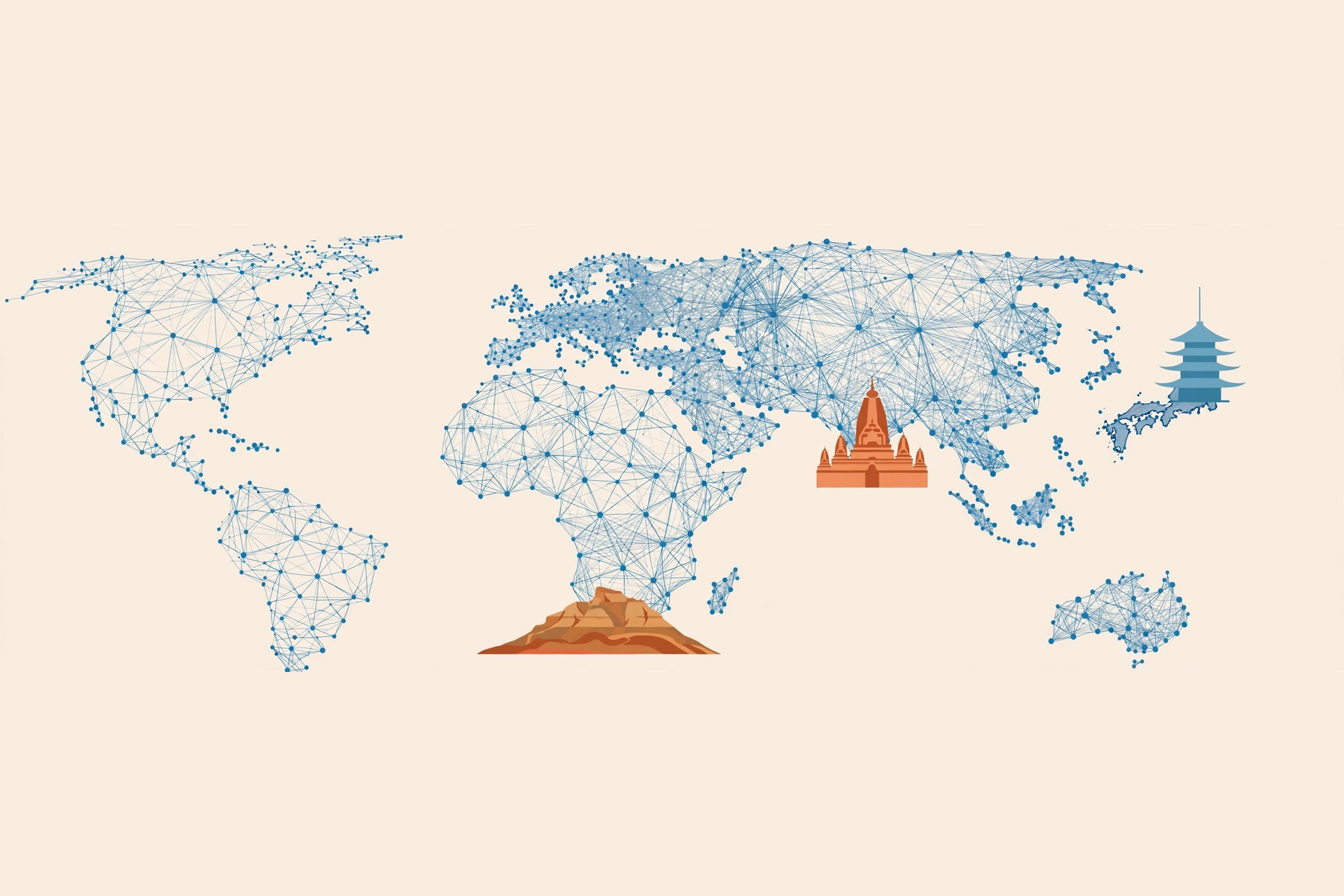
International headlines about the United States midterm elections were dominated by Europe, where newspapers called the Democratic victory a “blue wave” and a “historic blue tsunami.” But the reaction beyond Europe — in India, South Africa and Japan, among others — told a different and in some ways more revealing story. Governments and commentators in those countries were less interested in the partisan drama of Washington than in a practical question: what does a Democratic Congress mean for trade, for alliances, and for the stability of American policy over the next two years? Their answers were cautious, measured and focused on continuity, even where the headlines celebrated change.
That caution is understandable. For most countries, the president, not Congress, conducts foreign policy, negotiates with other leaders and commands the armed forces. A change in Congress therefore changes American politics without immediately changing American foreign policy. Foreign ministries know this, and their statements reflected it: congratulations where appropriate, emphasis on the bilateral relationship regardless of who controls Capitol Hill, and a wait-and-see approach to the policy debates — over tariffs, Ukraine aid and the war in Iran — that a Democratic Congress may now influence but cannot decide alone.
India Reaction to US Midterm Results 2026: Trade and Continuity
India’s press captured the scale of the Democratic victory in blunt terms. The Times of India’s headline ran “midterm blues for Trump,” framing the result as a setback for the president rather than only as a Democratic triumph. That framing reflects India’s interest in the stability of the bilateral relationship, which spans trade, technology, defence cooperation and the large Indian diaspora in the United States. Indian commentators have followed the tariff debate closely, because American tariffs affect Indian exports and because the Supreme Court case on the president’s emergency tariff powers — due to be heard on November 5 — could reshape the trade landscape regardless of who controls Congress.
For New Delhi, a Democratic Congress offers both opportunity and uncertainty. On one hand, Democrats in Congress have historically been more sympathetic to concerns about labour standards, climate policy and multilateral institutions, which could align with India’s positions in some forums. On the other hand, a Congress focused on domestic affordability and on challenging the president may be less predictable on trade legislation, and Indian exporters will watch closely whether tariff relief, if it comes, arrives through the courts, through Congress, or not at all. Indian officials, like their counterparts elsewhere, have therefore avoided taking sides in American domestic politics and have instead stressed the importance of the bilateral relationship itself — a relationship that has survived changes of party in both capitals.
India’s reading also reflects a broader Global South perspective: American midterm elections are watched not as a spectator sport but as a variable in economic planning. When American interest rates, tariffs or sanctions policy shift, emerging economies feel the effects through capital flows, export demand and commodity prices. A Democratic Congress that pushes back on tariffs could ease some of that pressure; a Congress that adds new conditions to trade or aid could increase it. Indian analysts will therefore read the new Congress’s first bills less for their partisan symbolism than for their practical effects on trade and investment.
South Africa and Japan: Stability First After the Midterms
South Africa’s reaction came from an unusual setting: President Cyril Ramaphosa spoke as he voted in his country’s own municipal elections, linking the American result to broader questions of diplomacy. The timing was symbolic — two democracies voting at once — and Ramaphosa’s comments, reported in international coverage, framed the American result as part of a wider democratic moment rather than as an isolated American event. For South Africa, which has navigated a complex relationship with Washington over trade preferences, health funding and positions on global conflicts, the key question is whether a Democratic Congress will take a different approach to Africa policy, including trade programmes and development assistance that require congressional approval.
Japan’s response was the most explicitly continuity-focused of all. Chief Cabinet Secretary Minoru Kihara told a news conference that Japan’s alliance with the United States remains essential for global peace and stability, regardless of the outcome of the midterm elections. That statement is standard diplomatic language, but it carries real meaning: Japan’s security planning depends on the American alliance, and Tokyo cannot afford to treat that alliance as contingent on which party controls Congress. Japan will work with the Trump administration on defence and regional security, while also engaging the new Democratic Congress on trade and technology issues where Congress has a direct role, such as export controls and appropriations.
China’s Foreign Ministry, in a similar vein, described the midterm elections as an internal affair of the United States, while saying Beijing was willing to continue working with Washington to strengthen communication, manage differences and build a constructive relationship based on respect and reciprocity. That measured tone contrasts with the more celebratory or alarmed reactions in some European capitals, and it reflects Beijing’s calculation that the fundamentals of the United States-China relationship — competition in technology and trade, rivalry in the Indo-Pacific, and interdependence in the global economy — will not be transformed by a change in Congress alone.
What the Non-European Reaction Reveals About Divided Washington
Taken together, the reactions from India, South Africa, Japan and China reveal a world that has learned to distinguish between American political noise and American policy change. The noise — the headlines, the social media posts, the claims of landslides and lame ducks — is loud. The policy change is slower, filtered through courts, through the president’s veto, and through the Senate’s 60-vote threshold for most legislation. Foreign governments understand that filter, and their public statements are calibrated accordingly: warm where a relationship needs warming, neutral where taking sides would cost more than it gains.
For American readers, that external perspective is a useful corrective. It is easy, in the days after a dramatic election, to assume that everything has changed. The view from New Delhi, Pretoria and Tokyo suggests something more modest: something important has changed — the party that sets Congress’s agenda, chairs its committees and can block the president’s nominees — but the president still conducts foreign policy, still commands the military, and still holds the veto. The world will adjust to divided government in Washington, as it has before, by engaging both the White House and the new Congress, and by waiting to see which of the new majority’s promises survive contact with the realities of American lawmaking. All reactions described here are as reported in international coverage on November 4, 2026.
For the United States itself, the non-European reaction offers a mirror. American commentators often describe midterm elections as a verdict on the president, and in 2026 that verdict was unusually clear. Foreign observers, however, describe the same election as a change in the composition of one branch of one government — important, but not the whole of American power. That distinction matters for how Americans themselves should read the result: the president remains in office, the courts remain independent, and the new Congress must still negotiate with both. The world is not waiting for America to resolve its internal arguments before continuing its own business; it is adjusting trade, defence and diplomatic plans around the new reality while keeping its options open.
Sources
USN reviewed reporting from multiple outlets for this story. Read more from NPR Illinois, Grenada Chronicle and Suara Garut.