

VARANASI — The fifth edition of Kashi Tamil Sangamam opened in Varanasi on Friday, 28 November 2026, with the release of the Thirukkural — the classical Tamil text on ethics, governance and human values — in 50 languages, including 10 foreign languages. The Vice-President of India, Shri C. P. Radhakrishnan, inaugurated the fortnight-long festival at Namo Ghat in the presence of Union Education Minister Shri Pralhad Joshi and Uttar Pradesh Chief Minister Shri Yogi Adityanath, describing the event as not merely a cultural programme but a movement to strengthen national unity.
The release of the Thirukkural in 50 languages was the centrepiece of the inaugural ceremony. The first edition of Kashi Tamil Sangamam, held in 2022, had seen the text published in 13 languages; the second edition added 16 more. That the fifth edition could present the work in 50 languages — 40 Indian languages and 10 foreign languages — was described by the Vice-President as a significant achievement for Tamil language and literature and a tribute to the universal relevance of the teachings of Thiruvalluvar, the Tamil poet-philosopher who composed the work more than 2,000 years ago.
The festival, which runs from 28 November to 12 December 2026, is built around the theme “Thirukkural Payilvom – Thirukkural Abhyas Karen”, meaning “Let Us Learn the Thirukkural”. Around 1,400 participants from Tamil Nadu — students, teachers, writers, journalists, farmers, artisans, women and industry representatives — are taking part, alongside students from 1,380 higher education institutions across India. The scale of the gathering, and the prominence of the people who opened it, reflect how far the Sangamam has travelled from a cultural event into a fixture of the national calendar.
A Fifth Edition Opens on the Banks of the Ganga
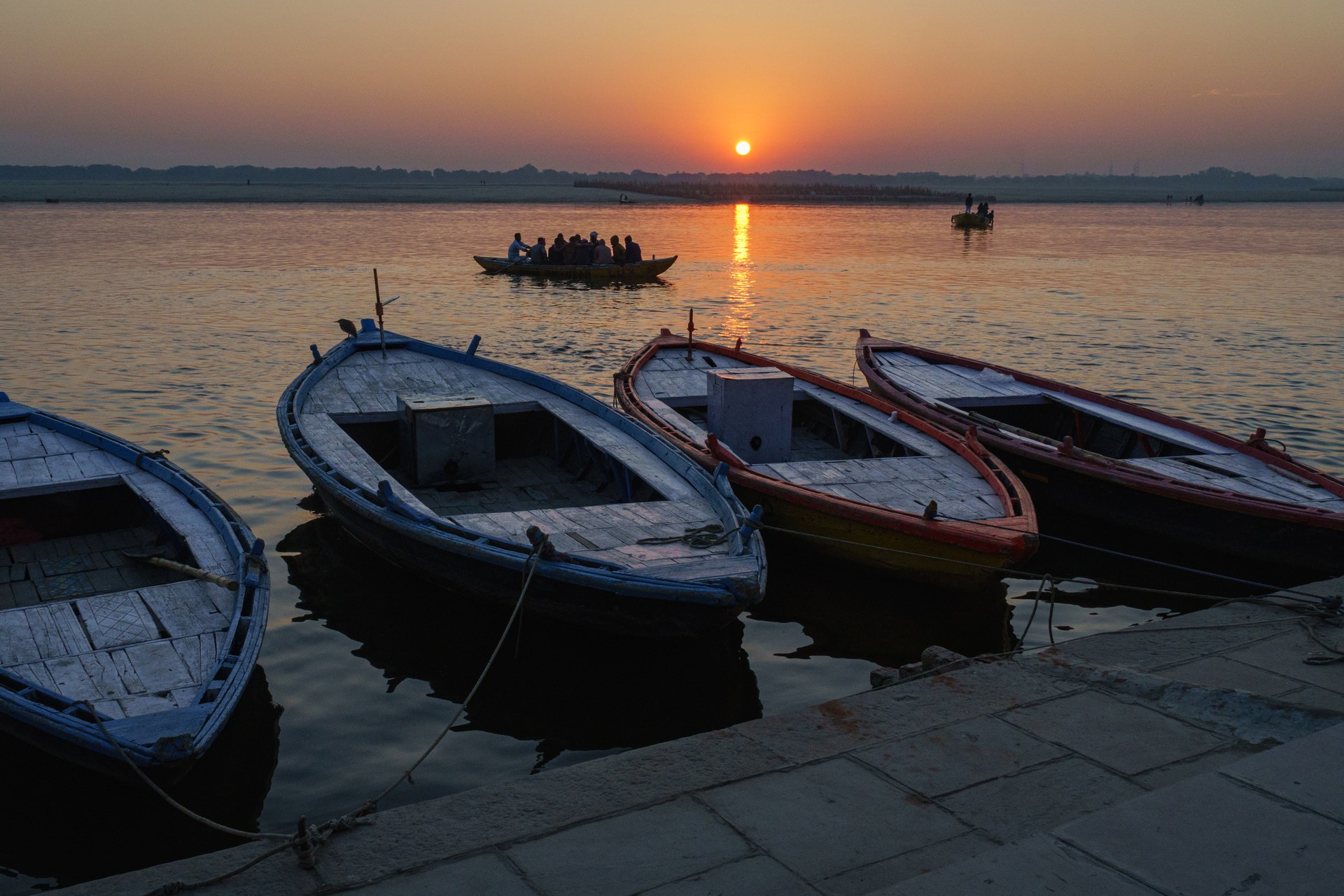
The inauguration took place at Namo Ghat, the renovated riverfront in Varanasi, on the morning of 28 November. The Vice-President arrived in the city earlier in the day and was received at Lal Bahadur Shastri International Airport by Chief Minister Yogi Adityanath. Before the ceremony, the two leaders visited the Shri Kashi Vishwanath Temple and the Shri Kaal Bhairav Temple and offered prayers, a sequence that has become part of the ritual of the Sangamam: the spiritual heart of Kashi first, then the celebration of the bond between Kashi and Tamil Nadu.
Addressing the gathering, the Vice-President said that Kashi and Tamil Nadu share a deep-rooted civilisational, cultural and spiritual relationship that goes back thousands of years. Describing Kashi as the spiritual capital of the world, he said the city holds a special place in the hearts of Tamil people, for whom a visit to Kashi and the darshan of Baba Vishwanath is a cherished spiritual aspiration. That aspiration is not abstract: Tamil pilgrims have travelled to Kashi for centuries, and Tamil neighbourhoods, temples and institutions in Varanasi — including the Kashi Nattukottai Nagarathar community — have kept the connection alive across generations.
Prime Minister Shri Narendra Modi welcomed the commencement of the festival in a post on social media on 28 November, greeting the delegates travelling from Tamil Nadu and other parts of the country and praising the theme of the year. “I am very glad that Kashi Tamil Sangamam 5.0 has commenced today,” he wrote, adding that it was wonderful that the translation of the Thirukkural had been released in 50 languages and expressing hope that it would deepen engagement among young people.
The event is being organised through the coordinated efforts of the Department of Higher Education in the Ministry of Education, the Indian Institute of Technology Madras, Banaras Hindu University, the Central Institute of Classical Tamil in Chennai, the Government of Uttar Pradesh and various ministries and departments of the Government of India. The breadth of that organisation — a central ministry, two of the country’s leading academic institutions, a state government and a specialist language institute — is itself a statement about how the festival is viewed in New Delhi: not as a regional celebration but as a national project.
The Thirukkural in 50 Languages
The release of the Thirukkural in 50 languages is the most concrete achievement of this year’s Sangamam, and it deserves to be understood on its own terms. The Thirukkural is a work of 1,330 couplets, organised into 133 chapters of ten couplets each, covering virtue, wealth and love — in the traditional Tamil scheme, aram, porul and inbam. It is one of the most translated works of Indian literature, but the scale of this release is new: 50 languages at once, including 10 foreign languages, presented at a single ceremony.
The Central Institute of Classical Tamil, which has led the translation effort, has translated the text into 25 Indian languages, including all 22 languages of the Eighth Schedule to the Constitution, in addition to several foreign languages and Braille. The 50-language figure announced at the inauguration builds on that work and extends it, bringing the Thirukkural to readers who could not previously read it in their own language. For a text whose couplets are each just two lines long, that accessibility matters: the Thirukkural is meant to be carried in the memory and quoted in daily life, and it can only be carried by people who can read it.
The Vice-President placed the translation milestone in a longer history. The first edition of the Sangamam, he recalled, saw the Thirukkural published in 13 languages, followed by translations into 16 additional languages in the second edition. Its availability in 50 languages in the fifth edition, he said, marks an important milestone in taking Tamil literary heritage to a wider audience. The progression — 13, then 29, then 50 — is a measure of how the festival’s ambitions have grown, and of how much institutional effort has gone into the translation work between editions.
Technology is carrying the text further still. The Thirukkural Multilingual App of the Central Institute of Classical Tamil carries all 1,330 couplets with translations into the 22 scheduled languages, putting the whole work in the pocket of anyone with a phone. That matters for the festival’s stated audience: students and young people, who are more likely to encounter the Thirukkural on a screen than in a printed volume, and who are the people the Sangamam most wants to reach.
What the Thirukkural Is — and Why It Travels So Far
To understand why a government festival would be built around a 2,000-year-old text, it helps to know what the Thirukkural is. Composed by Thiruvalluvar, a Tamil poet-philosopher whose life is dated by tradition to the early centuries of the Common Era, it is a work of practical ethics: short, dense couplets on how to live well, govern justly, speak truthfully and treat others fairly. It is secular in character — it belongs to no single religious tradition — and that secularity is part of why it has travelled so far beyond Tamil Nadu.
The couplets cover the whole of human life. The first section, on virtue, deals with domestic life, hospitality, gratitude and self-control. The second, on wealth, is in effect a manual of statecraft: it advises kings — and by extension, modern governments — on administration, taxation, diplomacy, the choice of ministers and the conduct of war. The third, on love, deals with human relationships. The combination is unusual: a single work that speaks to the householder, the ruler and the lover, in the same spare two-line form.
That breadth is why the Thirukkural has been translated so widely and why it has been claimed by so many different readers. It has been rendered into English, French, German, Russian, Chinese, Japanese, Arabic and dozens of other languages over the centuries, and it has been quoted by leaders as different as Mahatma Gandhi, who praised its ethical clarity, and Albert Schweitzer, who admired its universal humanism. The Vice-President’s description of it as “a universal guide to life, whose message of equality, humanism and righteousness transcends the boundaries of language, region and nation” follows in that tradition.
The choice of the Thirukkural as the theme of the fifth Sangamam is also a deliberate one. Earlier editions of the festival celebrated the Kashi-Tamil bond in general terms; this edition gives it a specific text and a specific task — to learn the Thirukkural. The theme, “Thirukkural Payilvom”, turns the festival from a celebration into a course of study, and that shift is reflected in the programme: orientation sessions, interactive discussions, quizzes and school visits, all built around the couplets.
Kashi Tamil Sangamam: How the Idea Grew
Kashi Tamil Sangamam was conceived under the vision of Prime Minister Narendra Modi and first held in November-December 2022, as part of the government’s Ek Bharat Shreshtha Bharat programme, which pairs states and regions to promote cultural exchange. The idea was simple: Kashi and Tamil Nadu share a civilisational bond that goes back thousands of years — Tamil saints sang of Kashi, Tamil scholars studied in its Sanskrit schools, and Tamil pilgrims have walked its ghats for centuries — and a festival that brought Tamil people to Kashi would renew that bond for a new generation.
The first edition brought more than 2,500 delegates from Tamil Nadu to Varanasi over a month, travelling in groups organised by theme: students, teachers, artisans, traders, spiritual leaders and professionals, each spending about a week in the city. The format — themed delegations, academic seminars, cultural performances, visits to the ghats and temples — has been repeated in each edition since, with the scale and the focus shifting year by year.
What has changed across the five editions is the festival’s self-understanding. The Vice-President said in Varanasi that the initiative has evolved beyond a cultural programme into a significant national movement that rekindles the historic ties between Tamil Nadu and Kashi and strengthens the spirit of Ek Bharat, Shreshtha Bharat. The Chief Minister of Uttar Pradesh, speaking at the same ceremony, said the teachings of Saint Thiruvalluvar offer timeless guidance for society, and the Union Education Minister called for disseminating those teachings widely. The language of the fifth edition is the language of a movement, not a festival: unity, heritage, values and the future of the nation.
That evolution is also visible in the numbers. The first edition’s 13-language Thirukkural has become 50 languages. The delegations have grown more diverse — this year’s 1,400 participants include farmers and artisans alongside students and writers — and the institutional footprint has widened, with 1,380 higher education institutions involved in the academic programme. The festival now has a dedicated portal, a multilingual app and a year-round translation programme behind it, which means it no longer begins and ends with the fortnight in Varanasi.
Students at the Centre of KTS 5.0
If the fifth edition has a single priority, it is students. The theme itself — “Let Us Learn the Thirukkural” — is addressed to them, and the programme is built around them. One thousand students from 1,000 participating institutions across India will study the Thirukkural with multilingual resources, take part in an academic orientation, write an article or research note, and carry the couplets back to their campuses. The festival’s own portal records 1,423 participating institutions registered across 36 states and union territories, and orientation sessions in 22 languages, with two lectures and a 20-minute question-and-answer session for each group.
The most concrete part of the student programme is the teacher exchange. During the Sangamam, 50 teachers from Tamil Nadu will visit Uttar Pradesh and teach the Thirukkural in schools and colleges, while Thirukkural experts from Tamil Nadu will visit schools and colleges in Varanasi, introducing students to the core values of the text through orientation modules, interactive sessions and quizzes. The exchange is designed to outlast the festival: the teachers and experts leave behind lesson plans, translations and a network of contacts, and the students leave with a text they can keep reading.
The Union Education Minister, Shri Pralhad Joshi, who addressed the inaugural ceremony, highlighted India’s civilisational unity and shared cultural heritage, and the Ministry of Education’s role as the festival’s organiser is significant. Kashi Tamil Sangamam is, in institutional terms, an education project as much as a cultural one: it is organised by the Department of Higher Education, it runs through IIT Madras and Banaras Hindu University, and its academic output — the translations, the app, the student essays — is the durable part of the festival. The performances and the ceremonies are the visible part; the study is the part that remains.
That emphasis on study also explains the choice of the Thirukkural as the theme. It is a short text — 1,330 couplets, each two lines — which means a student can read it in full, memorise parts of it and carry it into adult life. It is also a text that rewards study: the couplets are dense, and their meaning deepens with discussion. A festival that asks a thousand students to write about it is a festival that expects to be taken seriously as education, and the organisers have built the programme accordingly.
Language Pride Without Language Hostility
The most quoted line of the Vice-President’s address was also its most politically pointed. Emphasising the importance of linguistic harmony, he said that everyone should take pride in their mother tongue while respecting the languages of others, and added: “Love for one’s own language should never become hostility towards another language.” In a country where language has repeatedly become a fault line — and in a year when debates over language policy have run hot — the sentence was a deliberate intervention, and it was delivered at a festival whose entire premise is that two languages and two cultures can enrich each other.
The Vice-President developed the point. He observed that despite India’s immense linguistic, regional and cultural diversity, a shared civilisational and spiritual ethos has always united the country, and he said that India’s strength lies in its many languages and shared ideals. He recalled Prime Minister Modi’s reference at the United Nations to the Sangam-era poet Kaniyan Pungundranar’s celebrated words, “Yaadhum Oore, Yaavarum Kelir” — every place is my home, everyone is my kin — bringing the Tamil ideal of universal brotherhood to the global stage. The message was consistent: linguistic diversity is a strength, and the Thirukkural’s own universalism is the proof.
He also called upon the youth to draw inspiration from leaders such as Perunthalaivar K. Kamaraj and Pasumpon Muthuramalinga Thevar, and to uphold the spirit of national unity. Kamaraj, the former Chief Minister of Tamil Nadu, and Thevar, the freedom fighter and social reformer, are figures who command respect across political divides in Tamil Nadu, and invoking them at a festival in Varanasi was a way of rooting the Sangamam’s message in Tamil political history rather than in Delhi’s cultural policy alone.
Speaking about India’s aspirations for 2047, the Vice-President said that the goal of Viksit Bharat must extend beyond economic growth, and that India should also emerge as a global example of civilisational heritage, cultural values and humanism. He highlighted the relevance of India’s traditional philosophy of Vasudhaiva Kutumbakam — the world is one family — and Sarve Bhavantu Sukhinah — may all be happy — in a world facing conflict, uncertainty and divisions. It was the broadest statement of the day, and it framed the festival as part of a larger argument about what India offers the world: not just growth, but a way of thinking about human unity.
What the Fortnight in Varanasi Will Hold
The festival runs until 12 December 2026, and its programme is built around the delegations from Tamil Nadu and the students from across India. The 1,400 participants from Tamil Nadu represent diverse sections of society, and their days in Varanasi will follow the pattern established in earlier editions: morning academic sessions on the Thirukkural and on the Kashi-Tamil bond, visits to the Kashi Vishwanath Temple and the ghats, cultural performances in the evenings, and exchanges with local students, scholars and artisans.
The academic programme is the heart of it. The orientation sessions in 22 languages, the lectures and the question-and-answer sessions are designed to make the Thirukkural accessible to people who have never read it, and the student essays and research notes are designed to make the learning last. The festival’s portal lists the valedictory function on 12 December, which will close the fortnight and, presumably, take stock of what the fifth edition has achieved.
Concluding his address, the Vice-President expressed confidence in the vision of connecting the country’s rivers, stating that a day would come when the waters of the Ganga would reach the Cauvery. It was a striking image with which to end a speech about a cultural festival: the two rivers, one in the north and one in the south, joined by engineering, just as Kashi and Tamil Nadu are joined by culture. The river-linking project he referred to is a long-term national ambition, not a completed scheme, and his words should be read as a vision rather than an announcement — but as a vision, it captured the festival’s argument in a single sentence. What the Sangamam does for culture, the river-linking would do for water: connect the north and the south into a single system.
Whether the fifth edition succeeds will be judged, in the end, by what remains after 12 December: the translations in use, the students still reading the couplets, the teachers still in contact with the schools they visited, and the delegates who carry the experience of Varanasi back to Tamil Nadu. The release of the Thirukkural in 50 languages is a durable achievement whatever happens next, and the student programme gives the festival a reach beyond the fortnight. Kashi Tamil Sangamam began as a celebration of an old bond. In its fifth edition, it is trying to become something more durable: a shared curriculum, in 50 languages, for a country that speaks in many tongues.
Sources
USN reviewed reporting from multiple outlets for this story. Read more from Press Information Bureau, The New Indian Express and The Tribune.