

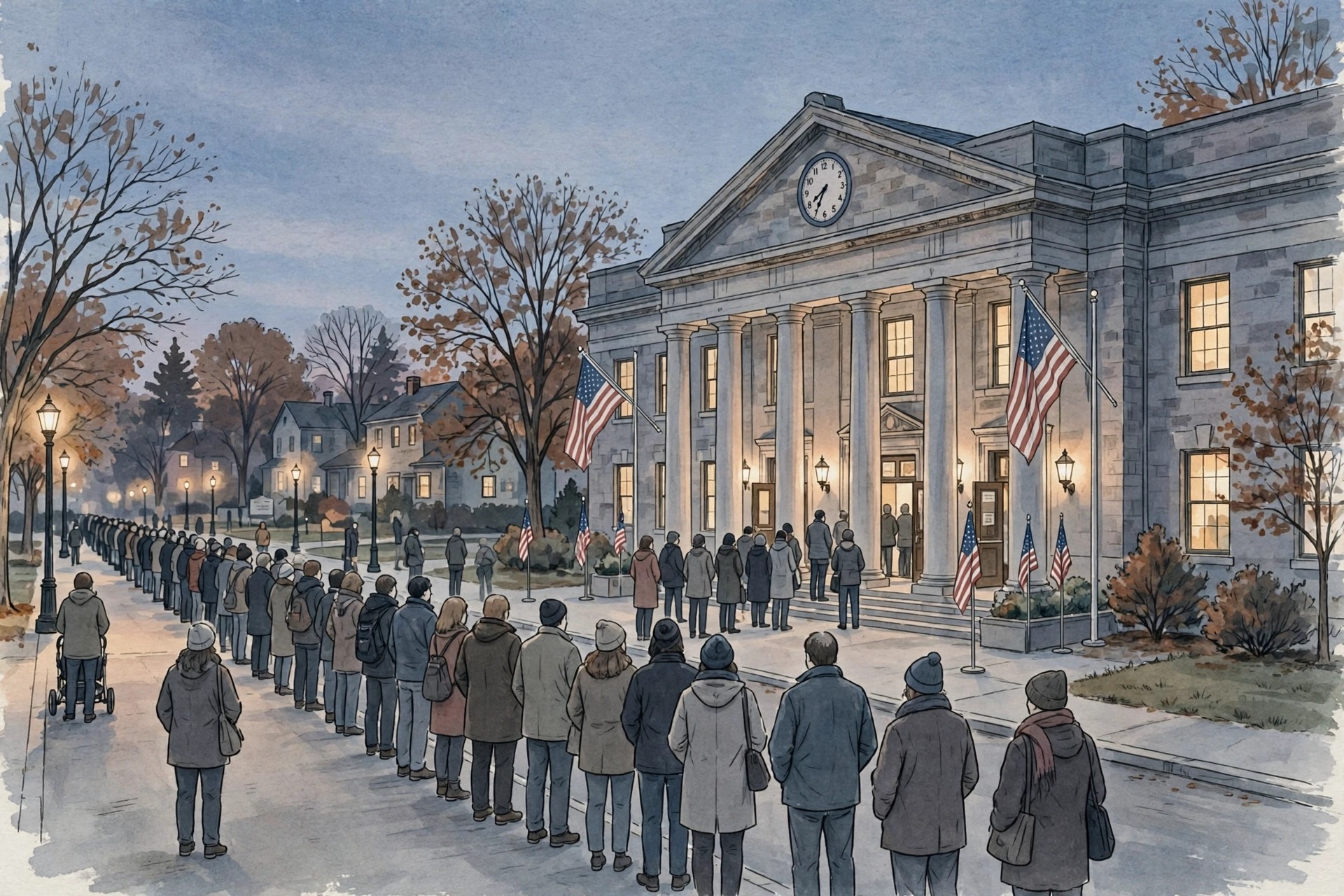
WASHINGTON — On Tuesday, November 3, 2026, Americans will vote in midterm elections that will decide control of Congress for the final two years of President Donald Trump’s term, and the night will unfold in waves. The first polls close at 6 p.m. Eastern Time in parts of Indiana and Kentucky. The last close in parts of Alaska at 1 a.m. Eastern on Wednesday, November 4. In between, every state will shut its polling places on its own schedule, election officials will begin counting ballots that in many places have already been arriving for weeks, and news organizations will start projecting winners — some within minutes of a state’s polls closing, others only after days of counting, recounts, or court proceedings. For voters trying to follow the night, the most useful thing to understand at the outset is that a poll closing time is not a result. It is simply the moment when in-person voting ends in that place and the counting and reporting process, which follows different rules in every state, moves into its public phase.
All 435 seats in the House of Representatives are on the ballot, along with 35 Senate seats and 36 governorships. In the Senate, Republicans currently hold a 53-47 majority, which means Democrats need a net gain of four seats to take control, assuming the normal tie-breaking rules that apply when the chamber is evenly split. In the House, Republicans hold a narrow 218-214 edge, with three vacancies, which means a net Democratic gain of just a handful of seats would be enough to flip the chamber. Those two numbers frame everything that will happen on election night. A small number of competitive Senate races and a few dozen competitive House districts will decide both chambers, and because several of those races are polling within the margin of error, the outcome may not be clear when most Americans go to bed on Tuesday night. That is not a sign that something has gone wrong. It is, in most cases, a sign that the count is proceeding exactly as state law requires.
More than 53 million Americans had already voted before Election Day, according to record early voting totals reported ahead of Tuesday, a figure that itself shapes how election night will look. Early and mail ballots are counted under rules that vary widely. Some states allow election workers to begin processing mail ballots — checking signatures, opening envelopes, and preparing them for tabulation — days or even weeks before Election Day, even though they cannot be counted until polls close. Other states, including some of the most closely watched battlegrounds, restrict that early processing, which means a large pile of ballots can only begin moving through the system after voting ends. The result is a familiar pattern: the first reported results on election night often reflect Election Day votes counted quickly, while mail ballots counted later can shift the totals, sometimes substantially, over the following hours and days. Analysts sometimes call the early, misleading picture a “red mirage” or a “blue mirage,” depending on which party’s votes are reported first, but the underlying reality is simpler and less dramatic. Different kinds of ballots are counted at different speeds, and the final total is the only total that matters.
2026 midterm elections poll closing times state by state
The closing schedule on Tuesday is best understood as a series of waves, all expressed here in Eastern Time. At 6 p.m. Eastern, polls close in the Eastern Time portions of Indiana and Kentucky, covering 15 House districts. At 7 p.m. Eastern, polls close in Georgia, South Carolina, Vermont, and Virginia, along with most of Florida and the remaining parts of Indiana and Kentucky, and the rest of New Hampshire. That wave includes the Senate races in Georgia and South Carolina, the governors’ races in Florida, Georgia, and New Hampshire, and 63 House districts. At 7:30 p.m. Eastern, North Carolina, Ohio, and West Virginia close, bringing the Senate races in North Carolina and Ohio, the Ohio governor’s race, and 31 House districts into the count. Voters in those states should check their local election office for their precise polling place hours, because counties within a state that spans two time zones can close at different Eastern times even when they close at the same local time.
The largest single wave arrives at 8 p.m. Eastern, when polls close in Alabama, Connecticut, Delaware, Illinois, Maine, Maryland, Massachusetts, Mississippi, Missouri, New Jersey, Oklahoma, Pennsylvania, Rhode Island, and Tennessee, along with Washington, D.C., the Florida Panhandle, and most of Kansas, Michigan, North Dakota, South Dakota, and Texas. That wave alone covers 163 House districts and the Senate races in Maine, Michigan, and Texas, as well as the governors’ races in Kansas, Michigan, and Texas. Arkansas follows at 8:30 p.m. Eastern. At 9 p.m. Eastern, Arizona, Colorado, Iowa, Louisiana, Minnesota, Nebraska, New Mexico, New York, Wisconsin, and Wyoming close, along with the western portions of Kansas, Michigan, North Dakota, South Dakota, and Texas. That wave includes the Senate races in Iowa, Minnesota, and Nebraska, the governors’ races in Arizona, Iowa, and Wisconsin, and 76 House districts. At 10 p.m. Eastern, most of Idaho, Montana, Nevada, and Utah close, along with part of Oregon. California, the rest of Idaho, most of Oregon, and Washington close at 11 p.m. Eastern, followed by most of Alaska and Hawaii at midnight Eastern, and the Aleutian Islands at 1 a.m. Eastern on Wednesday.
Those times matter for a second reason beyond simple curiosity. News organizations generally do not project a statewide winner until polls have closed throughout that state, which is why a state that spans two time zones cannot be called until its later-closing portion has finished voting. They also do not project a winner on the basis of exit polls alone. The Associated Press, whose vote counts most outlets rely on, says a race is called only when the trailing candidate no longer has a plausible path to victory based on the votes counted, the votes outstanding, and the history of how similar outstanding ballots have broken. That standard explains why some races are called within minutes — when the margin is wide and the outstanding vote is small — while others remain uncalled for days. It also explains why different outlets can disagree for a time about the same race. A projection is a news organization’s judgment, not an official result, and it can be revised if later counting changes the picture, although that is rare in races that are not extremely close.
How votes are counted and why some races take days
Counting begins, in most places, the moment polls close, but “counting” is a shorthand for several distinct steps. Election workers first reconcile the number of ballots cast with the number of voters checked in. They then tabulate ballots cast in person on Election Day, which in most jurisdictions are scanned and reported relatively quickly. Mail ballots, early in-person ballots, and ballots cast by military and overseas voters follow their own timelines. Some states require mail ballots to arrive by Election Day to count. Others, notably California, accept ballots postmarked by Election Day and received within a set number of days afterward — through November 10 in California’s case, subject to state requirements — which means the final margin in a close California House race can keep moving for a week after Election Day. Provisional ballots, cast when a voter’s eligibility cannot immediately be confirmed at the polling place, are set aside and adjudicated later. Ballots that are damaged, or that a scanner cannot read, are reviewed by bipartisan teams under state rules.
Several states are known to count slowly for structural reasons, not because of any dispute. California, Washington, and Oregon vote largely by mail, and their counts routinely extend for days or weeks as ballots arrive and are verified. Pennsylvania and Wisconsin, by contrast, have historically restricted how early mail ballots can be processed, which can delay their mail-ballot totals even when the overall count is not especially large. Michigan has changed its rules in recent years to allow earlier processing, which has sped up its reporting, but a close race there can still take days if the margin is narrow and many ballots remain outstanding. In every state, the official result is not final until the canvass is complete and the result is certified, a process that in most states takes days to weeks after Election Day. Certification involves checking that every precinct has reported, that the totals reconcile, and that any required audits have been performed. Recounts, where the margin falls within a state’s threshold or a candidate requests and pays for one, can extend the timeline further, as can litigation over specific ballots or procedures.
Voters should also expect a gap between what is known on election night and what is known later for a practical reason: the sheer number of ballots. Analysts estimate that more than 100 million ballots will be cast in these midterms, including the tens of millions already cast early. Counting that many ballots accurately, with signature verification for mail ballots and reconciliation for every precinct, takes time, and the states that report fastest are generally those that process mail ballots early, count in-person votes electronically, and have fewer ballots outstanding at the close of polls. Speed is not, by itself, a measure of accuracy. A state that reports 95 percent of its vote on election night and a state that reports 70 percent may both be counting correctly; they are simply at different points in different legal processes. The sensible way to follow the night is to watch the share of the expected vote that has been reported alongside the margin, and to be skeptical of any claim about a final outcome in a race where a large share of the vote remains uncounted.
What to watch for House and Senate control
The battle for the Senate will be decided, in the first instance, by whether Democrats can flip Republican-held seats while holding the seats they already defend. The final polling snapshot reported on Sunday, November 1, showed Democrats narrowly ahead in three races that illustrate how tight the map is. In Texas, Democratic state Representative James Talarico led Republican Attorney General Ken Paxton by 1.4 percentage points in the RealClearPolitics average of polls. In Michigan, Democratic nominee Abdul El-Sayed led former Representative Mike Rogers by 3.5 percentage points in the same average. In Maine, Democratic candidate Troy Jackson led Republican Senator Susan Collins by 1.7 percentage points. Each of those leads is within the margin of error of many individual surveys, which means none of them can be read as a prediction. Polls measure a moment in time, with sampling error, and they have missed in past cycles, sometimes in ways that favored one party systematically. The averages are best understood as a description of a close race, not as a forecast of its winner.
That caution applies with equal force to the House, where the national environment, as measured by the generic congressional ballot — the question that asks voters whether they prefer a Democrat or a Republican for Congress, without naming a candidate — has shown Democrats ahead by roughly eight points in recent averages. A generic-ballot lead of that size, if it held on Election Day, would ordinarily be consistent with a Democratic House majority, but House control is decided district by district, not nationally. Gerrymandering, the geographic distribution of each party’s voters, the quality of individual candidates, and local issues all mean that a national lead does not translate mechanically into a specific number of seats. Analysts will therefore watch the early House results in states that close at 7 p.m. and 8 p.m. Eastern — Virginia, Georgia, North Carolina, Pennsylvania, and Florida, among others — for the first signs of whether the night is breaking toward one party or the other, while remembering that the West Coast states that close at 11 p.m. Eastern, above all California, hold a large number of competitive House districts whose results may not be known for days.
There are also races beyond Congress that will shape the night’s meaning. Thirty-six governorships are on the ballot, including in Florida, Georgia, Texas, Michigan, Wisconsin, Arizona, and Nevada, and those results will affect redistricting, election administration, and state policy for years. Ballot measures on issues ranging from voting rules to taxes will be decided in many states. And in several states, the secretary of state or other election-administration offices on the ballot will determine who runs future elections. Those contests rarely draw the same attention as the Senate races, but they are part of the same story: the midterms are not a single national election but fifty state elections, plus the District of Columbia, held on the same day under different rules, and the national narrative that emerges on election night will be assembled, piece by piece, from those separate counts.
How to follow election night without being misled
A few practical habits will help anyone following the results. First, check the time a result was reported and the share of the vote counted before drawing a conclusion from a lead. A candidate leading by ten points with 10 percent of the vote counted is in a very different position from a candidate leading by ten points with 90 percent counted. Second, distinguish between a projection and an official result. A projection can be a useful signal, especially from an organization with a strong record, but it is not a certification, and in a close race it should be treated as provisional until the count is substantially complete. Third, be wary of claims that circulate on social media before official sources have reported them. In past cycles, early claims about turnout, ballot problems, or results in individual counties have often turned out to be incomplete, misattributed, or simply wrong, and election officials have had to correct them after they had already spread widely. The most reliable sources on election night remain state and county election offices, the Associated Press vote count, and established news organizations that show their work on how much of the vote remains.
Finally, remember what Election Day is and is not. It is the last day to vote in person in most states, but it is not the day the election is officially decided. Voters who are in line when polls close in their state are generally entitled to vote, and voters who have already cast a mail ballot can in many states track whether it was received and accepted. Voters who encounter a problem at a polling place — a registration question, an identification issue, a machine malfunction — should ask for a provisional ballot and for the contact information for their local election office, rather than leaving without voting. And voters who want to know when their own state’s results will be final should look to their secretary of state’s certification calendar, not to the pace of television coverage. The count will take as long as the law requires. The result, when it is certified, will be the result regardless of how long it took to reach.
By Wednesday morning, Americans will know a great deal about the next Congress, and they may know everything. But if the closest races follow the pattern of recent cycles, they will also wake up to a number of races still marked “too close to call,” with control of one or both chambers still formally undecided. That outcome would not be unusual, and it would not be evidence of failure. It would be the ordinary consequence of close elections in a large, decentralized system, where each state counts its own ballots under its own laws and certifies its own result. The story of Tuesday night will therefore be told in two parts: the part that is clear by midnight, and the part that only becomes clear as the counting continues in the days that follow. Both parts matter, and the second part is the one that will ultimately decide who holds power.
Sources
USN reviewed reporting from multiple outlets for this story. Read more from USA Today, 270toWin and Votebeat.