

The most striking verdict on the 2026 United States midterm elections may be the one that was never delivered in the usual way. For the first time since international observation of American federal elections began in 2002, there was no mission from the Organization for Security and Co-operation in Europe (OSCE) on the ground for a federal election, because the United States did not invite one. That single absence reshaped how the rest of the world could judge the process, and it means that any assessment published in the days after voting on 3 November 2026 must be read with its limits stated plainly: much of what observers normally verify in person had to be examined from a distance, through documents, interviews and the work of domestic observers.
The OSCE said so itself, in unusually direct language, before polling day. In a joint statement on 23 September 2026, its Office for Democratic Institutions and Human Rights (ODIHR) and its Parliamentary Assembly expressed regret at the decision and said it was not in line with commitments undertaken by participating states under the 1990 Copenhagen Document. ODIHR Director Maria Telalian stressed that international observation should not be read as a judgment on a country or its institutions, but as an independent assessment offered to voters, election administrators, candidates and the wider public. Parliamentary Assembly President Pere Joan Pons described the decision as a significant departure from an established democratic practice. The administration’s defenders, by contrast, have argued in public debate that American citizens can oversee their own elections and that international observers have more pressing work elsewhere. That disagreement about whether outside scrutiny is necessary at all is now part of the story of the 2026 process, not just a footnote to it.
What was lost, in practical terms, was a familiar machinery. Over 24 years, OSCE observers monitored 12 United States federal elections, including six previous midterms. Their missions typically examine election legislation, voter and candidate registration, campaigning, campaign finance, media conditions, election administration, complaints and appeals, voting technology, and the counting and publication of results. Observers do not administer elections, direct election officials, or have authority to change results. Their task is to assess the process against domestic law and international commitments, and then to publish independent findings and recommendations. Without an invitation, none of that in-person work could happen in 2026, and no OSCE final report can be expected for this cycle in the usual form.
In place of a mission, two European organisations stepped in with a different kind of exercise. MEMO 98 and Election-Watch.EU, both members of the European Partnership for Democracy, launched an International Remote Election Assessment, known as IREA, after the decision not to invite the OSCE. Its pre-election report was published on 2 November 2026, the day before voting. The assessment is explicitly remote: it is conducted through documentary research, expert analysis and stakeholder interviews, and it does not directly observe voting or counting. Its organisers state plainly that it is institutionally independent of the OSCE and does not substitute for an OSCE observation mission. That candour matters, because it prevents the remote exercise from being mistaken for something it is not, while still allowing its findings to be weighed on their merits.
What the 2026 midterm election observers could and could not see
The pre-election report recognised the professionalism and commitment of state and local election officials, alongside the mobilisation of civil society organisations for observation, voter protection, education and legal assistance. It described judicial review and decentralised election administration as important safeguards, while noting that some court decisions have narrowed electoral protections. Election-Watch.EU’s Armin Rabitsch said election officials and civil society organisations were showing resilience despite growing political pressure, and that independent scrutiny remains essential while safeguards against interference would face further tests during counting, certification and electoral disputes. That framing — resilience under pressure, with the hardest tests still to come — is the thread that runs through the assessment so far.
The same report identified significant challenges. It pointed to increased federal executive intervention, including investigations and demands for sensitive voter data, which it said raised concerns about the potential partisan use of government authority and resources. It also cited reduced federal election-security support, persistent threats against officials, and uneven resources across jurisdictions. Mid-decade redistricting and unequal voting and ballot-access requirements raised concerns about electoral equality, while immigration enforcement generated concerns about potential voter intimidation. None of these findings, as presented in the pre-election report, amounts to a claim that a particular result was altered; they are concerns about the conditions in which votes were cast and counted, and they are labelled here as the assessment’s concerns, not as established findings about outcomes.
Transparency and informed participation formed a second strand of the assessment. The report highlighted record independent expenditures for this stage of a midterm cycle, opaque political financing, pressure on independent journalism, and misleading electoral narratives. Artificial intelligence-generated political advertising, often without disclosure, and gaps in platform transparency further complicated public scrutiny, in the report’s account. MEMO 98 executive director Rasťo Kužel said elections are not only about casting and counting votes, but also about enabling voters to make informed choices, and that independent journalism, transparent political financing and scrutiny of misleading content, including deceptive uses of artificial intelligence, are essential to public trust. That argument connects the mechanics of administration to a broader question: whether voters had a fair chance to understand what they were choosing between.
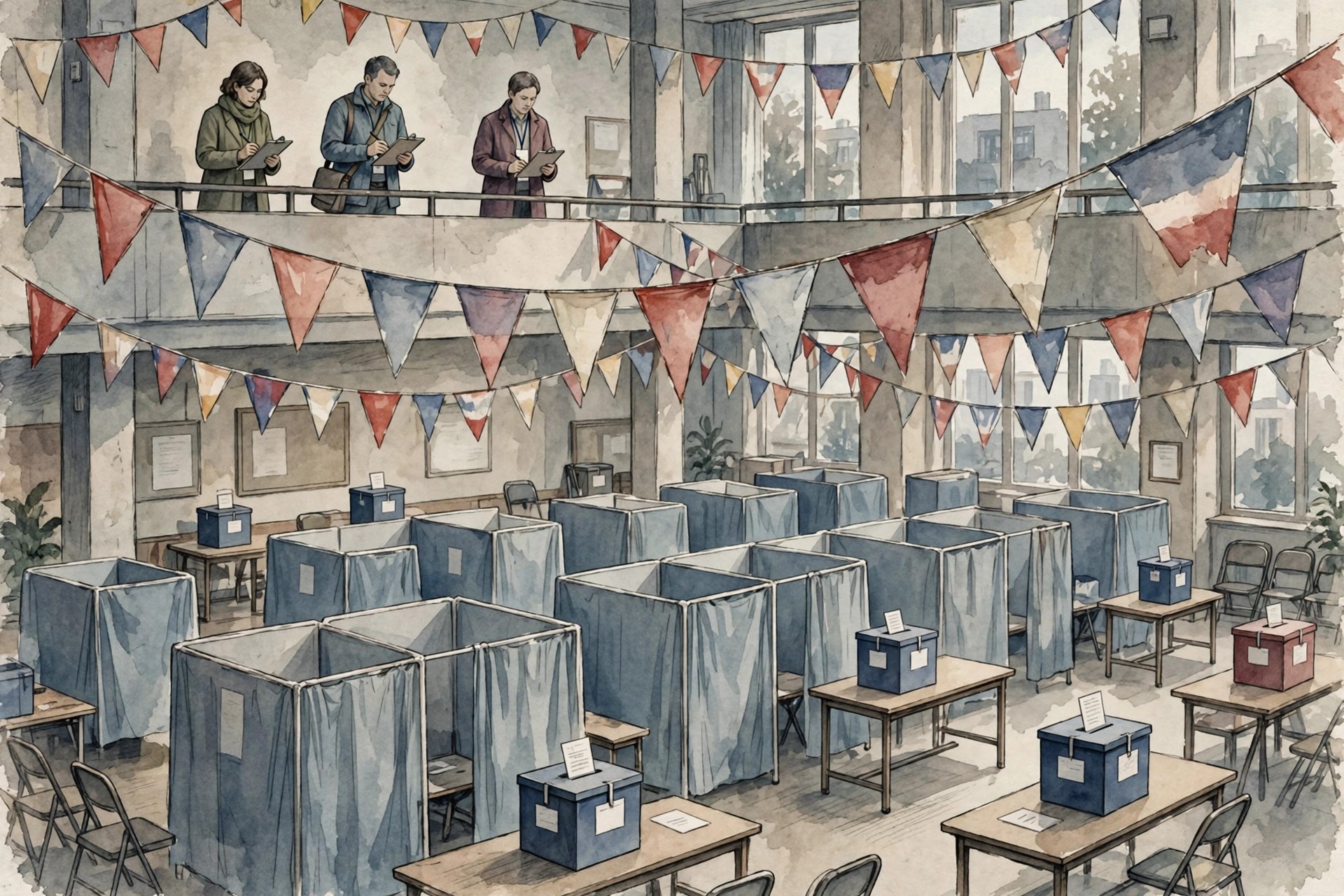
Domestic observation filled part of the gap left by the absent international mission, though only in a limited number of places. The Carter Center’s Democracy Program, which has conducted more than 125 election observation missions around the world since 1989, supported nonpartisan observation in five states for the 2026 midterms: Georgia, Michigan, Montana, Nevada and New Mexico. About 1,000 citizen observers signed up, according to the Center. Their access varied by state, because American election law is set state by state and, in some places, county by county. In Nevada, observers could monitor early voting; in Georgia, they could view tabulation and accuracy testing of equipment; in other states, they observed Election Day operations, ballot processing on the night and in the days after, and county canvassing in the weeks after polling day. In Montana and New Mexico, the work included examining the experience of Native American voters. The Carter Center has said it will also observe post-election audits in Georgia, which help ensure the accuracy of vote counts.
That patchwork is itself an important finding. Many states allow party poll watchers to be present, but few explicitly allow for nonpartisan observers, and the rules governing what an observer may watch differ widely. A domestic observer in one state may be able to follow a ballot from polling place to canvass, while an observer in another state may be limited to watching from a distance or excluded from certain stages altogether. Any overall verdict on 2026 administration therefore has to be assembled from these uneven pieces, rather than from a single nationwide observation. That is a structural feature of American elections, not a new invention of 2026, but the absence of an international mission made it more visible, because there was no single outside team with a mandate to look across state lines.
Administration access and counting compared with past US elections
Comparison with past elections is where the 2026 assessment becomes most useful, and also where it must be most careful. The most recent OSCE observation before 2026 was of the 2024 general election. Its final report concluded that the elections were well run and demonstrated the resilience of American democratic institutions, while documenting a highly polarised environment, disinformation, violent incidents and unsupported allegations of electoral fraud that affected public confidence. It contained 31 recommendations covering campaign-finance transparency, voter registration, safeguards against discrimination, election administration, media freedom and access for international and nonpartisan observers. The 2026 pre-election assessment, drawing on those findings, examined how the environment had changed since 2024 — and its tone was more concerned, particularly on federal intervention, threats to officials and the transparency of political money.
The contrast is not simply between a good election in 2024 and a bad one in 2026, and no responsible assessment available so far makes that claim. The 2024 report itself recorded serious problems alongside its positive overall judgment, and the 2026 remote assessment has not yet published a final verdict on counting and certification. What can fairly be said is that the conditions for scrutiny changed in 2026 in ways that make comparison harder. In 2024, an international mission was present to test claims against what it saw. In 2026, claims about administration, access and counting must be tested against documents, court records, state data and the partial coverage of domestic observers. That is a weaker evidence base, and the assessments themselves acknowledge it.
Access is a good example. In past OSCE missions, access for observers was itself a recurring recommendation: the 2024 report’s recommendations included better access for international and nonpartisan observers. In 2026, the question of access took a different form. The international mission was absent altogether, while domestic observers faced the existing patchwork of state rules. The Carter Center’s expansion of domestic observation, begun in 2020 and extended for 2026, shows that nonpartisan observation is growing inside the United States, but it also shows its limits: about 1,000 observers across five states cannot cover a country of 50 states and thousands of local jurisdictions. The growth of domestic observation is a genuine development; it is not a replacement for nationwide international observation, and it should not be presented as one.
Counting and certification follow a similarly decentralised pattern, and this is where the post-election phase of the assessment will matter most. Election night figures are unofficial. Each state sets its own timeline for canvassing and certification, and those timelines vary widely: South Dakota certifies within seven days, Florida on the 14th day, and California by the 38th day, according to a compilation of National Conference of State Legislatures deadlines, while some states specify no single deadline. The new Congress is due to convene at noon on 3 January 2027, when the 120th Congress begins, and certificates of election issued by state officials form the basis on which members are seated. The IREA assessment has said it will continue after election day, examining ballot processing and counting, certification, electoral disputes and the effectiveness of institutional safeguards, with a final report bringing together pre-election and post-election findings and recommendations. Until that final report appears, any claim to a complete international verdict on 2026 counting and certification would be premature.
Allegations of fraud and irregularity must be handled with the same discipline. Unsupported allegations of electoral fraud affected public confidence in 2024, according to ODIHR, and the 2026 pre-election assessment warned about misleading electoral narratives. That does not mean that every allegation made during or after the 2026 count is false, nor that every allegation is true. It means that allegations should be treated as allegations until they are tested through recounts, audits, court proceedings or official canvasses, and that the burden of proof lies with the person making the claim. Observers, whether international or domestic, do not certify results; state officials do, and each chamber of Congress is the judge of the elections of its own members. A verdict on the process is therefore not the same as a verdict on a single race, and conflating the two is one of the most common errors in election reporting.
What a final verdict would need to settle
A credible final assessment of 2026 would need to answer several questions that cannot yet be answered. First, did counting and canvassing proceed consistently with state law in the jurisdictions examined, and were discrepancies, where they occurred, resolved transparently? Second, did certification proceed on schedule, or were there delays, refusals or legal challenges that required courts to intervene, and on what grounds? Third, did voters face intimidation or unequal access in practice, not only in law, particularly where immigration enforcement, threats against officials or uneven resources were reported before polling day? Fourth, did the information environment allow voters to make informed choices, given the reported scale of undisclosed political spending and undisclosed artificial intelligence-generated advertising? Fifth, and most broadly, did the absence of an international mission itself affect confidence, even if administration on the ground was competent? Public trust is not measured only by whether ballots were counted correctly; it is also measured by whether the process was seen to be open to independent scrutiny.
Both sides of the American debate will read the eventual findings selectively, and that is itself a risk to the assessment’s value. Supporters of the decision not to invite the OSCE may point to competent local administration and to the work of domestic observers as evidence that outside scrutiny was unnecessary. Critics may point to the same record and argue that the absence of an international mission removed a check that had operated for more than two decades, and that its removal, whatever the quality of local administration, weakened confidence. A fair reading must hold both points at once: local administration can be professional and committed, as the pre-election assessment recognised, while the overall system of scrutiny can still be thinner than it was in previous cycles. Those two statements are not contradictory, and the final report, when it comes, will be judged by whether it keeps them distinct.
For other democracies, the 2026 American experience carries a wider lesson that goes beyond one election. The OSCE system rests on reciprocal commitments: states that invite observers to their own elections gain credibility when they ask other states to accept observation. When the United States, one of the system’s founding participants, declines to invite observers, it weakens the argument that observation is a normal, non-threatening part of democratic practice. That argument is not abstract. Other participating states that have restricted meaningful independent observation in the past, including Russia and Belarus, have been criticised for doing so, and American diplomats have historically pressed for access in those countries. The 2026 decision therefore has consequences for American credibility abroad that will outlast the counting of any single midterm race, whatever the final assessment concludes about administration on the ground.
For now, the honest summary is an interim one. The pre-election assessment recognised resilient officials and an active civil society, warned about federal pressure, unequal access, opaque money and misleading information, and promised to examine counting and certification after polling day. Domestic observers watched parts of the process in five states, under varying rules. The international mission that had watched every federal election since 2002 was absent, by decision, not by oversight. The final verdict on the 2026 midterms — on administration, access, counting and certification — is still being written, and it will be written, in part, by whether the post-election evidence confirms or qualifies the concerns raised before a single ballot was cast.
Sources
USN reviewed reporting from multiple outlets for this story. Read more from MEMO 98, Carter Center and USA Today.