

FRANKFURT — What began as a day of youth-led demonstrations across Germany ended in a night of smashed shopfronts, burning projectiles and injured officers in Frankfurt, where ministers are now promising severe punishment for those behind the violence. Police in the city say more than 100 officers were hurt in clashes on Saturday night, 17 stores were damaged and five were looted, after a largely peaceful nationwide day of protest gave way to disorder in the country’s financial centre.
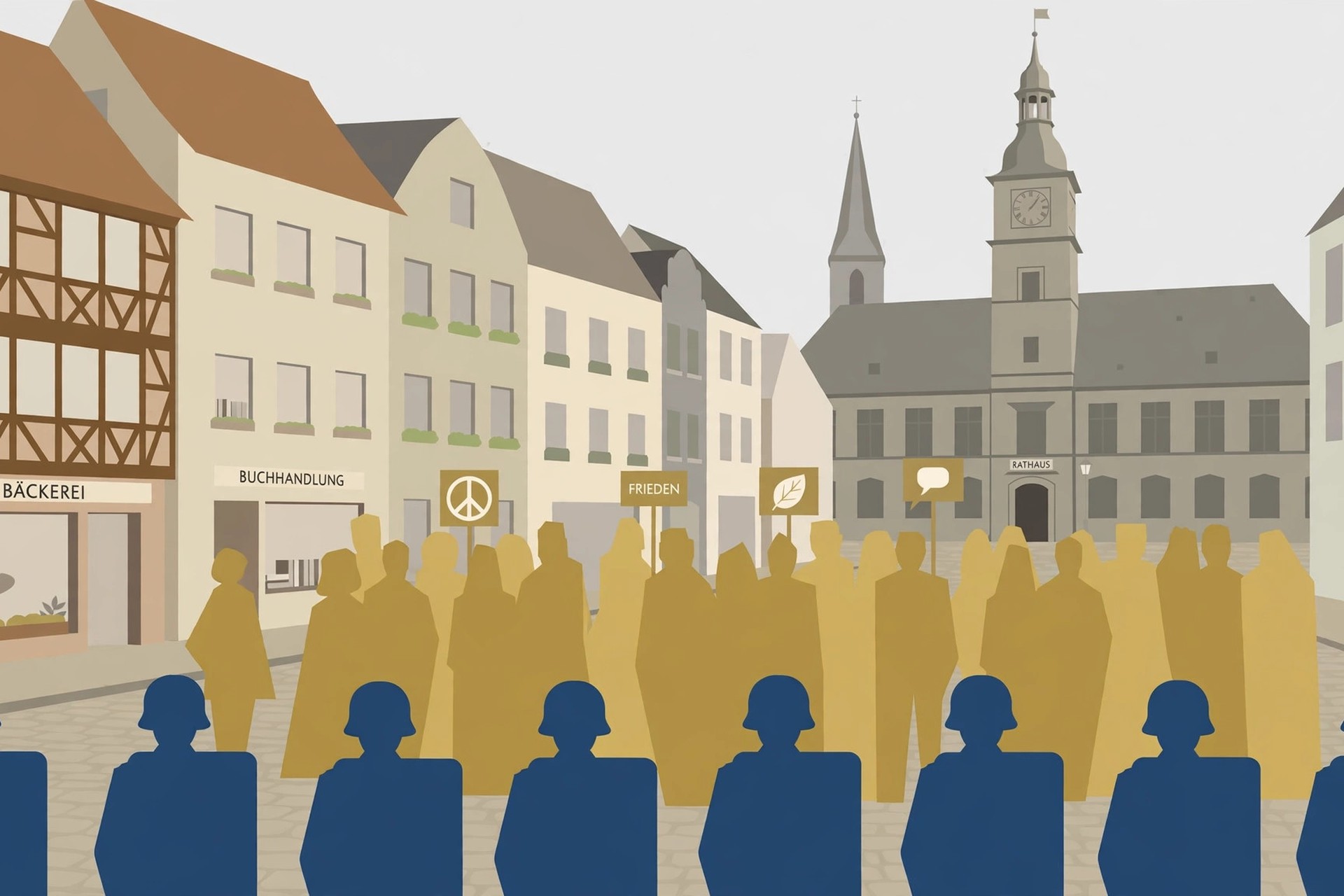
The unrest in Frankfurt became the sharpest flashpoint of a day in which tens of thousands of people took to the streets in dozens of German cities. The demonstrations were organised by the campaign group Gen Z regelt, a name that translates roughly as “Gen Z has got this” or “Gen Z takes charge”. Its supporters were calling for greater investment in education, relief from rising living costs, and action on issues including housing and the cost of everyday life. Organisers said around 120,000 people took part across the country, fewer than the roughly 180,000 they had hoped to mobilise, but still a turnout large enough to be felt in city after city, from Berlin to Munich.
For most of the day, the protests passed without major incident. The trouble, according to police accounts, came in the evening, when groups refused to disperse after demonstrations formally ended. In Frankfurt, officers described a rapidly escalating confrontation along the city’s main shopping street, where windows were broken, fireworks and bottles were thrown, and petrol bombs were hurled at emergency workers. Police answered with water cannon and pepper spray, sealed off a large section of the city centre, and kept a helicopter overhead as they worked to restore order. By the early hours of Sunday morning, the area had calmed, but the damage, and the political argument over who was responsible, was only beginning to take shape.
How the Frankfurt riots unfolded on the shopping streets
Frankfurt police said the violence included windows smashed at several shops and Molotov cocktails thrown at emergency personnel. Among the premises hit, according to reports from the scene, were a gun store, a trainer shop and a perfume store. Police said a suspect was arrested in connection with the gun store and two weapons were seized. Other reports described jewellery stores and luxury clothing shops boarding up their windows in advance of the protests, a precaution that underlined how far traders had expected trouble even before the first march set off.
The scale of the police operation in Frankfurt was considerable. Roman Poseck, the interior minister of the state of Hesse, told a press conference on Sunday that 1,300 officers had been deployed in the city and that more than 100 of them were injured in the clashes. Police arrested 54 people aged between 13 and 29. Poseck said he was shocked by what he had seen and that there was no point in sugar-coating it, adding in remarks reported from the press conference: “Things cannot go on like this.” The age range of those arrested, which includes teenagers, is likely to become a focus of the debate that follows, both about how young people were drawn into the disorder and about how the authorities respond to minors caught up in it.
Frankfurt was not the only city where the evening turned confrontational. Police also used water cannon in Hamburg and Cologne after saying demonstrators targeted emergency workers with fireworks, stones and bottles, and officers in Leipzig used pepper spray after protests there turned violent. In Bonn, an officer suffered minor injuries during a confrontation with a group. Those incidents, however, did not match Frankfurt in scale or in the level of property damage, which is why the city has become the centre of the national argument. In Berlin, where large crowds also gathered, the demonstrations were reported to have remained largely peaceful, a contrast that organisers and police alike are likely to point to when the events are reviewed.
It is important to keep the German events in proportion and in their own context. These were German protests, organised by a German campaign group, about German domestic concerns, and they are separate from the protest movements seen in France, where demonstrations have also continued in recent weekends. The French situation has its own history, including extensive rioting and looting on October 17, and should not be conflated with what happened in Frankfurt on October 31. What links the two countries is a broader European mood among younger protesters who feel that political leaders are not listening to their generation. What separates them is everything else: different organisers, different demands, different police operations and different outcomes.
What the Gen Z regelt protesters were demanding
The demands behind the demonstrations help explain why so many young people turned out, even if they do not explain the violence that followed in Frankfurt. The campaign’s grievances, as described in reporting of the protests, include underfunding of schools, cuts to education, social services, culture and healthcare, rising living costs, and opposition to military conscription. Other accounts of the day’s demands also mention housing costs and climate protection. Taken together, they describe a generation that feels squeezed on several fronts at once: classrooms and services they see as underfunded, rents and prices they see as rising faster than their incomes, and a future they feel is being decided without them.
The movement drew inspiration, according to reports of the day, from similar youth-led protests elsewhere in Europe, including in France and Italy, where young demonstrators have also sought to force established politicians to take their concerns seriously. That cross-border echo is part of the story, but it also carries a risk for the organisers: when a protest in one country turns violent, it colours perceptions of the wider movement, even where the vast majority of demonstrators marched peacefully. The organisers of Saturday’s protests in Germany moved quickly to draw that line. In a statement posted on Instagram, they distanced themselves from what they described as any form of violence, as well as from violent acts by other groups or individuals who were not part of the demonstrations.
That distancing matters because the central factual dispute now is not whether violence happened — the smashed windows, the looted stores and the injured officers are documented — but who carried it out and whether they belonged to the protest movement at all. The organisers’ position is that the rioters were not their people. The ministers’ position, as set out on Sunday, is that the protest was infiltrated and hijacked by others. Both claims cannot be fully tested from the information released so far, and the arrests, investigations and any court cases that follow will be watched closely for evidence about who the 54 arrested people were and what, if anything, connected them to the organised demonstrations.
Ministers promise tough penalties and identification of rioters
Germany’s federal interior minister, Alexander Dobrindt, and Hesse’s interior minister, Roman Poseck, both used Sunday to promise a hard response. Dobrindt, a member of the conservative Christian Social Union, told reporters that perpetrators would be identified and held to account, and that he expected severe penalties. In comments quoted from the Bild newspaper, he said the breach of the peace must be followed by tough penalties and that the government was not prepared to accept such rioting. Poseck, speaking at his press conference, praised the security forces for preventing wider violence, while making clear that he regarded the night’s events as unacceptable.
Dobrindt also credited the policing strategy itself. He said a strategy based on a large security presence and deployments across multiple locations had proved effective, and that excesses of violence on the scale seen in Paris had been prevented thanks to what he described as highly committed police forces. Border controls, he added, had been tightened ahead of the protests out of concern that extremist groups from abroad could exploit the demonstrations to stir riots. Whether that strategy will be judged a success depends on the measure used: the centre of Frankfurt was eventually secured, but only after more than 100 officers were injured and stores were looted, a toll that critics of the operation are unlikely to treat as a clean result.
The characterisation of the rioters is where the ministers’ account becomes contested, and readers should treat it as claims by officials rather than settled fact. Poseck said most of those arrested were German nationals, while also saying, citing police information, that many of those involved in the disturbances were of an immigrant or migrant background. He put the police estimate of violent troublemakers at between 1,000 and 1,500, described as predominantly from an immigrant background. Dobrindt accused troublemakers from the immigrant community of acting alongside left-wing extremists and other far-left groups, but did not provide evidence to support that claim or identify which groups had joined the demonstrations. Poseck separately said around 100 clearly identified left-wing extremists had infiltrated the protest in Frankfurt, according to reports of his remarks.
Those statements have already drawn the obvious tension into the open. If most of those arrested were German nationals, then nationality alone does not explain the violence, and the emphasis on background in the ministers’ account will be challenged by critics who argue that it risks stigmatising entire communities on the basis of police estimates that have not been published in detail. Supporters of the ministers will argue that police on the ground are best placed to describe whom they faced, and that identifying a problem honestly is a precondition for dealing with it. What is not yet in the public record is the detailed breakdown that would allow either argument to be tested: the charges brought, the evidence linking individuals to specific acts, and the demographic data behind the estimates. Until that record exists, the description of the rioters should be read as the police and ministers’ account, not as an established finding.
What happens next after the Frankfurt violence
The immediate next steps are investigative. Dobrindt’s promise that rioters and looters will be identified points to a process of reviewing video footage, witness accounts and arrest records, followed by prosecutions where the evidence supports charges. The penalties available will depend on the offences charged, which could range from breach of the peace and property damage to more serious offences where weapons, petrol bombs or attacks on officers are involved. How quickly cases reach court, and how severely they are punished, will be read as a signal of whether the tough rhetoric of Sunday translates into practice.
There will also be questions for the police operation itself. Deploying 1,300 officers in a single city is a major commitment, and the fact that more than 100 were injured raises questions about tactics, equipment and the point at which a demonstration that has formally ended should be dispersed. Police unions and officers’ representatives are likely to press for a full account of the injuries and for any lessons about protecting officers facing petrol bombs, fireworks and thrown objects. At the same time, civil liberties advocates and protest organisers will ask whether the use of water cannon and pepper spray was proportionate, and whether peaceful demonstrators were caught up in the response to a violent minority. Both sets of questions can be legitimate at once, and both deserve answers grounded in the operational record rather than in rhetoric.
The wider political question is what the night in Frankfurt does to the debate about young people and politics in Germany. The Gen Z regelt protests were an attempt to show that younger voters are engaged and organised, and the turnout of around 120,000 suggests that the attempt had real reach. The violence in Frankfurt risks overshadowing that message, giving opponents of the movement an easy shorthand and giving the government a reason to talk about public order rather than education funding or living costs. How the organisers respond, whether they can sustain peaceful mobilisation, and whether the government engages with the underlying demands or treats the whole movement through the lens of one night’s disorder, will shape whether October 31 is remembered as a protest that turned violent or as a violent night that swallowed a protest.
For Frankfurt’s traders, the reckoning is more immediate and more tangible. Seventeen damaged stores and five looted premises mean repairs, insurance claims, lost stock and, for some, a decision about whether to keep trading in the city centre at all. The gun store whose windows were smashed and from which police seized weapons after an arrest presents a particular concern for investigators, given the obvious public safety questions raised by weapons changing hands during disorder. For the officers who were injured, some of them seriously enough to require treatment at the scene, the night will be measured not in political arguments but in recovery time. Those human and commercial costs are the part of the story that will still be felt long after the ministerial press conferences are forgotten.
Sources
USN reviewed reporting from multiple outlets for this story. Read more from Free Malaysia Today, The Hindu and WNCY.