

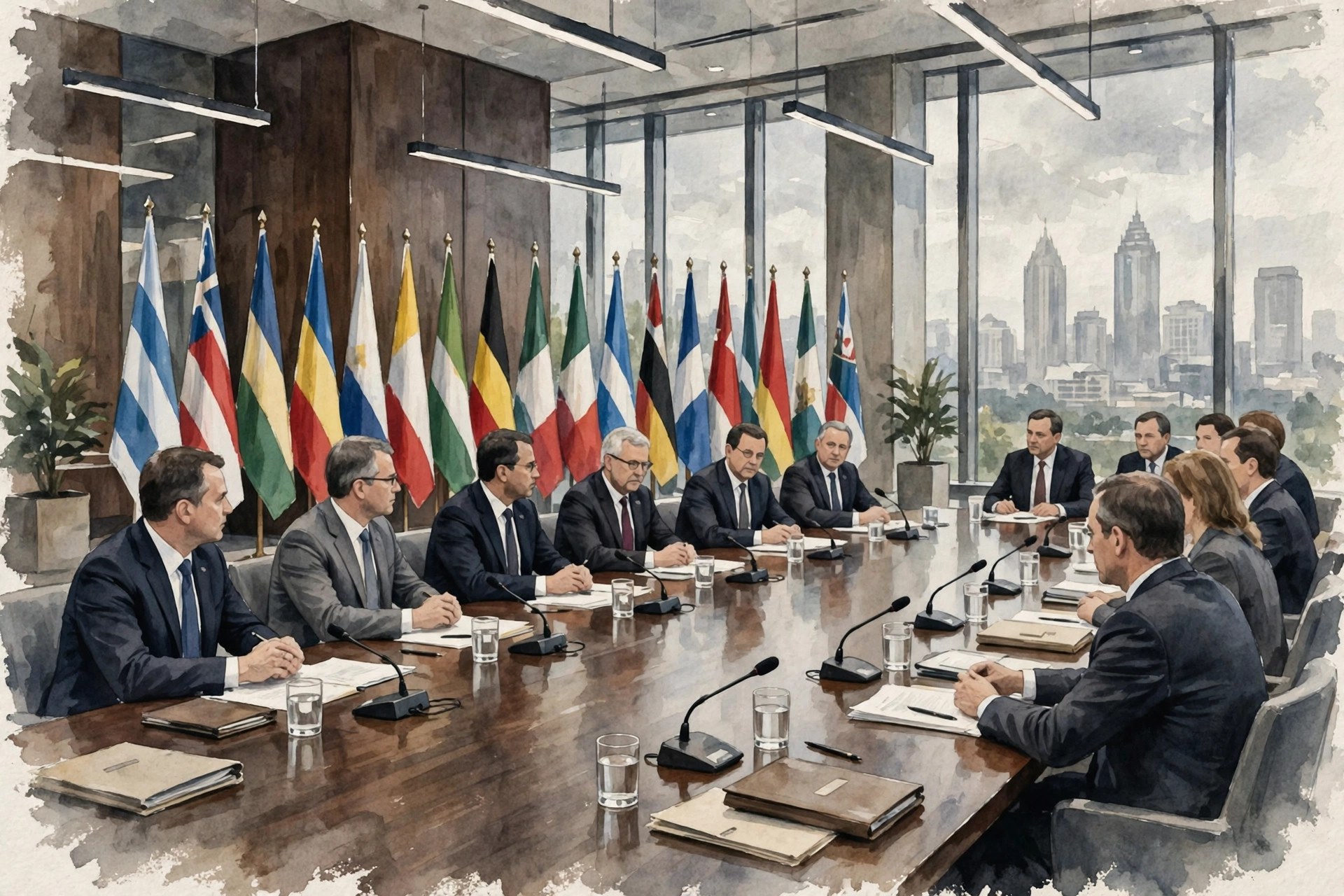
ATLANTA — The G20 foreign ministers’ meeting in Atlanta ended on October 31 without a joint statement, and not a word from the host government. In the absence of a U.S.-issued readout of the meeting, the absence itself has become the most quoted fact of the weekend. The lack of a joint statement does not necessarily mean a lack of progress, and it does not necessarily mean that the talks failed, but it does mean there is no agreement for the American public or the wider world to measure the meeting against.
Atlanta’s role in this story is as host, not as the main actor. The meeting was a G20 foreign ministers’ gathering convened on U.S. soil, with the United States holding the presidency in 2026. That combination matters, because a host presidency is expected to set the agenda and, at the end, to speak for the gathering. The absence of a U.S. readout is therefore more than a communications gap. It raises the question of whether Washington decided the meeting was too divisive to summarise, too unimportant to describe, or too uncertain to describe honestly, and no official account has yet answered that question.
The meeting’s significance is best understood in two parts, which can be told separately without conflating them. First, there is the formal G20 gathering itself, which concluded with no joint communique, a result that leaves the formal diplomatic record blank for this meeting. Second, there is a parallel diplomatic development announced on the same day by the Quad, the Indo-Pacific grouping of the United States, India, Australia and Japan, whose foreign ministers signed a statement pledging more than $85 million to support trusted artificial intelligence projects in Southeast Asia and the Pacific Islands. Those two developments happened on the same day and in the same city, but they are not the same story, and they should not be presented as if one compensates for the other.
For the G20 itself, the absence of a joint statement is the primary fact. No communique means no agreed language on energy, trade, migration, security or any of the issues that were expected to be on the table. It also means no agreed account of the meeting’s tone or conclusions, which leaves journalists, analysts and member governments to rely on national statements, press reporting and, in the case of this meeting, on the conspicuous silence of the host. That silence is itself a story, because it deprives the public of an official account of what the U.S. presidency achieved in Atlanta, and it invites speculation about whether the meeting was a failure, a holding exercise or simply a routine gathering that produced nothing that could be agreed.
What the Quad Actually Announced on Trusted AI
The Quad announcement is a separate development, and it should be reported as one. The joint statement signed on October 31 by the foreign ministers of the United States, India, Australia and Japan pledged more than $85 million to support trusted AI projects in Southeast Asia and the Pacific Islands, including $85 million in committed funding and additional investment expected to be generated. The statement described AI as a tool for advancing transparent and safe economic development, and it announced that the first-ever Quad Critical Technology and Innovation Forum would be held in 2026, along with a Quad Indo-Pacific Logistics Network and related initiatives.
For those who follow the Quad, the AI pledge is best understood as an investment in trusted technology partnerships. The $85 million is not a large sum by the standards of major development or defence spending, but it is a specific, named commitment to a specific region and a specific technology agenda. It signals that the Quad’s members see AI governance and infrastructure as a domain where they can offer an alternative to the models proposed by other powers, and it provides a concrete item that can be tracked in the months ahead.
Freedom of Navigation, Shipping Lanes and the Indo-Pacific
Ministers also took up broader security questions in their joint statement. They affirmed the importance of freedom of navigation and overflight in the Indo-Pacific, with specific reference to the Strait of Hormuz, the Red Sea and the Bab el-Mandeb strait. Those references are not incidental. They reflect concerns about the security of shipping lanes that carry energy, food and manufactured goods, and they signal a shared view among the Quad members that the rules governing those waterways should be respected.
For the wider region, the statement’s emphasis on energy security and trusted technology also matters. It suggests that the Quad is trying to link its technology agenda to its security agenda, presenting trusted AI as part of a broader effort to build resilient supply chains and to reduce dependence on untrusted suppliers. That framing is likely to be tested in the months ahead, as the Quad’s members try to convert a pledge into projects, and as other powers respond to the grouping’s growing activity in the region.
Other Agreements: The Arctic and Pacific Partnership Memorandum
On the sidelines of the Atlanta meeting, the United States, Japan and South Korea also signed a memorandum of understanding on an Arctic and Pacific Partnership. The agreement, described as a new era of trilateral cooperation, covers economic and scientific collaboration in the Arctic and Pacific regions. It is a separate initiative from the Quad statement, and it involves a different grouping of countries, but it shares the same logic: a focus on trusted partnerships, on technology and on the rules that govern shared spaces.
The memorandum’s significance lies in its timing and its participants. It brings together three major economies with shared interests in the Arctic and Pacific, and it does so at a moment when the rules governing those regions are under strain. Like the Quad AI pledge, it is a specific, named agreement that can be tracked, and it provides a concrete item to report alongside the G20’s silence.
What the Atlanta Meeting Did Not Produce
For the G20, however, the weekend’s story is the absence of an agreement. The lack of a joint statement leaves open the question of whether the ministers discussed energy, trade, migration or security in any depth, and whether they reached any informal understandings that were not recorded. Without a readout, the public cannot know what was discussed, what was agreed informally or what remains unresolved. That gap is not filled by the Quad announcement, which is a separate development with a separate set of participants and a separate agenda.
The G20’s silence also has implications for the next meeting. The leaders’ summit is scheduled for Miami in December, and the Atlanta meeting was supposed to help prepare for it. Without a joint statement from Atlanta, the Miami summit will have to start without a formal record of what the foreign ministers agreed, or failed to agree, in Atlanta. That does not make the Miami summit impossible, but it does make its task harder, because it will have to build on a foundation that has not been publicly defined.
The meeting also raises a broader question about the U.S. presidency of the G20. A presidency is expected to lead, to set the agenda and to speak for the gathering at the end. The absence of a U.S. readout from Atlanta suggests either that the presidency chose not to speak, or that it could not speak with the authority of the whole group. Either way, it leaves the public without an official account of what the U.S. presidency achieved in Atlanta, and it invites questions about how the presidency will handle the Miami summit.
What to Watch Before the December Miami Summit
For readers trying to make sense of the weekend, the key is to keep the two stories separate. The G20 meeting in Atlanta ended without a joint statement, and the host government has not issued a readout. That is a fact, and it should be reported as such. The Quad announcement, with its $85 million pledge for trusted AI, is a separate development, with a separate set of participants and a separate agenda. It should be reported as a Quad announcement, not as a G20 achievement.
What to watch in the weeks ahead is whether the U.S. government issues a readout of the Atlanta meeting, whether any G20 member issues its own account, and whether the Quad’s $85 million pledge is converted into specific projects in Southeast Asia and the Pacific Islands. Those are concrete, checkable developments, and they will tell us more about the Atlanta meeting than any speculation about its tone or its significance. For now, the most honest account of the weekend is the simplest: the G20 met in Atlanta, it ended without a joint statement, and the Quad, separately, pledged $85 million for trusted AI.
Sources: The Wire, AsiaToday, The Hindu