

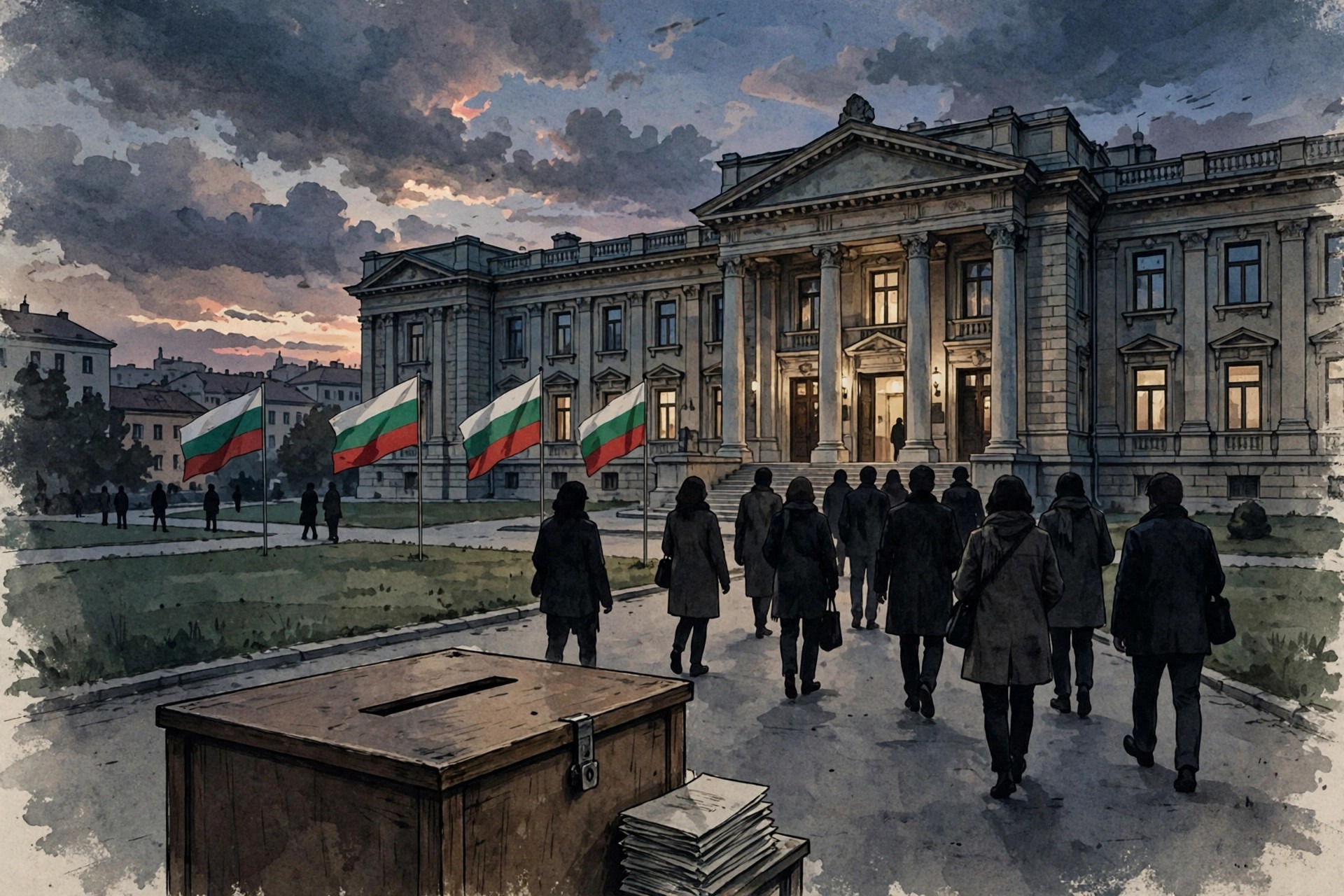
SOFIA, Bulgaria — Acting President Iliana Iotova has taken a clear lead in Bulgaria’s presidential runoff, according to exit polls released after voting closed on Sunday, putting her on course to become the first woman elected to the country’s highest office. The official result had not yet been announced when the exit polls were published, and the Central Election Commission must still count and verify the ballots.
The exit polls, conducted by the Alpha Research and Trend agencies, gave Iotova between 53.6 percent and 55.2 percent of the vote, against between 44.8 percent and 46.4 percent for her rival, Andrey Gyurov. If those figures hold in the official count, Iotova, 61, a former journalist and member of the European Parliament who served for nine years as vice president, will succeed herself as president, this time with a direct electoral mandate rather than as an acting head of state.
The runoff was the second round of an election that began two weeks earlier, when no candidate won an outright majority in the first round. Iotova led that first round with about 25 percent of the vote, ahead of Gyurov on about 20 percent, in a field of more than a dozen candidates. The low first-round shares reflected a fragmented field and a deeply disengaged electorate: turnout in the first round was just over 30 percent, and the runoff appears to have drawn even fewer voters.
Exit polls point to Iotova, but the official count is still to come
It is important to be precise about what the exit polls do and do not show. They are surveys of voters leaving polling stations, not the official count, and they carry a margin of error. In a runoff with low turnout, that margin matters more than usual, because the people who turn out to vote are not necessarily representative of the wider electorate, and because the sample is smaller. The Central Election Commission said the final official result was expected on Monday, after ballots were counted and verified, and until then the result remains a projection, not a declaration.
That distinction has not stopped political reactions, which began within minutes of the exit polls being published. Supporters of Iotova celebrated the projection as a historic moment for Bulgaria, while supporters of Gyurov urged caution and said the official count should be awaited. Both campaigns have said they will respect the official result, and there have been no reports of major irregularities that would call the outcome into question.
The context of the vote is a country that has voted repeatedly in recent years, with a series of parliamentary elections that have produced fragile coalitions and, at times, caretaker governments. Turnout has fallen steadily, and the runoff’s apparent turnout — below 30 percent by some early estimates — would be among the lowest in Bulgaria’s democratic history. For a presidency that is largely ceremonial, that low participation raises questions about mandate, even for a winner with a clear margin in the exit polls.
A historic first, if the projection holds
If Iotova’s lead is confirmed, she will make history as Bulgaria’s first elected woman president. Bulgaria has had a woman acting president before — Iotova herself, who took office on an acting basis earlier this year after her predecessor left office — but no woman has ever won a presidential election in the country. Her victory would also make her Bulgaria’s seventh president since the end of communist rule, and the first to take office after serving as vice president for almost a decade.
Iotova’s biography helps explain her appeal to a significant share of voters. Born in Sofia in 1964, she worked as a journalist before entering politics, serving as a member of the European Parliament from 2007 to 2017 and as vice president from 2017 until earlier this year. She is known for a calm, institutional style, and for emphasising dialogue and stability — qualities that resonated with voters tired of political turbulence, even as critics argue that her approach risks softening Bulgaria’s stance toward Russia.
Gyurov, 50, a former caretaker prime minister, ran as the candidate of the pro-Western opposition, presenting himself as a firm supporter of Bulgaria’s NATO and European Union membership and of continued military aid to Ukraine. His campaign argued that Bulgaria needed a president who would stand clearly with its Western allies at a time of war in Europe. The exit polls suggest that message did not persuade enough voters in a runoff where the more motivated electorate favoured Iotova.
What the result means for Bulgaria’s foreign policy
The reason this election has been watched far beyond Bulgaria’s borders is the sharp difference between the candidates on foreign policy, set against a deteriorating security picture in the Black Sea. In the past month, a series of drone attacks on merchant ships off Bulgaria’s Black Sea coast has drawn international condemnation and raised concerns about how far the war in Ukraine is reaching into waters that carry commercial shipping. Bulgaria, a member of both NATO and the European Union with a long Black Sea coastline, sits directly in that picture, and its president, as commander-in-chief of the armed forces, has a voice in how the country responds.
Iotova, 61, a former journalist and member of the European Parliament who served for nine years as vice president, is reported to support dialogue with Moscow and to oppose military aid to Ukraine. Some outlets have described her as Russia-friendly or pro-Russian, labels her supporters reject as a caricature of a position they describe as favouring negotiation and peace over continued escalation. Gyurov, 50, a former caretaker prime minister backed by the pro-Western opposition, has presented the opposite case: firm alignment with Bulgaria’s Western allies and continued support for Ukraine. Voters therefore faced a genuine choice about direction, not merely about personality, even though the presidency does not set foreign policy on its own.
That distinction matters for how the result should be interpreted in Washington and other allied capitals. Under Bulgaria’s constitution, the prime minister holds significantly greater powers than the president, and the government, not the presidency, runs foreign and defence policy day to day. A victory for Iotova would therefore strengthen a particular foreign policy approach in Sofia’s public debate and in the presidency’s institutional voice, but it would not by itself reverse Bulgaria’s NATO membership, its European Union membership, or government decisions on military aid. Allies will watch whether the new president uses the office’s powers — including the veto and the appointment of caretaker governments — to press her positions, and whether the government and the presidency find a workable coexistence or fall into open conflict.
Two visions, one largely ceremonial office
The paradox of the Bulgarian presidency is that an office with limited formal powers carries outsized symbolic weight. The president is head of state and commander-in-chief, can veto legislation, can refer laws to the constitutional court, and appoints caretaker governments when ordinary government formation fails. In a country with a history of political instability and repeated elections, the caretaker power alone has given presidents real influence over the timing and shape of politics. The president also speaks for Bulgaria abroad, and in a security crisis, the tone set from the presidency can matter as much as any single decree.
Iotova’s path to the runoff reflected that symbolic weight. As acting president and long-serving vice president, she entered the race as a known figure with an established base, and her first-round lead, though narrow, suggested that familiarity counted for more than novelty. Gyurov, as a former caretaker prime minister, offered executive experience of a different kind, but he trailed from the first round and never closed the gap in the polls. The runoff campaign, fought against the backdrop of Black Sea attacks and a war that has now shaped Bulgarian politics for years, turned less on domestic programmes than on the question of which candidate voters trusted to navigate an insecure neighbourhood.
For Gyurov’s supporters, the result, if confirmed, will be a disappointment but not necessarily a surprise: the first-round numbers always pointed to a difficult second round, and the low turnout favoured the candidate with the more motivated electorate. For Iotova’s supporters, the projection win carries its own burden. Becoming the first woman elected president in Bulgaria’s democratic history is a milestone that will be noted across Europe, but it comes with the expectation that the presidency will use its standing to calm rather than deepen the country’s divisions — including the division over Russia and Ukraine that defined this campaign.
Why Washington is watching
For the United States, Bulgaria matters for reasons that have little to do with the personalities on the ballot and everything to do with geography. Bulgaria is a NATO ally on the Black Sea, a region where the United States and its allies have watched merchant shipping come under attack and have debated how to protect commercial routes without widening the war. Allied cohesion on Ukraine — on sanctions, on military aid, on the political message sent to Moscow — depends on governments and heads of state pulling in broadly the same direction, even when their domestic politics differ. A Bulgarian presidency that publicly favours dialogue with Moscow and questions military aid to Ukraine therefore registers in Washington, even if it does not change government policy overnight.
The timing adds to the interest. The Pentagon is in the middle of a review of the future disposition of American forces in Europe, with options for troop numbers, basing and capabilities due to be presented in November and a formal review expected to conclude in December. Around 80,000 United States personnel are currently deployed in Europe, and any redistribution or reduction would affect allies across the continent, including on the Black Sea. Bulgaria’s election does not decide that review, but it forms part of the political landscape in which those decisions will be received — and in which allies will be asked to assume a larger share of Europe’s conventional defence burden.
It is also worth noting what this election is not. It is not a referendum on NATO membership, which neither leading candidate proposed leaving. It is not a verdict on the European Union, which Bulgaria joined in 2007. And it is not, on exit poll evidence alone, a landslide: a margin of roughly seven to nine points, on turnout below 30 percent, is a clear win, not a sweeping mandate. American and European observers who describe it in sweeping terms — as either a triumph or a disaster for the Western alliance — will be overstating what one ceremonial office, chosen by a minority of voters, can by itself decide.
What happens next
The immediate next step is the official count. The Central Election Commission must announce the results within three days of the vote, and the final official result was expected on Monday as ballots were counted. If the exit polls are confirmed, Iotova will take office as Bulgaria’s seventh president, and the first woman to be elected to the post in a democratic vote. The transition will then test the relationship between the presidency and the government, which holds the greater share of executive power, and will show whether the campaign’s sharp foreign policy divide softens into governing coexistence or hardens into institutional confrontation.
Beyond the transition, the questions that defined the campaign will not go away. Merchant shipping in the Black Sea remains exposed, the war in Ukraine continues to shape the region’s security, and Bulgaria’s voters remain strikingly disengaged, with most staying home even for a runoff. A president elected on low turnout, in a race defined by foreign policy, will have to speak to all three challenges at once: reassuring allies, managing relations with a difficult neighbourhood, and persuading Bulgarians that their institutions are worth participating in. The exit polls suggest who will face those challenges. The official count, and the months that follow, will show how they are met.
Sources
USN reviewed reporting from multiple outlets for this story. Read more from Reuters, The Straits Times and Radio Bulgaria.