

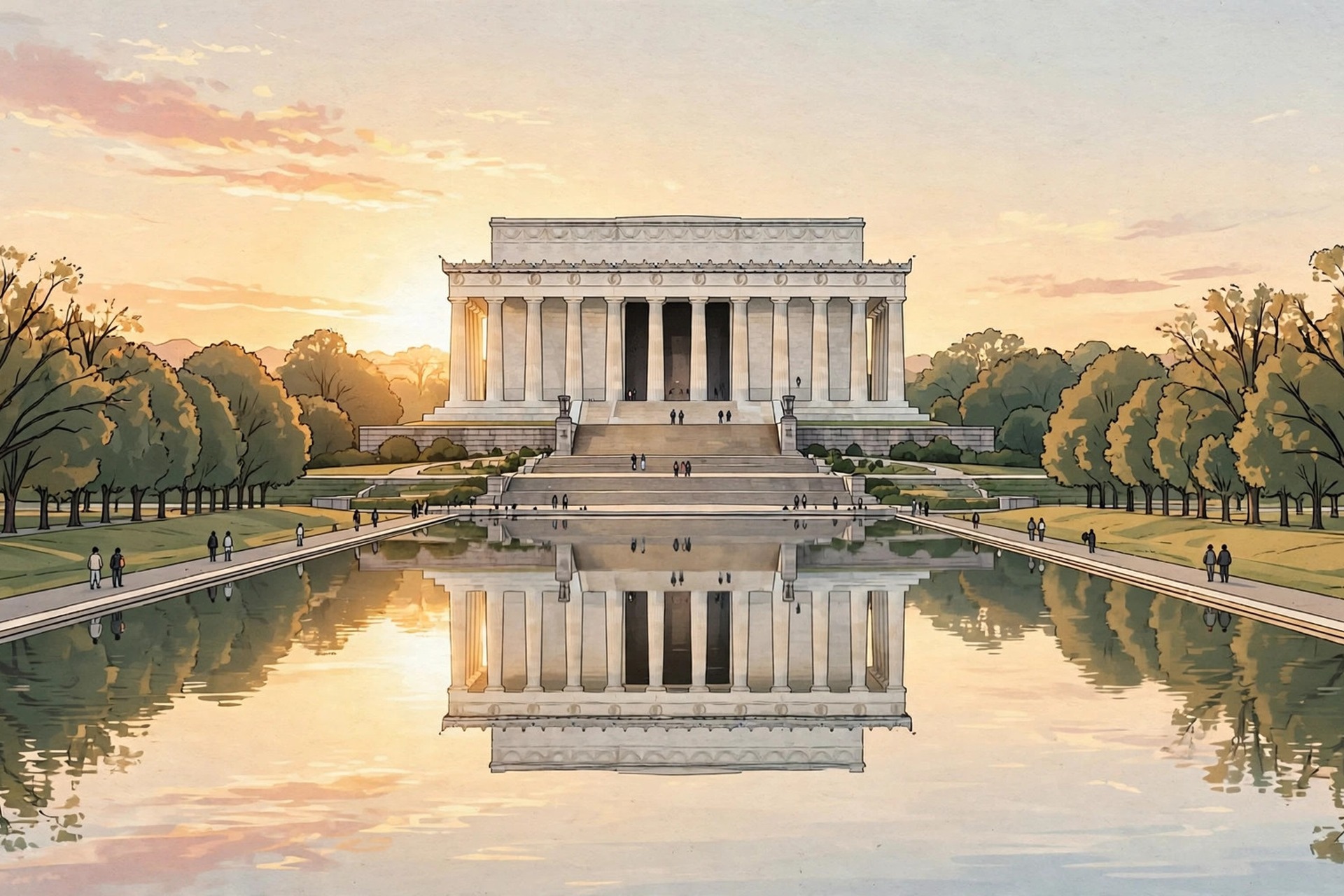
President Donald Trump is scheduled to deliver his closing midterm message on Monday afternoon, November 2, at the Lincoln Memorial Reflecting Pool in Washington, D.C., choosing one of the National Mall’s most recognisable landmarks as the backdrop for his final appeal to voters on the eve of Election Day. The White House formally announced the speech on Sunday, hours after Trump first signalled the plan to reporters, and the event is expected to serve as his closing argument for keeping Republican control of Congress.
This article is written before that speech is delivered, and it does not report its contents. What follows is what is known about the announcement, the unusual choice of venue, the history of the pool’s troubled renovation, and the themes Trump is expected to emphasise, based on his recent campaign remarks and the White House’s description of the event as a closing message before the midterms. Any account of what Trump actually said on Monday afternoon will need to be reported separately, after the event.
The choice breaks with the usual final-day playbook for a president campaigning in a midterm election. Traditionally, the last day is spent travelling to battleground states, holding large rallies, and urging supporters in closely contested districts to turn out. Trump, by contrast, is staying in Washington on Monday, after a month-long run of more than 25 rallies in largely conservative areas. His final campaign stops on Sunday were in Iowa and then Kansas, the latter of which he described on social media as his last stop.
A closing message from Washington, not the battlegrounds
Trump signalled the Reflecting Pool plan as he stepped off Air Force One for a Sunday rally in Iowa. Asked about the site, he said speaking there would show how beautiful it is, adding that the event might be held the following day or something along those lines, without giving specifics at that moment. Hours later, the White House confirmed the Monday afternoon speech, giving the closing event a formal time and place.
The decision to close in Washington, a city that votes overwhelmingly Democratic, rather than in a swing state, has drawn attention precisely because it is so unusual. Campaign strategists typically prize the final day for direct contact with voters in places where a few thousand votes could decide a House or Senate race. A speech from the National Mall, broadcast nationally, reaches a wider audience but does not put the president in a room with undecided voters in Pennsylvania, Georgia, Michigan or any other battleground.
Trump’s campaign team may be betting that the symbolism of the venue outweighs that drawback. The Lincoln Memorial, with its long reflecting pool stretching towards the Washington Monument, is one of the most photographed settings in American civic life, associated with presidential addresses, civil rights history and national ceremonies. A closing message delivered there is designed to look presidential rather than purely partisan, and to frame the midterm choice as a question about the direction of the country rather than about individual races.
It is also, whether intended or not, a showcase for one of Trump’s own Washington projects. The president has spoken repeatedly about reshaping the capital in his own image during his second term, from White House renovations to National Mall landmarks. The Reflecting Pool is the most visible of those projects to have run into public trouble, and choosing it as the closing backdrop puts that project, with all its history, back in the spotlight on the eve of the vote.
Trump’s closing midterm pitch: what he is expected to say
Based on the White House’s billing of the event as a closing message before the midterms, and on Trump’s recent rally remarks, the speech is expected to highlight his administration’s record in its second term, make a final appeal to Republican voters to turn out on Tuesday, and argue that keeping Republican majorities in Congress is necessary to continue that record. Administration officials have also described the event as touching on efforts in Washington itself, including what the White House has called restoring the capital.
In recent weeks, Trump has used his rallies to argue that Democrats would block his agenda, raise costs and investigate his administration if they win control of Congress, while Republicans would continue policies on immigration, tariffs, energy and public safety that he says have strengthened the country. He has also pointed to cost-of-living issues, arguing that his policies are addressing prices even as polls show many voters remain frustrated by grocery, housing and energy costs.
Those themes are likely to feature again on Monday, but the precise wording, any new announcements, and any response to the latest polling or to the record early-voting totals will only be known once the speech is delivered. Readers should be cautious about any summary that claims to quote the Monday speech before it has taken place; as of the writing of this article, the speech is scheduled, not yet given.
The expected audience is also worth noting. A Monday afternoon speech in Washington will be carried live by cable news and streamed online, reaching voters across the country who are deciding whether to vote on Tuesday or who have already voted early. For the more than 53 million Americans who have already cast early ballots, the speech is a closing argument they will hear after voting; for Election Day voters, it is one of the last major appeals they will hear before polls open.
The pool that was supposed to be quick and cheap
The Reflecting Pool saga began in April, when Trump said he wanted to change the pool’s colour and would use contractors he knew to fix the monument in mere days, for about 1.5 million dollars, before Independence Day. The pool, a shallow rectangular basin about 2,000 feet long between the Lincoln Memorial and the Washington Monument, had long suffered from leaks and maintenance problems, and Trump presented the fix as a straightforward, fast and inexpensive job.
That timetable and budget did not hold. The repairs wrapped up nearly three months behind schedule, and the cost ballooned to more than 10 times the early estimate, reaching about 15 million dollars according to one report. Trump initially declared the work complete in June, but problems emerged soon after the overhaul was unveiled.
Algae blooms choked the water, and the pool’s American-flag blue liner began peeling off in sections. The pool was drained again in mid-July for repairs, and it has been drained several times since as officials tried to address water quality, circulation and lining problems. Photographs from August and September showed construction continuing around the pool, with workers and machinery on site months after the work was supposed to be finished.
The National Park Service, which manages the National Mall, extended the closure of the Reflecting Pool and adjacent areas until November 20 at one point, citing ongoing restoration work involving heavy machinery, repairs to the water-circulation system and water-quality testing. That extension underscored how far the project had moved from a days-long fix to a months-long restoration.
Vandals or shoddy work? Two explanations
Trump has blamed vandals for the pool’s problems, describing what he has called bad legal vandalism and arguing that deliberate damage, not the renovation itself, caused the setbacks. He has also said security cameras have since been added to stop vandalism, and that the pool now works well after repairs.
A different explanation has come from the District of Columbia’s top federal prosecutor. Jeanine Pirro, the United States Attorney for the District of Columbia and a longtime Trump ally and former television host, attributed the problems to shoddy workmanship rather than sabotage. That assessment, coming from within the administration’s own law-enforcement leadership in Washington, has complicated the vandalism account.
The Justice Department also dropped charges against an initial suspect in the alleged vandalism, saying there was insufficient evidence to support allegations of sabotage. That decision did not settle the broader question of what went wrong with the renovation — whether materials, installation, water chemistry, or a combination of factors caused the liner to peel and algae to bloom — but it removed the one criminal case that had been presented as evidence of deliberate damage.
For critics, the pool has become a shorthand for a broader argument about the administration’s approach to large projects: ambitious promises, fast timelines, rising costs and disputed accountability when problems arise. For supporters, it is a landmark that, after setbacks, has been restored and is now being showcased as beautiful. Both readings will be present in how Monday’s speech is received, because the venue itself will be visible in every photograph and video clip of the event.
Why the venue choice matters politically
Presidents have long used symbolic settings for major speeches, and the Lincoln Memorial carries particular weight. It is the site of Abraham Lincoln’s memorial, of Martin Luther King Jr.’s 1963 address, and of countless national ceremonies. Speaking there invites comparison with those moments, and it frames the speaker as addressing the nation rather than a rally crowd.
That framing cuts both ways in a midterm campaign. A national, presidential address can elevate a closing argument above day-to-day campaign disputes. It can also look detached from the local races that actually decide control of Congress, especially when the president has spent the previous month holding rallies in conservative areas and is now closing in a city where his party has little electoral support.
Democrats are likely to use the venue’s troubled renovation history to make their own closing argument: that the administration promises quick, cheap fixes and delivers slow, expensive ones. Republicans are likely to counter that the pool is now restored, that it looks beautiful, and that the president is right to showcase a Washington landmark he helped to repair. Voters watching on Monday will hear both arguments, directly and indirectly, in the coverage that follows the speech.
The timing also matters. Monday afternoon is the last full day of campaigning before polls open on Tuesday. A speech at that hour dominates the evening news cycle and sets the tone for Election Day coverage, but it leaves little time for the campaign to adjust if the speech lands badly. It is, in that sense, a confident closing move: a single, high-profile event rather than a final swing through battlegrounds.
The wider campaign context
Trump’s closing pitch comes after a campaign in which his party has tried to overcome low approval ratings and polls predicting a strong night for Democrats, driven in part by the Iran war, high energy prices and cost-of-living increases. National polling in the final days put Democrats ahead in the generic congressional ballot, and Democrats need only a small net gain to take the House, although the Senate remains harder for them to flip.
The president’s rally tour over the past month was designed to energise his base, particularly in states and districts where his support is strongest, in the hope that high base turnout could offset Democratic enthusiasm. The decision to end that tour on Sunday in Kansas, and to close on Monday in Washington, suggests the campaign believes the base has been mobilised and that the final message should be national rather than local.
That strategy will be judged on Tuesday night, when results begin to arrive. If Republicans hold Congress, the Reflecting Pool speech will be remembered as a distinctive and effective closing choice. If Democrats win one or both chambers, critics will ask whether a final day spent in Washington, rather than in a battleground, was a missed opportunity. Either way, the speech itself, once delivered, will be the record against which those judgments are made — not the announcement that preceded it.
USN has followed the closing days of the campaign, including the exchanges between Trump and former President Barack Obama on the trail, in Trump and Obama trade blows on the trail five days before the midterms. Monday’s Reflecting Pool address is the final chapter of that closing stretch, and its contents, when delivered, will complete the picture this article can only preview.
Sources
USN reviewed reporting from multiple outlets for this story. Read more from The Week, Firstpost and Business Upturn.