

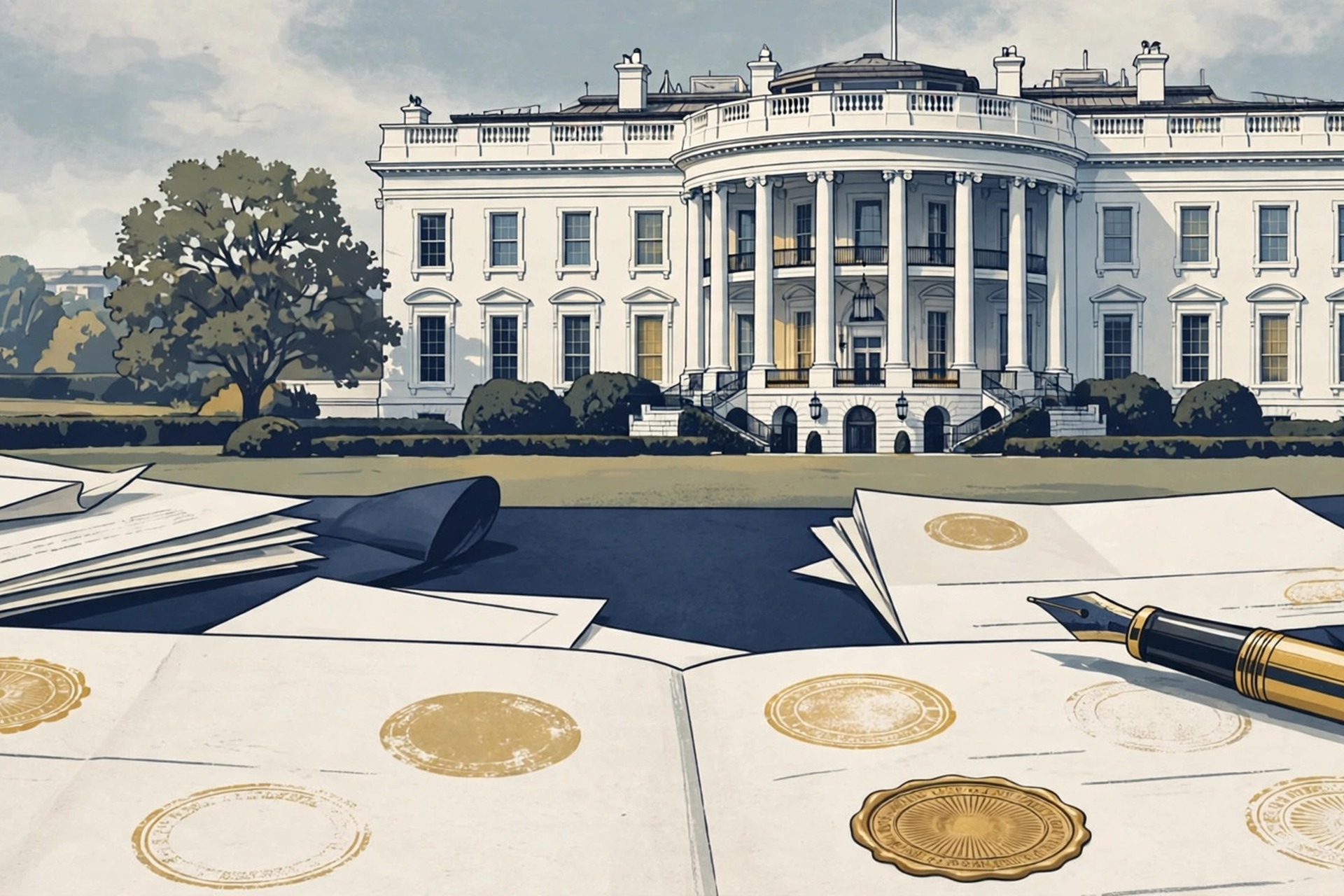
The White House has spent months preparing to govern by executive authority if Democrats capture Congress in Tuesday’s midterm elections, developing plans to advance major parts of President Donald Trump’s agenda without new legislation while bracing for investigations that a Democratic majority could launch. The preparations, reported by Reuters and reproduced in outlets on November 2, began in April and involve senior officials mapping which policies can be pursued through presidential power alone, where the legal limits lie, and how those decisions could be defended in court.
The story is one of preparation, not announcement. No new executive orders have been issued under this plan, and none of the specific measures under consideration — including possible new tariffs, tighter visa rules and steps to cut housing costs — has been decided. They are, according to officials familiar with the planning who spoke on condition of anonymity, actions under consideration for a scenario that has not yet happened: a Democratic takeover of one or both chambers of Congress on November 3. Keeping that distinction clear matters, because the difference between preparing an option and choosing it is the difference between a contingency plan and a policy.
At the centre of the planning are Deputy Chief of Staff Stephen Miller and Budget Director Russell Vought, working with the White House Counsel’s Office led by White House Counsel Will Scharf. Their task, as described by a White House official and two people familiar with the plans, has been to identify executive actions on immigration, tariffs, housing costs and federal spending that Trump could pursue without congressional approval, and to examine what the president can legally do on his own, where he could push the limits of his authority, and how to defend those decisions if they are challenged.
Why the White House is planning for a Democratic Congress
Democrats need a net gain of four seats in both the House of Representatives and the Senate to erase the current Republican majorities of 218-214 in the House and 53-47 in the Senate. Opinion polls in the final days of the campaign favoured Democrats to win the House, while the Senate remained too close to call. That polling picture does not guarantee a Democratic victory in either chamber, but it is enough to make contingency planning a prudent step for any administration facing a midterm election.
Capturing Congress would give Democrats significant new powers even without a veto-proof majority. They could block legislation, constrain spending priorities, and launch investigations into the administration through committee hearings, subpoenas and document demands. Senior House Democrats and committee aides have already discussed using those tools, according to earlier Reuters reporting, and the White House planning explicitly anticipates that oversight challenge.
At the same time, a Democratic Congress would not, on its own, strip the president of the broad executive authority he already holds over trade, foreign policy and the federal bureaucracy. Trump has used that authority aggressively during his second term, and the planning described in the Reuters report is, in effect, an effort to systematise that approach for a period in which legislation becomes harder to pass. The paradox of the midterms, as the report frames it, is that a Democratic victory would both constrain the president legislatively and leave his executive powers largely intact.
Trump himself acknowledged that dynamic in a New York Post podcast clip aired on Sunday on Fox News, in which he said he may have to become, in his words, Mr. Veto or Veto Man if Democrats win. The remark is a shorthand for a presidency that would rely more heavily on blocking Democratic legislation than on signing its own bills, while pursuing its agenda through orders, regulations and executive actions that do not require Congress.
Who is mapping the executive path
Miller, Vought and Scharf bring different strengths to the planning, and their roles reflect the three questions any executive-action strategy must answer: what policy to pursue, how to pay for it, and whether it will survive in court.
Miller, as deputy chief of staff, has been a central architect of the administration’s immigration and domestic policy approach, and his involvement signals that immigration will be a major focus of any post-midterm executive agenda. Vought, whose Office of Management and Budget oversees federal spending, is examining which priorities can move forward using money already appropriated by Congress, a crucial constraint because a Democratic Congress could refuse to fund new initiatives. Scharf and his team are examining the legal boundaries of presidential authority, including where the administration could push those limits and how to prepare defences for the lawsuits that would almost certainly follow.
Federal agencies have also submitted proposals and legal reviews of actions the administration could take unilaterally, according to one person familiar with the plans. That agency-level work suggests the planning is not confined to a small White House circle, but has involved departments thinking through what they could do within existing statutes, regulations and appropriations if Congress changes hands.
Vought is also reported to be considering changes to federal grant rules that would give political appointees greater influence over the allocation of taxpayer money. That element, if pursued, would be among the most contested parts of any executive strategy, because grant decisions affect states, local governments, universities and non-profit organisations across the country, and changes to how grants are awarded are likely to draw both political opposition and legal challenges.
Executive actions under consideration if Democrats win Congress
Among the executive actions under consideration are new tariffs on imports of critical minerals and wind turbines, tighter rules on visas for international students and temporary foreign workers, and measures aimed at lowering housing and construction costs. Each of these areas touches a major policy debate, and each illustrates a different use of executive power.
Tariffs are the area where presidential authority is broadest, although it is also the area where courts and Congress have pushed back most sharply in recent years. The president can impose tariffs under several statutes, including those dealing with national security and trade emergencies, but the scope of those statutes and the procedures for using them have been litigated extensively. New tariffs on critical minerals — materials used in batteries, electronics and defence equipment — would be framed as a matter of supply-chain security and domestic production, while tariffs on wind turbines would intersect with the administration’s scepticism about wind energy and its support for other energy sources.
Visa rules for international students and temporary foreign workers are another area where executive action can have immediate effects without legislation. The administration can adjust visa processing, eligibility criteria and enforcement priorities through regulations and guidance, although major changes are subject to notice-and-comment rulemaking and can be challenged in court. Tighter rules in this area would affect universities that rely on international students, employers that hire temporary foreign workers, and the workers and students themselves, many of whom are already in the United States or have plans to come.
Housing and construction costs are a different kind of target. Here, executive action is more indirect: the administration could adjust federal housing programmes, streamline permitting for federally involved projects, or use existing housing funds in new ways. Measures in this area would be aimed at a cost-of-living concern that has dominated the midterm campaign, and they would be presented as a way to lower costs even without a housing bill from Congress. Their actual impact would depend on how much of housing costs are driven by federal policy as opposed to local zoning, labour costs and interest rates, factors the White House cannot control by order alone.
None of these measures should be reported as decided policy. They are options that officials have identified as legally plausible and politically attractive in a divided-government scenario. Which, if any, are actually pursued will depend on the election outcome, on legal advice at the time, and on the president’s own priorities after Tuesday.
The limits of governing by executive order
Executive action has real limits, and the White House planning appears to recognise them. An executive order cannot appropriate money Congress has not provided, although it can direct how already-appropriated money is spent within legal bounds. It cannot create a new criminal offence, levy a tax in the ordinary sense, or override a statute. And it can be reversed by a future president, challenged in court, and, in some cases, overturned by Congress if a veto-proof majority can be assembled — a majority neither party is expected to hold after Tuesday.
The court challenge risk is particularly important. The administration has already faced lawsuits over executive actions during its second term, and any new tariffs, visa rules or grant changes would likely be challenged quickly by affected industries, states, universities or advocacy groups. Scharf’s team is therefore not just asking what the president can do, but how to write orders and regulations that are more likely to survive judicial review, including by grounding them in specific statutory authority and by building an administrative record that courts will accept.
There is also a political limit. Governing by executive action can be presented as decisive leadership, but it can also be presented by opponents as bypassing Congress and the voters who elected it. Democrats, if they win, will argue that executive actions that circumvent a newly elected majority lack democratic legitimacy, even if they are legally defensible. Republicans will argue that the president was elected nationally and has a mandate to act, even when Congress is divided. That argument will play out in public debate as well as in court.
Investigations are the one challenge executive action cannot sidestep. A Democratic House or Senate could compel testimony, demand documents and hold public hearings into the administration’s decisions, including its executive actions themselves. The White House planning, according to the reporting, anticipates that reality rather than assuming it away, and part of the preparation is likely to involve how to respond to oversight demands while protecting executive privilege claims where the administration believes they apply.
The trade debate and the veto
A related Reuters report on the trade consequences of a Democratic win underlines the veto dynamic. If Democrats win at least one chamber, they could stage symbolic votes on long-sidelined trade bills, such as Senator Chuck Schumer’s End Trump’s Tariff Tax Act, which would scrap the statute backing punitive tariffs on Canadian goods and the statute used for temporary global tariffs. Senator Ron Wyden, the top Democrat on the Senate Finance Committee, has said repealing tariffs on Canada would be an early priority.
Those votes, however, would run into the reality of Trump’s veto power. Neither party is expected to hold a veto-proof two-thirds majority in either chamber after Tuesday, which means Democratic tariff-rollback legislation could pass Congress but still be vetoed, and the veto could only be overridden with Republican support that is unlikely to materialise in sufficient numbers. Trade experts quoted in the report expect the debate to shift — with more oversight hearings, more scrutiny of tariff exemption processes, and more attention to how tariff revenues and investment pledges are handled — but not to produce a rollback of the tariff regime itself.
That assessment reinforces the White House’s executive-action logic. If Congress cannot override a veto, and the president can act on trade through executive authority, then trade policy will remain largely presidential even under a Democratic Congress. The same logic applies, with variations, to immigration enforcement, federal spending priorities and regulatory policy: the president’s tools do not disappear when Congress changes hands, even if his legislative tools do.
What happens after Tuesday
The immediate question after Tuesday will be the scale of any Democratic victory. Winning the House alone would give Democrats investigative and blocking power, but not control of the Senate’s confirmation and treaty functions. Winning both chambers would give them broader leverage, but still not a veto-proof majority. Losing both would leave the current unified Republican control intact, making the executive-action contingency plan less necessary, although some of the actions under consideration could still be pursued as part of the normal second-term agenda.
USN has followed the Senate battlegrounds that will decide that outcome, including in Democrats open leads in four Senate battlegrounds as the fight for Congress tightens (https://usnbreaking.com/democrats-open-leads-in-four-senate-battlegrounds-as-the-fight-for-congress-tightens/). Those races, along with House contests in competitive districts, will determine whether the White House plan described here becomes the governing strategy for the next two years or remains a contingency that was never fully activated.
The White House has publicly pushed back against suggestions that Republicans are heading towards defeat. Spokeswoman Lauren Bis said the administration would continue implementing Trump’s priorities and delivering on its promises to Americans, regardless of the election outcome. That statement is consistent with the contingency planning itself: an administration that is confident of winning can still prepare for losing, and preparation should not be mistaken for concession.
For voters, the practical takeaway is that Tuesday’s result will shape how, not just whether, the president’s agenda advances. A Republican Congress would allow that agenda to proceed through legislation. A Democratic Congress would push it towards executive orders, regulations, vetoes and court battles — a different kind of governing, with different speeds, different legal risks and different opportunities for public debate. The White House, by its own account through officials familiar with its planning, has been preparing for that second path since April. Whether it needs to use it will be known after the votes are counted.
Sources
USN reviewed reporting from multiple outlets for this story. Read more from Reuters (https://www.reuters.com/legal/government/trump-white-house-maps-path-govern-without-congress-if-democrats-win-2026-11-01/), IBC World News (https://www.ibcworldnews.com/news/white-house-prepares-for-possible-democratic-takeover) and UNN (https://unn.ua/en/news/trump-is-preparing-a-plan-to-bypass-congress-in-case-of-a-democratic-victory-in-the-elections-reuters).