

A Final Speech in Washington, Framed by History
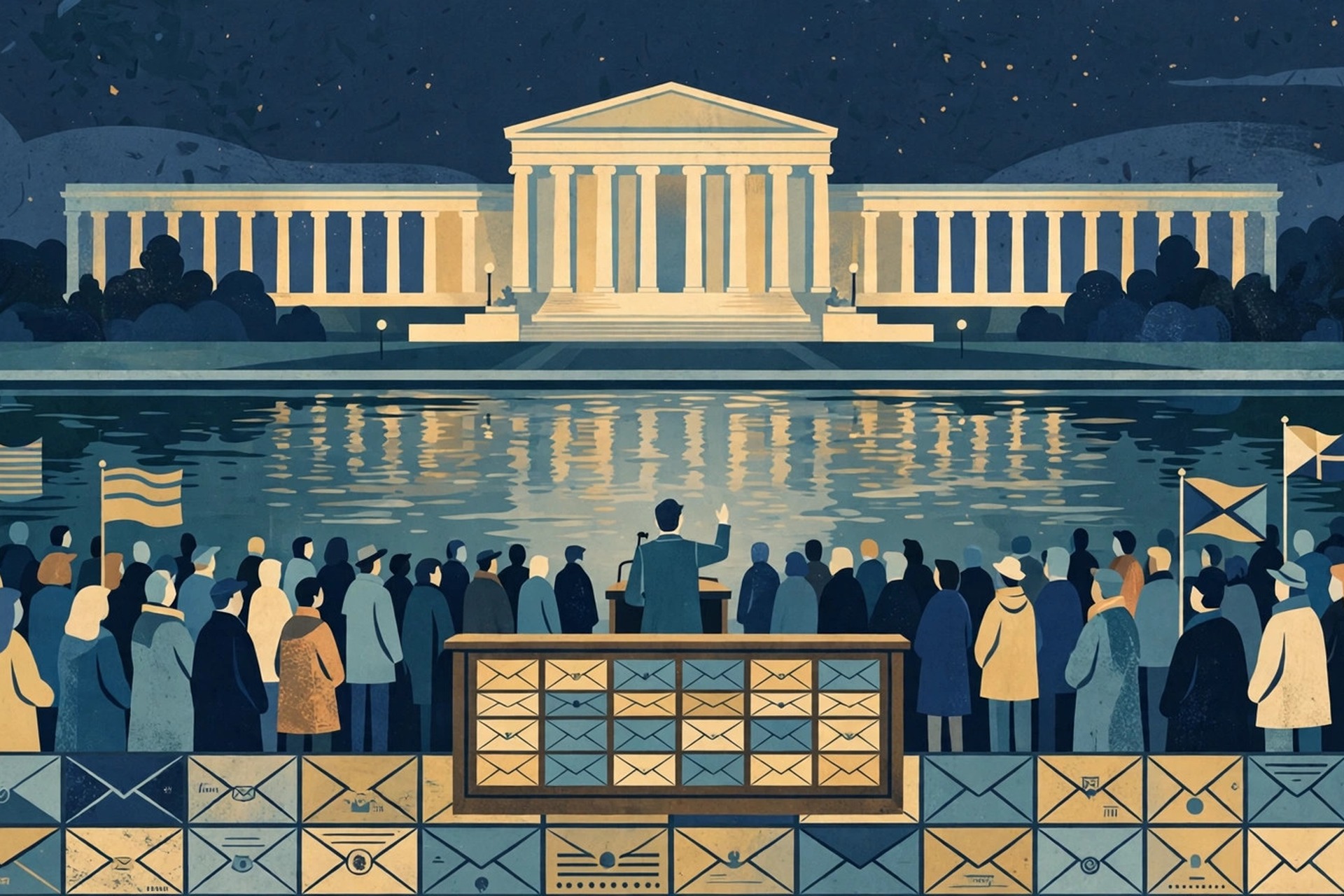
President Donald Trump delivered his final major campaign speech before the midterm elections on Monday in Washington, at the Lincoln Memorial Reflecting Pool, and he opened the political part of his argument with a concession that was striking for a closing message.He said, in words reported widely from the speech, that for some reason the sitting president does not win the midterms, but that his party had given the contest a very strong shot. The line was not presented as a prediction of defeat, and it was not presented as a surrender. It was presented as an acknowledgement of a historical pattern that has shaped almost every midterm election in modern American politics: the party that holds the White House usually loses ground when voters return to the polls two years after a presidential election.
The speech itself, which lasted close to an hour in most accounts, spent a large amount of time on subjects other than the election. Trump spoke at length about the restoration of the Reflecting Pool, including its pipes, joints, caulking, granite resurfacing, algae and leaks, and about wider plans for Washington, including a proposed triumphal arch, a promenade along the Potomac River, and a National Garden of American Heroes featuring hundreds of statues. He did not turn to the midterms explicitly until about twenty-three minutes into the address, when he called them the most important midterm, in his view, in the lifetime of those listening. That structure, part civic tour and part campaign closing argument, became a talking point in its own right in coverage of the speech, with supporters seeing a president showing tangible work in the capital and critics seeing a missed opportunity to address the economic concerns that polls suggested were driving many voters.
Trump also used the speech to urge Republicans to keep Congress strong and free, and to warn, in sharp language, that Democrats would undo his achievements if they gained control. In other closing appearances, including rallies held over thirty-two days across twenty states, he had described Democrats in far harsher terms, calling them communists and jihadists and members of the Muslim Brotherhood, and arguing that they would ruin what he had built. Those descriptions are his own characterisations, disputed by Democrats, and they formed part of a closing strategy that sought to make the election a choice about his presidency and about the direction of the country, rather than a referendum on any single policy. Whether that strategy worked is not something that can be known from a speech. It can only be judged once votes are counted, and at the time of writing no winner had been declared in any race.
Trump Final Midterm Speech and the Record Early Vote
The scale of voting already completed before Election Day gave the final speech a particular context. By Monday afternoon, more than fifty-seven million ballots had already been cast in forty-seven states and Washington, DC, through early in-person voting and mail ballots, according to tracking cited in coverage. That figure was higher than the early vote total at a comparable point in 2022, when fewer than forty-four point five million ballots had been cast early in forty-nine states and the District of Columbia. The increase does not, on its own, favour either party, and analysts cautioned against reading a partisan advantage into the total alone. Tracking of early voters who were registered by party, cited by NBC News, put Democrats at about forty-six percent and Republicans at about thirty-nine percent of that group, but party registration is not the same as a vote cast, and many early voters are not registered by party at all.
All four hundred and thirty-five seats in the House of Representatives were on the ballot on Tuesday, along with thirty-five of the one hundred seats in the Senate and governorships in thirty-six states. Democrats needed only a net gain of three seats in the House to take control of that chamber, given the balance going into the election, in which Republicans held two hundred and eighteen seats, Democrats held two hundred and fourteen, one independent sat with Republicans, and two seats were vacant. In the Senate, where Republicans held a fifty-three to forty-seven majority, Democrats needed a net gain of four seats to take control. Those arithmetic facts explain why forecasters could describe the House as leaning strongly toward Democrats while describing the Senate as much more competitive, even though both chambers were being contested on the same day.
A Reuters/Ipsos poll completed on Monday found forty-six percent of registered voters saying they would vote for Democrats in congressional elections, compared with thirty-eight percent for Republicans. That eight-point gap on the generic ballot, which asks voters which party they would support without naming individual candidates, is a useful indicator of the national mood, but it is not a forecast of seats, and it is not a result. Seat outcomes depend on individual districts and states, on turnout in specific places, and on candidates and local issues that a national poll cannot capture. Trump’s approval rating in the same polling series stood at about thirty-two percent, near a career low in that series, according to coverage, and that figure, like the generic ballot, describes the mood before voting rather than the outcome after counting.
Forecasts Are Not Results: What the Models Said Before Polls Closed
Before polls closed, several forecasting models pointed in the same general direction, but with different degrees of confidence, and this article reports them only as forecasts. Decision Desk HQ, in its final pre-election forecast, projected two hundred and forty-one House seats for Democrats against one hundred and ninety-four for Republicans, and a narrower fifty-two to forty-eight Democratic majority in the Senate. The same forecaster put the Democratic chance of winning the House at about eighty-four percent and the chance of winning the Senate at about sixty-four percent, based on simulations run on 2 November. Those numbers were widely cited in final-day coverage, and they are important precisely because they are probabilities and projections, not declarations. A model that gives a party an eighty-four percent chance is also, by its own logic, allowing a sixteen percent chance of the opposite outcome.
Other models reached broadly similar conclusions with different seat counts, which is itself a useful reminder of uncertainty. One model cited in coverage pointed to a Democratic House majority of about two hundred and thirty seats and eighteen of the thirty-five contested Senate seats, which, combined with seats not up for election, would also produce a narrow Democratic Senate majority. Another model gave Democrats a ninety-two percent chance of winning the House and a seventy-six percent chance of winning the Senate, with a median projection of about two hundred and thirty-seven House seats. The differences between those models reflect different methods, different weights given to polls and fundamentals, and different treatment of uncertainty. None of them should be quoted on election night as if they were results, and none of them can account for late shifts in turnout, for counting delays in close races, or for the possibility that polls have systematically misjudged support in either direction, a risk that forecasters themselves acknowledged.
The closing messages of the two parties reflected the different positions they believed they were in. Democrats, in their final push, focused heavily on voters’ economic frustrations, including the cost of living, tariff-related pressures, and the effect of the Iran conflict on fuel prices, while working through internal divisions to keep that message consistent. Republicans, by contrast, cast their opponents as dangerous radicals who would block Trump’s agenda and launch investigations if they gained power. Trump himself, in a podcast appearance, raised the prospect of becoming, in his phrase, Mr Veto if Republicans lost both chambers, a remark that framed a possible Democratic Congress not as the end of his presidency but as a shift to a more confrontational relationship with the legislature. That framing, like the sitting-president line in his final speech, suggested a White House preparing publicly for either outcome while still campaigning for the outcome it preferred.
What Voters Were Deciding, and What Happens Next
The midterm elections are often described as a referendum on the sitting president, and in 2026 that description carried particular weight because the second term had been marked by sweeping changes in trade, immigration, energy and foreign policy, and by a war with Iran that had lasted about eight months by Election Day. Voters were not voting directly on Trump himself, whose name was not on the ballot, but they were voting on the Congress that would either advance or constrain his agenda for the remaining two years of his term. A Republican Congress would allow him to continue pursuing legislation with fewer obstacles, although Senate rules would still require broad support for most bills. A Democratic House, or a Democratic Congress, would give his opponents control of committees, subpoena power, and the ability to block legislation, to investigate the administration, and to shape the agenda for the next presidential election.
That institutional consequence is why the final speech mattered beyond its immediate audience. Control of the House decides who chairs committees, who sets the legislative calendar, and who controls the purse for the rest of the term. Control of the Senate decides who confirms judges and senior officials, and who can block or advance nominations and treaties. Governorships, also on the ballot in thirty-six states, decide who implements policy at state level and who oversees election administration in many states. The midterm elections therefore shape far more than the balance of power in Washington in the abstract. They shape which policies can become law, which investigations can proceed, and which appointments can be confirmed, in ways that will be felt long after the campaign speeches are forgotten.
As polls closed on Tuesday, the honest position for any news organisation was to say that the outcome was not yet known, and that early counts would be preliminary, with close races potentially taking days or weeks to resolve. That caution is not a hedge for its own sake. It reflects the reality of American elections, in which mail ballots, provisional ballots and recount rules vary by state, and in which a lead on election night can change as more ballots are counted. Trump’s final speech, with its acknowledgement of history and its claim of a strong effort, will be read differently depending on the result, as a candid admission, as a pre-emptive explanation, or as an understatement of a stronger performance than expected. Until the counting is complete, all three readings remain possible, and the only verdict that matters is the one voters have already begun to deliver, ballot by ballot.
Sources
USN reviewed reporting from multiple outlets for this story. Read more from Business Today (https://www.businesstoday.in/world/us/story/gave-this-a-very-strong-shot-donald-trump-says-sitting-president-doesnt-win-midterms-in-final-campaign-speech-565275-2026-11-03), The Reflector (https://www.reflector.com/news/national/reflecting-pool-vs-the-state-of-the-economy-trump-and-dems-clash-in-closing-messages/article_a1c4f197-0573-57ae-a12c-bf4aec9e5912.html) and Vanguard (https://www.vanguardngr.com/2026/11/democrats-trump-hold-final-rallies-before-midterm-elections/).