

What Officials Say Happened Near Qeshm Island
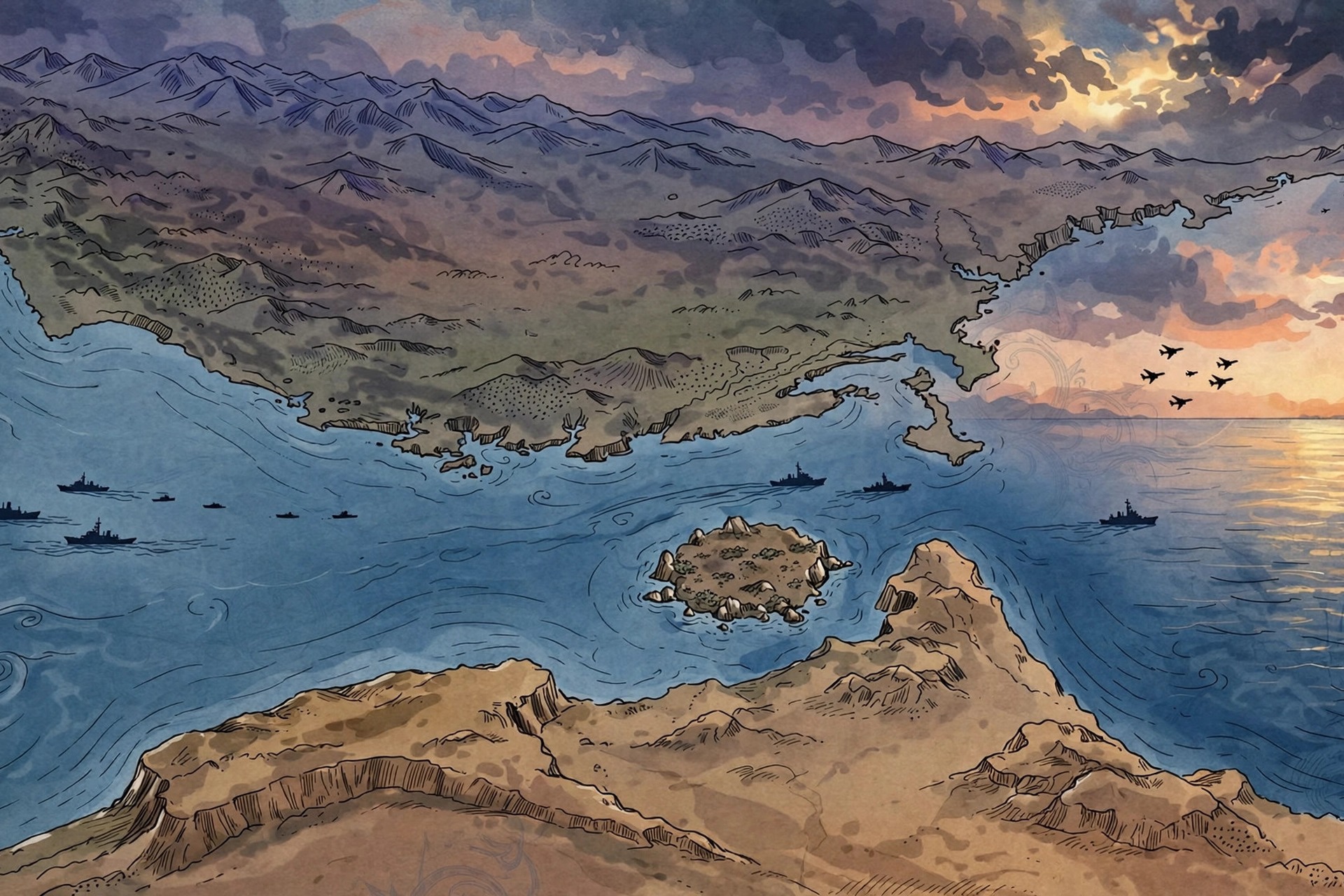
The United States carried out a limited set of strikes against targets on and around Qeshm Island on Monday, according to accounts attributed to American officials in reporting published late on Monday and early on Tuesday. The island sits at a sensitive point in the geography of the Persian Gulf, close to the Iranian mainland port of Bandar Abbas and beside the narrow waterway that connects the Gulf to the wider ocean. Because that waterway carries a very large share of the world’s seaborne oil and liquefied natural gas, any military action near it is watched closely by shipping companies, energy markets and governments far beyond the region, even when officials describe the action as narrow in scope.
Reporting of the strikes first pointed to The Wall Street Journal, which cited unnamed American officials, and was then followed by confirmation in broad terms from another American official who spoke to The Associated Press on condition of anonymity. That official described the targets as Iranians who were using surface-to-air missiles against American assets. A separate account, attributed to officials speaking to Fox News, described the action as a response to Iranian fire directed at an American aircraft. Those two descriptions are not identical in detail, and neither account, on its own, provides a complete public record of what was hit, what weapons were used, or what damage resulted. The Pentagon, when asked, referred questions to United States Central Command, which oversees American forces in the Middle East, and Central Command did not immediately provide a public comment in the reporting available at the time of writing.
Iranian state media reported a different, and in some respects more vivid, part of the picture from the ground. The state news agency IRNA reported that several explosions were heard in rapid succession on Qeshm Island on Monday evening, and that some residents reported seeing aircraft in the sky above the island. The semi-official Fars news agency later reported explosions in Bandar Lengeh, a port city west of the island and also near the Strait of Hormuz, and said the blasts appeared to have come from the sea, although their cause was not established in that report. Taken together, the Iranian reports confirm that something unusual was heard and seen in the area, but they do not by themselves confirm the American account of the targets or the purpose of the strikes, and independent verification of damage on the ground was not available in the early reporting.
US Strikes in the Strait of Hormuz Described as Defensive
American officials who spoke about the operation used a particular word repeatedly, and that word matters for how the action is understood. They described the strikes as defensive. In the explanation offered in the reporting, the purpose was to stop Iranian forces from being able to threaten commercial shipping in the Strait of Hormuz, and specifically to degrade the ability of people using surface-to-air missiles to endanger American assets operating in or near the waterway. That framing presents the strikes not as the opening of a new large campaign, but as a protective measure tied to a specific threat that officials said had been identified in the area.
The distinction between a limited defensive action and a return to full-scale hostilities is central to the early coverage, and officials were careful, in the accounts attributed to them, to draw that line. The strikes were described as limited, and as the latest in a series of smaller strikes that Washington has carried out quietly in recent weeks, with the previous publicly known actions of that kind dating to early September. By keeping the operations out of public view, according to one official quoted in the reporting, Washington was seeking to avoid signalling an intention to resume major combat operations. That explanation, if accurate, suggests a deliberate effort to manage escalation: to act against a perceived immediate threat while avoiding a public posture that could be read as a decision to restart a wider war.
The context of that waterway helps explain why even a limited action carries outsized attention. The Strait of Hormuz is one of the world’s most important energy chokepoints. Before the current conflict, which began in late February and has now lasted about eight months, roughly a fifth of global crude oil and natural gas supplies moved through it. Since the fighting began, traffic through the strait has been sharply reduced, and the resulting disruption has fed into higher energy prices and into political debate in the United States about the cost of living. Any report of strikes near the strait therefore moves markets quickly, as it did in early trading on Tuesday, when oil prices rose after the Qeshm reports, even though they had fallen sharply the previous day on hopes of a diplomatic settlement.
What Remains Unconfirmed and Why Caution Matters
Several important questions remain unanswered in the public record, and readers should treat early claims on both sides with care. No official American statement with a detailed account of the targets, the number of strikes, or any assessment of casualties or damage had been published in the reporting reviewed for this article. On the Iranian side, a claim carried by media linked to the Revolutionary Guards that Iranian forces had downed and captured an American drone near Qeshm was dismissed as false by Central Command in the reporting, and the claim could not be independently verified. That pattern, in which each side offers an account that the other disputes, is common in the first hours after a reported strike, and it is one reason this article attributes claims rather than presenting contested assertions as established fact.
The timing also raises a question that officials have not fully answered in public. President Donald Trump had previously said the United States would not launch new strikes on Iran before the midterm elections, and the Qeshm strikes were reported on the eve of voting on Tuesday, 3 November. Reporting noted that apparent tension without resolving it: the strikes were described as defensive and limited, which, in the officials’ framing, would place them in a different category from the kind of renewed offensive campaign Trump had discussed for after the elections. Whether that distinction will satisfy critics, or whether it will be challenged in Congress and in public debate once more details emerge, is a question for the days ahead rather than something that can be settled from the first reports alone.
Energy markets illustrate how quickly the same story can pull in opposite directions. On Monday, oil prices fell by more than seven percent, with Brent crude settling down by about seven point six percent, on optimism that a diplomatic settlement might be near. In early trading on Tuesday, prices rose again, by about half a percent, after the Qeshm strike report, on concern about escalation and prolonged disruption to Middle East supplies. Neither movement, on its own, tells the full story of the conflict. Together they show a market, and a public, reacting first to hope of a deal and then to evidence that military action has not stopped, even as talks continue.
Eve of the Midterms: Strikes, Talks and an Unfinished War
The strikes arrived at a moment when two very different narratives about Iran were competing in Washington. On one side, Trump said on Monday that a deal with Tehran could happen, and that Iran wanted a settlement as soon as possible. He linked falling oil prices to a sense that war would be avoided. On the other side, he had also said in recent weeks that the United States could resume larger strikes after the midterm elections, and he said on Monday night that the United States could strike a suspected nuclear facility at Pickaxe Mountain within an hour if necessary. Those statements do not sit easily together, and they reflect a pattern in which threats of force and offers of negotiation have alternated throughout the eight-month conflict.
Vice President JD Vance added a further layer to that picture on Monday, saying the administration had made progress in indirect talks and felt reasonably good about the prospect of a negotiated settlement, while also making clear that no deadline had been given to Tehran and that military options remained available. Iranian Foreign Minister Abbas Araghchi said indirect exchanges were continuing through mediators, and a senior Iranian official said Tehran was ready to begin a plan to reopen the Strait of Hormuz within two days if Washington met its list of demands, including lifting its naval blockade. No agreement has been announced, and the war is not over. The Qeshm strikes therefore do not, on the evidence available, mark either a collapse of diplomacy or a return to full war. They mark a middle position that is harder to categorise, and therefore harder to predict.
For American voters going to the polls on Tuesday, the strikes are part of a larger set of questions about the costs and direction of the Iran conflict, including fuel prices, the use of American military power, and the credibility of diplomatic claims made in the final days of a campaign. For people living near the Strait of Hormuz, and for crews on ships that must still navigate waters affected by the conflict, the questions are more immediate and more practical: whether shipping can move safely, whether the strait will reopen, and whether limited strikes will stay limited. Those questions will not be answered by a single night of reporting. They will be answered, if at all, by what officials say and do in the days after the election, when the political calendar no longer shapes every statement about war and peace in quite the same way.
Sources
USN reviewed reporting from multiple outlets for this story. Read more from Reuters [LINK: https://www.reuters.com/markets/commodities/oil-rises-after-report-us-strike-irans-qeshm-island-2026-11-03/], Al Jazeera [LINK: https://www.aljazeera.com/amp/news/liveblog/2026/11/3/iran-war-live-vance-sees-progress-in-talks-tehran-says-ball-in-us-court] and The Indian Express [LINK: https://indianexpress.com/article/world/us-iran-war-strikes-qeshm-island-trump-deal-hormuz-shipping-oil-prices-nuclear-threat-10948068/].