

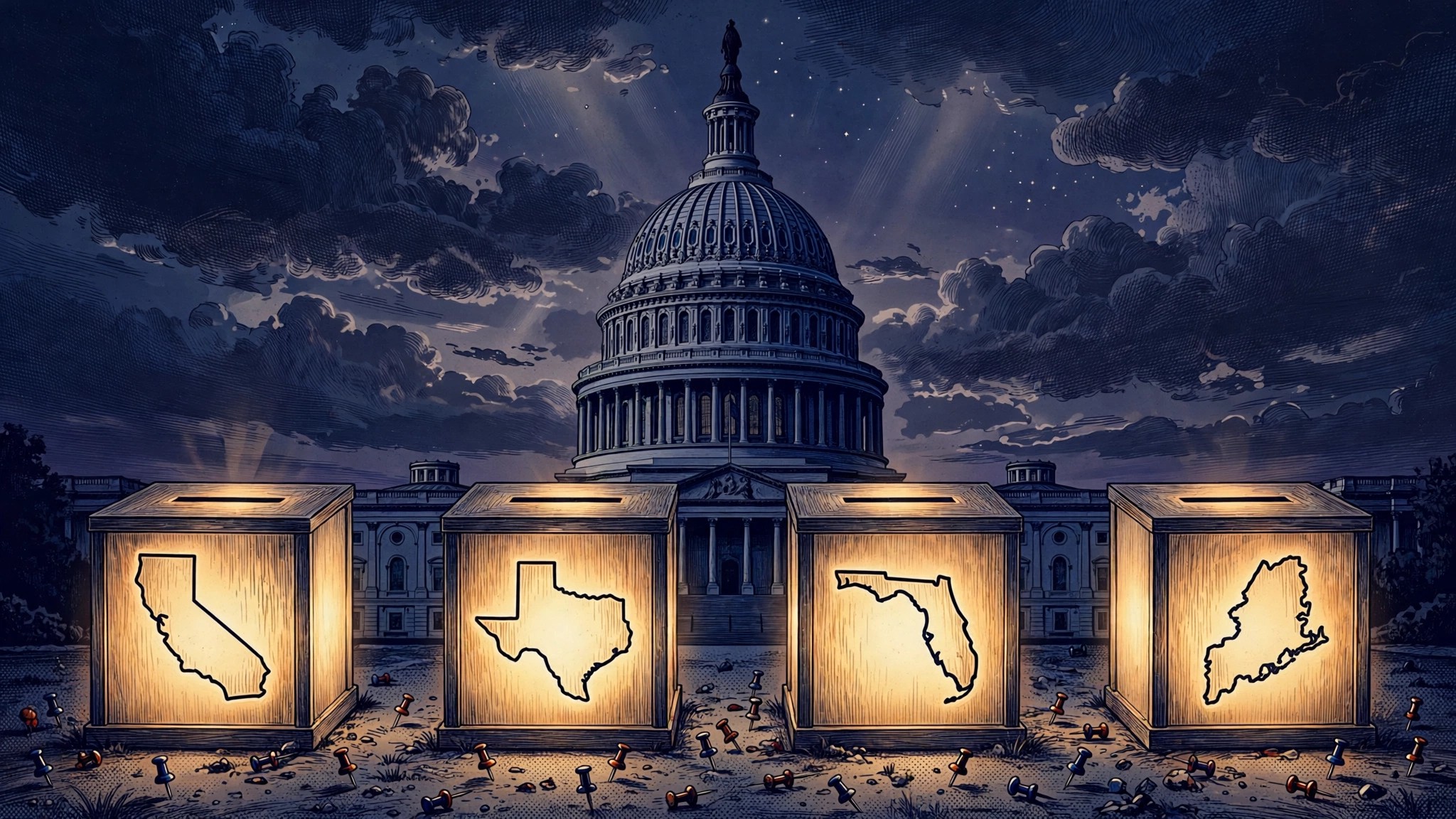
New polls released on Thursday have given Democrats a late boost in the fight for the United States Senate, showing the party’s candidates ahead in four of the states most likely to decide which party controls the chamber next year. The surveys, conducted for CNN by the research firm SSRS, put Democratic candidates in front in Michigan, Texas, Maine and Kansas — two of them by margins larger than the polls’ margin of error. With Election Day on November 3, the results suggest that control of both houses of Congress is genuinely in play, and that the Senate, long considered the harder prize for Democrats, may be within their reach.
The Numbers in the Four Polled States
In Michigan, Democrat Abdul El-Sayed leads Republican Mike Rogers by seven points, 49 percent to 42 percent, among likely voters. The seat is Democratic-held, and the race had been viewed as Republicans’ best opportunity to flip a seat in their favour; a seven-point deficit in the final week is a significant problem for that plan. In Texas, Democrat James Talarico leads the Republican nominee, state Attorney General Ken Paxton, by six points, 49 to 43. Texas has not elected a Democratic senator since 1988, and President Donald Trump carried the state by nearly 14 points in the 2024 presidential election, which makes a Democratic lead there — even a modest one — one of the striking features of this year’s map.
In Maine, Democrat Troy Jackson leads Republican Senator Susan Collins by four points, 49 to 45. Collins has held her seat for five terms and has survived competitive races before by building a personal brand distinct from her party’s; this year, that brand is being tested by a national environment running against Republicans. In Kansas, Democrat Adam Hamilton leads Republican Senator Roger Marshall by four points, also 49 to 45. Kansas has not sent a Democrat to the Senate since 1932, and Trump won the state by 16 points in 2024. The polls were conducted online and by phone beginning October 20, with margins of error between 4.2 and 4.7 percentage points. By that measure, the Democratic leads in Michigan and Texas sit outside the margin of error, while the Maine and Kansas leads sit within it — close enough that late movement could still reverse them.
The Senate Math
Republicans currently hold the Senate 53 seats to 47. Democrats therefore need a net gain of four seats to take the majority outright. Thirty-five seats are on the ballot this year, and the terrain is uneven: 22 of those seats are held by Republicans and only 13 by Democrats, which means Republicans are defending far more ground. Two of the 35 contests are special elections — in Florida, where Ashley Moody is defending the seat vacated by Marco Rubio, and in Ohio, where Senator Jon Husted faces former Senator Sherrod Brown for the seat JD Vance gave up to become vice president.
Forecasters broadly agree on where the chamber will be decided. Seven states recur in every serious analysis — Texas, Ohio, Iowa, Maine, Michigan, Alaska and Kansas. The Cook Political Report rates all seven as toss-ups. Other forecasters divide them differently: one model regards Texas, Ohio and Iowa as true toss-ups, sees Maine and Michigan leaning Democratic, and Kansas and Alaska leaning Republican, while Decision Desk HQ has rated Maine, Iowa, Ohio and Texas as toss-ups and Alaska as leaning Democratic. The disagreements are themselves informative: they show a map with more genuinely competitive Republican-held seats than in a typical midterm.
Beyond the CNN States
The picture in states CNN did not poll offers Democrats further encouragement. Averages of recent polling compiled by Real Clear Politics show Democrats ahead by about 11 points in North Carolina, where former Governor Roy Cooper is running against Republican Michael Whatley for an open seat that many analysts now regard as the party’s strongest pickup opportunity anywhere in the country. In Georgia, polling averages give the Democratic incumbent an eight-point cushion, consistent with the heavy investment both parties are making in the state. In Ohio’s special election, the same averages show Sherrod Brown leading Senator Jon Husted by roughly three points. In Minnesota, the Cook Political Report moved the race for retiring Senator Tina Smith’s seat to Lean Democratic on October 20, with Lieutenant Governor Peggy Flanagan favoured over Republican Michele Tafoya. Even in South Carolina, a special election once considered safe for Republicans has tightened, with Cook shifting its rating from Likely Republican to Lean Republican.
The House: A Handful of Districts
All 435 House seats are also on the ballot, and there the arithmetic is simpler but the margin is thinner. Republicans hold a narrow majority — 218 seats on the latest count — and analysts estimate Democrats need a net gain of about five seats to take control. National generic-ballot polling, which asks voters which party they would support for Congress without naming candidates, currently favours Democrats by roughly seven to eight points on average. Forecasting models translate that into a strong Democratic position: Decision Desk HQ’s October projection gave Democrats a 78 percent chance of winning the House with a median forecast of 236 seats, and a chance in the mid-to-high fifties of also taking the Senate with a narrow 51-seat majority. Prediction markets are more bullish still, pricing Democratic chances of House control at around 90 percent, though those markets reflect traders’ money rather than survey evidence and can swing quickly.
The Trump Factor
Hovering over every race is the president. Trump’s approval rating stands at about 36 percent in recent national polling, with 59 percent disapproving. The CNN battleground polls found disapproval higher still in the states he is visiting to campaign: 66 percent in Michigan, 67 percent in Maine, 59 percent in Texas and 57 percent in Kansas. Polling has consistently found that voters cite the economy and inflation as their dominant concerns and place primary blame for cost-of-living pressures on the president’s policies. Trump has nonetheless campaigned at a pace unusual for a president in a midterm year, crisscrossing the country and visiting historically deep-red states such as Mississippi and South Carolina — a schedule his party hopes will mobilize its base, but which Democratic strategists argue also raises turnout among voters motivated to oppose him.
What Each Outcome Would Mean
The institutional stakes explain the intensity of the final week. A Democratic House would hand the opposition the committee gavels, the subpoena power and control of spending bills for the remainder of Trump’s term, converting the last two years of his presidency into a rolling confrontation over investigations and appropriations. A Democratic Senate would additionally give the party control over confirmations of judges and executive officials. Forecasting models currently put the probability of Democrats capturing both chambers at roughly 54 to 55 percent — making a fully Democratic Congress the single most likely outcome in those projections, while several analysts note that the most plausible split result is a Democratic House alongside a Republican Senate. Any of these combinations ends the era of unified Republican control in Washington and reshapes what the White House can achieve before 2028.
Why Caution Is Still Warranted
None of this is a result. Polls are snapshots with real margins of error, and two of the four headline CNN leads fall within them. Forecasters who agree on the direction of the race disagree on individual states, and late-deciding voters, turnout differences between the parties’ coalitions and the quality of each campaign’s get-out-the-vote operation can all move a two- or three-point race in the final days. Republicans also note that their candidates remain competitive in states the presidential map says should not be close at all, and that the party needs to hold only a portion of its exposed seats to keep the Senate. Early voting is already under way across much of the country. What the polling establishes, five days out, is narrower but still significant: the fight for Congress is not a formality. Both chambers are contested, the Senate map has widened deep into Republican territory, and the outcome now rests on a handful of states and districts that remain, by every measure, too close to call.
Sources
USN reviewed reporting from multiple outlets for this story. Read more from USA Today, NorthJersey.com (USA Today Network), Delaware Online (USA Today Network) and CongressCountdown.
[…] a reminder of how many paths to control remain open. As USN has reported in its coverage of how the fight for Congress has tightened in the Senate battlegrounds, a handful of results could swing the chamber either way, and no single poll in any one state […]
[…] issues, with the president arguing that only his movement can prevent a Democratic takeover. The fight for the Senate has tightened in several battleground states, and the outcome in a handful of close races may […]
[…] For the state-level polling picture behind this national snapshot, see USN’s report on Democrats opening leads in four Senate battlegrounds. […]
[…] arrive. Illinois results will be reported alongside results from across the country, including the Senate battlegrounds that will decide control of the chamber. The pope’s ballot will be counted with all other […]
[…] in which Democrats have been gaining ground in several battleground states, a trend covered in USN’s reporting on Democrats opening leads in four Senate battlegrounds as the fight for Congr…. Michigan’s own polling background, including the earlier survey showing El-Sayed ahead of […]
[…] urgency for it. That postponement sits inside the wider contest for control of Congress, covered in USN’s reporting on Democrats opening leads in four Senate battlegrounds as the fight for Congr…, and it is that shifting national picture, more than any single hearing, that will decide whether […]
[…] attention in its final days. For the broader battleground picture, see USN’s reporting on Democrats opening leads in four Senate battlegrounds and on Trump and Obama trading blows on the campaign […]
[…] tied races in Kansas, Iowa and Nebraska. For the national stakes, see USN’s reporting on Democrats opening leads in four Senate battlegrounds and on Trump and Obama trading blows on the campaign […]
[…] map gives Ohio its context. Democrats have opened leads in several battlegrounds, as reported in Democrats open leads in four Senate battlegrounds as the fight for Congress tightens, but leads in polls are not seats, and several of those races remain within the margin of error. […]
[…] — a reminder that industrial policy on this scale depends on politics as much as engineering. The fight for Congress is therefore not a backdrop to the drone program; it is one of the variables that will decide […]
[…] 3 as well. Counting and certification timelines vary by state, and close races, including the Senate battleground races that will decide control of Congress, may take days to resolve. New lawsuits are likely, and […]
[…] In either narrow scenario, divided government becomes the defining fact of the next two years, because the Senate is rated a toss-up in final rankings and the presidency remains in Republican hands. A Democratic House could block Republican legislation, open investigations and use the power of the purse, but it could not enact its own program without Senate agreement and a presidential signature, or veto-proof majorities it is unlikely to hold. A Republican House could keep the president’s agenda moving through one chamber, but it would still face a Senate where the majority is uncertain and where sixty votes are usually needed for most major bills. That is why both parties, even while campaigning for a majority, are also preparing for negotiation, brinkmanship over funding deadlines and the possibility that the most consequential decisions of the next Congress will be about what does not pass, rather than what does. Readers following the wider fight for Congress can also read our earlier report on Democrats opening leads in four Senate battlegrounds. […]
[…] following the wider Senate map can also read USN’s earlier reporting on Democrats opening leads in four Senate battlegrounds as the fight for Congress tightens, which sets out how North Carolina fits alongside the other competitive Senate […]
[…] including in Democrats open leads in four Senate battlegrounds as the fight for Congress tightens (https://usnbreaking.com/democrats-open-leads-in-four-senate-battlegrounds-as-the-fight-for-congress-…). Those races, along with House contests in competitive districts, will determine whether the White […]