

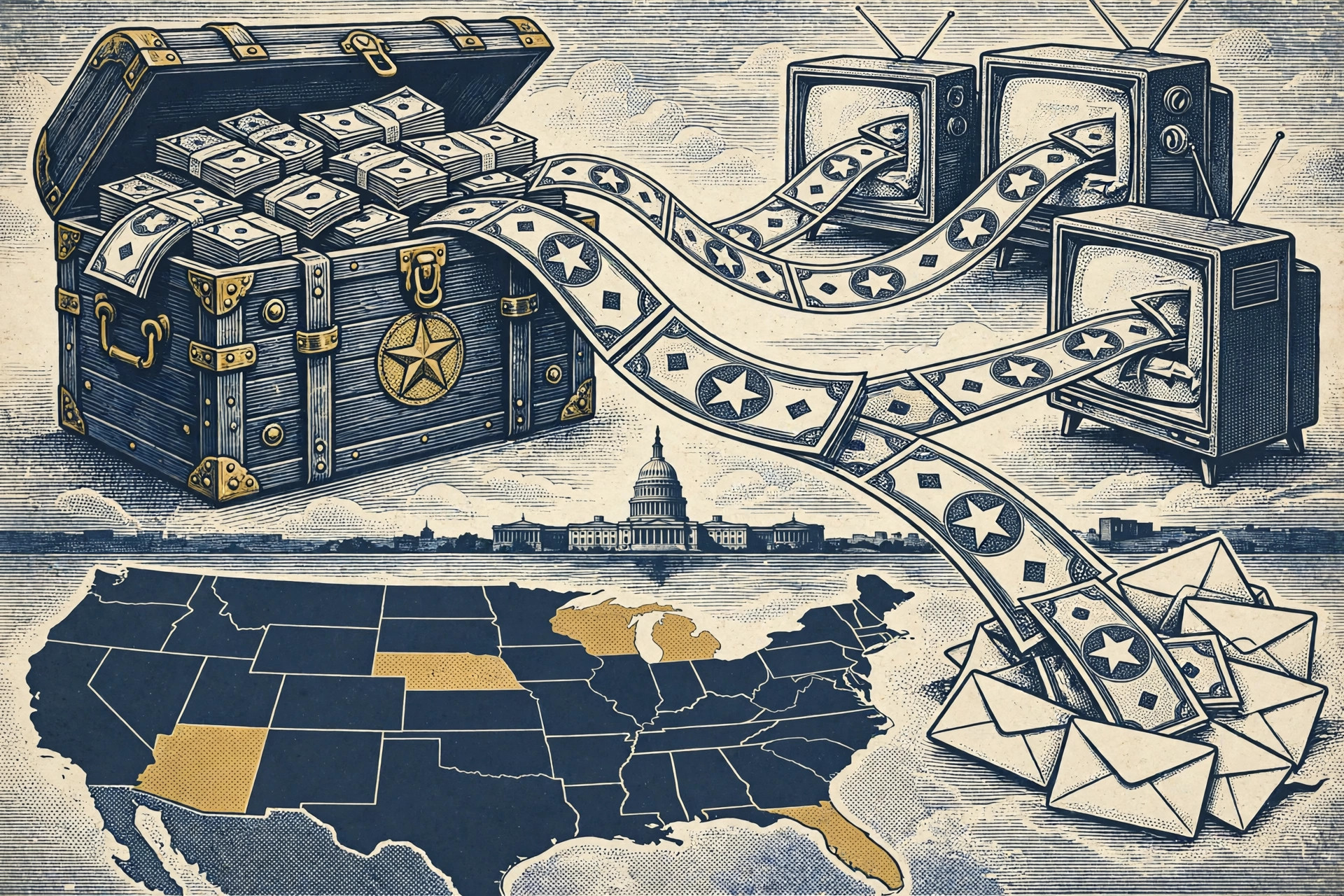
President Donald Trump said he would spend $400 million on the 2026 midterms. The claim sounded enormous. In the final days before Election Day on November 3, the public record now shows hundreds of millions of dollars in Republican-aligned spending, a sprawling advertising blitz and a Democratic counterweight, but not a clean, confirmed $400 million total from a single source.
His latest pledge, made on Truth Social in October, said he would spend $400 million to defend the Republican House and Senate majorities. It followed months in which Trump had already become the most financially active president in a midterm cycle in modern memory, headlining fundraisers, steering donors to super PACs and lending his name to a national advertising campaign.
How the Trump-linked spending breaks down
The spending does not sit in one account. It is spread across the president’s campaign committees, the Republican National Committee, House and Senate campaign arms and outside groups, according to filings released by the Federal Election Commission.
MAGA Inc, his main super PAC, has reported spending more than $300 million in the 2026 cycle, much of it on television and digital advertising in battleground House districts and Senate races. The group has also funded voter-turnout operations, polling and legal work tied to election administration.
Bloomberg reported that outside groups aligned with Democrats, including a network backed by former New York City Mayor Michael Bloomberg, have committed about $80 million in response, a sign that the president’s pledge has reshaped fundraising on both sides.
That total does not include spending by the Republican National Committee, the National Republican Senatorial Committee or the National Republican Congressional Committee, which together have reported hundreds of millions more in independent expenditures and coordinated advertising.
What the money bought
Most of the money went to an advertising blitz. Trump-aligned groups have spent at least $277 million on television, radio and digital ads since January, according to AdImpact data cited by multiple outlets. The ads have concentrated in Senate races in Texas, Michigan and Ohio, and in about 40 House districts rated competitive by the Cook Political Report.
The messages have been remarkably consistent: warnings about immigration, crime and inflation under Democratic leadership, combined with claims that Republican control is needed to protect Trump’s agenda. In Texas, ads have attacked Democratic challengers over border policy. In Michigan, they have focused on manufacturing and energy. In Ohio, they have tied Democratic candidates to Washington spending.
A smaller share went to ground operations. MAGA Inc and allied groups have funded canvassing, phone banking and text campaigns in Pennsylvania, Arizona, Georgia and Wisconsin, states where turnout in off-year elections can decide close races.
What filings do not yet prove
The $400 million figure itself remains unverified. No single filing, committee report or audited total confirms that Trump personally spent, raised or directed exactly $400 million. The number appears to combine pledges, projected spending and money raised by allied groups, some of which was not spent by Election Day.
One Republican strategist told The Hill that the $400 million was best understood as a signal to donors, not a budget line. It is a round number designed to scare Democrats and excite donors, the strategist said. The real spending is massive, but it is not that tidy.
That distinction matters because super PAC spending is reported on a lag. Filings covering the final weeks before November 3 will not be complete until after the election, meaning the full midterm total cannot be verified until December.
A record, even if the number is fuzzy
Even with that caveat, the scale is unprecedented for a sitting president in a midterm cycle. Previous presidents, including Barack Obama and George W. Bush, raised tens of millions for their parties in midterms. Trump has raised and steered hundreds of millions, using his personal brand as a fundraising engine in a way no predecessor has.
CNN reported that the spending has split Republican strategists. Some argue it has nationalized races that might otherwise have been local, forcing Democrats to spend heavily to defend seats. Others worry it has crowded out candidate-specific messaging in districts where local issues matter more.
What opponents say
Democrats have used the pledge as a campaign issue of its own, arguing that the scale of spending shows a presidency focused on retaining power rather than governing.
Senate Democratic Leader Chuck Schumer said in a statement last month: No president should be able to buy an election. Four hundred million dollars is not democracy. It is an auction.
On Truth Social, Trump framed the spending differently, as a necessary response to what he called radical left money flowing into Democratic campaigns. He has repeatedly said Democrats are backed by billionaires and outside groups, a claim that is also difficult to verify in full before final filings.
What to watch after November 3
The real test of the $400 million claim will come in December, when the Federal Election Commission publishes complete post-election reports. Those filings will show how much MAGA Inc, the RNC and allied groups actually spent, and whether the combined total reaches the president’s number.
The New York Times reported that early indicators suggest total Republican-aligned spending will exceed $1 billion when all committees and outside groups are counted, a figure that would make the $400 million pledge look modest by comparison, but also shows how difficult it is to attribute a single total to one person.
Until those filings are complete, the $400 million should be treated as what it is: a pledge, a political signal and a partially documented spending surge, not a verified total.
The Hill reported that Republican officials privately expect the final number tied directly to Trump-linked groups to land between $300 million and $450 million, a range that includes the $400 million figure but does not confirm it.
Bottom line: Trump has spent, raised and directed an extraordinary amount of money into the 2026 midterms. Filings prove hundreds of millions in spending. They do not yet prove $400 million from a single source, and voters should wait for the post-election filings before treating that number as fact.
Sources: Federal Election Commission, CNN, Bloomberg, The Hill and The New York Times.