

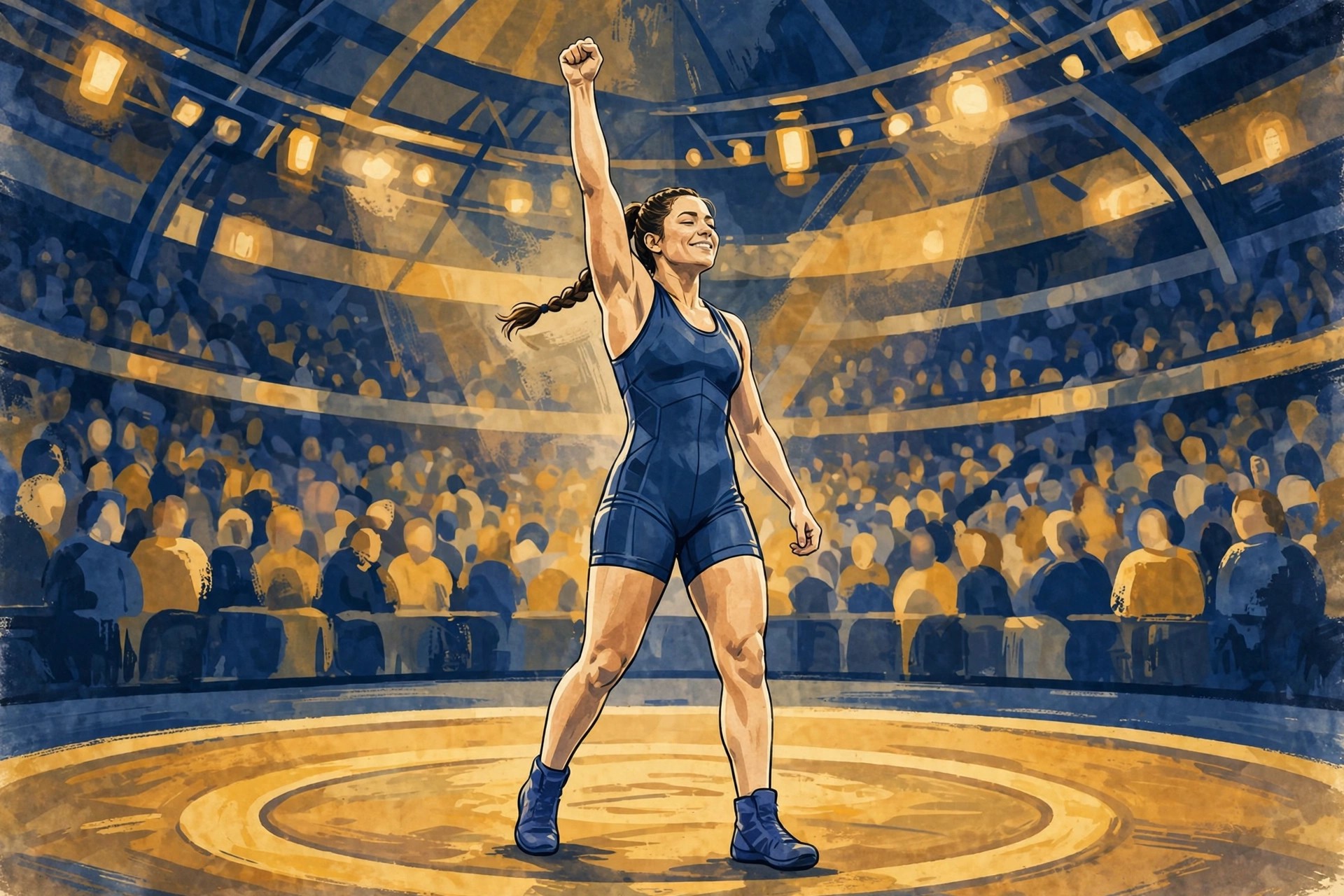
Manisha Bhanwala has become the first Indian woman to win a senior World Wrestling Championships gold medal, fighting back from 0-6 down to beat Abigail Elizabeth Nette of the United States 8-6 in the women’s 59kg freestyle final in Astana, Kazakhstan, on October 30, 2026. The comeback, completed in front of a global audience and celebrated with a grand welcome at Delhi Airport on November 1, ended a 16-year wait for an Indian senior world champion and a 21-year wait, since Indian women first competed at the championships in 2005, for a women’s title. It also made Bhanwala only the second Indian wrestler ever to win a senior world gold, after double Olympic medallist Sushil Kumar’s men’s 66kg title in 2010.
The result was more than one wrestler’s triumph. It capped an exceptional campaign for the Indian women’s team at the 2026 championships, which finished with four medals: Bhanwala’s gold, silver medals for Kajal Dhochak and Neelam Sirohi, and a bronze for Tanu Sharma in the 72kg category. For the first time in India’s history, three Indian women reached gold-medal bouts at the same edition of the championships. Bhanwala’s gold was the one that turned a strong team performance into a historic one, and the manner of it, a recovery from six points down in a world final, is why it will be remembered well beyond the medal table.
How Manisha Bhanwala’s wrestling world gold was won
The final began badly for Bhanwala. Nette, the reigning Pan American champion and the fourth seed, struck early with a four-point throw that put the American firmly in control, and by the early stages of the bout the scoreboard read 6-0 in her favour. In wrestling, a six-point deficit in a final is the kind of margin that usually settles a contest, because the leading wrestler can protect the lead, slow the pace and force the opponent to take risks. Bhanwala did the opposite of panicking. She began to score, first through a step-out point, and then worked her way back into the bout with the patient, grinding wrestling that had carried her through the earlier rounds.
According to United World Wrestling’s account of the bout, as reported after the final, the turning point came through a gut wrench, the move in which a wrestler rolls an opponent across the mat by the waist, which brought Bhanwala level at 6-6. A pressure takedown then put her 8-6 ahead, and she held that lead to the final whistle. The details of the sequence matter because they show a wrestler winning not with a single lucky throw but with sustained pressure: first stopping the slide, then levelling the score, then taking the lead late, when the bout was there to be won or lost. Nette, who had started so strongly, could not find a way back in the closing exchanges.
Speaking after her return to India, Bhanwala described the opening phase of the final as difficult, but said it had, in a sense, worked in her favour, because her opponent had spent a great deal of energy in the early attacks. She said the feeling of making history was hard to put into words, and that she felt proud to have done something no Indian woman had done before. It was a calm, understated reaction to a dramatic win, and it fitted the way she had wrestled the final itself: absorbing pressure, then using it.
Manisha Bhanwala’s road to the Astana final
Bhanwala arrived in Astana unseeded in an 18-wrestler 59kg draw, and her path to the final was, if anything, more dominant than the final itself. The official bracket, as reported, shows that she beat two seeded wrestlers on the way, winning two of her four bouts by fall, the decisive result in which a wrestler pins both of her opponent’s shoulders to the mat and ends the bout at once. In the round of 16 she beat Canada’s Laurence Beauregard, the second seed, a 2025 world bronze medallist and four-time Pan American champion, by fall at 4 minutes 35 seconds, after leading 6-2. In the quarter-final she beat Mongolia’s Bolortuya Khurelkhuu, the seventh seed, 6-0, without conceding a point.
The semi-final was more emphatic still. Against Kazakhstan’s Altyn Shagayeva, wrestling in front of a home crowd, Bhanwala won 10-0 by fall at 4 minutes 25 seconds, a result that sent her into the final with momentum and, just as importantly, without the exhaustion of a long, grinding semi-final. That matters in a tournament played over consecutive days, where recovery between bouts can decide a final as surely as technique. Bhanwala had reached her fourth senior World Championships without previously reaching the podium, according to reports of her record, which makes the authority of her run in Astana, three commanding wins followed by a comeback final, all the more striking.
The wider team story unfolded alongside her. Dhochak and Sirohi had both reached their finals earlier in the championships before settling for silver, and Sharma’s bronze completed a four-medal haul that came entirely from women’s freestyle events. For Indian wrestling, which has long produced world-class women, from the early medal won by Alka Tomar, a bronze in the 59kg category in 2006, to Anshu Malik’s silver in the 57kg category in 2021, the first time an Indian woman had reached a senior world final, Astana represented a barrier finally broken rather than a sudden arrival. The pipeline had been there for years. What had been missing was gold.
From Asian Games disappointment to world gold in ten days
What makes Bhanwala’s title still more remarkable is how little time separated it from disappointment. Just over 20 days before the world final, she had been competing in the 57kg category at the Asian Games at Aichi-Nagoya, where she lost her quarter-final to Japan’s Akari Fujinami, the Paris 2024 Olympic champion, and left without a medal. She has said she had been confident of winning a medal at the Asian Games, and that missing out affected her mentally. With only about ten days between the two competitions, there was little time to recover, let alone to cut weight again for a second major tournament.
The solution, agreed with her coaches, was to move up to 59kg for the World Championships, with Neha Sharma competing in the 57kg category instead. Coach Virender Dahiya explained the reasoning in comments reported after the win: both competitions were major events, there was not much time to lose weight again between them, and the World Championships, with ten weight categories against the Asian Games’ six, offered 59kg as an available option. Bhanwala herself said that losing weight in ten days would have been tough, and that 59kg therefore felt like the better choice. It was a pragmatic decision, taken under time pressure, and it produced a world title.
Bhanwala has also spoken about the private habits behind the public result. In interviews after the win, she said she keeps diaries in which she writes the words World Champion after every practice session, a small ritual that, in hindsight, reads less like superstition than like a statement of intent. She has said the Asian Games setback fuelled her determination, and that she channelled frustration from that loss into intensive training in the short window before Astana. The diary, the ten-day turnaround and the weight-class switch together tell the story of a wrestler who did not wait for ideal conditions, but adapted to the ones she had.
What Manisha Bhanwala’s gold means for Indian wrestling
The historical context gives the win its full weight. Sushil Kumar’s 2010 title had stood alone for 16 years as India’s only senior world championship gold, and Indian women had waited since their debut in 2005 for a champion of their own. Fittingly, Bhanwala’s gold came in the same 59kg category in which Tomar had won India’s first women’s medal at the championships, a bronze in 2006, bringing the story full circle two decades later. The wait, the near-misses and the three finals in a single edition all point to the same conclusion: Indian women’s wrestling had been close for a long time, and Astana was the edition in which closeness finally became victory.
The win also carries a message beyond sport, and Bhanwala’s family made it plain on her return. Her mother, Meena Devi, spoke of immense pride at her daughter’s achievement and urged parents to encourage and support their daughters in pursuing their ambitions, saying that what Manisha had done, other daughters could do too. Bhanwala herself thanked the Wrestling Federation of India for its role in her preparation, pointing to its training camps and to support through the Target Olympic Podium Scheme, the government-backed programme for elite athletes. The combination of federation support, structured camps and individual resilience is the unglamorous infrastructure behind most sporting breakthroughs, and Bhanwala’s gold is a reminder of how much of it has to work at once.
Attention now turns to what comes next. The 59kg category is not an Olympic weight, so Bhanwala’s stated target for the Los Angeles Olympics in 2028 is the 57kg category, the weight at which she competed at the Asian Games. She has said the coming year will be particularly important for her, with avoiding injury and focusing on recovery among her key priorities, a sensible note of caution from a 29-year-old wrestler who knows that a world title raises expectations as surely as it rewards past work. Dropping back to 57kg will demand the careful weight management she avoided before Astana, and the Olympic cycle will bring opponents who have now studied her comeback final in detail. None of that diminishes what happened in Astana. It simply defines the next challenge.
The Astana triumph also closed a crowded weekend of global news, in which audiences were following major stories far beyond sport, including Spain’s second high-speed rail disaster in a year. That a wrestling final could cut through such a news cycle, and be greeted at Delhi Airport with the warmth usually reserved for cricketing heroes, says something about how far Indian wrestling has come in public affection, and about how clearly a first can capture attention. Bhanwala did not merely win a medal. She became the answer to a question Indian wrestling had asked for two decades: when would a woman stand on top of the world podium? The answer, delivered from 0-6 down in Astana, is now part of the sport’s history, and the diary entry she wrote after every practice session has finally come true.
USN reviewed reporting from multiple outlets for this story. Read more from The Tribune, News18 and Telegraph India.