

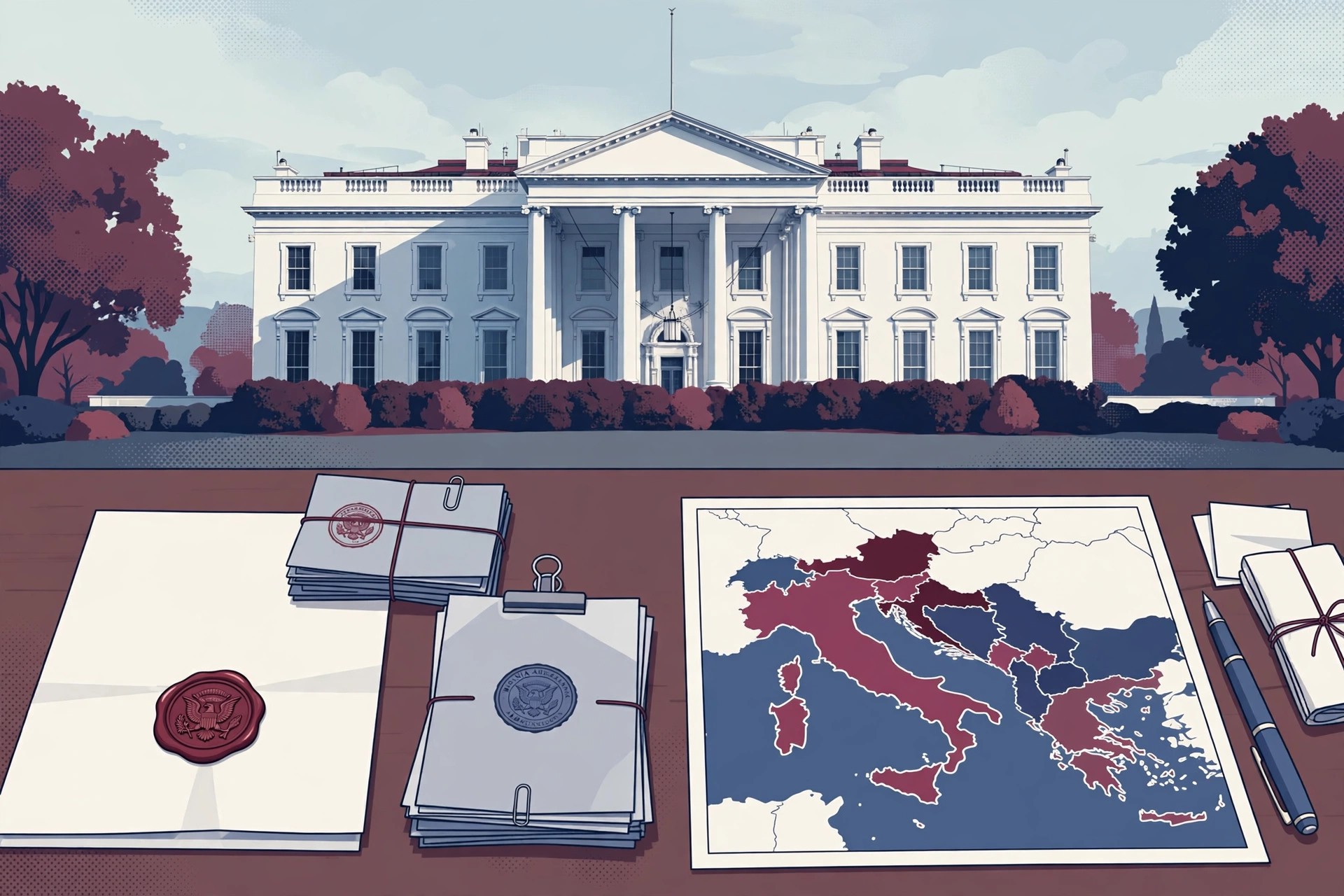
President Donald Trump has formally handed the machinery of a new Western Balkans sanctions law to the departments that will have to operate it. In a presidential memorandum signed on October 28, 2026, and published in the Federal Register on November 2, 2026, Trump delegated the sanctions authorities in Section 8335 of the National Defense Authorization Act for Fiscal Year 2026 to the Secretary of the Treasury and the Secretary of State, splitting the powers between them and directing other departments and agencies to implement sanctions once a person has been identified. The memorandum, identified as Federal Register Document Number 2026-22386, does not itself sanction any person, company, or government. It does something quieter and, for the people who work on sanctions policy, more consequential: it tells the executive branch who is allowed to pull which lever, so that a law Congress wrote as a mandatory duty can actually be carried out.
To understand the memorandum, it helps to start with the law it implements. Section 8335 is the sanctions title of the Western Balkans Democracy and Prosperity Act, which Congress included in the fiscal year 2026 defence authorisation act. The provision seeks to codify, and make mandatory, sanctions criteria that previously existed in Executive Order 14033, as amended by Executive Order 14140 in the final days of the previous administration. Where an executive order gives a president discretion to impose sanctions, Section 8335 says the president “shall” impose property-blocking and visa-related sanctions on foreign persons determined to meet its criteria. It also restricts the president’s authority to terminate such sanctions, requiring a congressional certification similar to the mechanism in the Countering America’s Adversaries Through Sanctions Act. In other words, Congress did not merely invite the executive branch to consider Balkans sanctions. It wrote a duty, and then fenced the exit.
Who gets what under the Trump sanctions delegation
The memorandum divides Section 8335 by subsection, and the division follows the traditional split of American sanctions labour. The Treasury Department, in consultation with the State Department, is assigned the functions and authorities in Section 8335(a), the core provision codified at 22 U.S.C. 10704(a). Once the Secretary of State identifies sanctionable foreign persons, the heads of relevant executive departments and agencies are delegated authority, within their areas of responsibility, to implement the sanctions. Treasury also receives, on its own, the authorities in Sections 8335(c)(1) and 8335(d)(1), and receives Section 8335(i). Treasury, in consultation with State, receives Section 8335(f). The State Department receives Section 8335(g) on its own.
That allocation is worth unpacking, because it mirrors how sanctions actually work. Treasury’s Office of Foreign Assets Control is the body that blocks property, issues licences, and maintains the lists that banks and businesses check before dealing with a person. State is the body that identifies foreign persons, makes the foreign-policy judgements, and handles the visa side of sanctions, since visa bans are administered through the immigration system rather than the financial system. When the memorandum gives Treasury the financial authorities and State the identification and visa-related authorities, it is not inventing a new structure. It is mapping a new statute onto the structure that already runs American sanctions, so that a designation under Section 8335 can travel the same path as a designation under older authorities: identification, listing, blocking, and enforcement.
The memorandum also contains two forward-looking clauses that lawyers notice immediately. First, the delegations will apply to any provision in a future public law that is the same or substantially the same as the provisions referenced, and any reference to an act is deemed to be a reference to that act as amended over time. Second, the Secretary of the Treasury is authorised and directed to publish the memorandum in the Federal Register, which is why the document appears in the November 2 issue. The first clause is standard delegation boilerplate, designed to prevent a future Congress from having to re-delegate the same powers after a technical re-enactment. It does not expand the president’s power beyond the statute; it preserves the delegation if the statute’s numbering or text changes in a substantially identical form. The second clause is what makes the memorandum public and citable, and it is the reason this story can be reported from the primary document rather than from anonymous description alone.
What Section 8335 targets in the Western Balkans
Section 8335’s criteria, as summarised in legal analysis of the fiscal year 2026 defence act, cover foreign persons who threaten the peace, security, stability, or territorial integrity of the Western Balkans; who undermine democratic processes or institutions; who engage in corruption or human rights abuses; or who engage in, or attempt to engage in, acts that obstruct or threaten the implementation of regional security and peace agreements in the Balkans. That is a broad net, and its breadth is deliberate. The Western Balkans — a region that includes Bosnia and Herzegovina, Serbia, Kosovo, Montenegro, Albania, and North Macedonia — has been a focus of American and European stability policy since the wars of the 1990s, and the Dayton peace framework for Bosnia remains a central reference point. Sanctions criteria that cover threats to territorial integrity, democratic processes, and peace agreements are designed to reach political actors, business figures, and networks that profit from instability, rather than only those who commit acts of violence.
The mandatory character of the provision is what makes the delegation matter. Under a discretionary executive order, a president can choose whether to designate a person, and can choose when. Under a “shall” statute with a certification requirement for termination, the executive branch’s discretion narrows: once a person is determined to meet the criteria, sanctions follow, and lifting them requires a process that involves Congress. Critics of mandatory sanctions argue that they tie a president’s hands in diplomacy, removing a bargaining chip that might otherwise be traded for concessions. Supporters argue that the constraint is the point: it signals to actors in the region, and to allies, that American policy will not shift with each change of administration or each diplomatic mood. The memorandum does not resolve that debate. It assumes the statute is valid and operative, and it puts the operating departments in a position to apply it.
It is equally important to state what the memorandum does not do. It does not name any sanctioned person. It does not add anyone to a sanctions list. It does not change the criteria, the standard of proof, or the rights of a designated person to challenge a listing. It does not state how many departments or agencies will implement sanctions beyond those referenced, and it does not set a deadline for the first designations. A reader who treats the November 2 publication as the announcement of new Balkans sanctions would be mistaken. The publication is the announcement of an internal allocation of authority. The first designations, if and when they come, will be separate public actions, published through Treasury and State channels, and they will be the moment at which the law’s practical effect on named individuals becomes visible.
Why a delegation memorandum matters at all
Presidential delegation memoranda are among the least dramatic documents a White House produces, and they are routinely overlooked in favour of executive orders and proclamations. But they are the connective tissue between a statute and an agency action. Without a delegation, a department that blocks a person’s property or denies a visa under a new statute risks acting without legal authority, and a court challenge could follow. With a delegation, the chain of authority is explicit: Congress gave the power to the president, the president gave defined pieces of it to named secretaries, and those secretaries act within the scope of the delegation. For banks, lawyers, and compliance officers, that chain is what makes a future designation defensible and therefore actionable. A designation without a clear delegation is a litigation risk; a designation with one is a compliance obligation.
The memorandum also sits inside a much larger fiscal year 2026 defence act, which runs to thousands of pages and covers a wide range of national security tools. Alongside the Balkans provision, the act includes China-focused measures on the biotechnology supply chain, defence, and surveillance sectors; an expansion of fentanyl sanctions and a new focus on Haiti; a repeal of longstanding statutory Syria sanctions; and new tools to target state sponsors of unlawful or wrongful detention. The Balkans delegation should therefore not be read as a standalone signal about the region alone. It is one piece of a broader reorganisation of sanctions authorities that Congress enacted and the White House is now implementing, piece by piece, through memoranda like this one. Each delegation brings a different statutory section into operation, and the cumulative effect is a sanctions apparatus that is increasingly codified in statute rather than resting solely on executive orders that a future president could revoke with a signature.
For the Western Balkans itself, the practical question now moves from Washington procedure to regional politics. The governments and political actors of the region will watch for the first designations under Section 8335, for the evidence and reasoning the administration publishes, and for whether the mandatory framework produces designations that a discretionary system would not have. Allies in Europe, who maintain their own Balkans sanctions regimes, will watch for coordination or divergence. And Congress, having written a mandatory duty with a certification requirement for termination, will watch whether the executive branch applies the law as written or finds ways to delay determinations. The memorandum answers the question of who decides. It does not answer the question of what they will decide, and that is where the story now moves.
The defence authorisation context has been closely watched in Washington, where a separate fight over the defence bill’s passage has been tracked (https://usnbreaking.com/defense-bill-standoff-congress-risks-ending-65-year-ndaa-streak-as-1-15-trillion-fight-drags-toward-thanksgiving/), and Treasury’s sanctions machinery has recently been used against an oil network (https://usnbreaking.com/russia-shadow-fleet-sanctions-us-treasury-targets-a7-network-behind-oil-and-illicit-finance/).
Sources
USN reviewed reporting from multiple outlets for this story. Read more from United States Tribune (https://unitedstatestribune.com/politics/trump-delegates-ndaa-section-8335-sanctions-authorities/), Covington (https://www.globalpolicywatch.com/2025/12/new-sanctions-authorities-in-the-fy-2026-ndaa/) and Kharon (https://www.kharon.com/brief/ndaa-2026-outbound-investment-rule-china-fentanyl-sanctions).
[…] Trump Delegates NDAA Section 8335 Western Balkans Sanctions Powers to Treasury and State […]