

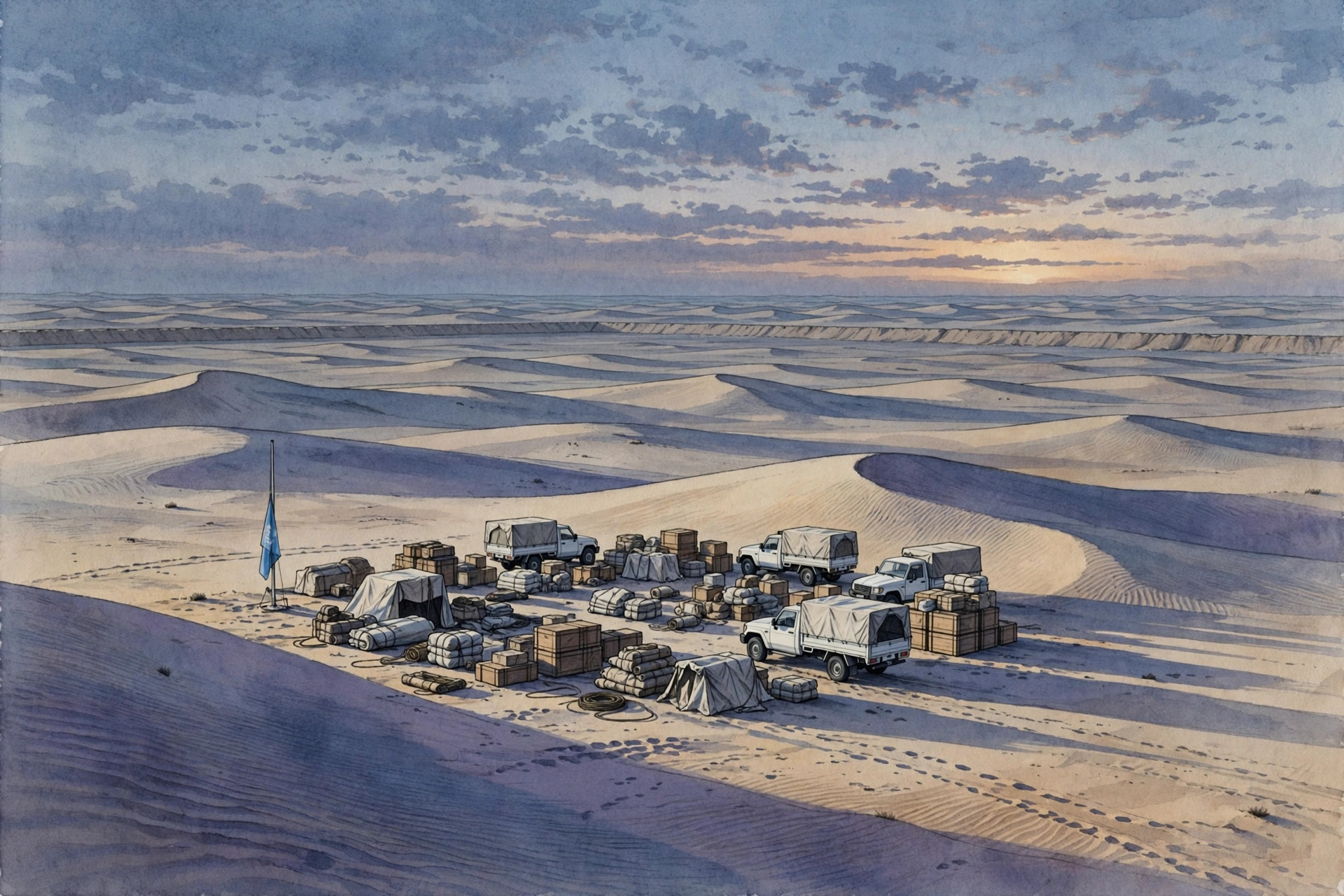
The United Nations has begun winding down its peacekeeping mission in Western Sahara, closing a presence that lasted 35 years. The liquidation phase started on 1 November 2026, the day after the mission’s mandate expired at midnight on 31 October, when the Security Council failed to agree on its future. What follows is not a single departure but a drawn-out administrative and logistical process: equipment must be accounted for, team sites must be closed, and a smaller United Nations team must oversee the disposal of mission property and the return of assets belonging to troop-contributing countries.
The mission at the centre of the story is the United Nations Mission for the Referendum in Western Sahara, known by its French-derived acronym MINURSO. It was created in 1991 to monitor a ceasefire and to prepare a referendum on the future of the territory, a vote that never took place because the parties could not agree on who was eligible to take part. Its end therefore closes two stories at once: a peacekeeping deployment that outlasted the settlement plan that created it, and a long-running argument about what should replace a referendum that was promised but never held.
Secretary-General António Guterres confirmed the end of the mission in a statement issued on Sunday, 1 November, through his spokesperson, Stéphane Dujarric. The statement said the departure of MINURSO “does not abrogate” the people’s “inalienable right to self-determination”, and it paid tribute to the 20 mission personnel who lost their lives during its 35 years in the territory. The wording matters, because it was aimed at two audiences at once: those who read the mission’s end as the end of the United Nations’ involvement, and those who feared that a political process built around self-determination was being quietly retired along with the mission’s name.
What the Western Sahara MINURSO liquidation means on the ground
Liquidation, in United Nations usage, is not the same as a sudden evacuation. A reduced team reporting to the Department of Operational Support will oversee the process, coordinating the return of equipment belonging to troop-contributing countries and deciding the fate of United Nations-owned property under established disposal procedures. When its mandate ended, the mission was headquartered in Laayoune, with nine team sites, four west of the berm and five east of it, and a liaison office in Tindouf. The berm is the long sand barrier that divides the territory, and the team sites on either side of it were the mission’s eyes on the ceasefire.
Early signs of the wind-down were already visible in Laayoune. Reporting from the Moroccan outlet Yabiladi, citing a source close to the matter, said a closed-door meeting of senior officials was held on Saturday at MINURSO headquarters to discuss withdrawal arrangements, that staff on leave were instructed not to return to Laayoune, and that contracts for Moroccan personnel were being terminated. A broader meeting of civilian and military officials was scheduled for Monday, 2 November, to continue preparations. Those details have not been confirmed in a United Nations statement, and they should be read as reported first steps rather than as an official timetable, but they fit the pattern of a liquidation that begins with administration before it becomes visible as convoys and closed sites.
The scale of what is being wound down is considerable. The mission was authorised to have 534 personnel, and its budget for 2026-2027 was more than 62 million dollars, according to the Associated Press. Those figures describe a mission that had already shrunk from the larger force once envisaged for a referendum, but that still maintained a network of observers across a vast desert territory roughly the size of Colorado, rich in minerals and fisheries along Africa’s north-western Atlantic coast.
How the Security Council deadlock happened
The immediate cause of the mission’s end was a Security Council meeting on Friday, 30 October, at which neither of the two drafts before the Council could pass. The United States circulated a draft that would have renewed and restructured the mission, extending it to 31 October 2027 while renaming it from MINURSO to MINUSO, the United Nations Mission in Western Sahara, from 1 November 2026. Removing the letter “R” was not a cosmetic change: it removed the explicit reference to a referendum, reflecting the argument, made by Washington and Rabat, that a referendum of the kind envisaged in 1991 is no longer a realistic path and that Morocco’s autonomy plan should be the basis for further talks.
That draft won the support of 11 of the Council’s 15 members, including fellow permanent members France and the United Kingdom, but Russia vetoed it. Explaining the veto, Russia’s ambassador said the text would have imposed one-sided solutions, describing his vote, in the words reported by UN News, as “a life-saving veto, so to speak”. The United States ambassador, Mike Waltz, criticised the veto and argued that the American draft would have supported the principle of self-determination while moving what he called a 50-year conflict forward, calling the status quo unacceptable. The two explanations cannot both be accepted at face value, and readers should treat them as the competing political claims they are: Washington presenting its draft as progress, Moscow presenting its veto as protection against a predetermined outcome.
A rival Russian draft, which would have extended the existing MINURSO mandate for another year without the restructuring, then failed to win the nine votes needed for adoption, receiving only three votes in favour, one against and 11 abstentions, according to Hespress and other reporting of the vote. Pakistan abstained on both drafts, urging a mutually acceptable political solution through dialogue and consensus. With no resolution adopted, the mandate simply expired. There was no vote to end the mission as such; there was a failure to agree on what should come next, and expiry did the rest.
This was not the first time the Council had struggled over Western Sahara, but the stakes were higher than in a routine annual renewal. A year earlier, the Council had adopted a United States-drafted resolution accepting Rabat’s plan to give the territory autonomy under Moroccan sovereignty as the “most feasible” solution to the conflict. Russia abstained in that vote. In 2026, the same argument returned in sharper form, with the mission’s name and purpose themselves on the table, and this time the Council could not bridge the gap.
Two readings of the same ending
Morocco welcomed the outcome. A statement from the Royal Office on 30 October described the non-renewal as a major development and a significant step towards what it called the definitive closure of the Moroccan Sahara issue at the United Nations. It said a 35-year chapter had come to a close, described the mission as rooted in an outdated context and as a tool for internationalising the dispute, and said the mission’s presence, including its personnel, vehicles, equipment and symbols, should cease in the coming days. Morocco also said it remained firmly committed to the ceasefire, with strict respect for its territorial integrity, national security and the tranquillity of its citizens.
The Polisario Front, which seeks independence for the territory and is backed by Algeria, read the same events very differently. Reporting of its reaction described concern at the loss of the mission, and the Front had earlier rejected the American draft on the grounds that it aligned completely with Morocco’s autonomy plan while leaving its own demands unanswered. For the Polisario, the mission’s name mattered precisely because it preserved the referendum idea, even after decades in which no referendum was held. Removing that reference, in this reading, is not modernisation but the quiet removal of an option.
The Secretary-General’s statement tried to hold a middle line. It reaffirmed the United Nations’ commitment to supporting a just, lasting and mutually acceptable political solution that provides for the self-determination of the people of Western Sahara, and it said the United Nations stands ready to continue supporting dialogue and a peaceful resolution through the Secretary-General’s Personal Envoy, Staffan de Mistura. Whether that commitment carries weight without a mission on the ground is the central open question of the next phase, and it will be judged by what de Mistura is able to do, not by what the statement promises.
The ceasefire question after the monitors leave
The most practical worry raised by the mission’s end concerns the ceasefire itself. MINURSO was established under Security Council resolution 690 (1991), following settlement proposals accepted in 1988 by Morocco and the Polisario Front, and a United Nations-brokered ceasefire took effect in 1991. Hostilities resumed in 2020, and since then the ceasefire has been fragile rather than settled. The Secretary-General warned of potential escalation of hostilities after the mission’s expiry, according to Al Jazeera’s reporting of his statement, a warning that should be read as a risk assessment rather than a prediction that fighting will resume on a particular date.
Without MINURSO’s observers, there will be no established United Nations mechanism routinely reporting on incidents along the berm, investigating alleged violations, or providing an agreed factual record when the two sides disagree about what happened. That loss matters even when no shooting takes place, because disputed incidents in a territory with no independent monitors tend to harden into competing narratives, and competing narratives make diplomacy harder. The United Nations has not announced a replacement monitoring arrangement, and none should be assumed to exist until one is formally proposed and agreed.
It is also worth noting what the mission’s end does not change. It does not settle the legal status of Western Sahara, which the United Nations classifies as a non-self-governing territory. It does not transfer sovereignty, and it does not remove the dispute from the Security Council’s agenda, even though Morocco’s Royal Office argued that it should. And it does not end the presence of Sahrawi refugees in camps around Tindouf, in Algeria, whose future is tied to any political solution and who have lived for decades with the promise of a vote that never arrived. Those facts will still be there when the last MINURSO vehicle leaves Laayoune.
For readers following this story from earlier coverage, the sequence is worth keeping straight: the mandate had already been left to lapse when the Council failed to renew it (https://usnbreaking.com/western-sahara-un-mission-in-limbo-as-rival-vetoes-leave-minurso-mandate-to-lapse/), and this article covers the next chapter, the liquidation that began on 1 November, rather than repeating the lapse itself.
What to watch next
Three things will show whether the mission’s end becomes a turning point or merely a gap. The first is the pace and orderliness of the liquidation itself: whether equipment is returned without incident, whether team sites close on a published schedule, and whether the reduced United Nations team can complete its work without becoming a new point of friction. The second is the work of the Personal Envoy: whether de Mistura can keep both parties talking, and whether any new Council text emerges that gives the political process a structure to replace the one MINURSO provided.
The third is the behaviour of the parties along the berm. A quiet first few months would not prove that monitoring is unnecessary, just as a single incident would not prove that the mission’s end caused it. What matters is the trend: whether incidents are reported, investigated and de-escalated through channels that both sides accept, or whether the absence of observers leaves each side to tell its own story unchecked. Diplomats in New York will also be watching whether the Council’s failure on Western Sahara becomes a pattern, in which a veto on one dispute leaves a long-standing mission to expire by default, a precedent that would worry every peacekeeping deployment whose mandate comes up for renewal in a divided Council.
For now, the accurate summary is deliberately modest. A 35-year mission has ended not by a vote to close it, but by a failure to agree on its future. Its people are being thanked, its equipment is being packed, and its political task, a just, lasting and mutually acceptable solution providing for self-determination, has been handed back to diplomacy without the observers who watched over it for a generation. The desert it monitored has not changed. The question is whether the politics around it have, and that answer will take months, not days, to emerge.
Sources
USN reviewed reporting from multiple outlets for this story. Read more from UN News, Reuters and Associated Press.