

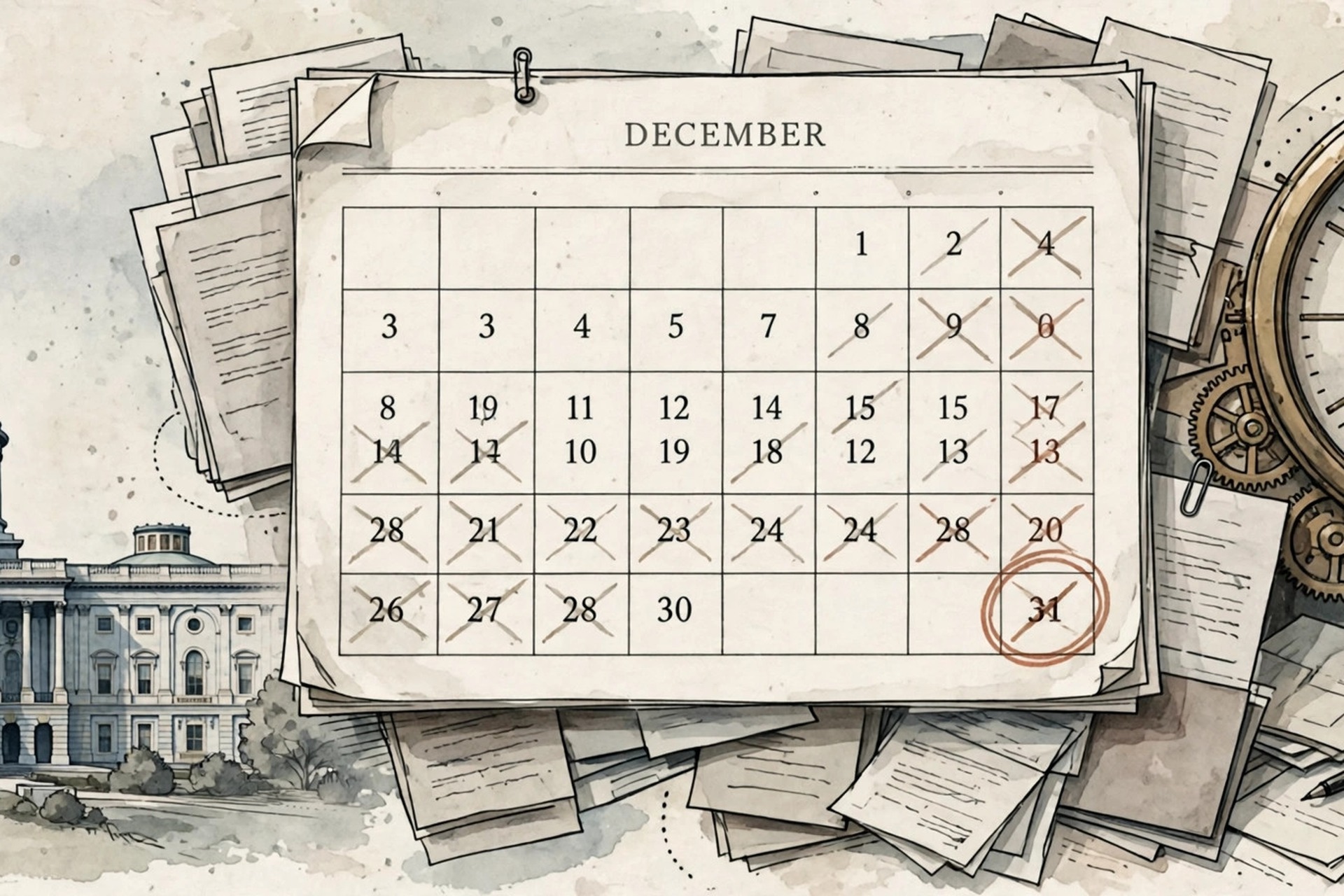
Congress will return after the midterm elections facing a crowded and interconnected year-end agenda, and the most immediate deadline is December 11, 2026, when the current continuing resolution expires. The lame-duck session, which begins on November 9, six days after Election Day, and is expected to run until Christmas, with a Thanksgiving break in between, will require action, or at minimum another temporary extension, on government funding, surface transportation programmes, portions of the Farm Bill, several healthcare programmes and other expiring authorities. At the same time, leaders will try to complete the fiscal year 2027 National Defense Authorization Act, the Water Resources Development Act, permitting legislation and potentially a year-end tax package. None of these items is small on its own, and together, they compete for the same scarce resource, floor time, in a session whose members include people who have just lost re-election or are retiring.
A lame-duck session is defined by that calendar. It is the period between Election Day and the new Congress taking office in January, when outgoing members still vote, and it could be the last weeks of unified Republican control of Congress and the White House, depending on the election result. If control of either chamber changes, incoming majority leaders may prefer to postpone major decisions until they can set the agenda in January, which would push difficult choices into the new Congress. If control does not change, the lame duck may be the best chance to finish bills that have been negotiated for months. Either way, the December 11 funding deadline does not move: without full-year appropriations or another stopgap, funding lapses, and a partial government shutdown becomes possible. That is the hard edge against which every other year-end negotiation will be measured.
The funding picture is stark in its incompleteness. Neither chamber has finished any of the 12 full-year appropriations bills for fiscal year 2027, according to pre-election summaries, although the House has passed three and the Senate has not passed any, and the chambers have not agreed on topline spending numbers. The September continuing resolution keeps prior-year spending levels in place, which is why agency operations, passport offices and benefit payments have continued during the campaign recess, but that resolution expires on December 11. Leaders have three broad options: an omnibus bill combining all 12 spending bills, a shorter-term continuing resolution into January or March 2027 accompanied by narrowly tailored extensions, or a split approach in which some bills, such as defence, are completed while others are extended. Each option has a different political cost, and the choice will depend on election result, on whether the parties can agree on spending levels, policy riders, defence funding, healthcare and administration authorities, and on how much time leaders are willing to spend on appropriations versus other must-pass bills.
December 11 funding expiry and the partial shutdown risk
A partial government shutdown remains possible if the parties cannot resolve those disputes before December 11, as law firm Holland and Knight’s October outlook warned, and as other year-end analyses have echoed. The word partial matters: a funding lapse does not shut down every federal function, because some programmes are funded by mandatory spending, fees or prior appropriations, and essential personnel continue to work, often without pay until funding is restored. But a lapse does disrupt services, furlough non-essential staff, delay payments and contracts, and create uncertainty for state and local governments that depend on federal funds. The main fight, according to the No Labels year-end summary, is over defence: the Trump administration wants a record 1.5 trillion dollars for defence, which Senate Democrats reject, although other summaries put the topline dispute in broader terms, including domestic spending levels and rescissions. Readers should treat the 1.5 trillion dollar figure as the administration’s request as reported in that summary, not as an agreed topline, because the Senate has not yet agreed on topline numbers.
The surface transportation deadline runs on the same date. Surface transportation programmes are currently extended through December 11, 2026, and without agreement on a longer-term reauthorization, Congress could turn to another short-term extension to maintain highway and transit programmes. That pattern, a short extension bundled into a second continuing resolution, is one Congress has used repeatedly in the 2010s, and Holland and Knight’s outlook suggests it is likely again, given the lack of Senate movement and the number of other issues pushed to the lame-duck calendar. A short extension avoids a cliff, but it also postpones the harder decisions about long-term funding for roads, bridges and transit, and it leaves state transportation agencies planning on a short horizon, which can delay projects that need multi-year certainty.
Healthcare extenders add another layer of December pressure. Several federal healthcare authorities and funding provisions expire on or before December 31, creating pressure for an extension package, and the No Labels summary notes that healthcare will be a significant component of year-end negotiations. The details of which programmes expire on which dates vary, and they are often bundled into a larger year-end vehicle, which means that a healthcare provision’s fate can depend less on its own merits than on whether it can ride along on a funding or defence bill that is moving. That bundling is normal in a lame duck, but it also means that readers should be cautious about headlines that present a healthcare extension as a standalone decision: in December, most decisions are package decisions.
NDAA, WRDA and the Farm Bill in the lame duck
The National Defense Authorization Act for fiscal year 2027 is the most likely large bill to clear both chambers in the lame duck, according to the same outlook, because committee work is largely complete and Congress has passed an NDAA every year for more than six decades. The House passed its version by a largely party-line 216-212 vote, while the Senate version stalled in July over topline numbers and major initiatives, and floor action is expected in the week of December 7. The NDAA sets Pentagon policy, including pay tables, housing allowances and procurement accounts for shipyards and munitions plants, and a delay past Christmas would not stop troop pay but would stall new-start contracts and policy changes. The bill’s streak, more than 60 years without a miss, is a powerful incentive to finish it, but it is not a guarantee: the defence topline dispute, and the question of whether the NDAA becomes a vehicle for other provisions, could still delay it.
The Water Resources Development Act of 2026 has made substantial progress toward enactment, as the biennial legislation authorising United States Army Corps of Engineers policy and projects. The House passed its bipartisan WRDA bill, H.R. 9497, by an overwhelming 415-9 vote on September 16, 2026, following unanimous approval by the House Transportation and Infrastructure Committee in July, and the Senate Environment and Public Works Committee separately approved its bipartisan WRDA bill, S. 4949, unanimously in July. The remaining work is primarily a bicameral reconciliation exercise, reconciling the two chambers’ project lists and policy provisions, which is the kind of work that can be done in a lame duck if leaders prioritise it, but which can also be crowded out by funding and defence fights. WRDA’s bipartisan margins in both chambers make it a plausible candidate for completion, and its project authorisations matter to communities waiting for flood control, navigation and ecosystem restoration work, even though authorisation is not the same as appropriation: a project authorised by WRDA still needs funding through appropriations to be built.
The Farm Bill presents a different kind of deadline, and a more consequential cliff. The legislation covers crop programmes and the Supplemental Nutrition Assistance Program, and it expired on September 30, 2026. Crop insurance and SNAP benefits continue for now, but conservation, research and rural development programmes face funding uncertainty, and if Congress does not act by December 31, farm programmes revert to permanent law written in the 1930s and 1940s, a set of outdated price-support formulas that no one intends to implement but that create legal pressure to act. The House passed a farm bill in April by 224-200, with 14 Democrats joining almost all Republicans, while the Senate has not passed a bill out of committee, and the parties remain divided, particularly over changes that would attempt to reduce SNAP error rates and require states to share in the administrative costs of providing SNAP benefits. Agriculture Committee leaders hope to complete a new Farm Bill before the end of the year, but the combination of a December 31 cliff, a divided Senate and a crowded calendar makes a full five-year bill a difficult lift in a lame duck, and a short extension is a plausible fallback.
Permitting, surveillance and the shape of a year-end package
Permitting reform is also queued for the lame duck, with a Senate vehicle tied to H.R. 2347, described in the Senate schedule as the Survivor Justice Tax Prevention Act but used as the legislative vehicle for permitting reform, with a cloture vote anticipated shortly after the November 9 return. Four senators introduced a bipartisan permitting bill before leaving for the campaign, and the Senate passed a college sports bill 77-22, both of which still need to pass the House. Those items illustrate how a lame duck can become a clearinghouse for bills that have bipartisan support in one chamber but have not yet been taken up in the other. Whether they move depends on whether leaders can find floor time and whether they can be attached to a moving vehicle without derailing it.
Two other items deserve mention because they show how wide the lame-duck agenda is. The surveillance authority known as FISA Section 702, which allows warrantless collection of foreigners’ communications abroad, lapsed in June 2026, although a court approval from March keeps collection going into early 2027, which reduces the immediate pressure but does not remove the need for reauthorisation. And Republicans have discussed a third budget reconciliation package, which would allow a bill to pass the Senate with a simple majority instead of the usual 60 votes, although reconciliation has its own procedural constraints and would require agreement on what it should contain. These items, like AI bills discussed elsewhere in this batch, are competing for the same December calendar, and not all of them can be completed.
For readers, the year-end agenda should be judged by what actually passes by December 11 and by December 31, not by what is promised in October outlooks. The most likely architecture, as Holland and Knight’s outlook put it, is either a full-year appropriations package, or a shorter-term continuing resolution into January or March 2027 accompanied by narrowly tailored extensions, with the NDAA and WRDA as the most plausible large bills to complete alongside it. A partial shutdown is possible, but it is not inevitable, and it is not the only risk: a lame duck that avoids a shutdown by passing only short extensions, and postpones the Farm Bill, permitting reform and healthcare extenders, would still leave major decisions for the new Congress on January 3. The calendar, in other words, forces a choice, but it does not force a particular outcome, and the election result on November 3 will shape which choice leaders make.
USN has previously reported on the lame-duck calendar, including Congress returning on November 9 to a crowded lame-duck session (https://usnbreaking.com/congress-returns-november-9-to-a-crowded-lame-duck-session-with-funding-deadline-december-11/), and on the defence bill, including the defence bill standoff and the risk to the 65-year NDAA streak (https://usnbreaking.com/defense-bill-standoff-congress-risks-ending-65-year-ndaa-streak-as-1-5-trillion-fight-drags-toward-thanksgiving/).
Sources
Sources: USN reviewed reporting from multiple outlets for this story. Read more from Holland and Knight (https://www.hklaw.com/en/insights/publications/2026/10/beyond-the-midterms-congress-faces-converging-year-end-deadlines), No Labels (https://nolabels.org/the-latest/the-2026-lame-duck-session-what-congress-still-has-to-pass-after-the-midterms/) and NSBA Advocate (https://nsbaadvocate.org/post/congress-faces-packed-year-end-agenda-after-midterm-elections).