

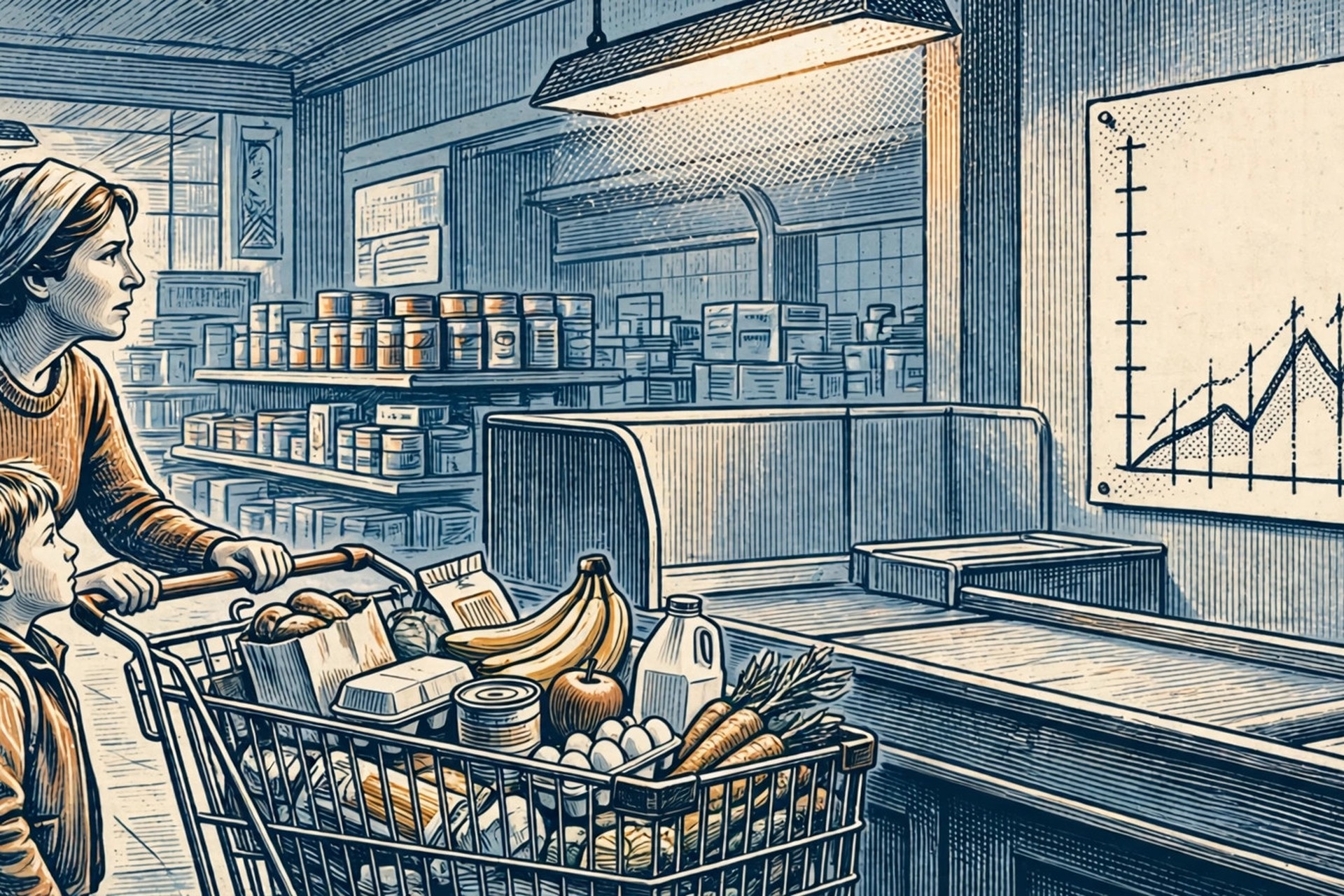
American consumers ended October feeling almost as gloomy as they have at any point in the survey’s 74-year history. The University of Michigan’s Surveys of Consumers reported a final Consumer Sentiment Index reading of 48.0 for October 2026, down a tenth of a point from 48.1 in September and only 3.2 points above the all-time low of 44.8 set in May. It was the second-lowest final reading on record, a result that captures, in a single number, the persistence of cost-of-living anxiety in American households even as the broader economy continues to produce jobs and spending. The survey does not measure economic output. It measures how people feel about their finances, and right now, on that measure, they feel squeezed.
The final figure was, in one sense, better than feared. The preliminary October reading had been 46.3, and economists polled by Reuters had expected the final number to match that preliminary figure. Instead, the final reading was revised up to 48.0, above every estimate in a Bloomberg survey of economists, with some forecasters having predicted as low as 46.0. The revision, however, did not change the story in any meaningful way. A tenth-of-a-point decline from September is, in the survey’s terms, essentially flat, and flat at 48.0 is still historically dreadful. Sentiment is now 10 percent below its level a year ago and 15 percent below February, just before the Middle East conflict that began with the Iran war in late February pushed energy prices sharply higher. The survey period for the final October reading ran from 22 September to 19 October.
Surveys of Consumers director Joanne Hsu summed up the finding in a sentence that has become the refrain of this economic moment: purchasing power continues to dominate consumer views of the economy. That phrase covers a bundle of everyday pressures that are easy to list and hard to escape. Prices are higher than they were before the pandemic-era inflation surge, and although the rate of price increases has eased from its peak, the level of prices has not come back down. Borrowing costs remain elevated, so a car loan, a mortgage or a credit-card balance costs more to carry. And gasoline, the price Americans notice most often because they see it posted on street corners, averaged 4.29 dollars a gallon in late October, according to AAA figures cited in reporting on the survey, roughly 43 percent higher than when the Iran war began. For many households, those three pressures together feel like a pay cut, whatever the official wage data say.
The details beneath the headline index show where the strain is concentrated. The Current Economic Conditions Index fell 8.3 percent in October, from 50.9 to 46.7. Hsu said that decline was driven entirely by buying conditions for durable goods, which plunged 18 percent to a record low. Durable goods are the big-ticket items households buy infrequently: cars, refrigerators, washing machines, furniture. When consumers say it is a bad time to buy those goods, they are usually saying two things at once, that prices are too high and that financing them is too expensive. Both complaints appeared in the October data. The survey found that 85 percent of consumers view now as a bad time to buy a house, with about 62 percent blaming high interest rates, up from 47 percent. A housing market in which most people think it is a bad time to buy is a market in which household formation, moves for work and the wealth-building that comes with ownership all slow down.
US consumer sentiment October 2026 and the inflation expectations problem
Inflation expectations, the survey’s most closely watched forward-looking component, moved in the wrong direction in October. Consumers’ expectations for inflation over the next year nudged up to 4.7 percent from 4.6 percent in September, while long-run expectations rose to 3.5 percent from 3.4 percent. Both are the highest since May, and both sit well above the Federal Reserve’s 2 percent target, a target inflation has now exceeded for more than five years. Year-ahead expectations stood at just 3.4 percent in February, before the conflict-driven energy shock, so the rise since then represents a substantial deterioration in how households think about the future path of prices.
That deterioration matters beyond household psychology, because inflation expectations can become self-reinforcing. Hsu addressed the risk directly in a special report published alongside the October survey, warning that after five years of above-target inflation, both short- and long-term expectations have ticked up in recent months, exposing risks that elevated expectations could become entrenched. The mechanism is familiar to economists: if workers expect higher prices, they press for higher wages; if businesses expect higher costs, they raise prices pre-emptively; and if both sides act on those expectations, inflation persists even after the original shock fades. Hsu drew a comparison with the 1960s to 1980s, when, with each successive inflationary episode, the trough in expectations was higher than the one before. The October data do not prove entrenchment, but they point in that direction, and that is why the Federal Reserve watches this survey as closely as it watches official price statistics.
There was one component that improved. The Index of Consumer Expectations, which captures how households feel about the future rather than the present, rose 5.4 percent to 48.8 from 46.3 in September. That improvement, however, starts from a very low base and leaves expectations still deep in pessimistic territory. Hsu also noted a political pattern in the October results: sentiment improved among both Democratic and Republican respondents compared with September, but those gains were offset by declining confidence among independent voters, leaving the overall index nearly unchanged. The partisan split is a reminder that sentiment surveys capture political mood as well as economic experience, and that the same economy can feel different depending on who is in the White House and how respondents feel about them. The independent voters’ decline is arguably the more economically informative signal, since it is less easily explained by partisan cheerleading.
The gap between sentiment and spending is one of the puzzles of the current economy, and October’s data sharpen it. Other economic data have shown real consumer spending rising, with one analysis noting a 0.6 percent monthly gain in August to 16.96 trillion dollars in real terms, the biggest monthly increase in 17 months. Americans, in other words, are spending more than ever while saying they feel worse than almost ever. Part of the explanation is composition: spending is concentrated among higher-income households with savings and asset wealth, while the sentiment survey weights all households equally, including those living pay cheque to pay cheque. Part of it is that spending on necessities is not optional: households must buy food, fuel and medicine whatever they think of the economy. And part of it is that sentiment captures expectations about the future, while spending captures decisions already made. A household can fill its petrol tank this week and still dread next month’s bills.
Cost of living anxiety for American households explained
The cost-of-living story behind the numbers is worth telling in concrete terms, because index points can feel abstract. Start with energy. United States crude oil prices exceeded 116 dollars per barrel in late October, a six-month high, and the pass-through to petrol prices is swift and visible. A driver who filled a 15-gallon tank at the late-October average paid roughly 64 dollars, against roughly 45 dollars at pre-conflict prices, a difference of about 19 dollars per fill-up, repeated week after week. For a household with two cars and a long commute, that alone can absorb a meaningful share of a monthly budget. Add grocery prices that remain well above their pre-pandemic levels, rents that have risen in most metropolitan areas, and insurance premiums that have climbed sharply, and the feeling of being squeezed is not a mystery. It is arithmetic.
Borrowing costs add a second layer. When the Federal Reserve raised interest rates to fight inflation, it made mortgages, car loans and credit-card debt more expensive, and those rates have come down only slowly. A household that could have financed a car at a low rate a few years ago now faces a monthly payment hundreds of dollars higher for the same vehicle. The survey’s record-low reading on buying conditions for durable goods reflects exactly that calculation: households are not refusing to buy because they do not want a new refrigerator or a reliable car, but because the combination of price and financing makes the purchase feel unaffordable. The 62 percent of respondents who blame high interest rates for the bad time to buy a house are making the same calculation at a larger scale, since a one-percentage-point difference in mortgage rates can change a monthly payment by hundreds of dollars.
Official price data confirm that the squeeze is real, even if it is not accelerating as fast as it once was. Federal government data showed prices rising 3.7 percent year over year in September, the latest month for which figures were available when the sentiment survey was released. That is a substantial rate by the standards of the pre-pandemic decade, when annual inflation typically ran near 2 percent, and it means that a household whose income rose by 2 percent over the year still lost purchasing power. The survey’s finding that sentiment is 10 percent below a year ago, when the index stood at 53.6, is consistent with that arithmetic: households are not imagining the erosion of their budgets, they are reporting it.
What makes the October reading historically notable is its company. Five of the six lowest readings on record have now come in 2026, according to one analysis of the survey’s history. The previous record low before this year dated from the pandemic-era inflation surge, and the survey’s long history includes recessions, oil shocks and financial crises. That a year without a recession, with unemployment still relatively low by historical standards, should produce sentiment readings clustered at the bottom of the distribution tells us something about the particular character of this downturn in mood: it is driven less by job loss than by the price level. People who have jobs but cannot afford what their incomes bought a few years ago feel worse, in survey terms, than people in some past recessions who lost jobs but faced stable prices. That distinction matters for policy, because the tools that fight unemployment are not the same as the tools that restore purchasing power.
What happens next for consumer confidence
The next data point comes soon. The university’s preliminary November reading is scheduled for Friday 6 November, and it will show whether October’s near-record gloom was a plateau or a staging post for something worse. A sustained reading near 48 would suggest that households have settled into a grim equilibrium, spending because they must while expecting prices to keep rising. A further fall towards the May low of 44.8 would suggest that the pressures of late October, including energy prices and borrowing costs, are still tightening. A rebound would need a visible trigger, such as a fall in petrol prices, a clear easing in inflation data, or a drop in interest rates that households actually feel in loan offers. None of those triggers was visible in the October survey window.
For policymakers, the October survey presents an uncomfortable combination. The Federal Reserve must weigh the risk that cutting interest rates too soon could entrench the very inflation expectations Hsu warned about, against the risk that holding rates high prolongs the affordability squeeze that is depressing sentiment and, in particular, housing activity. For the administration, the survey is a reminder that voters experience the economy through prices, not through aggregate statistics, and that affordability, the word that recurs in every discussion of this survey, is not an abstract theme but a daily calculation at the checkout and the petrol pump. For businesses, the record-low buying conditions for durable goods are a warning that big-ticket demand may stay soft until financing costs fall or prices adjust, whatever headline spending figures suggest.
For households, the practical implication is less about forecasting than about the texture of daily life that the survey captures. Sentiment at 48.0 does not mean Americans have stopped living their lives. It means they are living them with a constant awareness of cost: delaying a car purchase, repairing rather than replacing an appliance, choosing a cheaper grocery brand, thinking twice about a move. Those are the decisions that, aggregated across millions of households, produce both the spending data and the sentiment data, and they are the reason a survey that asks people how they feel can tell us something that output statistics alone cannot. The economy, in October 2026, is not mainly a story of collapse. It is a story of endurance under pressure, and the pressure, as measured by the University of Michigan, has barely eased at all.
Sources
USN reviewed reporting from multiple outlets for this story. Read more from TheStreet [LINK: https://pro.thestreet.com/market-commentary/consumer-sentiment-revised-up-but-still-second-worst-ever-as-inflation-fears-climb], The Digital Free Press [LINK: https://www.thedigitalfreepress.com/post/consumer-sentiment-near-record-low-october-inflation-expectations] and Business News Malaysia [LINK: https://businessnews.com.my/us-consumer-sentiment-october-final/].