

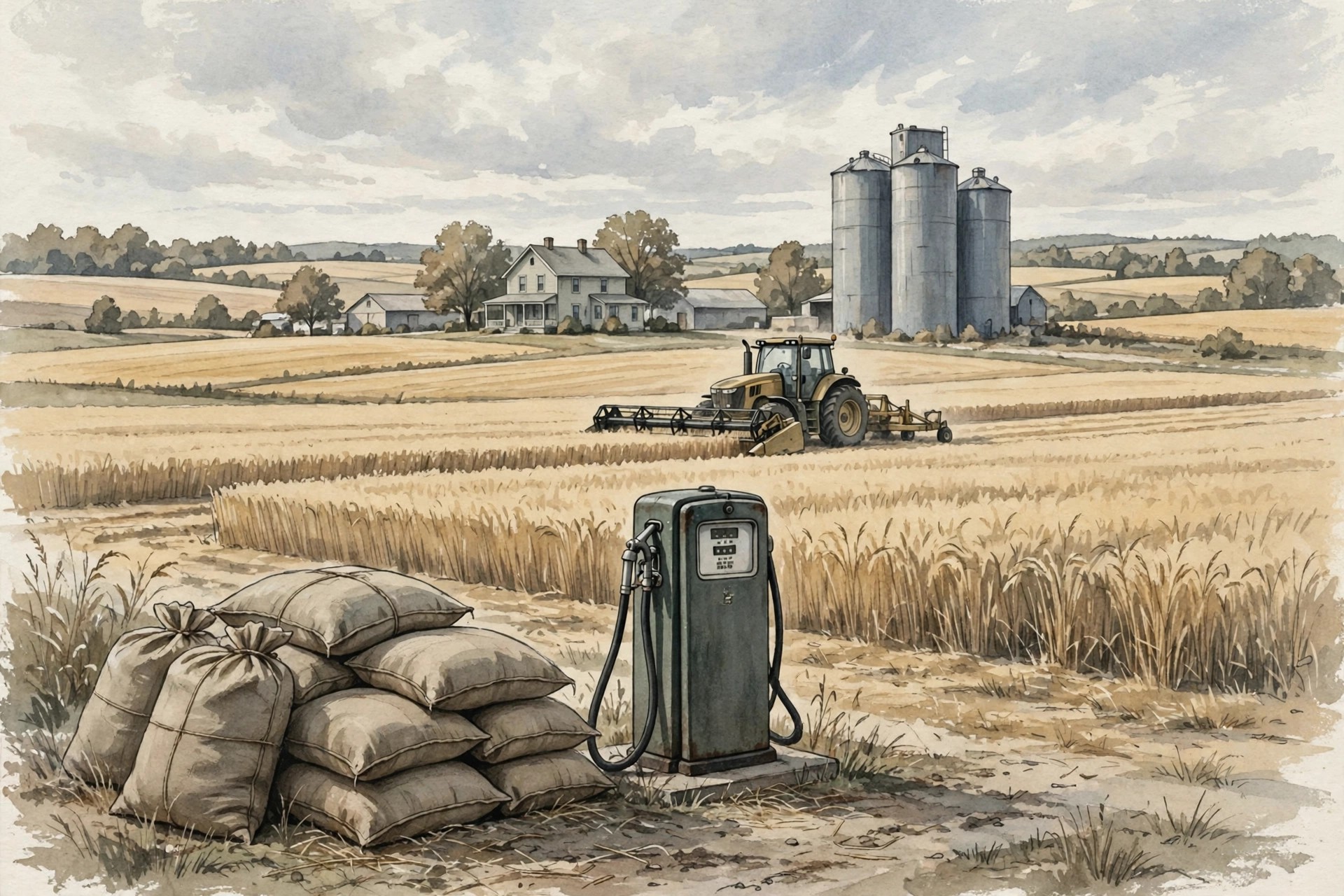
The Trump administration has promised more than 15 billion dollars in payments, loans and other initiatives to American agriculture producers in the weeks before the November 3 midterm elections, in a package intended to offset sharply higher diesel and fertilizer costs that farmers have largely blamed on the administration’s tariffs and the war involving Iran. The total, tallied by the Associated Press from Department of Agriculture announcements, is a promise, not money already in farmers’ bank accounts, and that distinction runs through the whole story. The largest piece, an 8 billion dollar one-time payment programme for diesel costs, has been announced but its commodity-specific payment rates had not yet been released, and the department had not said when farmers would actually receive the money. For producers facing harvest-season bills now, the timing matters as much as the headline total.
The centrepiece is the Harvest Fuel Relief programme, unveiled on October 19, 2026. It is a one-time payment to farmers this harvest season to offset market disruptions and higher input costs, calculated with a uniform formula covering part of modelled losses for the 2026 crop year. The calculation uses planted acreage reported to the Farm Service Agency, cost-of-production estimates from the Economic Research Service, and yield and price figures from the department’s monthly supply and demand estimates. Producers of the main programme commodities are to receive rates first, with the department saying those rates would be released in November, while a method for specialty crops, fishing and other producers would come later. The application period had not yet been announced, and enrolment in crop insurance is not required, which widens eligibility but also leaves producers waiting for the practical details of how to claim.
President Donald Trump announced the programme at a rally in Kansas, telling the crowd that the Department of Agriculture would launch a new harvest fuel relief programme providing farmers with 8 billion dollars in support to offset diesel costs during the harvest season. Agriculture Secretary Brooke Rollins has described the initiative as a major investment in the sector. The political context is unavoidable: the announcement came in the final weeks of a midterm campaign in which traditionally Republican agricultural states such as Iowa and Kansas have seen closely contested races, and Trump visited both states on the Sunday before the election, two days before voters went to the polls. Supporters argue that the timing reflects a genuine harvest-season need, not merely a campaign calendar, because diesel and fertilizer bills arrive in the autumn regardless of elections. Critics argue that a package announced in the closing weeks of a campaign, with payment dates still unspecified, should be judged by what is delivered, not by what is promised.
What the Trump farmers 15 billion aid package contains
Beyond the 8 billion dollar fuel relief programme, the package tallied by the Associated Press includes at least 5 billion dollars in guaranteed loans for ranchers and fishermen, 1.8 billion dollars in payments for producers and landowners participating in conservation programmes, 573 million dollars for fertilizer manufacturing projects, 86.6 million dollars in grants for specialty crop innovation, and 57 million dollars to expand meat-processing capacity. Those components are not all the same kind of help, and conflating them would mislead readers. A guaranteed loan is not a grant: it helps a borrower obtain credit on better terms, but it must be repaid, and its value depends on whether a rancher or fisherman can use the credit profitably. A conservation payment rewards practices already undertaken or to be undertaken under a programme, while a fertilizer manufacturing grant is aimed at domestic production capacity over a longer horizon than a single harvest. The 15 billion dollar total is therefore a sum of different instruments, announced at different times, with different delivery timelines, rather than a single cheque to farmers.
Separately, and not counted in the 15 billion dollar total, the Department of Agriculture plans 13.8 billion dollars in safety-net programme payments for eligible producers for the 2025 crop year, offsetting shortfalls for farmers who grow key crops such as corn, soybeans, wheat and rice. Those safety-net payments arise from established programmes, not from the new pre-midterm announcements, and they should not be added to the 15 billion dollars to produce a larger headline figure. The department also announced, on the Thursday before the Associated Press tally, that it would purchase up to 472.5 million dollars in agricultural commodities to support producers and give food to charitable programmes. Other measures in the package include expanding sales of a diesel normally used only for off-road use, helping ranchers by making cattle sale data more transparent, and strengthening wolf management policies to protect livestock. The money will primarily come from the Department of Agriculture and does not need immediate congressional approval, according to the Associated Press account, which is why the administration could announce it without a new farm bill or appropriations act.
The cost pressure behind the aid is visible at the pump and in farm budgets. Diesel averaged 6.32 dollars a gallon on the Friday before the tally, according to AAA data cited by the Associated Press, slightly below a September peak but about 70 percent higher than a year earlier. Filling a 100-gallon tank costs about 260 dollars more than it did a year ago, a figure that scales quickly for a farm running trucks, tractors and combines through harvest. The Department of Agriculture forecasts that production expenses will rise 4.5 percent to 492.8 billion dollars this year, including fertilizer costs up 15.3 percent and fuel expenses up 28.8 percent, while inflation-adjusted net farm income is expected to decline 5.5 percent. Those forecasts explain why even a large aid package may feel inadequate to producers whose margins have been squeezed from both sides: higher input costs and, for some, weaker export demand amid trade tensions with China, which last year led to a near boycott of United States agricultural goods, according to the Associated Press.
Why farmers blame tariffs and the Iran war for costs
Farmers have largely blamed the higher diesel and fertilizer prices on the Trump administration’s tariffs and the war involving Iran, the Associated Press reported, and that attribution deserves careful presentation. It is a claim about causation made by producers and reported by the press, not a settled econometric finding that tariffs or the war alone explain the full price increase. Diesel prices are influenced by global crude markets, refining capacity, seasonal demand and geopolitical risk, as well as by domestic policy, and fertilizer prices are influenced by natural gas costs, global supply chains and trade flows. Tariffs can raise the cost of imported equipment, parts and some inputs, and trade tensions can reduce export demand, which in turn affects farm income even if input prices are unchanged. The war involving Iran can raise energy risk premiums and disrupt shipping, which can feed through to fuel prices. The administration’s supporters argue that other factors, including global markets and prior policy, also contribute, and that the aid package is a response to a global cost shock, not an admission that domestic policy caused it. Readers should hold both parts of that debate in mind: the cost increase is documented, while the precise share attributable to any single cause is contested.
Kansas State University farm management specialist Gregg Ibendahl, quoted by the Associated Press, estimated that the payments could more than cover the increase in fuel costs, and that the money could help with high fertilizer prices. That assessment, if borne out by the eventual payment rates, would mean the fuel relief programme is, for many producers, more than a token gesture. But Ibendahl also cautioned, in related coverage, that the payments do not address the broader forces driving prices higher, a point that economists have echoed more generally: temporary payments cannot resolve structural pressures on rural producers, including energy prices, input markets and export demand. A one-time payment helps with this harvest’s diesel bill; it does not lower next year’s fertilizer price, restore a lost export market, or change the cost of equipment. That limitation does not make the aid worthless, but it does set a limit on what it can achieve, and it is the reason farm groups tend to judge aid packages alongside longer-term policy, including trade, energy and the farm bill, rather than in isolation.
The political question is whether the package will affect rural voting, and that question is, by its nature, unproven before the election. Traditionally Republican seats in farm states have become more competitive in 2026, for reasons that include rising farming costs and opposition to the administration’s immigration crackdown, as well as the war and its effect on fuel prices. A farm aid announcement in the final weeks of a campaign can be read, by supporters, as responsive government helping a constituency under strain, and by critics, as an attempt to buy goodwill with promises whose delivery dates are still unknown. The honest position, before votes are counted, is that the package’s electoral effect is uncertain, and that it will be judged in retrospect alongside other factors, including candidate quality, local races and turnout. What is certain is that the package has changed the policy conversation in farm states from abstract trade and energy debates to a concrete question: when will the money arrive, how much will each producer receive, and will it be enough to cover the diesel bill that is already due?
What farmers should watch next
The next concrete steps are administrative, not political, and they are the steps producers should track. First, the Department of Agriculture’s release of commodity-specific payment rates in November, which will show how the uniform formula translates into dollars per acre or per unit for the main commodities. Second, the opening of the application window, which had not been announced at the time of the Associated Press tally, and the guidance on what documentation producers will need to provide. Third, the method for specialty crops, fishing and other producers, who are promised a later announcement and who should not assume that the main-commodity rates apply to them. Fourth, the delivery of the guaranteed loans, conservation payments and other components, each of which has its own eligibility rules and timelines. Producers who need help now should contact their local Farm Service Agency office for the latest guidance, rather than relying on rally announcements or headline totals, because the department’s published rates and application instructions, when they appear, will be the authoritative source.
For the wider public, the farm aid package is a useful case study in how to read pre-election economic announcements. A total that combines grants, loans, purchases and manufacturing grants is not the same as cash in hand. A programme announced in October, with rates due in November and no application date yet, is not the same as a programme already paying out. And a package that is additional to, but separate from, established safety-net payments should not be merged with those payments to inflate the total. None of that means the package is insignificant: 15 billion dollars in announced help, led by an 8 billion dollar fuel relief programme, is a large intervention in a sector under real cost pressure, and if the rates and delivery match the announcement, it will ease a difficult harvest for many producers. But the test of the package will be in November’s rates, in the application window, and in the bank accounts of farmers, not in the announcement itself.
USN has previously reported on farm policy and the lame-duck calendar, including Congress returning on November 9 to a crowded lame-duck session, which frames the farm bill debate that will follow the election, and on the midterm campaign, including Trump’s affordability closing pitch before the November 3 midterms.
Sources
USN reviewed reporting from multiple outlets for this story. Read more from Associated Press via The Week, Firstpost and The Manila Times.