

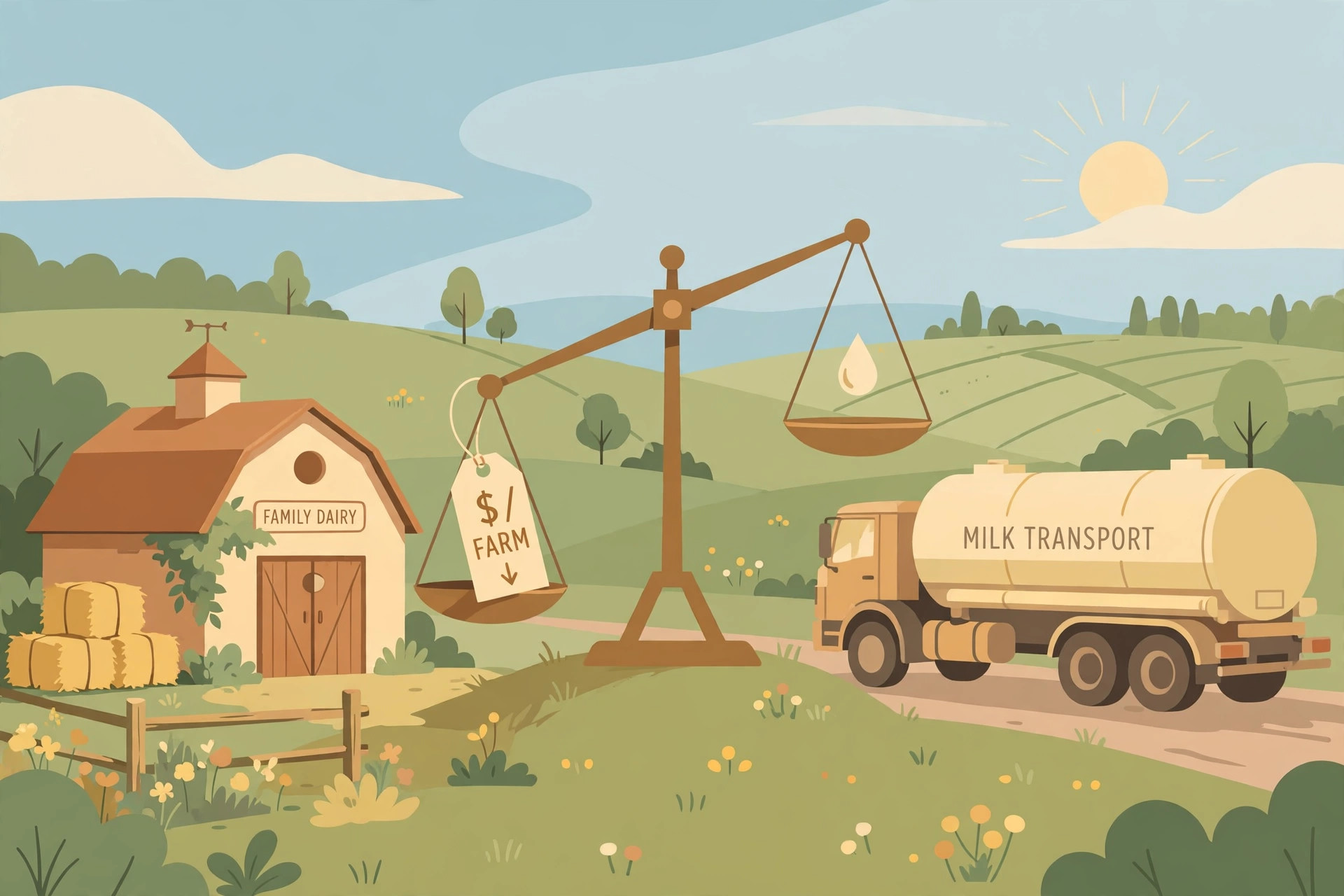
A coalition of farm, rural, labour, processor and environmental organisations is pressing Congress to act on a Senate bill that would fundamentally change how milk prices are set in the United States, arguing that family dairy farms cannot survive under a pricing system that routinely pays them less than it costs to produce milk. The bill at the centre of the campaign is S. 4906, the Milk from Family Dairies Act, introduced in the Senate in June 2026 and referred on 24 June to the Senate Agriculture Committee. On 23 October 2026, the National Family Farm Coalition, together with eighty-seven farmer, rural, labour, processor and environmental organisations, sent a letter to congressional agriculture leaders demanding swift action on the measure. Wisconsin farm advocates joined the push around 29 October, adding a Midwestern voice to a campaign that began, in legislative terms, in Vermont. As of 2 November reporting, no hearing had been held on the bill. It remains a marker bill awaiting committee action, not a law, and not yet an amendment to the Farm Bill, and any reporting that describes it otherwise would misstate its status.
The bill’s lead sponsor is Senator Peter Welch, a Democrat from Vermont, and its cosponsor is Senator Bernie Sanders, an Independent from Vermont who caucuses with the Democrats. That Vermont pairing is not incidental. Vermont is a small state with a dairy industry that is culturally and economically central, and its delegation has long argued that national dairy policy, designed around large-scale production and complex pricing formulas, disadvantages smaller family operations. The bill’s supporters present it as a correction to decades of consolidation, in which larger operations have grown, smaller farms have closed, and the price paid to farmers has failed to keep pace with the cost of feed, labour, equipment, veterinary care and other inputs. The opposition, led by the National Milk Producers Federation, presents a different view, warning that the bill’s approach would distort markets and create new problems of its own. The debate, in other words, is not between supporters of farmers and opponents of farmers, but between two different accounts of what would actually help farmers survive.
The scale of farm loss cited by supporters is stark, and it should be attributed to its source rather than presented as an undisputed census. According to figures from Senator Welch’s office, cited in reporting on the bill, seventy-five percent of United States dairy farms have shuttered since 2000. The same office is cited for the figure that Vermont has lost more than forty percent of its dairy farms in the past decade. Those figures, if accepted, describe a transformation of rural America that goes far beyond one commodity: closed barns, sold herds, lost processing capacity in small towns, and a generation of farm families leaving an industry their parents and grandparents worked. Critics of the bill do not necessarily dispute that farms have closed, but they do dispute the cause and the cure. Consolidation has many drivers, including technology, economies of scale, changing consumer demand and the structure of processing markets, and a price floor alone, critics argue, may not address all of them, and may create incentives that work against its own goals.
What the Milk from Family Dairies Act would do
The bill’s central mechanism is a minimum, or floor, price for milk, set by the United States Department of Agriculture. Unlike the current federal milk marketing order system, which uses complex formulas based on end-product prices and regional pooling, the proposed floor would be based, in the bill’s design, on herd size and on production costs. The idea is that a farmer’s costs should be the starting point for the price they receive, rather than a residual left over after processors, retailers and market formulas have taken their shares. A floor tied to costs would, in supporters’ telling, give family farms a predictable minimum return, allowing them to plan, invest and survive periods when market prices fall below the cost of production. That predictability is presented as the bill’s main virtue, and it is the feature that distinguishes it from emergency payments, disaster assistance or ad hoc support, all of which arrive after losses have already occurred.
Alongside the price floor, the bill would allocate production allowances to individual farms, with fees charged on production above the allowance. This is a supply management tool, and it is essential to understanding how the floor is supposed to work. A price floor on its own, without any control on supply, risks encouraging overproduction: if every farmer is guaranteed a minimum price, every farmer has an incentive to produce more, which increases supply, depresses market prices and increases the cost of maintaining the floor. Production allowances are intended to prevent that spiral by giving each farm a defined share of production, and by charging a fee on output beyond that share. Supporters argue that this combination, a floor plus managed supply, matches production to demand and prevents the boom-and-bust cycles that have characterised dairy markets. Opponents argue that allowances freeze the industry in place, penalise growing farms, and create a bureaucratic system for allocating production rights that will be contested, gamed and litigated.
The bill would also create a Dairy Market Stabilization Program within the Department of Agriculture, advised by a producer-led National Dairy Producer Board and by regional boards. The emphasis on producer leadership is deliberate. Current dairy policy is often described, by its critics, as a system in which farmers are price-takers, with limited influence over the formulas that determine what they are paid. A producer-led board is intended to reverse that dynamic, giving farmers a formal role in advising on how the stabilisation programme operates, how allowances are set, and how the system responds to changing market conditions. Regional boards would, in the same logic, allow for differences between dairy regions, where costs, herd sizes, climates and processing infrastructure vary widely. Whether such boards would in practice empower small farmers, or whether they would be captured by larger interests, is a question that cannot be answered from the bill’s text alone, and it is one of the points on which supporters and sceptics are likely to disagree most sharply.
Why supporters say the current system fails family farms
Supporters’ case rests on a simple claim: for years, and in their telling for decades, the price paid to farmers for milk has been below the cost of producing it. A business that sells its product below cost cannot survive indefinitely, whatever its efficiency, unless it has other income, off-farm employment, or subsidies to bridge the gap. Many family dairy farms have done exactly that, with family members working second jobs, drawing on savings, or relying on off-farm income to keep the farm operating. That pattern, supporters argue, is not sustainable, and it is not a sign of a healthy industry. It is a sign of a pricing system that extracts value from producers and transfers it elsewhere in the supply chain. The price floor, in this account, is not a subsidy in the ordinary sense, but a correction: a requirement that the market pay at least what production costs, rather than allowing processors and retailers to benefit from prices that do not cover those costs.
The letter sent on 23 October, signed by the National Family Farm Coalition and eighty-seven other organisations, gives that argument a coalition form. The signatories are not only dairy farmers. They include rural organisations, labour groups, processors and environmental organisations, a breadth that supporters present as evidence that the issue extends beyond dairy barns. Labour groups have an interest because dairy workers’ wages and conditions are linked to farm viability. Environmental groups have an interest because the survival of smaller, pasture-based or diversified farms is linked, in their view, to land stewardship and rural landscapes, as opposed to ever-larger confined operations. Processors, particularly smaller ones, have an interest because the loss of local farms threatens their own supply base. The coalition is therefore making a broader claim: that dairy pricing is not a narrow commodity issue, but a question about what kind of rural economy and food system the country wants. That breadth helps the campaign politically, but it also means its signatories may have different priorities, and may disagree on details even while agreeing on the need for action.
Wisconsin’s involvement, reported around 29 October, adds weight to that claim, because Wisconsin is one of the largest dairy states, and its farm advocates speak from a position of scale as well as principle. A campaign led only by Vermont, however sympathetic, could be dismissed as a small-state issue. A campaign that includes Wisconsin advocates, alongside a national coalition, is harder to dismiss in those terms. It suggests that the pressures described by Vermont farmers, low prices, rising costs, consolidation and farm loss, are felt in the heart of American dairy country as well. That does not prove the bill is the right remedy, but it does suggest that the problem it addresses is not confined to one region or one kind of farm.
Opposition and caution: what critics say about the bill
The National Milk Producers Federation, which represents dairy cooperatives and producers, opposes the bill. Its opposition matters because it is not an outside industry voice, but an organisation that itself claims to speak for dairy producers, including many family farms. The existence of organised producer opposition alongside organised producer support is a reminder that dairy farmers are not a single bloc with a single view. Larger cooperatives, which handle milk from many farms and negotiate with processors, may see the bill’s supply management and price floor as a threat to their business model, to their members’ ability to grow, or to the competitiveness of American dairy exports. Smaller independent farms may see the same measures as protection. The debate within dairy farming is therefore as important as the debate between farmers and other interests, and any honest account must reflect that split rather than presenting one side as the voice of all farmers.
One critical analysis, reported in coverage of the bill, raises a specific technical point that deserves careful presentation. The analysis notes that the bill does not specify which measure of production cost the Department of Agriculture should use to set the floor, and that the choice matters enormously. Using a full economic cost measure, the analysis puts the figure at twenty-seven dollars and twenty-one cents per hundredweight for a two-hundred-cow herd, while using an operating cost only measure puts it at fourteen dollars and fifty-three cents per hundredweight for the same herd. Those figures are the analyst’s or critic’s figures, not prices stated in the bill itself, and they should not be reported as the bill’s own prices. Their significance lies in the gap between them: a floor set on full economic cost would be far higher, and far more expensive to maintain, than a floor set on operating cost alone. Supporters might respond that the Department of Agriculture, advised by producer boards, is the right body to make that choice, and that flexibility is a virtue. Critics might respond that leaving so consequential a choice unspecified makes it impossible to judge the bill’s cost, its effect on consumer prices, or its effect on trade. Both points are legitimate contributions to the debate, and the bill’s future will depend in part on whether its sponsors address the ambiguity or leave it to be resolved in implementation.
Other cautions follow from the same logic. A price floor that raises farm-gate prices could raise retail prices for milk, cheese and other dairy products, affecting consumers, particularly low-income households, and food assistance programmes. It could affect exports, if American dairy becomes more expensive on world markets, and it could invite challenges under trade rules. It could also, as noted, encourage production beyond allowances if enforcement is weak, or penalise efficient farms if allowances are rigid. None of these cautions, on their own, proves the bill unworkable, and supporters would argue that the current system already imposes costs, on farmers, rural communities and taxpayers through ad hoc support, that are simply less visible. But they do explain why a bill with eighty-seven organisations behind it has not yet received a hearing: in Congress, a proposal that reorganises a major commodity market, creates a new programme and a new board structure, and raises questions about costs and trade, faces a high bar for committee action, even when its moral case is strong.
Status: a marker bill, not a law, and what comes next
As of 2 November reporting, S. 4906 has been referred to the Senate Agriculture Committee and has not received a hearing. It has not been passed by the Senate, it has not been considered by the House, and it has not been signed into law. It is not, at this stage, an amendment to the Farm Bill, although supporters may seek to advance its principles through Farm Bill negotiations or through future standalone action. Describing it as law, as imminent, or as already changing the price farmers receive would be incorrect and would mislead the very farmers it is intended to help. Its status as a marker bill is not a criticism. Marker bills are a normal part of congressional practice: they stake out a position, build a coalition, create a text for debate, and provide a vehicle that can be moved if political conditions change. Many major reforms began as marker bills that waited for years before finding a legislative vehicle. Others never moved beyond that stage. Which fate awaits this bill cannot be known from its introduction alone.
What comes next will depend on several factors outside the bill’s text. The Senate Agriculture Committee’s agenda, the progress of Farm Bill reauthorisation, the state of dairy markets, and the ability of the coalition to sustain pressure beyond a single letter will all matter. The October letter is a step in that process, not its conclusion. If the coalition can keep the issue visible, attract additional Senate cosponsors, and persuade committee leadership to hold a hearing, the bill will move from a statement to a subject of formal scrutiny, where its cost estimates, its allowance mechanism and its board structure can be tested in public. If it cannot, it will remain a marker, useful for signalling and organising, but not changing prices. For family dairy farmers deciding whether to invest, expand, sell or retire, that distinction matters enormously, and it is the distinction this article has sought to keep clear throughout.
For readers following congressional action on agriculture and food policy, the dairy bill sits alongside other recent bills that test how Congress balances market power, producer income and consumer prices. USN has previously reported on a bipartisan bill to protect safety-net drug discounts, including the Protect 340B Act of 2026, and on a bill to change merger settlement transparency, including the Antitrust Accountability and Transparency Act. Those measures, like the dairy bill, raise the same underlying question in different sectors: who sets the terms on which producers, consumers and large intermediaries meet, and what role should Congress play in setting them?
Sources
USN reviewed reporting from multiple outlets for this story. Read more from Global Agriculture, Food Navigator and Senator Peter Welch.