

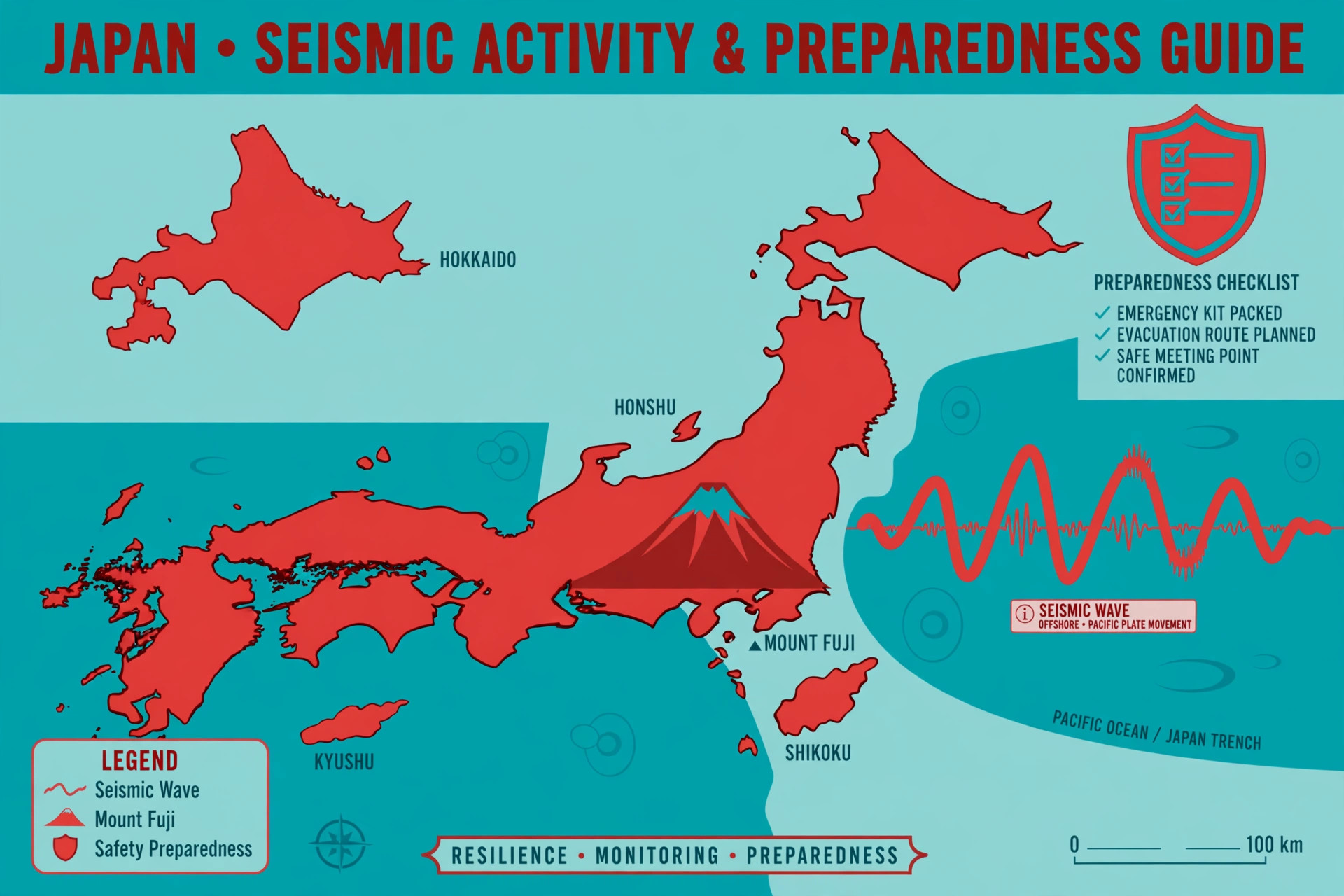
Japan launched a new National Disaster Management Agency on Monday, November 2, 2026, creating a single, expanded command centre for the country’s preparations for the disasters it fears most: a Nankai Trough megaquake, a major earthquake directly beneath the Tokyo metropolitan area, and an eruption of Mount Fuji. The agency, also rendered in some reporting as the Disaster Prevention Agency, was reorganised and upgraded from the disaster management division of the Cabinet Office, with a larger staff and a larger budget than the unit it replaces. Its creation marks a structural change in how Japan organises for catastrophe, moving disaster work from a division inside a general government office into a dedicated agency whose sole job is the full cycle of disaster management.
The agency is headed by the Prime Minister, Sanae Takaichi, and its day-to-day oversight falls to Goshi Hosono, appointed as Japan’s first disaster management minister, who also serves as Reconstruction Minister. That dual role is deliberate: Hosono already carries responsibility for recovery from past disasters, and the new post adds preparation and emergency response to the same portfolio, so that the official who plans for the next disaster is also the official who has overseen rebuilding after previous ones. The agency’s staff numbers about 350 people, a figure that gives it substantially more capacity than its predecessor division, though still a modest headquarters for a task that spans a nation of more than 120 million people, thousands of municipalities and some of the world’s most closely studied seismic and volcanic hazards.
Its remit covers the whole arc of a disaster, rather than a single phase. It is responsible for preparation before an event, for emergency response and assistance while an event is unfolding, and for restoration and reconstruction afterwards. In practice, that means the same agency that helps households and local governments prepare stockpiles and evacuation plans will also coordinate rescue and relief in the first hours and days after a quake or eruption, and will stay involved as communities rebuild homes, infrastructure and livelihoods over months and years. The intention is to end the fragmentation that can occur when preparation, response and recovery sit in different offices with different chains of command, and to give Japan a single centre that can be held accountable for the entire cycle.
Japan’s new disaster agency and the Nankai megaquake scenario it is built for
The scenarios the agency is built around are government assessments of what could happen, not predictions that any of these events is about to occur. That distinction is central to the launch, and it was stressed repeatedly by Hosono himself. The most severe scenario is a megathrust earthquake along the Nankai Trough, the offshore fault zone south of central Japan where the Philippine Sea Plate is forced beneath the Eurasian Plate. Government estimates for such an event put deaths at about 298,000, evacuees at about 6.5 million, and homes lost at about 2.35 million. Those figures describe a catastrophe on a scale that would overwhelm any single prefecture or municipality, and they explain why the response plan for the Nankai event runs to 106 separate items, spanning evacuation, medical care, transport, food and water supply, temporary housing and the restoration of lifeline infrastructure.
The second scenario is an earthquake directly beneath the Tokyo metropolitan area, the densely populated capital region where tens of millions of people live and work and where the national government itself is headquartered. Government assessments for a direct Tokyo quake put deaths at about 18,000 and evacuees at about 4.1 million. The death toll is far lower than for the Nankai scenario, largely because a Tokyo quake would not generate the same scale of tsunami, but the disruption would still be immense: collapsed and damaged buildings, fires, broken transport networks, and millions of people unable to return home or reach workplaces in a city that depends on trains running on time and on infrastructure functioning at full capacity. A disaster that strikes the capital is also a disaster that strikes the centre of government, which is one reason a national command agency, rather than a purely local response, is seen as necessary.
The third scenario is an eruption of Mount Fuji, Japan’s most famous volcano. Fuji last erupted in 1707 and remains monitored, but a modern eruption would affect about 790,000 people and homes, according to the assessments cited at the launch, and disrupt transport and power across a wide area. Ashfall is the principal threat for much of the affected population: ash can close roads and airports, short-circuit power systems and contaminate water supplies. Fuji’s inclusion signals that the agency’s remit covers the full range of natural hazards, not seismic risk alone.
Long-term probabilities cited at the launch underline why Japan treats these scenarios as planning necessities. The probability of a Nankai megaquake within thirty years is cited at 60 to 90 per cent or more, while the probability of a direct Tokyo earthquake is cited at about 70 per cent, on the time horizon reported. Those figures are not short-term forecasts, and they do not mean an earthquake is expected tomorrow or next year — only that, over a lifetime, the chance is high enough that failing to prepare would be a failure of a basic duty.
Goshi Hosono’s emergency request: stockpiles, furniture and evacuation routes
Alongside the launch, Hosono issued what was described as an emergency request to ministries, municipalities and ordinary citizens, setting out practical steps that households should take now. Families were urged to check whether their homes are resistant to earthquakes, to anchor furniture so that it cannot topple during shaking, and to review their evacuation routes so that they know where to go and how to get there without relying on a single road or bridge. Households were asked to stockpile at least three days’ worth of food, water and portable toilets, and preferably a full week’s supply, so that they can survive the period before outside help can reliably reach them. Homes built before 1981, when Japan’s building standards were significantly strengthened, were singled out for seismic assessments, because older construction is more vulnerable to collapse in strong shaking.
Ministries and prefectures were given a deadline of their own: they are to report progress by the end of the year on the 106-item Nankai response plan. That requirement turns a general call for preparedness into a measurable task, with a date by which central and local government must show what they have done. It also reflects a lesson from past Japanese disasters, in which the gap between a plan on paper and readiness on the ground has proved costly. A stockpile that exists only in a budget document does not feed anyone; an evacuation route that has never been walked may be blocked when it is needed most. By requiring a year-end report, Hosono is asking the bureaucracy to demonstrate, not merely to promise, that the Nankai plan is moving from document to reality.
Hosono was explicit that the request is not a warning that a disaster is imminent, and that point deserves emphasis because public reaction to disaster announcements can itself create harm. On October 29 and 30, Hosono said the request was not prompted by any information predicting a disaster, and Japan’s Meteorological Agency reported on October 7 that it had observed no unusual change that would raise the probability of a Nankai earthquake above its already-elevated long-term risk. In other words, the launch of the agency and the emergency request reflect long-standing risk and a new institutional capacity, not a new piece of intelligence suggesting that an earthquake or eruption is about to happen. Readers who encounter social-media claims that the government knows something it is not saying should weigh those claims against that explicit denial and against the Meteorological Agency’s own assessment.
Some online speculation has linked the stockpiling advice to fears of war or cyberattack, rather than to natural disaster. That is public speculation only, which Hosono has denied as the basis for the request. The request is framed in terms of earthquakes and volcanic eruption, and the stockpiles are standard provisions for surviving days without power, water or open shops after a natural disaster. Conflating it with unrelated security fears risks frightening people unnecessarily and distracting them from practical steps — anchoring furniture, checking a route, storing water — that would actually help if the ground shakes.
What the agency will do next, from regional bureaus to local offices
The agency’s own timetable extends beyond the launch day. Regional bureaus are to be sited by the summer of 2027, giving the agency a presence beyond Tokyo from which it can coordinate across prefectures in the first hours of a major event. Local bureaus are planned by the summer of 2028, extending that presence further into the communities that would bear the brunt of a disaster. The phased timetable recognises that an agency cannot be built overnight: staff must be recruited and trained, relationships with prefectures and municipalities must be established, and the regional and local offices must be equipped to function even when communications and transport are disrupted, which is precisely when they will be needed most.
For ordinary households, the launch carries a simpler message. Japan has lived with earthquakes and volcanoes throughout its recorded history, and has built one of the world’s most sophisticated systems for monitoring them and warning the public. What the new agency adds is a single, accountable centre for turning that knowledge into preparation, response and recovery. The emergency request — check the house, anchor furniture, know the route, store food, water and portable toilets for three days, preferably a week — is the household version of the same idea: small steps now, so a catastrophe finds people as ready as planning can make them. Related USN coverage: US Japan South Korea Arctic partnership pact signed in Atlanta. Related USN coverage: Ukraine peace deal gets closer as Oleshky ceasefire ends ahead of December G20.
The test of the new agency will not be its launch ceremony, but its performance in the first real emergency it faces, and in the quieter work between emergencies: the year-end Nankai report, regional bureaus by next summer, seismic assessments of pre-1981 homes, and household stockpiles that no headline will celebrate. If those tasks are completed, Japan will enter its next major disaster better prepared than before; if not, the agency will have changed a nameplate without changing readiness.
Sources
USN reviewed reporting from multiple outlets for this story. Read more from Channel News Asia, Nippon.com and Seoul Economic Daily.