

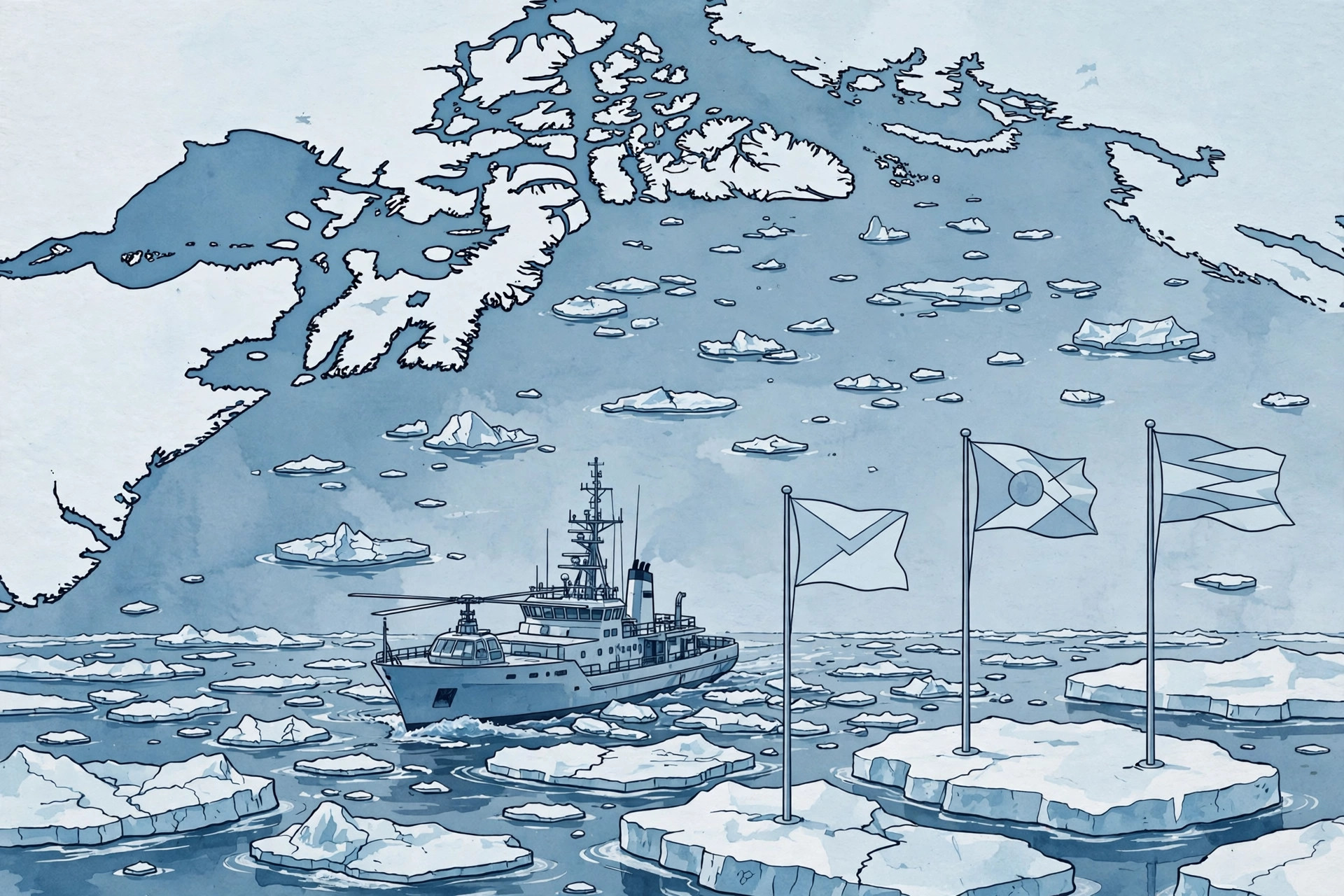
ATLANTA — The United States, Japan and South Korea signed a new Arctic cooperation pact on Friday, October 30, and restated their shared demand for the complete denuclearization of North Korea, using the sidelines of the Group of 20 foreign ministers meeting in Atlanta to lock in a trilateral agenda that stretches from Korean Peninsula security to shipping, energy and supply chains in the far north. The agreement, a memorandum of cooperation establishing the Trilateral Arctic Pacific Partnership, known as TAPP, was signed by United States Secretary of State Marco Rubio, South Korean Foreign Minister Cho Hyun and Japanese Foreign Minister Toshimitsu Motegi after their three-way talks in Georgia. It was, by the count of the three governments, their fourth meeting as foreign ministers this year, following earlier sessions in Türkiye in July, the Philippines later that month and New York in September, a rhythm that itself tells a story about how deliberately the three capitals are now tending this partnership. The Atlanta session arrived at a tense moment. A day earlier, North Korea had launched about ten short-range ballistic missiles from the Wonsan area toward the East Sea, according to South Korea’s Joint Chiefs of Staff, a reminder of why deterrence and diplomacy remain twin tracks in the allies’ approach rather than alternatives to one another.
For Washington, the signing also served a second purpose: it showed that even a G20 gathering marked by sharp disagreement elsewhere could still produce concrete cooperation among like-minded partners. The broader foreign ministers meeting in Atlanta, held October 30 and 31 under the American presidency of the G20, was expected to close without a joint communique, with deep divisions over Russia’s war in Ukraine, the conflict involving the United States and Israel against Iran, American tariffs and Chinese actions in the South China Sea. A chairman’s statement from Rubio, summarising the talks, was instead expected to stand in place of a consensus document. That context matters, because it separates two different things that are easy to confuse in a busy news cycle: a signed three-country memorandum on Arctic cooperation, which is real and specific, and a twenty-member consensus on the world’s hardest wars, which Atlanta did not produce. The trilateral pact belongs firmly in the first category, and its significance should be judged on what it actually sets in motion rather than on what the wider G20 could not agree.
What the US-Japan-South Korea Arctic Partnership Actually Does
The memorandum creates a framework for the three countries to explore maritime cooperation and economic opportunities in the Pacific Arctic, and it establishes a trilateral working group to identify where that cooperation should go first. According to the accounts released by the three foreign ministries, the early priorities include maritime safety and emergency response, areas where Arctic conditions make cooperation less a luxury than a necessity. A vessel in distress in icy, remote waters cannot wait for a political argument to resolve itself, and a search-and-rescue or pollution-response capability that spans three capable maritime nations is worth more than three separate ones. The working group is also expected to examine economic partnerships in the region, a deliberately broad phrase that covers shipping routes, port and logistics questions, and the energy and resource interests that are drawing growing attention to the Arctic as sea ice patterns change and as global supply chains are rethought.
A Renewed Pledge on North Korea Denuclearization
Alongside the Arctic signing, the three ministers restated what the United States State Department described as their resolute commitment to the complete denuclearization of North Korea and to the full implementation of United Nations Security Council resolutions. They also reaffirmed their commitment to enforcing sanctions that bar activities generating revenue for Pyongyang’s nuclear and ballistic missile programmes. That language is familiar, and familiarity can make it easy to skim past, but in the week of a fresh missile barrage it carried a sharper edge. The ministers agreed to maintain a robust deterrence posture against North Korea through close coordination while continuing to pursue peace, stability and denuclearization on the peninsula through dialogue and diplomacy, according to Seoul’s account of the talks. South Korea’s foreign minister, Cho Hyun, also emphasised Seoul’s ambition to act as a pacemaker for building a peace framework on the peninsula and for resuming talks between North Korea and the United States, in close coordination with Washington.
Economic Security Beyond the Arctic
The Atlanta trilateral session ranged well beyond the Arctic and the peninsula, and that wider agenda is part of why the meeting matters for American economic interests. The ministers agreed to strengthen cooperation on economic security, including diversifying critical mineral supply chains, small modular reactors, artificial intelligence and other emerging technologies. Each of those items connects to a live American concern: critical minerals underpin batteries, electronics and defence manufacturing, and dependence on a single dominant supplier has become a recognised vulnerability; small modular reactors are pitched as a way to add reliable, lower-carbon power for energy-hungry industries and data centres; and artificial intelligence is now treated in Washington, Tokyo and Seoul alike as a question of national competitiveness, not merely a commercial one. By tying these subjects to the same trilateral table as security, the three governments are signalling that they see economic resilience and military deterrence as parts of one strategy rather than separate files handled by separate ministries.
Atlanta, the G20, and What Comes Next in Doral
The Atlanta meeting was a staging post, not a destination. Its formal purpose was to prepare the ground for the G20 leaders’ summit that President Donald Trump is to host at Trump National Doral in Miami on December 14 and 15, 2026, and the foreign ministers’ discussions on energy, food security, freedom of navigation and supply chains were framed as shaping the leaders’ economic agenda. The contrast between the two levels of the G20 process is instructive. At the leaders’ level, the same divisions that blocked a joint communique in Atlanta — over Ukraine, over Iran, over tariffs and over the South China Sea — will still be present, and the question of whether a leaders’ summit can produce more consensus than a ministers’ meeting is genuinely uncertain. Reporting from Atlanta noted that diplomats hoped the ministerial session would at least help make the December summit a success, and that the traditional group photograph was cancelled after European diplomats objected to being pictured with Russian Foreign Minister Sergey Lavrov, who attended the Atlanta talks. The absence of a family photo is a small detail, but it captured the mood of a gathering where protocol itself became a negotiation.
Why This Matters for American Readers
There are, of course, limits to what a memorandum can achieve, and this article does not overstate them. TAPP does not create a military alliance for the Arctic, it does not resolve the North Korea nuclear question, and it does not settle the wider G20 arguments that Atlanta exposed. Its value lies in the working group it creates, the institutional habits it reinforces, and the signal it sends that three of the Indo-Pacific’s most important democracies can still agree on concrete steps while the larger room argues. Readers following the road to Doral in December should watch for two things: whether the working group announces specific maritime safety or economic projects before the leaders meet, and whether the leaders’ summit itself gives the trilateral partnership a mention that turns ministerial cooperation into a leaders-level commitment. If both happen, the Atlanta signing will look in retrospect like more than a sideline ceremony. If neither happens, it will still have value as a record of what the three allies agreed when the wider world could not, and that record, preserved in a signed memorandum rather than a press statement, is harder to walk back. That durability is, in the end, the point of putting pen to paper in Atlanta.
That wider context includes the strains in American foreign policy that have dominated recent coverage, from Washington’s warnings to allies over possible new Iran strikes to the political battles playing out at home as voters head to the polls. The Atlanta meeting sat at the intersection of those two stories: a foreign ministers gathering held days before midterm elections, in a year when American leadership abroad and American politics at home are unusually intertwined. Readers who want to follow that domestic side of the story can also follow the campaign trail clashes shaping the final days before the midterms, where the arguments about America’s direction are being made in the open, while the quieter work of alliance management continues in rooms like the one in Atlanta.
Sources
USN reviewed reporting from multiple outlets for this story. Read more from Yonhap News Agency, Aju Press and The Korea Times.
[…] steps now, so a catastrophe finds people as ready as planning can make them. Related USN coverage: US Japan South Korea Arctic partnership pact signed in Atlanta. Related USN coverage: Ukraine peace deal gets closer as Oleshky ceasefire ends ahead of December […]