

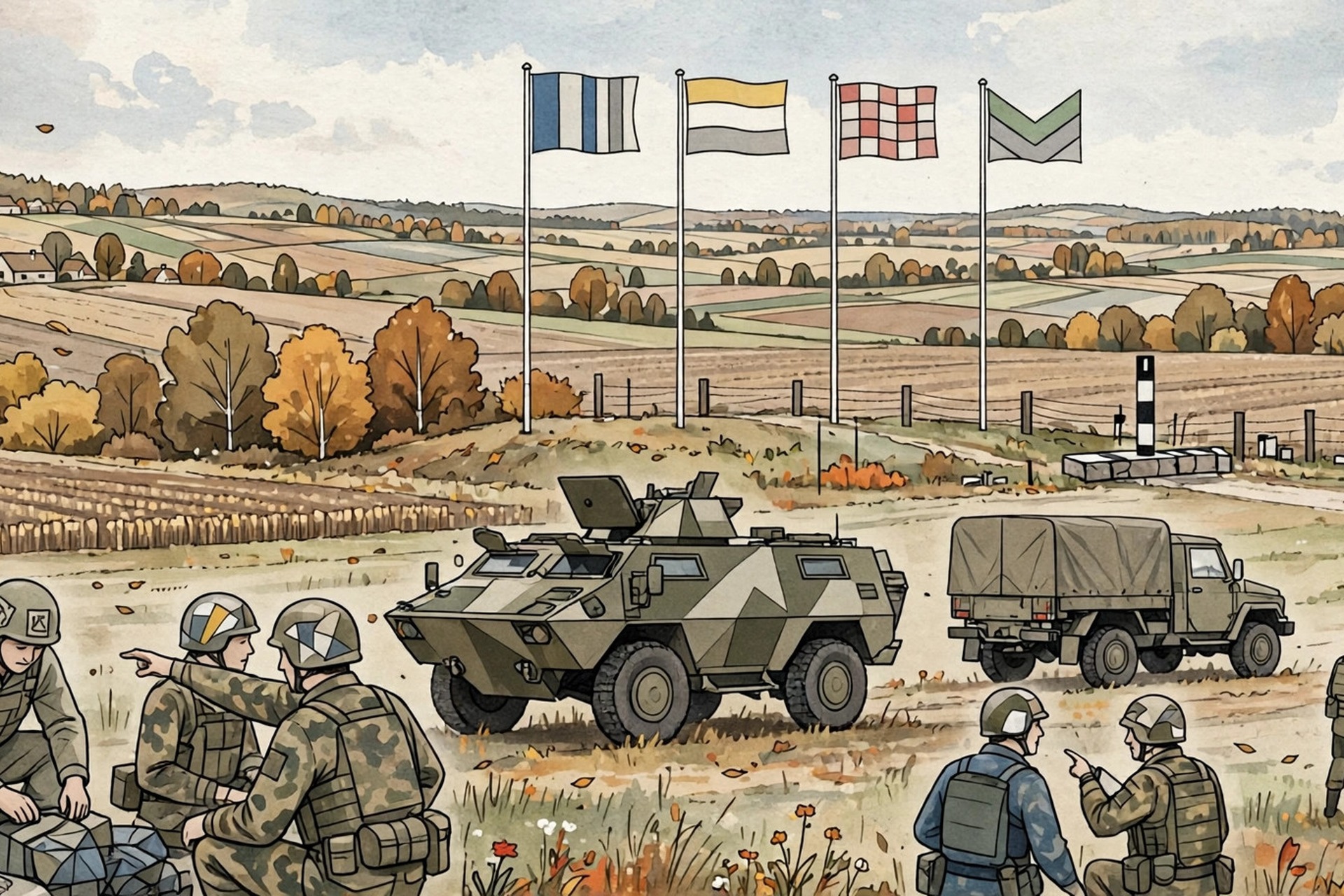
PARIS — Some 2,800 troops from European countries will stage the first exercise of a new multinational force in support of Ukraine in Poland in November, London and Paris said on November 3, in a rehearsal designed to test whether a coalition force could deploy quickly and work together once a ceasefire ends Russia’s full-scale invasion of Ukraine. The exercise, called Koalicja — the Polish word for coalition — is scheduled to run from November 9 to 22 in south-east Poland, around the town of Nowa Deba, about 100 kilometres west of the Ukrainian border. It is the first major drill organised by the Multinational Force-Ukraine, known as MNF-U, and officials on both sides have described it as a key milestone in turning political pledges of support for Ukraine into a force that could actually operate on the ground, at sea and in the air.
The force at the centre of the exercise is not a NATO operation, and it is not a peacekeeping mission in the usual sense. London and Paris said it has no offensive mission, and that it is only to be deployed once a ceasefire is agreed. Its stated aims are to support the Ukrainian armed forces, help ensure security in Ukrainian skies, and allow economic activity to resume in the Black Sea. Those aims, if achieved, would amount to a security guarantee of a kind that Ukraine has sought since 2022: a European-led presence that deters a future Russian attack and helps Ukraine rebuild its forces, without placing Western troops on the front line or engaging in combat while the war continues.
The exercise comes at a moment when no ceasefire is in place, and when Moscow has shown little appetite for a settlement that would include Western troops on Ukrainian territory. Russia has previously described such a deployment as a threat and a legitimate target, a position that underscores the political sensitivity of the exercise even though it takes place in Poland, not Ukraine, and involves no offensive operations. The organisers’ message, in announcing Koalicja, is therefore twofold: to Kyiv, that European partners are preparing in concrete terms; and to Moscow, that a post-war security arrangement is being built whether or not Russia welcomes it. Whether that message deters or antagonises is a question that analysts will debate long after the exercise ends.
Multinational Ukraine Force Koalicja Exercise: Who Is Taking Part and Where
The largest contingent in Poland will come from France, with 1,100 troops, followed by Britain with 300 soldiers, plus Royal Air Force Typhoon fighter jets and a Voyager refuelling aircraft. Poland itself will contribute about 500 soldiers, mostly in support roles. The other participants in the land and air operations around Nowa Deba are Belgium, Estonia, Germany, Lithuania, the Netherlands, Spain and Sweden. Counting Turkey, which leads a separate maritime simulation, the exercise involves 11 nations in all, although some counts describe 10 countries taking part in Poland itself. That small difference in counting — whether Turkey is included as a participant in Poland or only as the leader of a separate maritime element — explains why early reports gave figures of 10, 11 and even 12 countries. The core fact is consistent across those reports: about 2,800 troops, overwhelmingly European, rehearsing together for two weeks.
The choice of Nowa Deba is itself significant. The town lies in south-east Poland, close enough to Ukraine for the exercise to feel realistic, but far enough from the border, and on NATO territory, for it to be conducted safely and without any suggestion that troops are preparing to enter Ukraine during hostilities. The exercise will test command structures, logistics and coordination across land, air and maritime forces, with the largest component — ground troops — in Poland, the air component coordinated from Romania, and aircraft departing from Romania to join the exercise in Poland. Light equipment, such as drones, will be deployed for anti-drone and self-defence exercises, rather than heavy weaponry, and no tanks are expected to be deployed. Observers should not, therefore, expect a show of force featuring tanks and missiles. The point of Koalicja is command, communication and logistics, not firepower.
That emphasis on command and logistics reflects a lesson from coalition warfare: the hardest part of a multinational deployment is rarely the fighting itself, but the unglamorous work of moving people, fuel, food, ammunition and medical supplies across borders, communicating in different languages and with different equipment, and making decisions quickly when plans change. Koalicja will test whether forces from different European militaries can operate together under a single command structure, share information securely, and sustain themselves in the field. It will also check the compatibility of communication systems among MNF-U members, a technical but vital requirement: a force that cannot talk to itself cannot coordinate, and a force that cannot coordinate cannot reassure anyone.
Co-Led by France and Britain: Dirou and Bateman in Command
The exercise will be co-led by French General Armel Dirou and Britain’s Lieutenant-General Tom Bateman. Dirou is Bateman’s second-in-command in the MNF-U, and Bateman is the force’s commander. In their joint statements, both men have stressed the same points: that the exercise is a concrete demonstration of the force’s ability to deploy as soon as hostilities have ended, and that its purpose is reassurance and support for Ukraine’s armed forces, not offensive operations, ceasefire monitoring or peacekeeping in the traditional sense. Bateman has said the mission is not designed for offensive operations, and that its purpose is to provide reassurance and support the regeneration of Ukraine’s armed forces, strengthening their ability to deter and, if necessary, defend against future Russian aggression.
The command arrangement itself mirrors the political leadership of the wider Coalition of the Willing, the group of about 34 to 36 countries that have pledged long-term support to Kyiv and potentially to deploy a multinational deterrence force after the war ends. France and Britain co-chair that grouping, and they have led the work to make its military plans operational since the MNF-U was set up in 2025. The force already has an operational headquarters in Paris, established that year, and Koalicja is the first test of whether that headquarters can direct a multinational exercise in the field. If it succeeds, it will lend credibility to the claim that a post-ceasefire force could be assembled quickly. If it reveals serious problems — in communication, logistics or command — those problems are better discovered in Poland in November than in Ukraine after a ceasefire, when the stakes would be far higher.
The short preparation period for the exercise is one reason not all countries that have expressed willingness to contribute to the MNF-U are taking part. About 26 countries have previously expressed willingness to contribute troops or equipment, and the MNF-U could eventually bring together up to 24 contributing countries out of the coalition’s wider membership. Only a subset could be included in this first exercise, in part because of the time available to plan, move and integrate forces. Future exercises, suggested by the full edition name Koalicja 2026.2, may involve more countries and more complex scenarios, but no detailed programme for later exercises has yet been announced. For now, Koalicja should be understood as a first step, not a final rehearsal for a fully formed force.
Maritime Simulation From Istanbul and the Black Sea Question
While the main exercise takes place in Poland, a separate maritime element will be led by Turkey from Istanbul. That element is a tabletop simulation — a command-post exercise conducted around a table, rather than with ships at sea — focused on preparedness for mine-clearing in the Black Sea. Its purpose is to test how a multinational force could help reopen commercial shipping in the Black Sea once hostilities end, a goal that matters economically as well as militarily. Ukraine is a major grain exporter, and the Black Sea has been a contested waterway since 2022, with mines, blockades and attacks on shipping disrupting trade and raising food prices far beyond the region.
Turkey’s role in this element is geographically and legally significant. As the country that controls the straits between the Mediterranean and the Black Sea under the Montreux Convention, Turkey is central to any arrangement for Black Sea security. Its leadership of the maritime simulation signals that the coalition’s plans for the sea are not merely an afterthought to the land exercise, but a distinct component with its own command, planning and political sensitivities. At the same time, the fact that Turkish troops will not take part in Poland itself, and that the maritime element is a simulation rather than a deployment of ships, underlines the exercise’s overall character: it is a rehearsal of planning, command and coordination, not a deployment of combat power to a contested area.
The air component, coordinated from Romania, adds a further dimension. Aircraft departing from Romania to join the exercise in Poland will test how air forces from different countries can operate together, refuel in flight, and support ground forces without a single national air force dominating the operation. The inclusion of British Typhoons and a Voyager tanker aircraft is a reminder that air power, even in a reassurance mission, requires complex logistics: fuel, maintenance, airspace coordination and rules of engagement must all be agreed in advance. In a real post-ceasefire deployment, those details would determine whether a force could protect itself, move quickly, and respond to a crisis without confusion.
What Koalicja Is Not: No NATO Operation, No Front-Line Deployment
One of the most important clarifications from London and Paris is what Koalicja is not. It is not a NATO operation, and NATO has been informed about the exercise but is not taking part. That distinction matters for several reasons. First, it means the exercise does not carry the political weight of a NATO decision, which would require consensus among all allies, including the United States. Second, it means the force’s command, funding and political authority come from the coalition itself, not from NATO structures. Third, it leaves open the question of what role, if any, the United States would play in a future deployment. The United States is not contributing troops to this exercise, but it continues discussions with Ukraine and European allies on future security guarantees, including Washington’s potential role in a post-ceasefire arrangement.
Equally important is what a future MNF-U deployment would not do. Western officials have emphasised that any future force deployed to Ukraine would not participate in offensive military operations, peacekeeping missions or ceasefire monitoring, and would not be stationed on the front line. Instead, according to the intervention model described in early reporting, MNF-U troops — which could number up to 20,000 if deployed, equivalent to a division — would remain at a safe distance from the Russian border, focusing on reassurance, training, support for Ukraine’s forces, and protection of key infrastructure and airspace. That model is designed to deter a future attack by making clear that an attack on Ukraine would encounter a multinational presence, without placing that presence in a position where it would be drawn into combat on the first day of a renewed war.
Whether that model would work in practice is untested, and Koalicja will not answer the hardest questions. It will not show how Russia would react to a real deployment, how Ukraine’s own forces would integrate with a multinational presence, or how a force of up to 20,000 troops would be funded, sustained and politically governed over years rather than weeks. It will, however, show whether the coalition can move, communicate and command together at a smaller scale, and whether its headquarters in Paris can direct an operation across multiple countries. Those are necessary conditions for any larger deployment, even if they are not sufficient on their own.
For Ukraine, the exercise’s timing and visibility matter as much as its technical content. Kyiv has long argued that security guarantees must be concrete, not merely rhetorical, and that a guarantee that exists only on paper will not deter a future aggressor. A multinational exercise, conducted openly in a NATO country near Ukraine’s border, with named commanders, named contingents and a named headquarters, is a step toward concreteness. It does not, by itself, guarantee Ukraine’s security, and it does not replace the need for a ceasefire agreement, for American support, or for Ukraine’s own military strength. But it does signal that European countries are willing to invest time, troops and political capital in preparing for the day after the war, rather than waiting until that day arrives to begin planning.
For the wider world, Koalicja is also a test of European defence cooperation in a period when questions about American commitment to European security have grown louder. A European-led force, with a Paris headquarters, French and British commanders, and contributions from across the continent, is an assertion that Europe can organise its own security arrangements, at least for this mission, even without American troops on the ground. Whether that assertion holds in a real crisis, and whether it complements or competes with NATO, will be watched closely in Washington, Moscow and Kyiv alike. For the next two weeks, however, the focus will be narrower: on the fields around Nowa Deba, the airspace over Poland and Romania, and the conference tables in Istanbul, where officers from different nations will learn, in practice, whether they can work as one force.
Sources
USN reviewed reporting from multiple outlets for this story. Read more from The Straits Times [LINK: https://www.straitstimes.com/world/europe/multinational-ukraine-force-to-hold-first-exercise-in-poland], Kyiv Post [LINK: https://www.kyivpost.com/post/88953] and Le Monde [LINK: https://www.lemonde.fr/en/international/article/2026/11/03/in-poland-coalition-of-the-willing-holds-first-large-scale-military-exercise_6769567_4.html].