

Fresh Scrutiny for a Radar Contract Renewed Without Competition
Reporting published on Monday, 2 November 2026, has brought renewed attention in Washington to a Pentagon decision to extend, without competition, a large contract for maintaining some of America’s most important missile-defence radars. The contract, held by Raytheon, a subsidiary of RTX, covers operations and sustainment support for the AN/TPY-2 radar system, a transportable sensor that sits at the centre of the Terminal High Altitude Area Defense system, known as THAAD, and also works as a standalone early-warning radar. The renewed scrutiny does not allege that the radars themselves have failed. It asks a different question: whether a contractor with a recent, admitted history of defrauding the military should have received a further sole-source extension, and whether the Pentagon’s explanation for doing so is sufficient.
The timing of the story needs to be stated plainly, because two dates are involved. The contract modification itself was awarded on 21 October 2026, according to the federal award notice, and was reported in defence trade publications in the days that followed. What happened on 2 November was a new round of reporting, led by the newsletter PunchUp and carried by other outlets, that placed the extension in a wider context: a September decision by Navy officials that Raytheon need not be suspended or barred from government work, and the company’s 2024 settlement over fraud that cost the Defence Department more than 111 million dollars. It is that context, rather than the bare fact of a contract renewal, that has made the extension a subject of debate in Washington this week.
That distinction is important for readers trying to judge the story fairly. A contract notice, on its own, is routine Pentagon business: thousands of modifications are issued each year, many of them sole-source, for systems where only the original manufacturer can realistically provide support. A news report that connects a routine notice to a fraud settlement and to a recent eligibility decision is a different kind of document. It invites the reader to ask whether routine process was the right process in this case, and whether the safeguards that are supposed to follow a fraud admission actually constrained anything.
Pentagon Raytheon Radar Contract Extension: The Numbers Behind the Deal
The modification at issue, numbered P00038, was made to an indefinite-delivery, indefinite-quantity contract first awarded to Raytheon on a sole-source basis in 2018. It provides for a non-competitive, two-year extension of operations and sustainment support for AN/TPY-2 radars, and it raises the contract ceiling from 2,605,033,000 dollars to 2,999,033,000 dollars, an increase of about 394 million dollars. The ordering period is extended from 31 October 2026 to 31 October 2028. At the time of the award, 112,309,403 dollars in fiscal 2027 operations and maintenance, research and development, and procurement funds were obligated through a task-order modification.
Those figures describe a ceiling, not a guaranteed payment. A contract ceiling is the maximum value that can be ordered under the arrangement, and the amount actually spent depends on the task orders the Missile Defense Agency issues over the two years. Even so, the scale is substantial: the AN/TPY-2 sustainment arrangement is now a contract worth close to three billion dollars at its ceiling, for a fleet of radars that are expensive, slow to replace, and deployed at sites in the United States and abroad. The work is performed from Raytheon’s facility in Woburn, Massachusetts, and at multiple radar sites inside and outside the continental United States, using a mix of cost-plus-incentive-fee, cost-plus-fixed-fee, and firm-fixed-price contract items. The contracting activity is the Missile Defense Agency at Redstone Arsenal, Alabama.
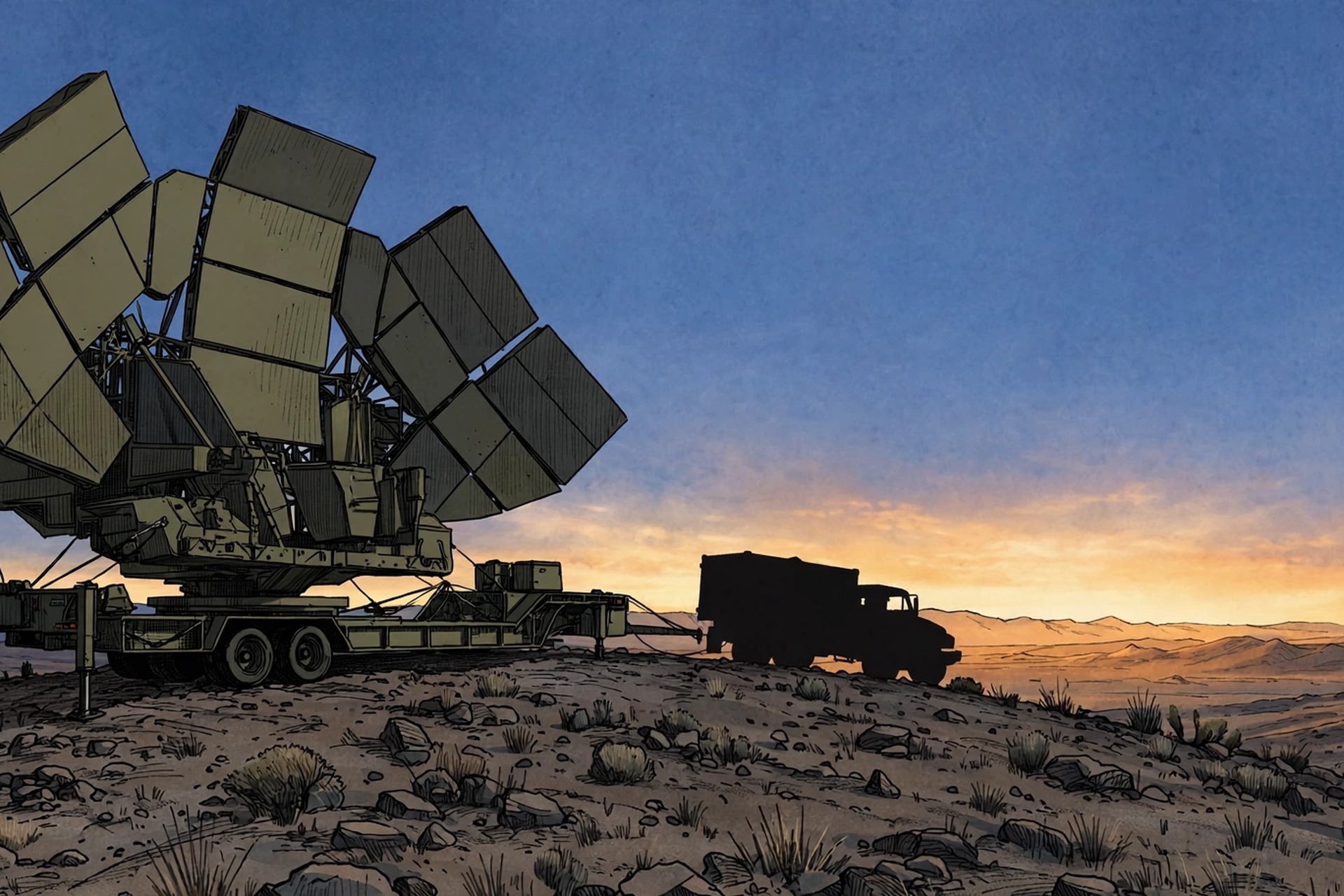
The same radar family has been in the news for another reason this year. The AN/TPY-2 is a high-resolution, X-band phased-array radar that can search for, track, and help discriminate ballistic missiles from decoys and other objects. In terminal mode, it serves as the fire-control radar for a THAAD battery, guiding interceptors toward an incoming warhead. In forward-based mode, it is placed far from the defended area to detect missiles shortly after launch and pass tracking data to the wider ballistic-missile-defence system. The United States Army fields eight THAAD batteries, each with one AN/TPY-2 radar, including units at Fort Bliss in Texas, in South Korea, and on Guam, while forward-based radars have been stationed in places including Japan, Türkiye, Israel, and Qatar. During the war with Iran this year, satellite imagery analysed by news outlets indicated damage to radar sites in the region, which has only increased the premium on keeping the existing fleet operational while new radars are built, a process that takes years and costs hundreds of millions of dollars per radar.
Why the Pentagon Says Competition Was Not the Right Tool Here
The Missile Defense Agency has defended the extension in terms that will be familiar to anyone who follows defence procurement. In a statement reported this week, the agency said that because the contractor was not suspended or debarred, and because the acquisition fulfilled a critical mission requirement, it executed the extension. The underlying argument is straightforward: Raytheon designed and built the AN/TPY-2, it holds the technical knowledge and the supply chain for the system, and interrupting sustainment support to run a competition could leave radars unmaintained at a time when they are actively needed. From that perspective, continuity is not a favour to a contractor. It is a requirement of the mission.
That argument carries weight, but it also has limits, and critics of sole-source awards point to them regularly. A sole-source justification based on the original manufacturer’s unique knowledge can become self-reinforcing: the longer one company maintains a system, the harder it becomes for anyone else to compete for the work, and the less incentive there is to develop alternative sources of support. Defence officials respond that this is a known trade-off, and that the alternative — a gap in support for a missile-defence sensor — is worse. The public record for this extension does not show that the agency weighed a detailed alternative, such as a shorter bridge contract with a competition to follow, and the reporting this week does not claim that such an alternative was feasible on the same timetable. What it does show is that the decision was made through the standard sole-source process, without a competitive solicitation, and that the agency’s public explanation rested on eligibility and mission need.
The eligibility question is where the fraud history enters the story. In September 2026, Navy officials determined, in federal filings reviewed by PunchUp, that suspension or debarment proceedings were not necessary to protect the government’s interests. That determination left Raytheon eligible for government contracts, including the Missile Defense Agency extension that followed about a month later. The Navy’s reasoning, as reported, was that severe punishment was not necessary in the circumstances. Supporters of the decision would say that suspension and debarment are discretionary tools, meant to protect the government from present risk, not to punish past conduct that has already been settled through a deferred prosecution agreement and a compliance monitor. Critics would say that a company that admitted to inflating prices on defence contracts should face a higher bar before receiving further non-competitive work, even if it remains technically eligible.
The 2024 Fraud Settlement Behind the Debate
The fraud at the centre of the debate dates to a Justice Department resolution announced in October 2024. Raytheon admitted to two schemes that caused the Defence Department to pay more than 111 million dollars more than it should have. In one, involving an Air Force radar maintenance arrangement, the price was fraudulently inflated by about 11.1 million dollars. In the other, involving an Army Patriot missile contract, the overcharge was about 100.1 million dollars. The company entered a deferred prosecution agreement in Massachusetts, under which it agreed to pay a criminal penalty of about 146.7 million dollars, to provide victim compensation of about 111.2 million dollars, and to retain an independent compliance monitor for three years.
That defence-pricing resolution was part of a larger settlement announced at the same time, under which Raytheon agreed to pay more than 950 million dollars in total to resolve criminal and civil investigations. The larger figure included separate matters involving alleged foreign bribery in Qatar and export-control violations, which were resolved through additional agreements and penalties. It is important not to conflate those matters: the 950-million-dollar total covers several distinct investigations, while the 111-million-dollar overcharge figure relates specifically to the defective-pricing schemes on Defence Department contracts. What they share is a pattern that prosecutors described as serious misconduct on critical military systems, followed by a settlement structure designed to punish, compensate, and monitor, rather than to exclude the company from future work.
Since that settlement, Raytheon has continued to win government work. Reporting this week notes a 15.1 million dollar Navy delivery order for radar parts in October 2026, and larger missile-related awards with ceilings reported in the billions. None of that is, by itself, evidence of wrongdoing in the new awards. A deferred prosecution agreement, by design, allows a company to continue operating under supervision, and the government’s suspension and debarment system is separate from the criminal process. The question raised by the new reporting is not whether Raytheon was legally barred from the AN/TPY-2 extension. On the record available, it was not. The question is whether the government should have used its discretion differently, given the recency and scale of the admitted fraud, and whether a non-competitive extension was the best way to protect both the mission and the taxpayer.
What Happens Next, and What to Watch
For the next two years, the practical outcome is continuity. Raytheon will continue to operate and sustain AN/TPY-2 radars under the extended ordering period, which runs through 31 October 2028, and the Missile Defense Agency will issue task orders for individual radar sites as needed. The agency will also, at some point, have to decide how to handle long-term sustainment of the fleet beyond 2028. That decision is the one where competition, or the lack of it, will matter most: a further sole-source extension in 2028 would suggest that the current arrangement has become effectively permanent, while a competitive solicitation, or a plan to build alternative support capacity, would suggest that the agency is using the two-year window to create options it does not currently have.
Oversight bodies and Congress may also take an interest, although no formal investigation or hearing has been announced in the reporting reviewed for this article. The issues that would naturally draw attention are the ones this story has identified: the size of the ceiling increase relative to the amount obligated at award, the relationship between the Navy’s September eligibility decision and the October extension, and the status of the independent compliance monitor appointed under the 2024 agreement. The monitor’s three-year term, if counted from late 2024, would still be running during the extension period, which means the company remains under heightened supervision while it performs the new work. Whether that supervision has produced measurable changes in pricing practices is a question that public reporting has not yet answered in detail.
Readers should also keep the scale of the debate in proportion. The AN/TPY-2 extension is a significant contract, but it is one part of a much larger missile-defence enterprise, and the decision to extend it does not, on its own, prove that the Pentagon ignored the fraud settlement or that it acted improperly. What the reporting this week establishes is narrower and more useful: a major defence contractor that admitted to defrauding the military received a further non-competitive extension shortly after being cleared to remain eligible for government work, and the agency’s stated reasons were mission need and the absence of a suspension or debarment. Whether that balance was right is a judgment for oversight officials, for Congress, and for the public to make with the full record in view — a record that, as this article has noted, includes both the contract notice of 21 October and the scrutiny that followed on 2 November.
Sources
USN reviewed reporting from multiple outlets for this story. Read more from Defence Blog [LINK: https://defence-blog.com/pentagon-extends-raytheon-deal-for-missile-defense-radars/], ClearanceJobs [LINK: https://news.clearancejobs.com/2026/10/22/raytheon-secures-394m-missile-defense-contract-extension/] and GovTribe [LINK: https://govtribe.com/opportunity/federal-contract-opportunity/contractor-logistics-support-fy27-fy28-extension-mda27tban01].