

Florida Plane Crash: What the NTSB Has Said So Far
A business jet carrying nine people crashed in Palm Beach County, Florida, on Sunday 1 November, killing everyone on board, and investigators have now offered their first detailed public account of what the early evidence suggests. The aircraft, a Learjet 60 travelling from Texas to the Bahamas, went down near Military Trail and Northlake Boulevard, in the area around Greenacres, shortly before midday local time, according to flight records and local reporting. The National Transportation Safety Board, which is leading the investigation, said on Monday 2 November that debris from the jet was found scattered over a wide area, a pattern investigators said could indicate that the aircraft had begun to break apart before it hit the ground. That finding, if confirmed, would be central to understanding the crash, but officials were careful to present it as an early assessment, not a final conclusion.
Don Chapman, the NTSB board member who spoke to reporters in Florida, said the evidence so far was consistent with the possibility of an in-flight breakup, while stressing that the investigation was still in its earliest phase. Investigators are examining where each piece of wreckage landed, how far it travelled, and whether the distribution of debris matches a breakup in the air or a breakup caused by the impact itself. That distinction is not a technical detail. It determines which questions investigators ask next, from the aircraft’s structure and maintenance history to the weather it encountered and the actions of the crew. Chapman also addressed the state of the investigation more broadly, noting that the site itself presented immediate difficulties: water in the impact crater was complicating access, and recovering major wreckage would be one of the team’s biggest challenges in the days ahead.
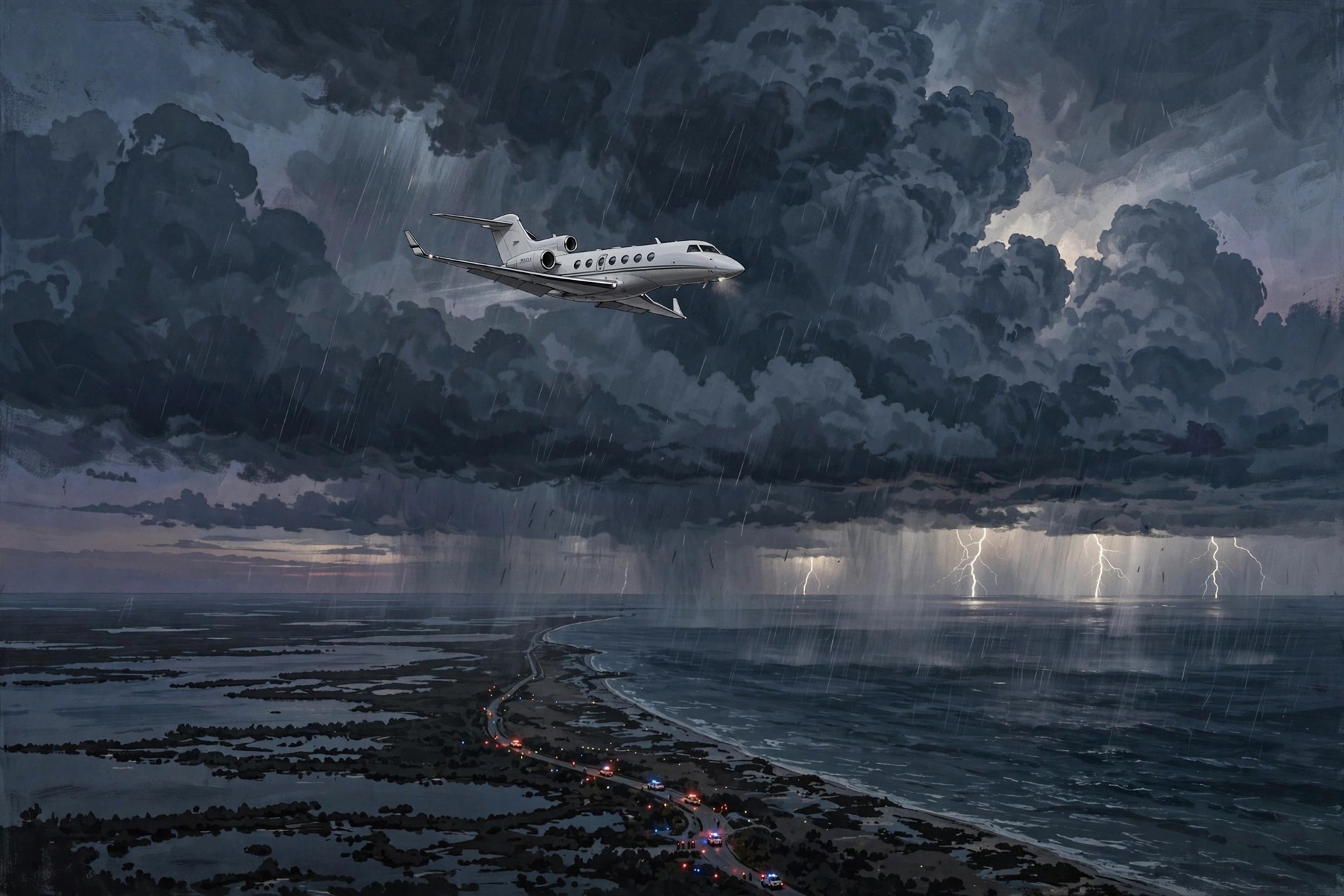
The flight itself had begun routinely enough, according to the information released so far. The jet departed from Austin, Texas, and was heading for the Bahamas when it encountered severe weather over South Florida. Air-traffic-control audio and flight-tracking data, reported in the days after the crash, indicate that the crew reported icing and moderate turbulence and said they were picking up precipitation as the aircraft travelled east. Heavy rain and thunderstorms were moving through the area at the time, according to a statement from forecaster AccuWeather reported after the crash. Less than a minute after the initial distress reports, the crew issued a mayday call and reported a descent rate of about 10,000 feet per minute, which then accelerated to about 20,000 feet per minute in a subsequent transmission. Flight-tracking data cited in reporting showed a vertical descent rate at one point exceeding 32,000 feet per minute, although tracking estimates of that kind are not a substitute for the aircraft’s own recorded data and should be read as an indication of severity rather than a precise official measurement.
Learjet Crash: How Investigators Will Test the Breakup Theory
The NTSB’s work from here will be methodical, and readers should expect the story to develop slowly rather than in a single revelation. Investigators will map the debris field in detail, looking at the weight, shape and condition of each fragment and at how far lighter pieces, such as interior panels, travelled from heavier structural parts. They will examine the aircraft’s maintenance and operational history, including any previous work on its structure and any reported issues, and they will reconstruct the weather the aircraft actually encountered at altitude, not just the weather visible from the ground. They will also seek the aircraft’s recorded flight data, if it survived, and any other recordings that can clarify the crew’s final decisions. Chapman said investigators were very hopeful of recovering the cockpit voice recorder, often called a black box, noting that records indicate such a recorder was installed on the aircraft at some point, but that they did not yet know whether it was still on board before the crash. Recovery will not be straightforward, given water in the crater, but the recorder, if found and readable, could clarify the crew’s final decisions in a way that radar tracks and debris patterns alone cannot.
One piece of that work concerns the aircraft’s cockpit voice recorder, often called a black box. Chapman said records indicate such a recorder was installed on the aircraft at some point, but investigators did not yet know whether it was still on board before the crash. He said investigators were very hopeful of recovering it, and that they would be better off if the device were found, while adding that they could still carry out substantial detective work without it. Recovery will not be straightforward: investigators said water in the impact crater was already making access to the site more difficult, and that recovering major wreckage from the crater would be among their biggest obstacles. The recorder, if recovered and readable, could clarify the crew’s final decisions in a way that radar tracks and debris patterns alone cannot.
The Final Minutes: Ice, Turbulence and a Mayday Call
What is already known about the flight’s final minutes comes from air-traffic-control audio and flight-tracking data reported in the days after the crash, and it paints a picture of a crew dealing with rapidly worsening conditions. The crew reported managing ice and moderate turbulence, and picking up precipitation, as the aircraft travelled east. Heavy rain and thunderstorms were moving through the area at the time, according to a statement from forecaster AccuWeather reported after the crash. Less than a minute after the initial distress reports, the crew issued a mayday call and reported a descent rate of about 10,000 feet per minute, which then accelerated to about 20,000 feet per minute in a subsequent transmission, according to audio reported from air-traffic-control broadcasts. Flight-tracking data cited in reporting showed a vertical descent rate at one point exceeding 32,000 feet per minute, although tracking estimates of that kind are not a substitute for the aircraft’s own recorded data and should be read as an indication of severity rather than a precise official measurement.
Aviation experts who reviewed the audio, radar images and flight-path data told reporters that the central question will be what caused the crew to lose control. One expert, Robert Joslin, a professor of aerospace engineering at Embry-Riddle Aeronautical University, described a catastrophic event of some kind, while stressing that many factors might have contributed, including ice, which can reduce an aircraft’s ability to generate lift, and turbulence, which can disrupt airflow and, in severe cases, cause structural damage. He also highlighted the crew’s report of an overspeed condition, meaning the aircraft was travelling faster than its maximum operating speed, which can itself lead to a wide range of stresses and damage. His assessment, like the NTSB’s, was framed as a set of possibilities to be tested, not a verdict, and he emphasised the volume of information investigators still have to gather, from maintenance history to weather at altitude to any recordings that are recovered.
Another line of expert discussion concerns the weather the crew may have been trying to escape. Experts who spoke to the Palm Beach Post suggested the jet might have been trying to fly above an intense thunderstorm, whose powerful upward rush of warm, moist air can lead to rapid freezing of water droplets at higher altitudes. In severe icing, a senior meteorologist noted, a complete loss of manoeuvrability can occur. Chapman, asked whether climbing to escape such conditions was the right decision, said it was one of several possible manoeuvres in that situation, declining to judge the crew’s choices before the evidence is complete. That restraint is important for readers as well: it is tempting, from the ground, to second-guess decisions made in seconds in a cockpit, but the investigation exists precisely because those decisions can only fairly be assessed once the full sequence of weather, aircraft performance and crew actions is reconstructed.
The People Aboard, as Families Have Described Them
While the official identification process continued, families began to share the names and stories of those they had lost, and those accounts give the crash a human dimension that statistics cannot. Family members identified the passengers as Adam Robinson, 45, his wife Helen Sharp, 40, their children Charlie, 4, and Emma, 2, the children’s nanny Anita Maria Cetina, and another couple, Rachael Reed and Charmi Fehr. In a joint statement on November 2, the families of the passengers thanked first responders, investigators and the Palm Beach County community for their care, and said their hearts will also be with the families of the pilots, who were alongside them. Those names are reported here as family identifications, not as the medical examiner’s official list, because that official process had not been completed when the families spoke.
The copilot, Nathalia Filgueiras, 20, has been described in particular detail by her family. Her sister Giulia, 21, said in an interview outside her home in Boca Raton that Nathalia had fought until the last moment she could, and had wanted to be a pilot since she was 12. Her mother said her daughter had logged more than 1,300 hours of flight time, had earned her pilot’s licence at 17, and worked for Upper Jets, a private charter firm based in Fort Lauderdale. Upper Jets said in a statement that it was cooperating with local, state and federal authorities, offered condolences to everyone affected, and said it was committed to supporting the families of all those who lost a loved one. NASA Administrator Jared Isaacman, himself an experienced pilot, also drew attention to the copilot’s final communications with air traffic control, while urging the public not to speculate about the cause before investigators complete their work, noting that questions remain about maintenance history, possible structural failure and the role of weather or turbulence.
There is a reason to dwell, briefly, on that appeal against speculation. In the hours after a high-profile crash, social media fills with video, audio clips and confident theories, and some of that material is genuine while some of it is mislabelled or incomplete. Dash-camera and surveillance video of the jet’s final descent has circulated widely, and it is harrowing to watch, but video of an impact does not explain an impact. The NTSB’s investigation, by contrast, is deliberately slow: it will examine the wreckage piece by piece, test whether the aircraft’s structure failed before or after control was lost, reconstruct the weather the aircraft actually encountered at altitude, and review the aircraft’s maintenance and operational history. That process will take far longer than a news cycle, and its preliminary findings, when they come, will still be preliminary.
What Comes Next for Palm Beach County and the Investigation
For the neighbourhood around Military Trail, the immediate aftermath has been practical as well as emotional: road closures, an evacuation affecting about 600 people, fires to extinguish, debris to clear and a crater to make safe. For the families, the days ahead will bring the formal identification process, funeral arrangements and the long wait for an official account of what happened to their loved ones. For the wider aviation community, the crash will be watched as a test of how well existing safeguards, from weather briefings to icing procedures to recorder recovery, performed under extreme conditions, and whether any lesson from this flight should change how similar flights are planned or flown.
Readers should also keep the scale of the tragedy in proportion. Nine deaths in a single crash is a major loss of life, and it is the kind of event that rightly commands national attention, but a single crash, however shocking, does not by itself establish a pattern about business aviation safety. The investigation’s value lies in its specificity: it will ask what happened to this aircraft, on this flight, in this weather, with this crew, and it will answer, as far as the evidence allows, in those terms. Until it does, the responsible summary is the one investigators themselves have offered. A business jet flying from Texas to the Bahamas crashed in Palm Beach County on November 1, killing everyone aboard. Early evidence suggests it may have begun breaking apart before impact. Weather is a major concern of the investigation. The cause is not yet determined. Everything beyond that, for now, is a question awaiting evidence.
Sources
Sources: USN reviewed reporting from multiple outlets for this story. Read more from USA Today, BusinessWorld and The Hindu.