

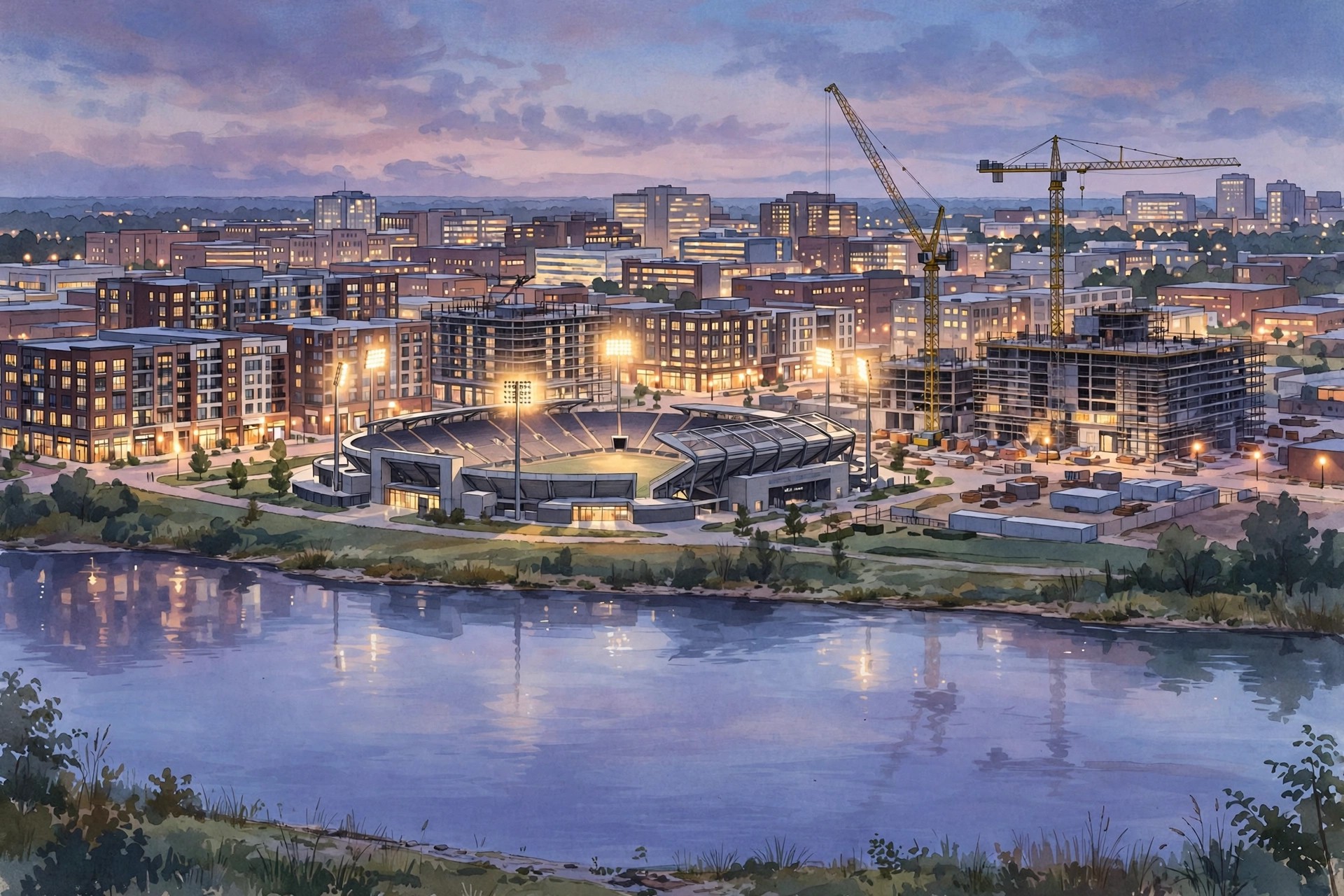
Des Moines Council Reopens the Stadium Conversation
Des Moines took a quiet but consequential step toward professional soccer on Monday, November 2, when the City Council set a public hearing for December 7 on a proposed land agreement tied to a long-delayed stadium district. The vote, taken without discussion at the council meeting, concerned a portion of the city-owned former DICO factory site near downtown, where a professional soccer stadium and an events plaza have been planned for years. The agreement under consideration would involve the sale of one parcel to Krause+, the development arm of the Krause Group, and it is the clearest sign yet that a project many residents had written off in August may be back on the table.
The distinction matters, and it is worth stating plainly at the outset. Setting a hearing date is not the same as approving a sale, and it is not the same as approving a stadium. What the council did on November 2 was to open a formal public process: a hearing, followed by a competitive bidding process, before any land can change hands. That process gives residents, rival developers and sceptics a chance to be heard, and it gives the council a chance to test whether the revised terms are genuinely better than the deal that collapsed in the summer. For a project that has been promised, delayed and renegotiated since 2019, the hearing is best understood as a door reopening, not a finish line.
The company at the centre of the proposal is familiar to Iowans. Kyle Krause, chief executive of the Krause Group and the former owner of the Kum & Go convenience-store chain, holds the franchises for the United Soccer League teams that would play in the new stadium: a men’s team in the USL Championship, the league’s second tier, and a women’s team in the Gainbridge Super League, a first-tier women’s competition. In a statement after the council vote, Krause described the decision as a unanimous vote to advance the proposed stadium district agreement, and said the project offered a chance to build a lasting legacy for Des Moines. Helen Aboah, president and chief operating officer of the Krause Group, called the hearing date another step in the right direction and said community advocacy from developers, restaurant owners, architects, small business owners, sports professionals and fans had helped bring the project back to the table after negotiations ended abruptly in August.
What the Des Moines Soccer Stadium District Would Include
The stadium itself is only part of the picture. The proposed facility, to be owned and operated by the nonprofit Iowa Soccer Development Foundation, is currently costed at about $95 million, with an events plaza alongside it. The foundation has already secured a 50-year lease, approved by the council in June, for the portion of land the stadium and plaza would occupy. Supporters say the stadium would finally give Iowa a purpose-built home for professional men’s and women’s soccer, with early planning pointing to matches in late 2028 or 2029 if construction proceeds on schedule, and a completion deadline of December 31, 2029, attached to earlier city funding.
Around the stadium, Krause+ proposes a much larger district worth about $550 million in private development. That district, in the company’s telling, is not an optional extra but the financial engine of the whole scheme: hotels, offices, restaurants, shops and housing that would add value to the surrounding land and help make the stadium’s financing work. Council member Josh Mandelbaum, whose ward includes the site, has pointed to that wider redevelopment as a major reason to keep the proposal alive, describing a stretch of hotels, office space, restaurants and housing linking the site to downtown’s Western Gateway. The appeal, for city leaders, is not simply a place to watch soccer on a Saturday evening, but a reason for people to spend time, and money, in a part of downtown that has long been defined by its industrial past rather than its future.
That breadth is also where the disagreement has always lived. A stadium can be financed one way; a whole district, with cleanup costs, infrastructure and competing demands on public money, is a harder bargain. City officials have declined to say exactly how much public support Krause sought for the broader development, but City Manager Scott Sanders has said the agreement now under consideration would save Des Moines taxpayers more than $20 million compared with the terms previously discussed. That claim will be tested in public in December, when the agreement itself, rather than summaries of it, is the subject of the hearing. Until then, residents should treat the savings figure as the city’s account of its own negotiating position, not as an independently audited total.
Why Talks Collapsed in August, and What Changed
To understand why November 2 mattered, it helps to retrace the summer. In August, the city announced that it had ended negotiations with Krause+ over the commercial development surrounding the stadium, saying it was ready to move on after years of talks about how much public assistance the city was willing to provide for cleanup and construction. The city said at the time that it remained committed to the stadium itself, but the end of the district negotiations left the stadium’s financing unclear. The city had previously said it was unwilling to go beyond roughly $21 million it had already pledged to the stadium and plaza, and the gap between that position and the developer’s needs proved too wide to bridge in that round of talks.
What followed was a period of open competition for Des Moines’ soccer future. Major League Soccer, through a group tied to Sporting Kansas City, pitched a rival proposal for a roughly $65 million stadium with parking lots near the Iowa Events Center and Casey’s Center, on the north side of downtown. That stadium, with an estimated 5,500 to 6,500 seats, would house a third-tier MLS NEXT Pro feeder team relocating from the Kansas City area. City leaders said they would consider any credible opportunity to bring professional soccer to Des Moines, and for a time it looked as though the original Krause plan might be replaced entirely by a smaller, cheaper and differently owned alternative.
City leaders now say renewed talks with Krause have produced a potentially more workable financial proposal, and that the original plan carries advantages the rival bid does not: local ownership, substantial financing already in place, and a nonprofit stadium owner rooted in Iowa. That is the city’s framing, and supporters of the rival proposal would no doubt dispute parts of it. The important point for residents is procedural rather than rhetorical. The December process is designed to allow competing proposals to be filed and considered, rather than to rubber-stamp a single developer’s plan. Reporting on the council documents has described a deadline of 4:30 p.m. on December 4 for competing proposals, with a possible Urban Design Review Board meeting on December 15 and a shifted hearing date of December 21 if a competing plan merits further evaluation. Those dates should be confirmed against the council’s published agenda as December approaches, because they are the moments when the public process either stays on track or changes course.
The DICO Site: A Difficult Piece of Land With a Long History
Underneath the stadium debate lies a piece of land with a complicated past. The DICO site, a roughly 40-acre property bordered by Martin Luther King Jr. Parkway to the north and the Raccoon River to the west and south, once housed a factory whose operations left significant chemical contamination. The wider Des Moines TCE Superfund site, of which the former Dico property is a part, was added to the federal National Priorities List in 1983, after past industrial operations, including a foundry, a steel-wheels plant and chemical and pesticide work, contaminated soil and groundwater. Cleanup has involved removing contaminated soil, treating groundwater, capping parts of the site and placing restrictions on land and groundwater use, and the city acquired the property in 2021 as part of a settlement framework that transferred the former Dico parcel to Des Moines.
That history shapes what can be built and how. The old factory buildings have been cleared, contaminated soil has been removed, and a monitoring system is in place, but further cleanup will still be needed before redevelopment can proceed, and any stadium construction must comply with federal environmental requirements. The June lease agreement included a $13 million grant to the foundation to cover environmental costs associated with the property, with documentation required before the money is released. It is one reason city leaders talk about the site as both an opportunity and a burden: a stadium, which does not require housing on the land, is often presented as a sensible reuse for ground where permanent homes would face stricter limits, but the environmental bill does not disappear simply because the use changes.
What Happens Next in Des Moines
The December 7 hearing is the next formal step, and it is not the last. After the hearing, the competitive bidding process will determine whether Krause+ proceeds alone, whether a rival proposal gains traction, or whether the council decides that neither plan justifies a sale on acceptable terms. Residents who want to influence that outcome will have their clearest opportunity in the hearing itself and in the written comments that accompany it, because the council’s decision will turn not only on the stadium’s appeal but on the details of the land deal: price, public support, cleanup obligations, timelines and what happens if the developer does not deliver. Those details have not yet been published in full, and they are the material that will allow the public to judge whether the revised agreement is, as the city says, a better deal than the one that failed in August.
For the wider city, the stakes extend beyond sport. A stadium district, if it is built, would reshape a long-neglected stretch of downtown and give Des Moines a venue it has sought for years. If it fails again, the city will face the same question it faced in August: whether to pursue a different soccer proposal, wait for a better deal, or accept that the DICO site’s future lies in another kind of development altogether. The November 2 vote does not answer that question. It simply ensures that, after a summer in which the project appeared finished, the question will be asked again, in public, in December, with competing proposals on the table and residents in the room.
Sources
Sources: USN reviewed the Des Moines City Council agenda and meeting documents. Read more from the Des Moines Register, the U.S. Environmental Protection Agency and StadiumDB.