

A Short Post Lands on a Crowded Election Day Feed
On Tuesday, 3 November 2026, as millions of Americans headed to polling places for the midterm elections, the official White House account on X shared an image that had little to do with ballots, polling places or policy papers. The post presented President Donald Trump and members of his administration in the visual language of One Piece, the long-running Japanese pirate adventure created by Eiichiro Oda. Its caption was brief, patriotic and deliberately in-group: a reference to a good crew, followed by an American flag emoji. Within hours, entertainment sites and social media commentators were discussing it, and the post had become one of the most talked-about White House messages of the day, even though no result in any race had yet been called and no official outcome could responsibly be claimed from it.
The timing mattered, and it also complicated any simple reading of the post. Election Day is usually a day when official accounts are watched for practical information, for reassurance about voting, or for restraint. A playful, franchise-flavoured image cuts through that atmosphere precisely because it is unexpected. Supporters could read it as confidence and team spirit. Critics could read it as a distraction, or as a sign that official channels are being used for campaign-style branding. Fans of the series could read it in a third way altogether, asking whether the story being borrowed actually fits the message being sent. All three readings circulated at once, which is part of why a single image generated so much discussion.
It is important to be clear about what this story is, and what it is not. This article does not claim that the post changed any vote, decided any race, or reflected any election outcome, because no such outcome had been established at the time of writing and none is claimed here. It also does not claim that the creator of One Piece endorsed the post, because no such endorsement has been reported. What can be established is narrower and still interesting: an official White House account published an anime-inspired image on Election Day, entertainment outlets reported it the same day, and the image reopened a debate that has followed the administration for more than a year about the use of Japanese popular culture in American political messaging.
What the White House One Piece Post Actually Showed
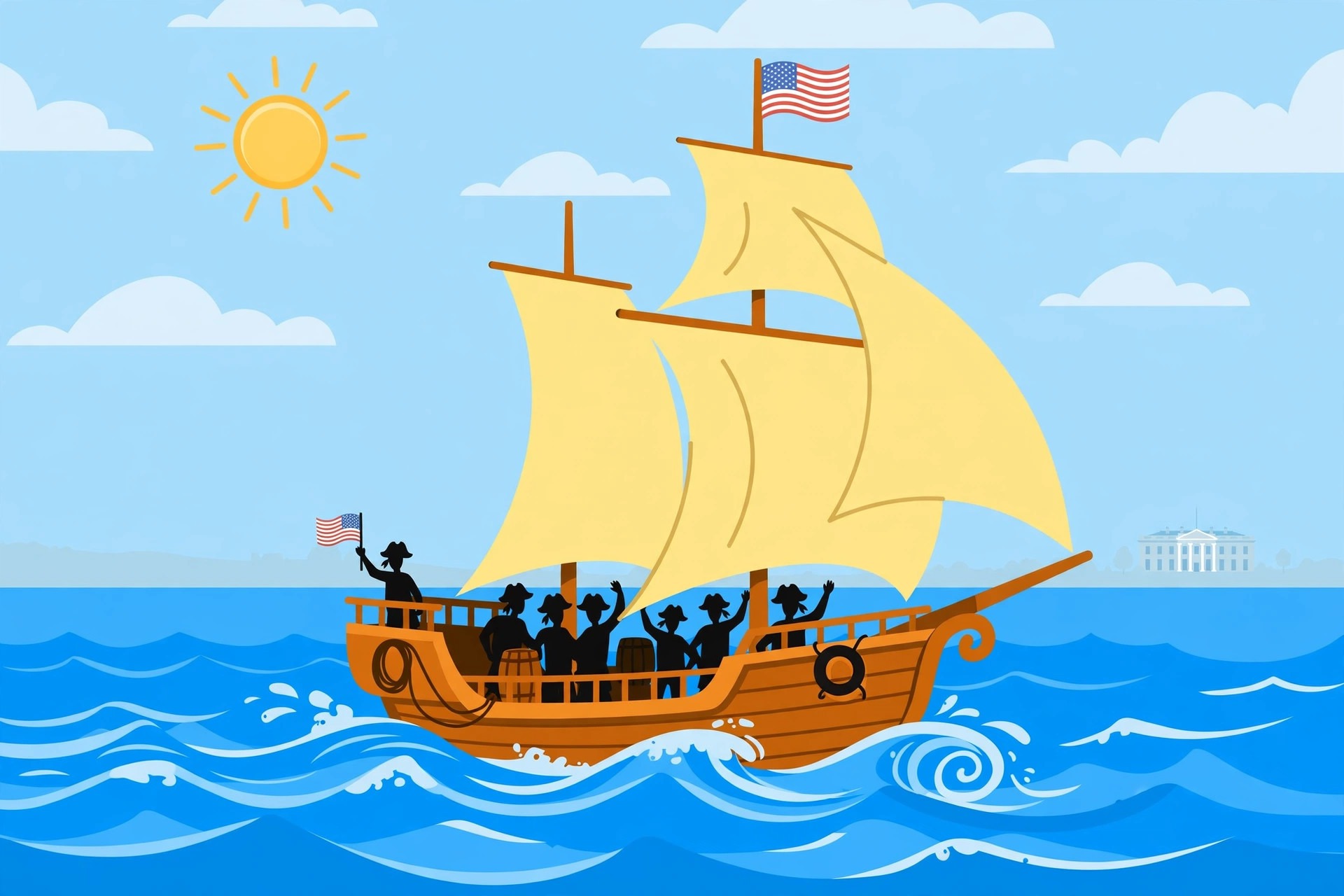
Reports of the post described a custom graphic in which President Trump appeared at the helm of a ship styled after the Going Merry, the vessel associated with the Straw Hat crew in One Piece. The figurehead wore a bright red cap bearing the slogan Make America Great Again. Vice President JD Vance and other administration figures were also placed in the pirate universe, in place of the fictional crew. The caption, The Mark of a Good Crew, played on the idea of loyalty, teamwork and a shared voyage, while the flag emoji anchored the image firmly in American political branding rather than in the fictional world alone.
That combination is the whole point of the format. The image borrows instant recognition from a franchise that has been running for decades, in manga, animation and, more recently, a live-action adaptation, and it transfers some of that familiarity to a political team. A viewer does not need to follow the plot of One Piece to understand the shorthand: a captain, a crew, a ship heading somewhere together, and a sense of adventure. A viewer who does know the series, however, will notice far more, including the irony that the fictional crew is famous for resisting a powerful, centralised authority. That tension between the borrowed story and the political message is not an accident of the format; it is the reason the format keeps generating argument.
The post also fits a broader pattern in which official accounts do not merely announce policy but perform personality. A press release explains; a meme signals belonging. A meme tells supporters that they are in on the joke, that the administration speaks their internet language, and that politics can be fun as well as serious. It also tells opponents that the administration is not particularly worried about conventional decorum. Both messages can be true at the same time, and both help explain why the same image can be celebrated in one timeline and condemned in another.
Why a Pirate Story Travels So Far Online
One Piece is not a niche reference. It is one of the most successful manga and anime franchises in the world, with a story centred on Monkey D. Luffy and his crew searching for treasure while challenging the World Government, a fictional authority presented as corrupt and oppressive. Its themes are friendship, freedom, perseverance and loyalty to a chosen crew rather than to an institution. Those themes are broad enough that almost any political movement could try to claim them, and specific enough that fans notice when the claim feels strained.
For a political account, that breadth is useful. A pirate crew is an attractive metaphor for an outsider movement: a small group, bound by loyalty, sailing against larger powers, refusing to follow the usual rules. It suggests adventure rather than bureaucracy, and solidarity rather than hierarchy. For fans, however, the metaphor can feel backwards when it is used by the government itself, which is, in the real world, the institution with power. That mismatch has fuelled much of the online reaction, with some fans arguing that the crew in the story would be sailing against the very kind of authority the post appears to celebrate.
The format also travels well because it is visual, wordless in its main impact, and easy to share without context. A person can repost the image, add a laughing emoji, a critical comment or a counter-meme, and the conversation continues without anyone needing to read a policy document. That is a strength for reach and a weakness for precision. The image says team, adventure and confidence, but it does not say anything specific about what the team will do next, and it invites viewers to fill in the rest themselves.
The Longer Pattern: Pokemon, Dragon Ball and Other Borrowings
The One Piece post did not appear from nowhere. Entertainment and news reporting on the administration’s social media output has documented a series of earlier borrowings from Japanese animation and video games. In September 2025, the Department of Homeland Security posted an immigration-enforcement video using Pokemon imagery and its familiar theme song, presenting arrested people in trading-card-style images. The Pokemon Company International later said it had not participated in the creation of that video and had not authorised the use of its intellectual property.
In March 2026, the White House returned to Pokemon with an image inspired by the artwork and typography of Pokemon Pokopia, carrying the slogan MAGA alongside a lightning emoji. Around the same time, the White House published a military-themed montage that incorporated clips from Dragon Ball Z, Dragon Ball Super and Yu-Gi-Oh! alongside footage of military strikes. Supporters described those posts as energetic and modern. Critics described them as trivialising serious subjects, or as using other people’s creative work for political promotion without permission.
Later posts continued the pattern in different registers. A video depicting the president as Naruto, the ninja protagonist of another long-running series, drew renewed attention to the issue, and reporting in the summer of 2026 described growing backlash in Japan, including an online petition urging the president and the White House to respect Japanese manga and to stop using anime characters in political messaging without permission. Organisers were reported to have gathered close to twenty thousand signatures. Those earlier episodes are relevant because they show that the One Piece post is not an isolated joke but part of a repeated communications strategy, and that the objections to it are also part of a repeated pattern.
Japan, Creators and the Permission Question
One of the most serious questions raised by the One Piece post is also the simplest: did anyone ask permission? In the Pokemon case, the rights holder said publicly that it had not. In other cases, rights holders have said they were not involved, or have declined to be associated with a political viewpoint. Reporting on the wider controversy has said that Japan’s Ministry of Foreign Affairs raised concerns with the United States Embassy in Tokyo on more than one occasion, worried both about possible unauthorised use and about the effect of linking well-known Japanese brands with political messaging on public perception in Japan.
It would be wrong to present that concern as a settled legal finding about the One Piece image itself. As of the reporting available on 3 November, no public statement from the One Piece rights holders specifically addressing this post had been widely reported, and the White House had not published a detailed response to the permission question. Copyright and trademark questions in cases like this can be complex, depending on how much of an original work is used, whether the image is an original illustration inspired by a style rather than a direct copy, and whether a particular use is treated as commentary, parody or political speech. Those are questions for lawyers and rights holders, not conclusions that a news summary should jump to.
What can be said is that the political and cultural question is distinct from the legal one. Even if an image is lawful, fans and creators may still object to the association. A franchise built over decades carries meanings for its audience that cannot be transferred by a single post, and the audience may resist a new meaning being imposed on it. That resistance is visible in petitions, in fan art that answers the official image, and in commentary that quotes the story back at the administration. The post, in other words, does not end the conversation about the franchise; it starts a new round of it.
Supporters, Critics and the Election Day Timing
Among supporters, the appeal is straightforward. The image is fun, it is confident, and it treats politics as a shared cultural experience rather than a dry institutional process. For younger voters who grew up with anime, it signals that the administration is speaking to them in a language they recognise. For loyal supporters more broadly, it reinforces the idea of a team that sticks together under pressure, which is a useful message on a day when that team is being judged by voters.
Among critics, the objections fall into three broad groups. The first is about taste and seriousness: an official account, critics argue, should not be turning government communication into fan content on Election Day. The second is about intellectual property and respect for creators, as described above. The third is about meaning: critics argue that One Piece, with its story of resistance to a powerful World Government, is a poor fit for a government celebrating its own power, and that the borrowing therefore misunderstands the story it claims to honour. None of these criticisms, on their own, proves that the post was unlawful or that it affected any election, and they should not be presented as if they do.
The Election Day timing adds a further layer. On a day when attention is focused on voting, a viral cultural post can dominate feeds that might otherwise carry practical voting information or sober analysis. Supporters may see that as smart communications, capturing attention when attention is highest. Critics may see it as a deliberate attempt to set the tone of the day. Both interpretations assume a level of strategy that cannot be proven from the post alone. What is certain is that the post was published on 3 November, that it was reported the same day, and that its reception was divided in ways that mirror wider divisions about the administration’s style.
What Is Not Known, and What to Watch Next
Several questions remain open, and readers should be cautious about any account that pretends otherwise. It is not publicly known whether the One Piece rights holders will comment on this specific image, whether they will ask for it to be removed, or whether they will choose to say nothing, as rights holders sometimes do when they do not wish to amplify a political dispute. It is not known whether the White House intends this as a one-off Election Day post or as the start of a longer series of franchise-themed images. It is also not known how the post will be remembered: as a successful viral moment, as a footnote in a long campaign day, or as another entry in a growing list of cultural borrowings that eventually prompts a firmer response from creators or from Japan.
What is worth watching is not only the next post but the response around it. If rights holders comment, their words will matter more than speculation about their views. If Japanese officials raise the matter again through diplomatic channels, that will signal that the concern is being treated as more than a fan dispute. If supporters continue to share and remix the image, that will show that the format has a life beyond the official account. And if critics produce counter-images that use the same franchise to make the opposite point, that will show how porous political branding becomes once it borrows from a story that belongs, in the cultural sense, to its audience.
For now, the One Piece post stands as a small but revealing episode in how modern White House communication works. It shows an administration comfortable using the internet’s most shareable language, willing to borrow from global popular culture, and unconcerned about the charge that official channels should sound official. It also shows the limits of that approach: a borrowed story brings its own fans, its own meanings and its own creators, and none of them can be controlled by a caption. On Election Day, when voters were deciding the next two years of American politics, the White House chose to present itself as a crew setting sail. Whether voters saw a team they wanted to join, a joke they enjoyed, or a story they felt had been taken without asking, depended on where they were already standing, and no single image, however widely shared, could settle that question for them.
Sources
USN reviewed reporting from multiple outlets for this story. Read more from FandomWire, NetflixJunkie and Ada Derana.