

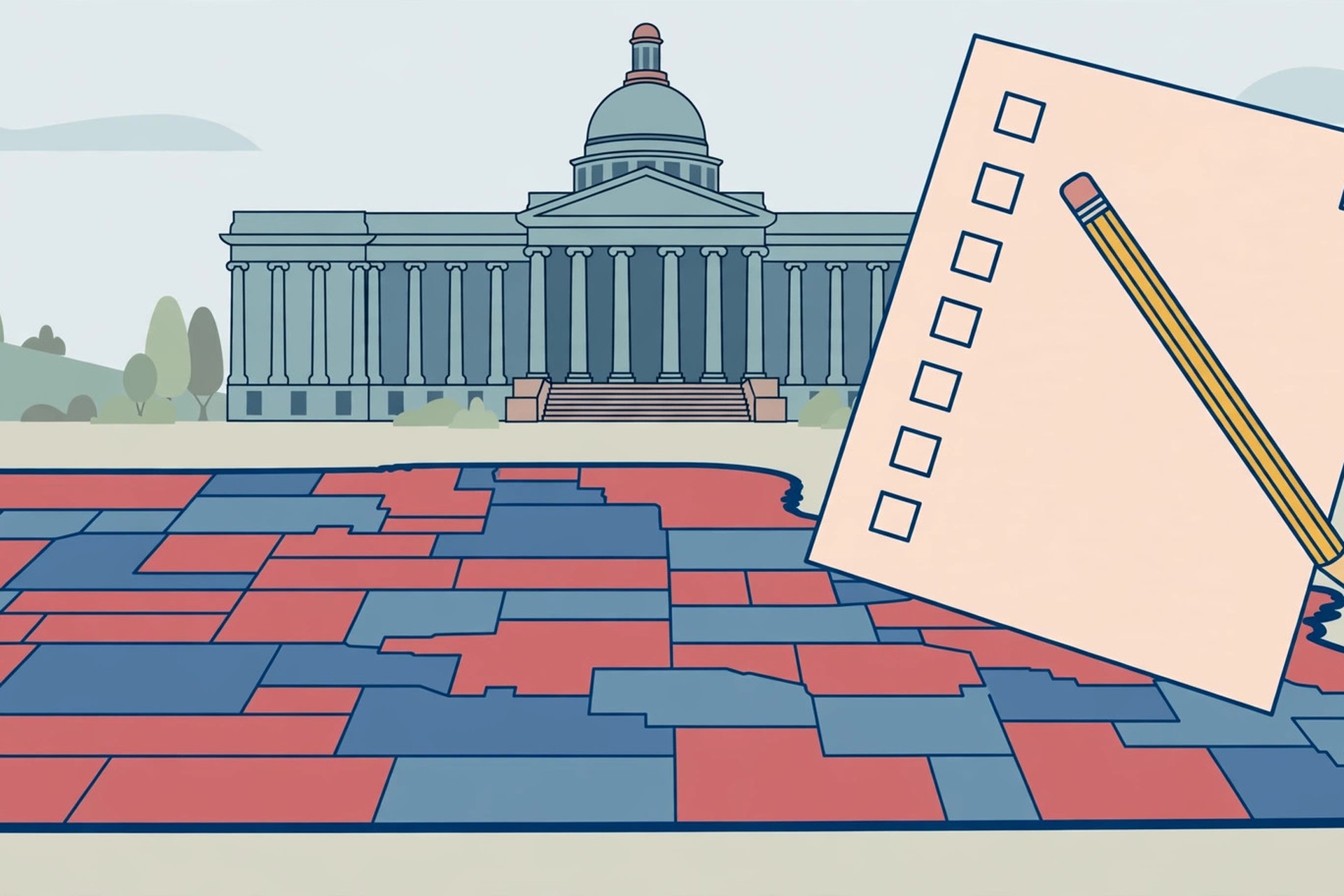
Missouri Voters Face a Direct Choice on Their Congressional Map
Missouri voters are deciding on Tuesday, November 3, 2026, whether to approve a new congressional district map that state lawmakers adopted in 2025, or to keep the map enacted in 2022. The question, known as Proposition A, is a statewide referendum on House Bill 1, passed during a special session of the General Assembly. It is one of the most consequential ballot questions in Missouri this year because it will shape how Missourians elect members of the United States House of Representatives in future elections, even though it does not change the districts used for the House races on this same ballot.
That distinction is essential and is a frequent source of confusion. Following court orders, including a ruling by the Missouri Supreme Court in September 2026 and a decision by the United States Supreme Court on September 25, 2026, not to revive the 2025 map for this election, Missouri’s 2026 congressional races are being held under the 2022 districts. Proposition A therefore decides which map governs future elections, not who wins a House seat on November 3. A yes vote approves the 2025 map for future cycles. A no vote rejects that map and leaves the 2022 map in place.
The referendum reached the ballot through Missouri’s petition process. The campaign People Not Politicians gathered more than 305,000 signatures to force a public vote on the new map, arguing that voters themselves should decide whether mid-decade redistricting should stand. Supporters of the 2025 map argue that the legislature acted within its authority and that the new boundaries better reflect county lines and communities. Opponents argue that the redraw was designed for partisan advantage and that it unfairly divides Kansas City. Both sides present their case as a defence of fair representation, but they define fairness in very different ways.
What Missouri Proposition A Would Change
The official ballot language asks voters whether they approve House Bill 1, which repeals Missouri’s existing congressional plan and replaces it with new boundaries that, according to the ballot description, keep more counties intact. A yes vote would adopt that plan. A no vote would veto it. The measure is a referendum on a law, not a constitutional amendment, which means its effect is to approve or reject the legislature’s map rather than to rewrite the state constitution’s redistricting rules.
Missouri currently sends eight members to the United States House of Representatives: six Republicans and two Democrats. The 2025 map was designed, according to its critics and to reporting on its passage, to shift that balance toward seven Republicans and one Democrat. The most significant change concerned the Kansas City-based Fifth District, represented by Democratic Congressman Emanuel Cleaver. Under the 2025 plan, Kansas City would be split among three districts, with parts of the city joined to more rural, Republican-leaning areas to the east and elsewhere. Critics describe that as cracking a Democratic-leaning city across multiple districts so that its voters are outnumbered in each one. Supporters of the map dispute the characterisation of partisan intent and argue that district lines must balance many factors, including keeping counties whole and following population changes.
Cleaver has represented the Fifth District since 2005, and the district has long centred on Kansas City. Under the 2022 map, the city remains largely within one district, which supporters of the current map say preserves a community of interest. Under the 2025 map, no Kansas City-area district would lean Democratic, according to analyses cited by opponents. That claim is contested by map supporters, who say future elections, candidate quality and voter turnout, not lines alone, determine outcomes. What is not in dispute is that the two maps would create different electorates for future House races in western Missouri, and that the choice matters for how competitive those races are likely to be.
How Missouri Reached a Referendum on Its Own Map
The dispute began in September 2025, when Missouri lawmakers, called into special session by Governor Mike Kehoe at the urging of President Donald Trump, approved new congressional boundaries. The move was part of a national mid-decade redistricting push in which several states sought to redraw House maps ahead of the 2026 midterms, outside the usual once-a-decade cycle that follows the census. In Missouri, as in other states, the stated goal by Republican leaders was to strengthen their party’s position in the House. Opponents said the effort was an attempt to lock in partisan advantage before voters had a chance to weigh in.
People Not Politicians, the group behind the referendum, collected signatures to suspend the new law and put it to voters. Missouri law allows voters to veto a new law by petition, and the campaign’s submission of more than 305,000 signatures was sufficient to trigger the referendum. The state then fought the referendum in court, arguing over its validity and timing. On September 3, 2026, the Missouri Supreme Court ruled the referendum valid and ordered the Secretary of State to run the November election on the previous map until voters had spoken.
The United States Supreme Court then declined on September 25, 2026, to revive the Republican-backed map for the 2026 election, allowing the Missouri Supreme Court’s ruling to stand. The unsigned order warned, in effect, that changing district boundaries so close to a general election could disrupt voting. That sequence of rulings meant that, whatever voters decide on Proposition A, the 2026 House elections would proceed on familiar lines. The referendum’s effect, if the new map is approved, would begin with future election cycles, with reporting indicating the next cycle in which it would apply would be 2028.
The legal history matters because it frames the referendum as both a policy choice and a test of direct democracy. Supporters of the referendum process say it gives voters a check on the legislature when lawmakers redraw their own districts. Supporters of the legislature’s map say elected representatives, not petition campaigns, should draw districts, and that courts should not lightly set aside legislative action. Those arguments will continue after November 3, whatever the result, because redistricting litigation and legislation have become recurring features of American politics.
The Arguments for a Yes Vote on Proposition A
Supporters of a yes vote argue that the 2025 map is a legitimate legislative product that improves on the 2022 map in specific ways. The ballot language itself highlights keeping more counties intact, a principle that redistricting experts often cite as desirable because it avoids splitting local communities across multiple representatives. Supporters say voters should respect the legislature’s judgement on how to balance population equality, county integrity and other traditional criteria, and that rejecting the map would freeze in place boundaries that are themselves the product of earlier political compromises.
Some yes supporters also argue that Missouri’s congressional delegation should more closely reflect the state’s overall partisan balance, which leans Republican. From that perspective, a 7-1 Republican delegation is not an anomaly but a reflection of statewide voting patterns, even if individual districts are drawn in ways that favour one party. They argue that Democrats already hold two seats under the current map, including a St. Louis-based district, and that the Kansas City district’s current shape is itself a product of partisan line-drawing in an earlier cycle.
Other supporters take a more procedural position: they say mid-decade redistricting is lawful, that legislatures redraw maps when political or demographic conditions change, and that voters who disagree with the legislature can express that disagreement by electing different lawmakers. On that view, a referendum that vetoes a single map does not settle the underlying question of who should draw districts, and a yes vote simply allows the legislature’s work to take effect.
It is important to note that support for Proposition A is not uniform, even among groups that generally favour Republican policies. Some voter guides that lean toward approving the map have described their support as reluctant, noting that the mid-decade redraw was handled poorly even if they favour the resulting lines on balance. That nuance suggests that some yes voters may be voting for the map itself, rather than for the process that produced it.
The Arguments for a No Vote on Proposition A
Opponents of Proposition A, including the League of Women Voters of Missouri and the People Not Politicians campaign, argue that the 2025 map is a partisan gerrymander that divides Kansas City to dilute the voting power of its residents. They say a community that shares schools, employers, hospitals, transit and cultural institutions should not be split three ways for the purpose of changing election outcomes. A no vote, in their framing, preserves the 2022 map, keeps communities of similar interests together, and upholds the principle that redistricting should occur once a decade, after the census, rather than whenever a party in power sees an opportunity.
Opponents also point to the signature campaign itself as evidence of public opposition. More than 305,000 Missourians signed petitions to put the map to a vote, a threshold that required organisation across the state. Campaigners say that level of mobilisation shows voters want a direct say, and that the courts’ decisions to allow the referendum and to keep the 2022 map for 2026 vindicated that process. Kansas City Mayor Quinton Lucas, among other local leaders, has urged a no vote, arguing that the redraw was ordered from Washington and designed to deprive Kansas City voters of effective representation.
Critics of the map also argue that mid-decade redistricting undermines trust in elections. When district lines change in the middle of a decade, they say, voters may find themselves in a new district with a new representative, new campaign issues and new community ties, even though they have not moved. That disruption, they argue, is especially problematic when it occurs close to an election, which is why courts intervened to keep the 2022 map for 2026. A no vote, on this view, is a vote for stability and for a redistricting process tied to the census cycle.
As with the yes campaign, the no campaign is not monolithic. Some opponents focus on Kansas City specifically, while others focus on the broader principle of partisan fairness or on the process by which the map was adopted. Some voters may oppose the map because they oppose the president’s involvement, others because they oppose any mid-decade redraw regardless of party, and others because they believe the 2022 map simply works better for their community.
What Polling Suggests, and Why It May Not Predict the Result
Polling on ballot measures is often less reliable than polling on candidate races, because voters may be less familiar with the measure, may be confused by ballot language, or may decide late. An August poll from Saint Louis University and YouGov found 35 percent in favour of the new map, 32 percent opposed, and 33 percent undecided. That large undecided share means the referendum could move significantly in either direction as voters learn more, hear campaign advertising, or receive guidance from trusted local sources.
Ballot language itself can affect outcomes. The official question describes the new map as keeping more counties intact, a framing that supporters say is accurate and opponents say is favourable to the yes side. Voter guides have therefore tried to explain in plain language what each vote does, emphasising that a yes vote approves House Bill 1 and a no vote keeps the 2022 map. Election officials and nonpartisan groups encourage voters to read the full text and certified ballot language through the Missouri Secretary of State’s office, rather than relying solely on campaign advertisements.
Turnout patterns will also matter. Proposition A appears on a high-turnout midterm ballot alongside Senate, House, gubernatorial and other contests, which means many voters who come to vote for candidates will also face the referendum. Some may skip the question, leaving it blank, while others may vote based on party cues, local endorsements or a general sense of fairness. In a referendum where the undecided share was one-third in August, late-deciding voters could be decisive.
Missouri polls are open from 6 a.m. to 7 p.m. on November 3, and voters in line at closing time may still vote. As with candidate races, no result for Proposition A has been called while voting is underway. Results will be reported as counties tally ballots, and a close referendum may take time to resolve, particularly if mail and provisional ballots remain to be counted.
Why Proposition A Matters for Congress Beyond Missouri
Missouri has only eight House seats, so a shift from 6-2 to 7-1 would change the national House balance by a single seat. In a House where majorities have been narrow in recent years, however, a single seat can matter for control, for committee majorities, and for the margin available to a governing party when members defect on difficult votes. That is why national attention has focused on Missouri’s referendum even though the state is not the largest battleground.
More broadly, Proposition A is a test of whether voters, given a direct veto, will approve or reject a mid-decade map drawn for partisan advantage. Similar fights have played out in other states this cycle, including Maryland, where voters are considering whether to exempt congressional districts from certain state constitutional requirements, and Colorado, where voters are considering a measure on how future maps are approved. The Missouri result will therefore be read by redistricting experts, party strategists and reform advocates as a signal about public tolerance for mid-decade redrawing, even though each state’s law and politics differ.
The result will also shape Missouri politics for years. If voters approve the 2025 map, future House campaigns in western Missouri will be fought on new lines, with different combinations of urban and rural voters, and incumbents and challengers will adjust their strategies accordingly. If voters reject the map, the 2022 lines will remain until the next census-based redistricting, and lawmakers who favoured the redraw will need to decide whether to try again, accept the current map, or pursue a different approach to redistricting reform.
For Kansas City voters in particular, the stakes are immediate and personal. The question is not abstract: it is whether their city will continue to anchor a single congressional district or be divided among three. That is why local leaders, community organisations and neighbourhood groups have been among the most active voices in the campaign, and why turnout in Jackson County and surrounding areas will be watched closely as results come in.
As voting continues on November 3, the essential facts remain clear, and the outcome remains unknown. Missouri’s House races are being decided under the 2022 map. Proposition A will decide which map governs future elections. Voters who mark yes are approving the legislature’s 2025 plan. Voters who mark no are keeping the map they have used since 2022. The count will determine which choice a majority of Missourians made, and Congress will feel the effect in the elections that follow.
Sources
USN reviewed reporting from multiple outlets for this story. Read more from WIONews, Ballotpedia and VOTP News STL.