

DC Election Day 2026: What Voters Need to Know Before 8pm
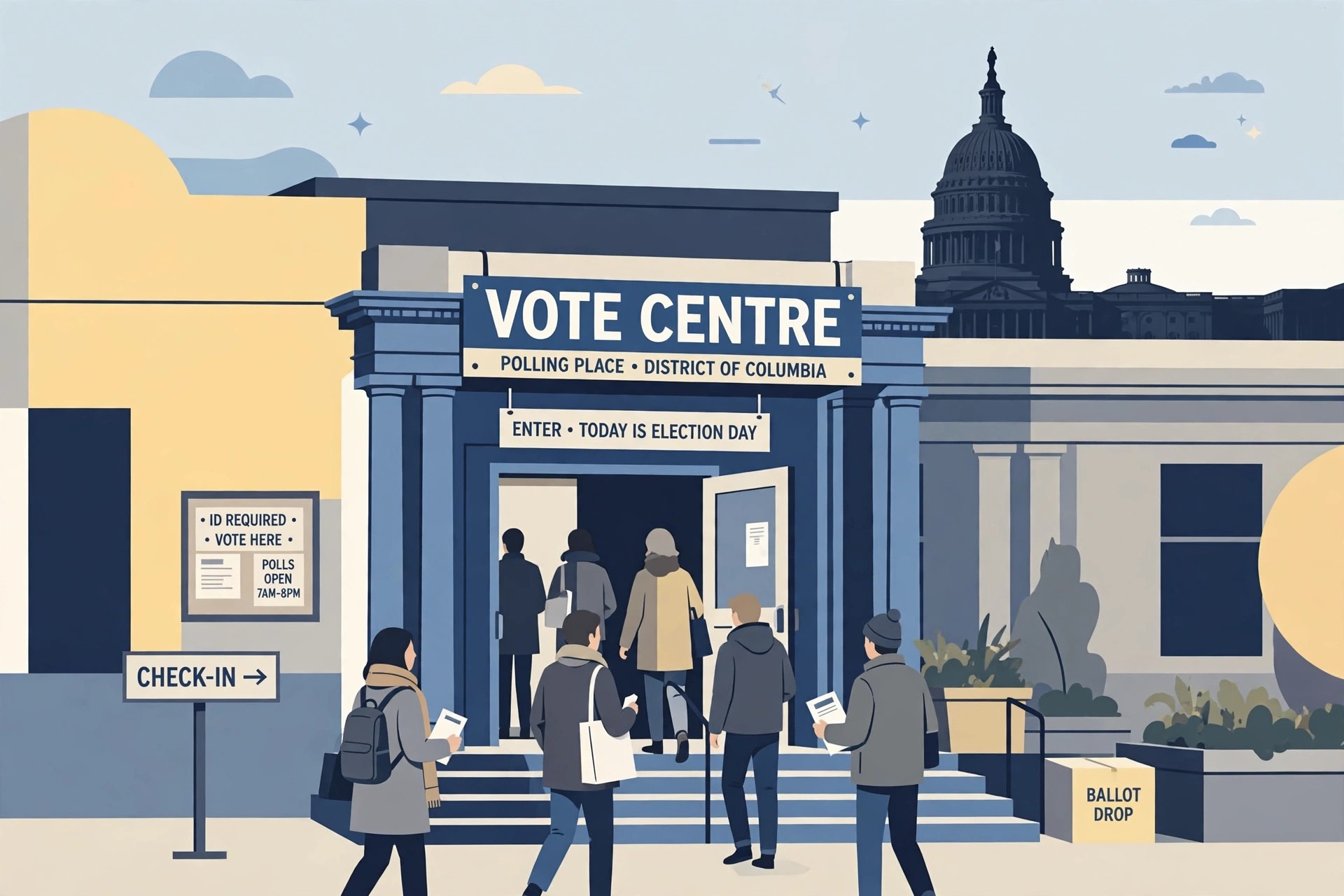
Washington voters headed to the polls on Tuesday, November 3, 2026, for an Election Day that will reshape much of the District’s government. The vote centres opened at 7am and were scheduled to close at 8pm, with 145 centres operating across the city, giving voters a full day to cast ballots in person. In addition to the in-person vote, mail ballots remained central to the process, with ballots postmarked by November 3 and received by November 13 still counted. Certification of the results was tentatively scheduled for December 2.
The most important practical point for anyone voting in person on Election Day was the closing rule. Anyone who is in line at 8pm at their vote centre is entitled to vote, even if the queue takes some time to clear. That rule protects voters who arrive on time but face a wait, and it is the reason election officials urge people not to leave a line simply because the clock has passed closing time.
That citywide choice is part of a broader pattern in District elections, where the emphasis has increasingly been on making voting possible across the city rather than tying voters to a single neighbourhood polling place. Vote centres, early voting and mail ballots are all part of that model, and together they are designed to give voters more options than a traditional precinct system.
The Mayor’s Race: A Contest to Succeed Muriel Bowser
The headline contest on the District ballot was the race for mayor. The winner will succeed Muriel Bowser, who did not seek re-election, and will take over a city government facing questions about housing, public safety, economic development and the District’s relationship with the federal government.
Janeese Lewis George, a Democrat, entered the mayoral contest as the heavy favourite after winning the Democratic primary in June 2026. A former Council member and a prominent voice in District politics, she campaigned on a platform that emphasised affordable housing, support for working families and a more activist approach to city government.
Her opponents on the ballot included Robert Gross of the Statehood Green Party and independent candidate Adam Eidinger. Gross and Eidinger offered voters alternatives from outside the Democratic mainstream, with campaigns that focused on statehood, local autonomy and different approaches to development and policing. Their presence on the ballot meant that voters who were dissatisfied with the Democratic nominee had options, even if the outcome was widely expected to favour Lewis George.
What the next mayor will inherit is a city government facing the ordinary but demanding work of running a major American city, alongside the distinctive challenge of governing a federal district without full voting representation in Congress. Budgets, services, schools and public safety all depend on the mayor’s leadership, and the next mayor will need to build relationships quickly with a partly new Council and with federal officials.
Delegate to Congress: An Open Seat After a Late Resignation
Alongside the mayoral race, District voters were also choosing their delegate to Congress, the nonvoting representative who advocates for the District in the House of Representatives. The contest was shaped by a late change in the field that altered the dynamics of the race in its final weeks.
The sequence matters because it illustrates how tightly the District’s ballot contests are linked. When a prominent Council member leaves a seat to run for another office, or when a long-serving delegate steps down, the effects ripple through other races, creating vacancies and opportunities that reshape the whole ballot. Voters on Tuesday were therefore not only choosing individuals for specific offices, but also responding to a chain of decisions that had unfolded over months.
The delegate’s seat itself was open because Eleanor Holmes Norton, the long-serving delegate, was not seeking re-election. Norton’s tenure had spanned decades in which the District’s delegate has been a central voice for statehood, for voting representation in Congress, and for District interests in federal legislation. Her decision not to seek another term meant that District voters were not merely re-electing a familiar figure but choosing a successor who would have to build new relationships in the House, learn the committee and legislative processes from a fresh position, and carry forward the District’s long-standing demand for fuller representation. The delegate cannot vote on final passage of legislation on the House floor, a limitation that has defined the office throughout its history, but the role remains the District’s principal elected voice in Congress, with committee participation, advocacy and the ability to shape debate.
For voters, the delegate contest therefore asked a different kind of question from the mayoral race. The mayor runs a government. The delegate represents the city in a federal legislature in which the District still lacks the full voting representation that states enjoy. Choosing a delegate is, in part, choosing a strategy and a style for that advocacy at a moment when the District’s status remains contested in national politics.
Attorney General, Council Leadership and Ward Seats
The ballot did not stop at mayor and delegate. Voters were also choosing the District’s attorney general, with Brian Schwalb facing Manuel Rivera. The attorney general is the District’s chief legal officer, responsible for legal advice to District agencies, for consumer protection and other enforcement work, and for representing the District in litigation. In recent years, the office has also become a visible actor in disputes involving federal authority and District autonomy, which gives the contest a significance beyond its administrative functions. Voters weighing this race were weighing legal experience, priorities for enforcement, and approach to the office’s public role.
Voters were also choosing a Council chair and an at-large Council member, as well as Council members for Wards 1, 3, 5 and 6. The Council chair presides over the legislative body, shapes its agenda and committee structure, and acts as a central figure in negotiations with the mayor over budgets and legislation. The at-large member represents the whole District rather than a single ward, which gives that seat a citywide character distinct from ward seats. Ward members, by contrast, are directly accountable to the residents of a particular part of the city, and ward races often turn on highly local questions: development, schools, public safety resources, transportation changes and neighbourhood services. Taken together, the Council contests on this ballot would determine much of the legislative leadership that the next mayor will have to work with, and the balance of perspectives within the Council itself.
That interaction between mayor and Council is one of the reasons a single Election Day can matter so much in the District. A new mayor arriving alongside a partly new Council, a new Council chair and a new delegate creates a fresh set of relationships across the District government. Budgets, legislation and oversight all depend on those relationships working, and voters on Tuesday were, in effect, choosing the team that will have to build them.
Initiative Measure No. 86 and the Foie Gras Question
Also on the ballot was Initiative Measure No. 86, concerning force-feeding birds and the sale of foie gras. Ballot measures of this kind ask voters to decide a specific policy question directly, rather than through their elected representatives alone. The measure’s subject, the practice of force-feeding birds to produce foie gras and whether sales connected to that practice should be restricted, sits at the intersection of animal welfare, food policy and local business regulation. Supporters of such measures typically argue from animal welfare principles, while opponents typically argue about consumer choice, restaurant and food business impacts, and the proper scope of local regulation. Voters encountering the measure on a long ballot needed to read its wording carefully, because initiative language can be technical and its practical effect depends on precise definitions and implementation provisions, not only on the general principle in its title.
The presence of the initiative on the same ballot as the city’s top offices also illustrates the breadth of direct democracy in the District. On a single day, voters were asked to choose leaders and to settle a policy question, a combination that rewards voters who arrive informed about both halves of the ballot. For many voters, the initiative may have been the least familiar item on the ballot, which makes pre-election guides and the official ballot information especially valuable.
Mail Ballots, Counting and Certification: What Happens Next
Election Day is not the end of the process. Mail ballots postmarked by November 3, Election Day itself, and received by November 13 will still count, which means that the full picture of the vote will take time to assemble. That window exists to ensure that ballots mailed on or before Election Day are not discarded simply because postal delivery takes several days. It also means that close contests may remain genuinely uncertain for days after the polls close, and that early reported totals on election night may shift as mail ballots arrive and are processed.
Certification of the results was tentatively scheduled for December 2. Certification is the formal step in which election officials confirm the final, official totals after all valid ballots have been counted and any required checks have been completed. Until certification, results reported on election night and in the days that follow are best understood as unofficial or preliminary, however complete they may appear. That distinction matters for every race on the ballot, from mayor to ward Council seats to the initiative, and it is especially important in a year when a late resignation, an open delegate seat and a change of mayor all coincide.
Voters who want to follow the count can do so through the District Board of Elections results reporting, which provides the official channel for returns as they are updated. News coverage will also track the count, but the Board’s reporting remains the authoritative source for the official position. For residents, the days after Election Day will therefore be a period of watching, waiting and, where margins are close, patience. The outcome of this election will shape the District’s government for years to come, but the process of establishing that outcome with certainty is deliberately careful, and it does not end when the vote centres close at 8pm.
What is already clear, even before any result is known, is the scale of change this election represents. A new mayor, a new delegate, a potentially reshaped Council and a decision on a contested ballot measure, all decided on the same day, mark a moment of renewal for District government. The voters who turned out on Tuesday, whether at a vote centre near home or across the city, by mail or in the early voting period, were participating in that renewal. The results, when they are known and certified, will show which direction they chose.
Sources
USN reviewed reporting from multiple outlets for this story. Read more from FOX 5 DC, DC Board of Elections and FOX 5 DC.