

Polls in New York opened at 6 a.m. on Tuesday, 3 November 2026, and in Westchester County, just north of New York City, the first voters of the day walked into an unexpected problem. The machines that scan paper ballots were not accepting them. At polling places across the county, voters filled out their ballots as usual, only to find that the scanner would not take the sheet, or would return it again and again. By mid-morning, the county Board of Elections had confirmed what poll workers already knew from their first hours on duty: this was not a single faulty machine in a single building, but a countywide failure.
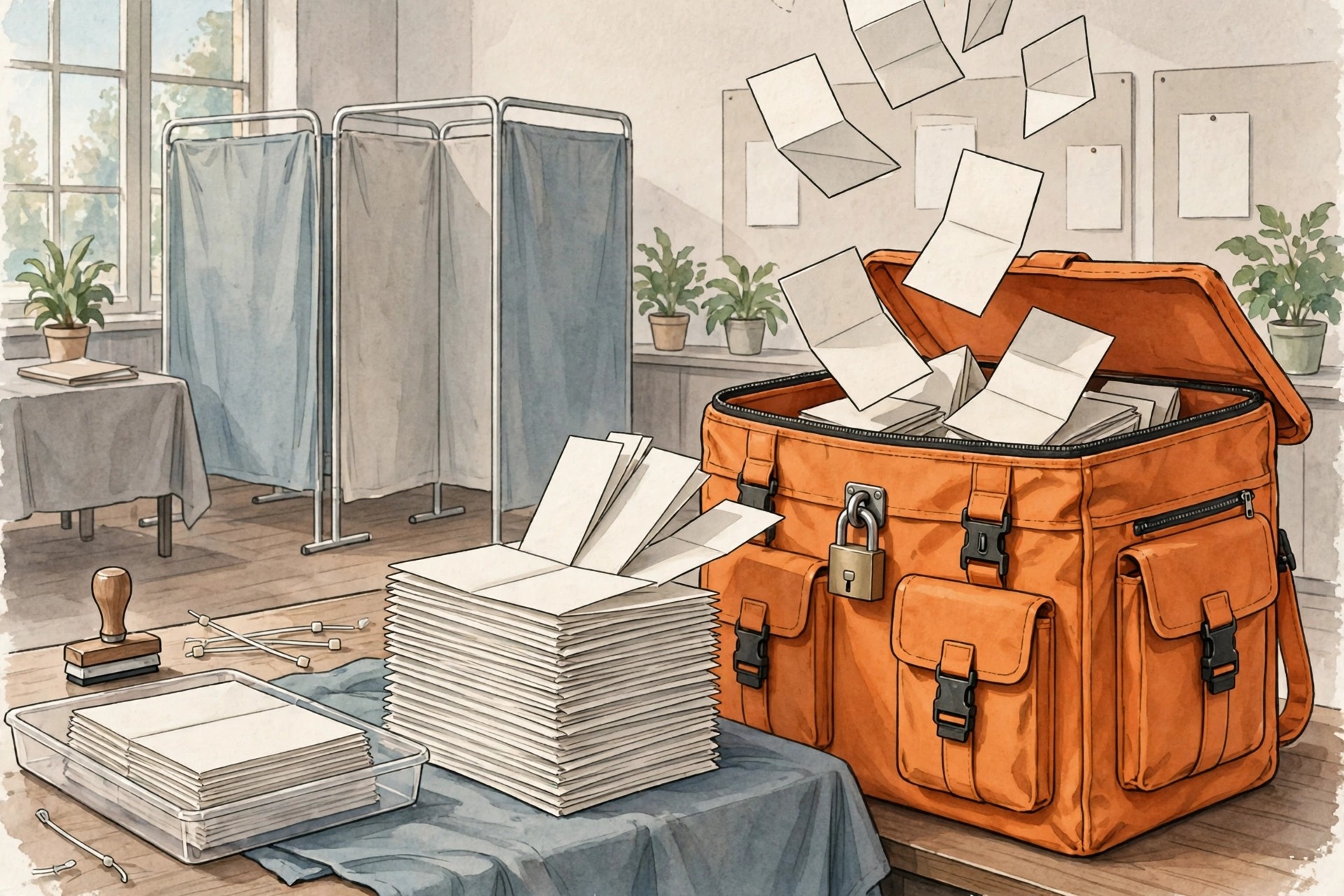
The board confirmed the problem at around 7:30 a.m. Eastern time, roughly ninety minutes after polls opened. From that point on, the story of Election Day in Westchester became a story about a backup plan. Voters were checked in, given paper ballots, and asked to place their completed ballots in secure orange emergency bags, under the watch of poll workers from both parties. Those bags would be taken to the Board of Elections at the end of the night, and the ballots inside them would be counted first, before ballots that had gone through working machines. Voting, officials insisted at every level, had not stopped.
That reassurance mattered, because Westchester is not an ordinary county on an ordinary Election Day. Most of northern Westchester, along with a sliver of the south, lies in New York’s 17th Congressional District, where Republican Representative Mike Lawler is seeking re-election against Democratic challenger Cait Conley in one of the closest House races in the country. Voters there were also deciding races for governor, attorney general, comptroller, state Senate, state Assembly, judges, and local offices. A countywide scanner failure in such a county, on the morning of a high-stakes midterm election, was bound to draw attention far beyond the county line.
What went wrong with the Westchester County ballot scanners
The precise cause was not settled on Tuesday morning, and that uncertainty became part of the story. The county Board of Elections first pointed to the thickness of the ballot paper as the reason machines were rejecting ballots. That explanation was then corrected, and the board’s later description was broader and less specific: an issue involving paper ballots that was preventing some voting machines from accepting ballots at polling locations throughout the county. County Executive Ken Jenkins, speaking as the problem unfolded, did not give a definitive cause either, and said there was no word yet on when the machines would be fixed.
Lawler, in a statement on Tuesday morning, put the uncertainty plainly, saying it was not yet known whether the fault lay with the ballot or with the machine, and that the Board of Elections was working with its vendors to resolve it. A Republican poll worker in Mount Kisco told local reporters that a source had attributed the problem to the width of the preprinted Election Day ballots, noting that early-voting ballots are printed on site as voters arrive, while Election Day ballots arrive preprinted in packs. That detail, if confirmed, could help explain why a problem appeared on Election Day itself rather than during early voting, but on Tuesday morning it remained an unconfirmed account from the floor of a polling place, not an official finding.
What was confirmed was the scale. Scanners at most polling sites were affected, according to county and state accounts. Reports came in from Montrose, Yonkers, White Plains, New Castle, Irvington, Croton-on-Hudson, Mount Kisco, North Salem, and Sleepy Hollow, among other communities. At the Hendrick Hudson Free Library in Montrose, at the Ukrainian Youth Center in Yonkers, and at the Hudson Museum polling site, voters reported machines that would not accept ballots. At Ridgeway Elementary School in White Plains, some voters were uncomfortable leaving their ballots in bags and looked into voting elsewhere. In Irvington, a poll worker reported that none of the three machines at his site would accept completed ballots.
One of the earliest voters illustrated how the morning unfolded at ground level. Brad Kennedy, 37, of Croton-on-Hudson, said he was the first voter at his polling place when it opened at 6 a.m., and that the scanner repeatedly rejected his ballot even after he turned it over and tried again. Poll workers tried several times, consulted their instructions, and then told him what voters across the county were hearing that morning: the problem was widespread, and his ballot would have to go into a secured orange bag.
Emergency paper ballots, orange bags, and bipartisan control
Westchester uses paper ballots that voters mark by hand and then feed into a scanner, which reads and tallies the votes while preserving the paper record. When the scanner cannot read a ballot, the paper itself is not lost. That design is what made the emergency procedure possible. Voters still marked a real ballot, and poll workers still secured it, even though the machine could not count it on the spot.
The procedure, as described by the county board and the New York State Board of Elections, was deliberately old-fashioned and deliberately watched. Completed ballots were placed in designated orange emergency ballot bags, which would remain secure and monitored. The state board said the ballots were secured under bipartisan control and would be counted, and that there was no disruption to voting because long-established emergency procedures had been implemented for precisely this kind of circumstance. The county board urged voters to remain in line, to be patient, and above all to cast their ballots, adding that every eligible vote would be counted.
At the end of the night, the bags were to be delivered to the Board of Elections, and the ballots inside them were to be counted before ballots cast through machines. Technicians were dispatched to polling locations experiencing problems, but as of Tuesday morning there was no estimate for when the scanners would be back in service, and no official count of how many ballots had gone into bags. That lack of a timeline was frustrating for voters who had taken time out of a working day to vote, and it raised an obvious question about the evening: whether the hand-counting of bagged ballots would delay results in the county, and in the closely watched 17th District race in particular.
Officials did not answer that question on Tuesday morning. It was not immediately clear whether the scanner problems would delay a vote count after polls closed at 9 p.m., and the county board’s statements focused on the immediate task: getting every voter who arrived a ballot, securing that ballot, and keeping the process moving. The counting question would have to wait for the evening, when technicians, board staff, and bipartisan teams could work through the bags.
Candidates, the attorney general, and voters urge calm
Both candidates in the 17th District race moved quickly to urge voters not to be deterred. Lawler said every ballot scanner in the county was experiencing problems, encouraged voters to remain in line and cast their ballots, and noted that the board was working with vendors on a fix. Conley told voters that there were technical issues with ballot scanners in Westchester, but that they could still vote and that every vote was being counted, urging them not to be dissuaded and to have their voices heard. In a race decided by narrow margins in recent cycles, both campaigns had an interest in the same message: a scanner failure must not become a reason for any voter to walk away.
New York Attorney General Letitia James said her office was monitoring the scanner issues and was in contact with state and local election officials as they worked on a solution. She told Westchester voters that they could still safely fill out and turn in their ballots at their polling locations, and that their votes would count. The state Board of Elections, through spokesperson Kathleen McGrath, said her office was in constant contact with the county board. The Election Protection hotline, reachable at 866-OUR-VOTE, said lawyers were available to assist callers in multiple languages, and that voters could complete emergency paper ballots to be placed in secure bags and counted.
Federal election monitors were already on the ground in Westchester on Tuesday, part of the wider federal monitoring effort that USN has covered in USN’s report on federal election monitors heading to polls in all 50 states. Their presence did not resolve the scanner problem, but it did mean that an outside set of eyes was watching how the backup procedure was carried out.
For voters, the practical advice on Tuesday morning was consistent across every official statement. Stay in line. Mark the paper ballot. Place it in the orange emergency bag if the scanner will not take it. Do not leave without voting. The message was repeated by the county board, the state board, the attorney general’s office, and both House candidates, because the risk officials feared most was not that ballots would be lost — the paper record was designed to prevent that — but that voters, faced with a broken machine and an unfamiliar bag, would give up and go home.
Why neighbouring counties mattered to the story
One reason the Westchester failure drew so much attention was that it did not appear to be a statewide problem. Reports from neighbouring counties on Tuesday morning did not describe the same countywide scanner failure, which suggested that the issue was specific to Westchester’s ballots, machines, or some combination of the two, rather than a failure of the state’s voting system as a whole. That distinction mattered for public confidence: a local failure, however embarrassing, is easier to isolate and fix than a systemic one.
It also mattered for the politics of the day. Because the 17th District is one of the most closely watched House races in the country, any voting problem in Westchester was bound to be scrutinised by both parties and by national media. The fact that both candidates urged calm, and that the state board emphasised bipartisan control of the emergency bags, was a deliberate effort to prevent a technical failure from becoming a political controversy about the legitimacy of the count.
Whether that effort succeeded would depend on the evening count. If bagged ballots were counted first, as officials promised, and if the results were reported without a long delay, the scanner failure might be remembered as a frustrating morning that did not change the outcome. If the count was delayed, or if the number of bagged ballots turned out to be very large, questions about the process would be harder to put to rest. On Tuesday morning, neither outcome could yet be known.
What could be known was simpler, and it was the point officials returned to again and again: voting had not stopped in Westchester. Voters were still being checked in, still marking paper ballots, and still having those ballots secured for counting. The machines had failed. The backup plan, for all its old-fashioned simplicity, was working as designed.
Sources
USN reviewed reporting from multiple outlets for this story. Read more from USA Today, lohud and Halston Media.