

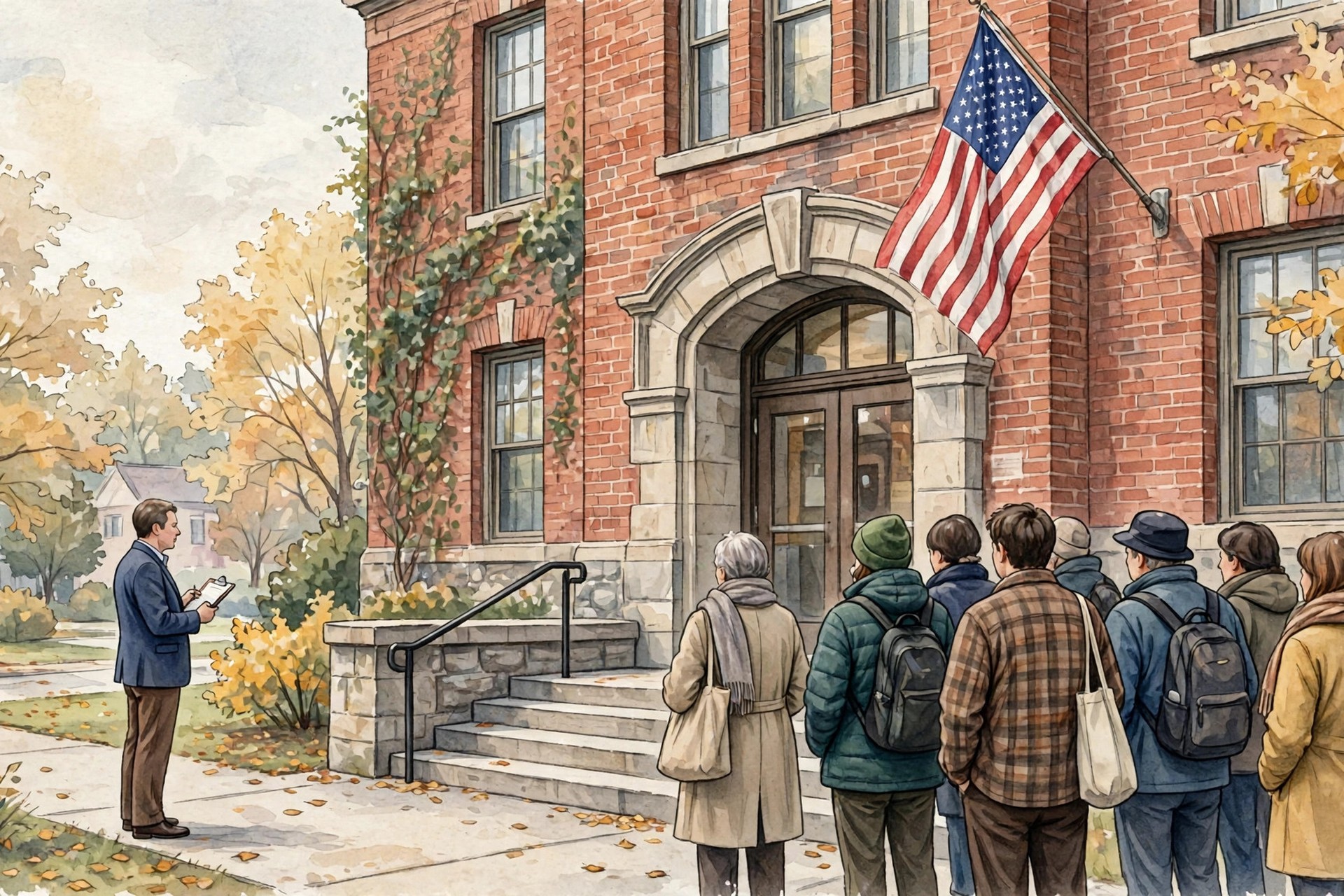
WASHINGTON — The Justice Department is preparing to send about 1,000 federal election monitors to polling places across the United States for the November 3 midterm elections, in what officials describe as the largest monitoring deployment in the department’s history. The monitors will be present in all 50 states, a sharp expansion from past elections, when federal observers were typically sent to a limited number of jurisdictions with a history of voting problems or under specific court orders. The plan has drawn both praise from supporters, who say it will deter violations of federal voting law, and concern from voting-rights advocates and some state officials, who worry that an unfamiliar federal presence could unsettle voters or election workers in the final days of a tense campaign.
The deployment lands in an election already shaped by record early voting. More than 52 million Americans had already cast ballots in person or by mail by the final weekend, according to the University of Florida’s Election Lab, a record for a midterm and up from nearly 46 million before Election Day in 2022. That context matters because the monitors are not being sent to early-voting sites. Their assignment, as described by the department and in court filings, is Election Day itself: polling places on Tuesday, where they will watch for possible violations of federal law and report what they see back to Washington for review after the votes are counted.
Federal election monitoring is not new. The Justice Department has sent observers to polling places for decades under the Voting Rights Act and other federal statutes, checking compliance with laws such as the Voting Rights Act, the National Voter Registration Act and the Help America Vote Act. What is new in 2026 is the scale, the nationwide footprint and the political backdrop. The department under President Joe Biden monitored 64 jurisdictions in 24 states on Election Day in 2022, sending about 388 monitors, according to PBS News reporting cited in recent coverage. In 2024 the number rose to about 714. The jump to roughly 1,000 in 2026 therefore represents not a new invention but a significant expansion of an existing tool, applied this time to every state rather than a selected list.
What the monitors can and cannot do
The most important ground rules were set out in a sworn declaration filed in federal court in Washington in late October by Eric Neff, acting chief of the Voting Section in the Justice Department’s Civil Rights Division. The declaration was filed in a lawsuit brought by the NAACP, which sought records about the expanded monitoring plan. According to reporting on the declaration, no FBI employees and no Immigration and Customs Enforcement employees will serve as election monitors. The Civil Rights Division is not using sworn personnel with arrest authority in a law-enforcement-agent capacity as monitors, Neff stated, a point the department has repeated publicly as it tries to calm fears that immigration agents could appear inside voting sites.
Instead, the monitor pool will be drawn largely from other parts of the federal workforce. Reporting on the declaration names employees of the Federal Bureau of Prisons, the Bureau of Alcohol, Tobacco, Firearms and Explosives and the Drug Enforcement Administration, along with one Customs and Border Protection employee detailed to the Justice Department. Those personnel, the declaration says, will operate as trained observers rather than armed agents. They will not carry firearms while monitoring, they will not exercise law-enforcement authority while on election duty, and they will wear business-casual clothing with no agency insignia, according to summaries of the filing.
Their assigned job is deliberately narrow. In a letter to Pennsylvania officials, Justice Department attorney James Catania wrote that monitors ‘only observe and take notes’ and ‘do not intrude or interfere in any way in the voting process,’ adding that they follow all rules of the state and jurisdiction. Department spokeswoman Kiersten Pels has described the role in the same terms: monitors observe for potential violations of federal law and report concerns to the department, which reviews them after Election Day and acts where appropriate. They may speak to voters only outside a polling place, only after those voters have cast ballots, and only if the voters are willing to talk. They are barred by federal law from engaging in political activity, such as promoting a candidate, and from intimidating voters.
Access, however, is not automatic. Justice Department monitors may enter a polling place only with the permission of local election officials; otherwise they must observe from outside. Pennsylvania Secretary of the Commonwealth Al Schmidt has said that federal monitors ‘are not legally entitled to any greater access to polling places than any member of the public.’ Several states, including Colorado, Indiana and Wyoming, have said they will not allow Justice Department monitors within a certain distance of polling places. Colorado officials have pointed to state rules requiring observers to have permission from the secretary of state’s office unless a court has ordered observation. The department says it trains all monitors on the state and local laws of their assigned jurisdictions, and Pels has said monitors are subject to state and local laws and rules for polling locations.
How the 2026 DOJ election monitor deployment differs from past midterms
The comparison with earlier elections helps explain why this deployment has attracted so much attention. In 2022, monitors went to 64 jurisdictions in 24 states. In 2026, the department says monitors will be in all 50 states, although it has declined to publish the complete list of locations in advance, saying the full list will be released on Election Day. Notices have already reached jurisdictions in a long list of states, including Arkansas, Georgia, Kansas, Maine, Massachusetts, New Hampshire, Oklahoma, Pennsylvania and South Carolina, and NPR has confirmed notifications to counties in Colorado, Florida, Minnesota, Texas and Washington, including King County, Washington, Miami-Dade County, Florida, and Hennepin and Ramsey counties in Minnesota. Seven counties in Texas and four counties in Pennsylvania are also among those notified, along with seven cities in Michigan.
The staffing shift is equally notable. Traditionally, monitors were usually attorneys from the Civil Rights Division. To reach 1,000, the department has had to recruit more widely, and the Campaign Legal Center has warned that attorneys from outside the division may lack knowledge of federal civil-rights laws and training on how to engage in election monitoring, raising the possibility that monitors could inadvertently intimidate voters or election officials. The center has produced a guide to the laws and standards monitors should follow. The department’s answer is training: every monitor is trained on the applicable state and local laws, and the court declaration sets out conduct rules designed to keep the role observational.
The NAACP lawsuit that produced the declaration remains part of the story. Filed on October 2 against the division and Assistant Attorney General Harmeet Dhillon, it challenged the department’s refusal to say where monitors would go or who they would be. Similar lawsuits from Arlington County, Denver and voting-rights groups raised concerns about armed federal agents at polling places. The declaration answers part of that concern — no FBI or ICE monitors, no firearms, no arrest authority on duty — but it does not answer everything. It says nothing, for example, about immigration enforcement near polling places outside the monitoring programme itself, a distinction that critics have flagged and that voters may find confusing on Election Day.
Both parties, outside groups and the record-preservation letters
The federal monitors will not be the only watchers at polling places on Tuesday. The Republican National Committee is deploying its own monitors and lawyers, Senate Democrats are sending more than 100 staffers to monitor elections in nine states, and voting-rights groups such as Common Cause and the American Civil Liberties Union are sending their own observers. That layered presence is normal in a high-stakes election, but in 2026 it arrives alongside a separate federal action that has drawn its own controversy: letters from the Justice Department warning election officials in all 50 states to preserve voting records or face possible prosecution.
Days before the election, Acting Deputy Attorney General Trent McCotter sent formal letters nationwide telling state officials they must preserve election records for at least 22 months, citing a federal law under which wilfully destroying, concealing or altering such records can be a federal crime punishable by up to one year in prison and a $1,000 fine. The records covered include registration forms, poll books, sign-in sheets, identification papers submitted, requests for mail-in ballots and the envelopes containing those ballots. Department officials describe the letters as routine enforcement of a long-standing preservation requirement. Critics, including some election officials, read them as pressure in the final days of the campaign, and the letters are now part of the same court disputes as the monitoring plan, with judges in several cases weighing where legitimate federal oversight ends and interference with state-run elections begins.
For voters, the practical guidance from officials across the spectrum is consistent on one point: monitors, whoever sends them, do not decide whether a ballot counts. That decision rests with local election officials under state law, subject to court orders. A federal monitor’s note can become the basis for a later Justice Department review or a legal challenge, and reporting on the programme notes that what monitors document could shape litigation after polls close. But on Election Day itself, the monitor’s lawful role is to watch, to take notes and to leave the voting process itself to the officials and voters in the room. Voters who believe they have been intimidated can report the incident to local election officials, and federal law bars intimidation regardless of who is doing it.
As Tuesday approaches, the open questions are mostly logistical: the full list of monitored locations, which will only be confirmed on Election Day; how smoothly the state-permission rule works in states that have restricted monitor access; and whether the expanded, largely non-lawyer monitor pool follows the conduct rules set out in the court declaration. The answers will emerge polling place by polling place. What is already clear is that the 2026 deployment is the largest of its kind, that its ground rules are now written down in a court filing rather than left to informal practice, and that both the department and its critics will be watching closely — each, in their own way, for the same reason: because in a midterm decided by narrow majorities in both chambers, confidence in how the vote was run matters as much as the result itself. Readers following the count can consult our midterm results guide for when polls close and why some races take days, and our coverage of record early voting for how the electorate arrived at Election Day.
Sources
USN reviewed reporting from multiple outlets for this story. Read more from Votebeat, NPR, New York Post.