

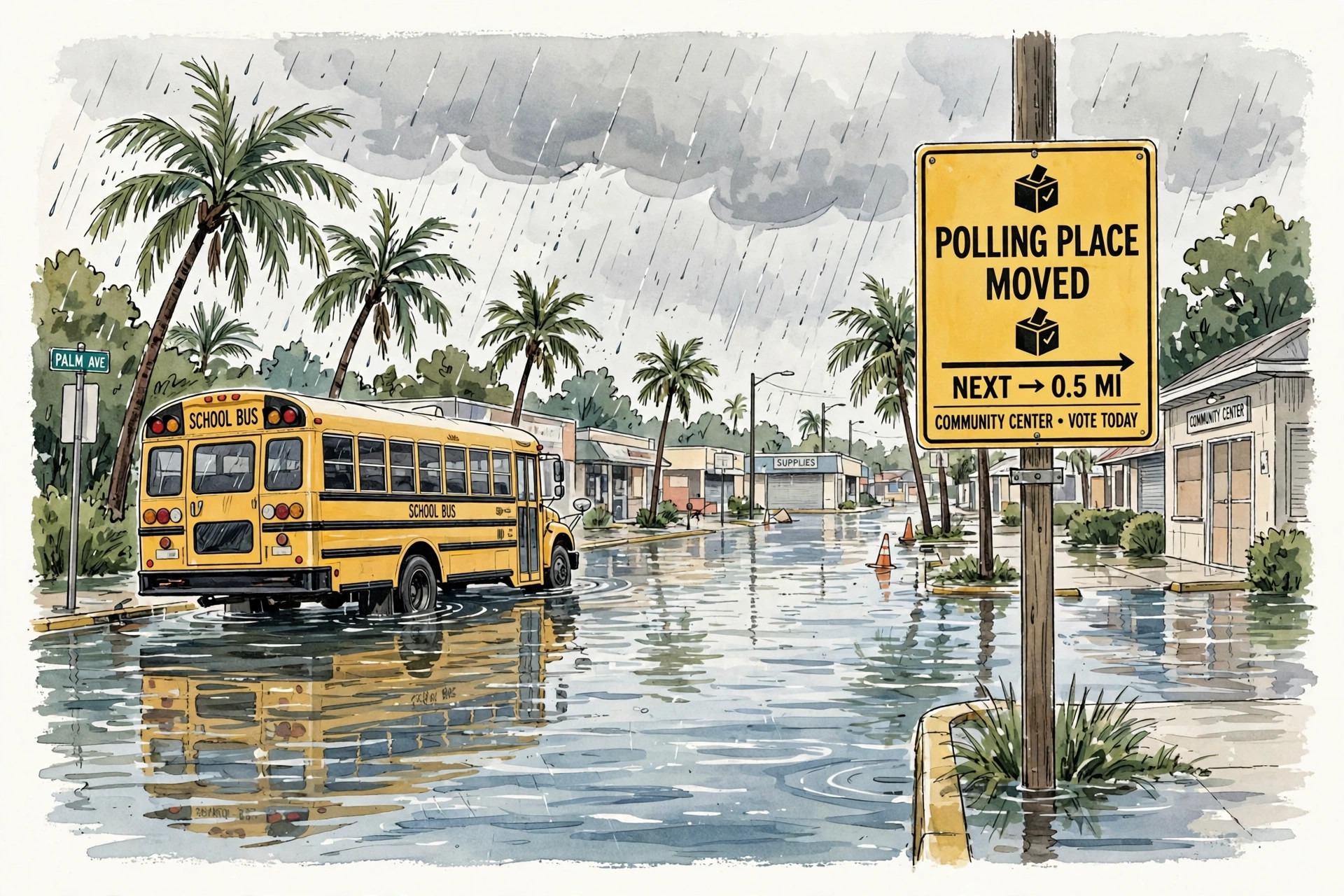
Florida Flooding Closes Schools on Election Day
Heavy rain and flooding disrupted Election Day across parts of Florida on Tuesday, November 3, 2026, closing schools in several counties, forcing some polling places to move, and leaving emergency crews to rescue more than 100 people from floodwaters in the hardest-hit areas. The flooding followed a day of intense rainfall on Monday, November 2, when some Treasure Coast communities received between six and ten inches of rain. By Election Day morning, flood warnings were still in effect in the region, even as forecasters said conditions were improving compared with the previous day. Voters were urged to check their polling place before travelling, because some locations had changed at short notice and further changes during the day could not be ruled out. This article makes no claim about the effect of the flooding or the polling moves on any election result; no race is called or decided here, and results were not yet known at the time of writing.
According to the Florida Department of Education’s list, schools were closed on November 3 in Brevard, Hardee, Indian River and Martin counties, and on November 3 and 4 in DeSoto County. Those closures reflected a mix of flooded roads, water in school buildings or grounds, and the use of school facilities for emergency response, as well as safety concerns about students and staff travelling through standing water. Indian River State College also moved its campuses to remote operations from noon on November 2 through November 3. For families, the closures added a practical complication to Election Day itself: parents who had planned school drop-offs and work routines around a normal school day had to rearrange childcare and travel, sometimes while also checking whether their own polling place had moved.
The scale of the rainfall helps explain why the disruption was so widespread. Port St. Lucie received six to ten inches of rain on November 2, and Sebastian received six to nine inches, according to reporting on the storm. Rainfall of that intensity in a short period can overwhelm drainage systems, especially in low-lying coastal areas where water has limited places to go. Roads can become impassable even when the rain has stopped, because water continues to drain slowly from saturated ground and swollen waterways. A flood warning ran through the morning of November 3 in all three Treasure Coast counties, a reminder that the danger does not end the moment the heaviest rain passes. Standing water can hide road damage, debris and downed power lines, and driving through it remains one of the most common causes of flood-related deaths in the United States.
Governor Ron DeSantis declared a state of emergency for seven counties: Brevard, DeSoto, Hardee, Highlands, Indian River, Martin and St. Lucie. A state of emergency declaration is an administrative step that allows state agencies to coordinate response efforts, deploy resources and, where necessary, waive certain rules to speed up assistance. It does not by itself describe the severity of damage in any one neighbourhood, but it signals that the state government regarded the flooding as a multi-county event requiring a coordinated response rather than a series of isolated local incidents. Emergency managers, sheriff’s offices, fire departments and public works crews worked through the storm and into Election Day to clear drains, close flooded roads, check on residents and carry out rescues.
More than 100 people were rescued from floodwaters in the hardest-hit areas, according to reporting on the response. Rescue figures of that kind usually include a range of situations: drivers stranded in vehicles on flooded roads, residents whose homes took in water, and people who needed help reaching higher ground. Each rescue also represents a decision by emergency crews to enter hazardous conditions, often in darkness or in fast-moving water. Officials routinely warn residents not to attempt to drive through flooded roads, using the slogan “Turn Around, Don’t Drown,” because even a few inches of moving water can sweep a vehicle off the road, and deeper water can stall an engine and trap occupants. On Election Day, that safety message applied with equal force to voters travelling to polling places: a route that was passable in the morning might not be passable later, and a polling place that was open might still be difficult to reach safely.
Florida Flooding Moves Polling Places on Election Day
The most consequential Election Day change for voters was the relocation of some polling places. In St. Lucie County, for example, Precincts 49 and 71, normally voting at Oak Hammock K-8, were moved to the Port St. Lucie Community Center. Precincts 67 and 86, normally voting at St. Lucie West Centennial High School, were moved to the Indian River State College Veterans Center of Excellence. Those moves were reported as examples of the adjustments election officials made in response to flooding, and they illustrate the kind of last-minute change that can confuse voters who arrive at a familiar school only to find it closed or reassigned. Election officials generally post notices at the original location and update their websites and voter lookup tools, but voters who do not check in advance can lose time, and in some cases may be unable to reach the new location before polls close.
Polling place moves on Election Day raise a set of practical and democratic concerns that go beyond inconvenience. A polling place is not just a building; it is the place voters have planned around, often chosen because it is near home, work or a child’s school, or because it is accessible for voters with disabilities. Moving it, even for good safety reasons, can disrupt those plans. It can also affect voters who rely on public transport, who have limited time off work, or who do not have easy access to updated information online. Election officials therefore face a difficult balance: keeping a flooded or unsafe polling place open risks voters’ safety and the integrity of the voting process itself, while moving it risks confusion and lower turnout at that location. In this case, officials chose to move affected polling places rather than keep voters travelling to flooded schools, a decision driven by safety and by the school closures themselves, since schools that are closed for flooding cannot readily serve as voting sites.
Voters in affected counties were advised to verify their polling place through their county supervisor of elections before setting out, and to allow extra time for travel. That advice is especially important because polling moves can change during the day as conditions evolve: a road that reopens may allow a site to return to normal, while a new flood warning may force another move. Voters who checked early in the morning were therefore encouraged to check again if they travelled later in the day. Election officials also typically provide information by phone for voters without internet access, and poll workers at original locations can direct voters to the new site. None of those measures fully removes the risk of confusion, but together they are designed to minimise it.
It is important to be precise about what is and is not known about the effect of these changes. This article does not claim that the flooding or the polling moves changed the outcome of any race, increased or decreased turnout by a specific amount, or affected one candidate more than another. Such claims would require data on turnout by precinct, on how many voters were redirected, and on certified results, none of which were available at the time of writing. What can be said is that flooding created an additional barrier for some voters on Election Day, and that election officials responded by moving polling places to safer locations. Whether that barrier proved decisive in any contest is a question for later analysis, once turnout data and certified results are available, not for speculation on Election Day itself.
Election Day Forecast Improves, but Rain Risk Remains
The weather outlook for Election Day itself was better than the day before, but not entirely clear. According to National Weather Service Melbourne meteorologist Zach Law, as reported in local coverage, Election Day brought a 30 to 50 percent chance of rain with coastal showers, a marked improvement on the heavy rainfall of November 2. That forecast mattered for two reasons. First, it suggested that the worst of the rain had passed, giving floodwaters a chance to recede and roads a chance to reopen. Second, it warned that the risk had not disappeared: coastal showers could still produce localised heavy rain, and already saturated ground meant that even moderate additional rainfall could cause renewed ponding on roads and in low-lying areas.
Forecasters distinguish between the chance of rain and the amount of rain, and that distinction was relevant on Election Day. A 30 to 50 percent chance does not mean that half the day will be wet, or that any given voter will encounter rain. It means that, across the forecast area, there is a roughly one-in-three to one-in-two chance of measurable rain at any given point, with showers that may be scattered rather than widespread. For voters, the practical message was to prepare for the possibility of showers — an umbrella, extra travel time, and a check on road conditions — without assuming that the day would be a repeat of November 2. For emergency managers, the message was to remain ready for localised flooding even as the broader situation improved.
The Treasure Coast, which bore the brunt of the November 2 rainfall, remained the focus of attention on Election Day. The three Treasure Coast counties — Indian River, Martin and St. Lucie — were all under flood warnings through the morning, reflecting the volume of water already on the ground. In coastal Florida, flooding is often a combination of heavy rain, high tides and saturated soils, and water can linger in canals, retention ponds and low-lying streets long after the rain stops. Clearing that water depends on drainage systems, pumping where available, and natural runoff, all of which take time. Residents returning to normal routines on Election Day therefore encountered a landscape that was still recovering, even if the sky was clearer than the day before.
How Florida Communities Cope With Election Day Flooding
Florida is no stranger to Election Day weather disruption. The state holds elections in the late Atlantic hurricane season, when tropical moisture, slow-moving fronts and coastal storms can all produce heavy rain. Schools, which serve as polling places in many counties, are also among the first facilities to close when flooding threatens student safety, which creates a direct link between school closures and voting logistics. That link was visible on November 3: the same counties that closed schools were also the counties where polling places had to be reconsidered. Emergency management and election administration, which are usually separate functions, had to work together on a compressed timetable, with decisions made overnight and communicated in the early hours of Election Day.
For residents, the experience of Election Day flooding is often a mix of frustration and resilience. Many voters will have checked their polling place, adjusted their route, and cast a ballot despite the disruption. Others, particularly those in the hardest-hit neighbourhoods, may have faced harder choices: whether to leave a home that was taking in water, whether to attempt a flooded road, or whether to prioritise immediate safety over voting. Election officials cannot resolve those individual dilemmas from a central office, but they can reduce the friction by providing clear, timely information, by keeping alternative sites accessible, and by ensuring that poll workers at both old and new locations know where voters should go. The rescues reported during the storm are a reminder that, for some residents, the flooding was not an inconvenience but an emergency, and that voting, however important, rightly came second to personal safety.
Looking ahead, the flooding will also prompt questions about infrastructure and preparedness. Why did some areas flood more severely than others? Were drainage systems, canals and pumps able to cope with six to ten inches of rain, or were they overwhelmed? Should polling places in flood-prone areas have backup sites designated in advance, so that moves can be communicated more quickly? Those questions will be examined by county officials, emergency managers and election supervisors in the days after the storm, once damage assessments are complete. They are legitimate questions, but they should not be answered on the basis of Election Day impressions alone. Flood damage, road closures and drainage performance all require detailed assessment, and early reports, while valuable, are necessarily incomplete.
For now, the clearest facts are these: schools closed in Brevard, Hardee, Indian River and Martin counties on November 3, and in DeSoto County on November 3 and 4; Indian River State College campuses operated remotely from noon on November 2 through November 3; more than 100 people were rescued from floodwaters; a state of emergency covered seven counties; Port St. Lucie and Sebastian received some of the heaviest rain on November 2; flood warnings continued into the morning of November 3; and some polling places, including the St. Lucie County examples described above, were moved to safer locations. Voters who still need to confirm their polling place should check with their county supervisor of elections, allow extra travel time, and never drive through flooded roads. The election will be decided by certified results, not by the weather, but on this Election Day the weather shaped how many Floridians reached the ballot box, and that experience is part of the story of November 3, 2026.
Sources
USN reviewed reporting from multiple outlets for this story. Read more from Florida Today, TCPalm and Florida Today.