

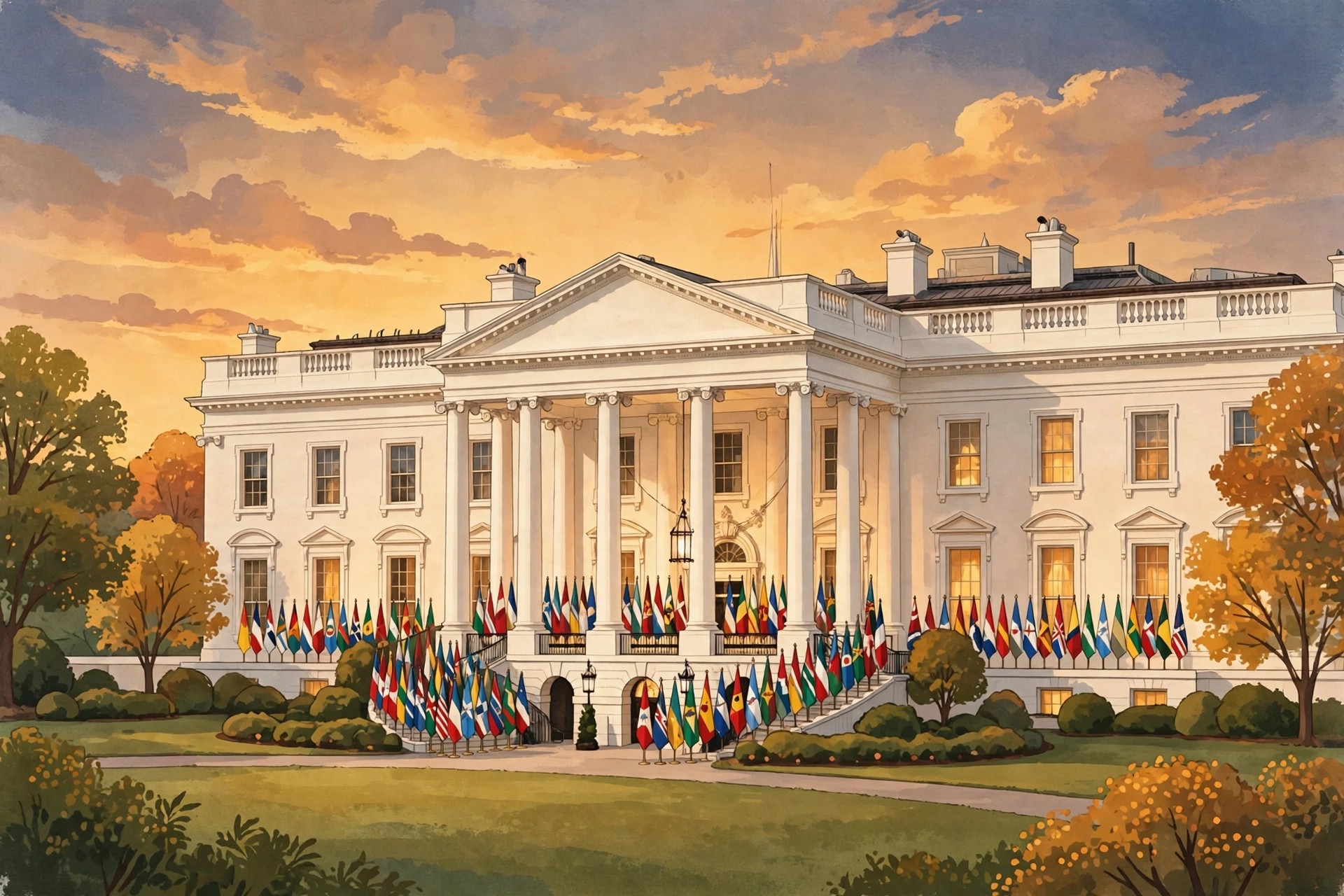
The White House has announced a striking new step in the diplomacy around Ukraine: First Lady Melania Trump will bring representatives of Russia and Ukraine together at the White House on Thursday, November 5, 2026, and deliver remarks on the ceasefire in Oleshky. The announcement, made on Tuesday, November 3, places two nations still at war in the same room in Washington, under the auspices of the American first lady, and it immediately raised questions about what such a meeting can achieve while the wider war grinds on.
According to the White House, Mrs. Trump will speak about the Oleshky ceasefire at 11:00 a.m. Eastern Time on Thursday. The statement described the gathering as an extraordinary moment in American history, and it credited the first lady with independently opening a channel between the two warring sides and securing the local pause in fighting that made a humanitarian operation possible. The White House did not name the Russian or Ukrainian representatives who are expected to attend, and it did not publish an agenda beyond the ceasefire discussion and the first lady’s remarks.
The timing matters. The local ceasefire around Oleshky, a city in the occupied part of Ukraine’s Kherson region, ended on Sunday evening, November 1, after a humanitarian operation that moved several hundred civilians out of harm’s way. The announcement of a White House meeting just two days later suggests that the administration sees the Oleshky episode not as a closed chapter but as a possible opening, a small example of agreement that might be widened into something larger. Whether the two sides see it the same way will become clearer on Thursday, when the representatives sit down in Washington and the first lady addresses the effort in public.
This article is about that new announcement: the Thursday hosting, the remarks, and what comes next. It is not a repeat of the evacuation story itself, which USN covered when buses began moving residents out of Oleshky under the temporary pause. The evacuation was the event; the White House meeting is the follow-up, and the distinction is important because the two stories answer different questions. The first asked whether civilians could get out safely. The second asks whether a local pause can become a bridge to broader talks.
What Was Announced for Thursday
The White House statement, issued through the Office of the First Lady on Tuesday, was short but unusually emphatic. It said Mrs. Trump would personally bring representatives of Russia and Ukraine, two nations actively at war, together at the White House. It said she had independently initiated engagement between the two sides and successfully secured a ceasefire in Oleshky and the surrounding Kherson region. And it set the time for her remarks: Thursday, November 5, at 11:00 a.m. Eastern Time.
What the statement did not do is equally telling. It did not identify the attendees by name or rank, leaving open whether they will be senior negotiators, diplomats, humanitarian officials, or a mix. It did not say how long the meeting will last, whether President Donald Trump will take part, or whether any joint statement or document is expected afterward. It did not describe the terms of the Oleshky ceasefire in detail, nor did it say whether the pause could be extended or revived. Those gaps are normal for an announcement made two days ahead of an event, but they also mean that much of the substance will only be known when Thursday arrives.
For now, the confirmed facts are these: the meeting will happen at the White House, it will involve representatives of both Russia and Ukraine, it is framed around the Oleshky ceasefire, and the first lady will speak about it publicly at a set hour. Everything else, from the guest list to the outcome, remains to be disclosed, and that uncertainty is part of why the announcement has drawn attention far beyond Washington.
It is also worth noting the sequence. The White House statement came on the same day that the European Commission announced its own Ukraine-related meeting for Wednesday, bringing together representatives of the United States, Ukraine, France, Germany, the United Kingdom, NATO and the World Bank. That meeting, officials said, would build on earlier talks in Miami. The Washington gathering on Thursday therefore sits inside a busy week of diplomacy, with European capitals, Washington and, soon, Abu Dhabi all hosting conversations about the same war in quick succession.
How the Oleshky Ceasefire Came About
Oleshky sits in the part of the Kherson region that has been under Russian control since the early stages of Russia’s full-scale invasion of Ukraine, which began in February 2022. For civilians still living there, the front line has meant danger, shortages and severe limits on movement. A humanitarian pause, even a brief and local one, was therefore a significant undertaking, requiring agreement from both sides on routes, timing and safety guarantees.
According to reporting on the operation, the pause began on Tuesday, October 27, and ran for several days, allowing buses and humanitarian teams to move residents out of Oleshky and nearby areas. Ukraine’s human rights commissioner, Dmytro Lubinets, said afterward that Mrs. Trump’s team had played an important role in securing the agreement and coordinating the operation. By Saturday, October 31, the Ukrainian delegation that had carried out the humanitarian mission had returned to Ukrainian-controlled territory, and by Sunday evening the local ceasefire had come to an end.
Several hundred civilians were evacuated during the window, according to reports of the operation. That number, while small against the scale of displacement caused by the war, represents families who were able to leave a dangerous area because two armies agreed, for a few days, not to shoot along agreed routes. Humanitarian pauses of this kind are fragile by nature: they depend on trust, on clear communication between military commands, and on restraint in the moments when a single incident could collapse the whole arrangement. That this one held long enough for the operation to conclude is itself a fact worth noting.
The White House has since framed the episode as a starting point rather than an end point. After the operation, Mrs. Trump called for the Oleshky ceasefire to be used as a foundation for lasting peace between Ukraine and Russia. Tuesday’s announcement gives that idea institutional form: a meeting, at the White House, with both sides present, chaired in effect by the first lady who helped arrange the pause. The question now is whether a humanitarian success can be translated into a diplomatic one.
Readers following the evacuation itself can revisit USN’s earlier coverage of the Oleshky evacuation buses moving residents out under the Melania Trump-brokered ceasefire, which covered the operation while it was under way.
What the Melania Trump White House Meeting Could Decide
A meeting hosted by a first lady is unusual in the diplomacy of an active war, and its power lies partly in that unusual quality. First ladies do not command armies, sign treaties or direct foreign ministries, and no one expects Thursday’s gathering to produce a peace agreement. But a first lady can do something that formal negotiators sometimes cannot: create a setting in which both sides can meet without the meeting itself becoming a concession, a victory claim or a political risk. The informality is the point. When the host is not the president, the stakes of sitting down are lower, and the room for conversation is wider.
That framing also carries risks. If Thursday produces warm words but no follow-through, critics may dismiss it as symbolism. If one side uses the meeting to claim legitimacy or to shape the narrative of the war, the other side may regret attending. And if the guest list turns out to be junior or largely ceremonial, the gap between the White House’s language and the reality of the room will invite scrutiny. The administration has set expectations high by describing the event in historic terms, and high expectations make the actual outcome easier to judge, for better or worse.
There are, however, concrete outcomes that a meeting like this could plausibly deliver. It could agree on another humanitarian window, whether in Oleshky or elsewhere, building on the routes and contacts established in late October. It could produce a shared statement on protecting civilians, which, while not a ceasefire, would still carry weight. It could simply keep a channel open between two sides that otherwise communicate mainly through intermediaries and public statements. In a war where direct contact is rare, even a maintained channel has value, because it gives both sides a faster way to test ideas, correct misunderstandings and de-escalate incidents before they spiral.
The most important audience for Thursday may not be in the room at all. It may be the negotiators preparing for Abu Dhabi, the European officials meeting on Wednesday, and the publics in Ukraine and Russia who will read about the White House gathering and judge whether their leaders are serious about finding a way out of the war. A meeting that looks constructive could strengthen the hand of those arguing for talks. A meeting that looks empty could do the opposite.
The Road to Abu Dhabi on November 10 and 11
Thursday’s White House meeting does not stand alone. The United States will bring together delegations from Ukraine and Russia in Abu Dhabi on November 10 and 11 to discuss ending the war, post-war security arrangements and de-escalation, according to statements by the American special envoy Steve Witkoff. Russia confirmed on Tuesday that the Abu Dhabi talks will go ahead next week, and the Kremlin said that presidential aide Vladimir Medinsky will serve as Moscow’s chief negotiator there.
The Abu Dhabi talks are the more conventional diplomatic track: government delegations, a defined agenda, and a mediator in the United States. The White House meeting on Thursday can be read as a prelude to that track, a way of warming the atmosphere and testing whether the Oleshky experience can inform a larger conversation. It can also be read as a parallel track, one that keeps a humanitarian and human focus alongside the strategic bargaining that will dominate in Abu Dhabi.
The distinction matters because the two tracks face different obstacles. In Abu Dhabi, the hard questions will be territory, security guarantees, and the terms under which fighting might stop across the whole front, not just around one city. Those questions have resisted agreement for years, and no single meeting will resolve them. In Washington on Thursday, the questions are narrower and more human: can civilians be protected, can evacuations be repeated, and can a local agreement become a habit of agreement? Narrower questions are easier to answer, and an answer to them could give the Abu Dhabi negotiators something concrete to build on.
There is also the European dimension. Wednesday’s meeting in Brussels, hosted by the European Commission with the United States, Ukraine and key European allies, is expected to build on earlier talks in Miami. Europe’s role in any settlement, from security guarantees to reconstruction, will be central, and the sequencing of Brussels on Wednesday, Washington on Thursday and Abu Dhabi the following week suggests a deliberate attempt to align the various tracks before the delegations sit down in the Gulf. Whether that alignment holds will depend on what each meeting actually produces, not just on the fact that the meetings are happening.
Why a First Lady’s Role Draws Attention
American first ladies have often taken on humanitarian causes, from children’s health to education to the welfare of military families, and some have carried those causes into international settings. What makes this case different is the directness of the engagement: the White House says Mrs. Trump herself initiated contact between two nations at war and secured a ceasefire, even a local and temporary one. That is a claim about diplomacy, not just advocacy, and it invites both interest and skepticism in equal measure.
Supporters of the initiative will point to the result: civilians moved, a pause held, and now a meeting in Washington. They will argue that unconventional channels sometimes succeed precisely because they are unconventional, bypassing the entrenched positions and public posturing that can freeze formal talks. They will also note that humanitarian work has often been the entry point for wider diplomacy, because protecting civilians is a goal that both sides can endorse without conceding on territory or sovereignty.
Skeptics will ask harder questions. They will want to know who exactly Mrs. Trump spoke to, what was promised in return for the pause, and whether the ceasefire was the product of her initiative or of parallel military and diplomatic contacts that have not been publicly credited. They will ask whether a first lady-led channel risks confusing lines of authority, and whether it could complicate the work of the official envoy and the State Department. Those questions are legitimate, and Thursday’s remarks may answer some of them, particularly if Mrs. Trump describes how the engagement unfolded.
There is also a broader point about how wars end. They rarely end in a single dramatic moment. More often, they end through a accumulation of small agreements: a prisoner exchange here, a humanitarian corridor there, a local pause that holds, a meeting that leads to another meeting. Each small agreement tests whether the other side will keep its word, and each test that is passed makes the next agreement slightly easier. Viewed in that light, Oleshky was a test, and Thursday is the next one. The outcome will not be peace, but it may be evidence about whether peace is becoming more or less plausible.
What to Watch on Thursday
Several details on Thursday will matter more than the general atmosphere. First, the guest list: the seniority and roles of the Russian and Ukrainian representatives will signal how seriously each side takes the meeting. Senior negotiators would suggest a substantive discussion; humanitarian officials would suggest a focus on civilian protection; a mix would suggest both.
Second, the remarks themselves: Mrs. Trump is expected to address the Oleshky ceasefire and her role in the initiative. The tone and content of those remarks, whether they look backward at the evacuation or forward to new steps, will indicate what the White House hopes Thursday will achieve. A forward-looking speech, with specific proposals, would be a stronger signal than a purely commemorative one.
Third, any joint outcome: a shared statement, an agreement on a further humanitarian step, or even an announced date for a follow-up meeting would give Thursday a concrete legacy. The absence of any of those would not make the meeting meaningless, but it would leave the burden of proof on the next round of talks in Abu Dhabi.
Fourth, the reaction from Kyiv and Moscow. Official statements after the meeting, and the way state and independent media in both countries cover it, will reveal whether the gathering is seen as a genuine step or as a piece of political theater. In wartime diplomacy, perception is not a side issue; it shapes what leaders can do next.
Finally, the connection to the wider war should not be lost. Oleshky is one city in one region, and the fighting elsewhere continues. A successful meeting on Thursday will not stop missiles or change front lines by itself. What it can do is demonstrate, in a visible and public way, that agreement between Russia and Ukraine is possible at all, even on a limited scale, and that the United States is willing to host the conversation. In a conflict where such demonstrations have been rare, that alone is newsworthy, and it is why Thursday’s gathering will be watched closely in Washington, Kyiv, Moscow and beyond.
USN will follow Thursday’s meeting and the Abu Dhabi talks as they develop, with updates on what was said, who attended, and what, if anything, was agreed.
Sources
USN reviewed reporting from multiple outlets for this story. Read more from Reuters, Kyiv Post and Ukrinform.