

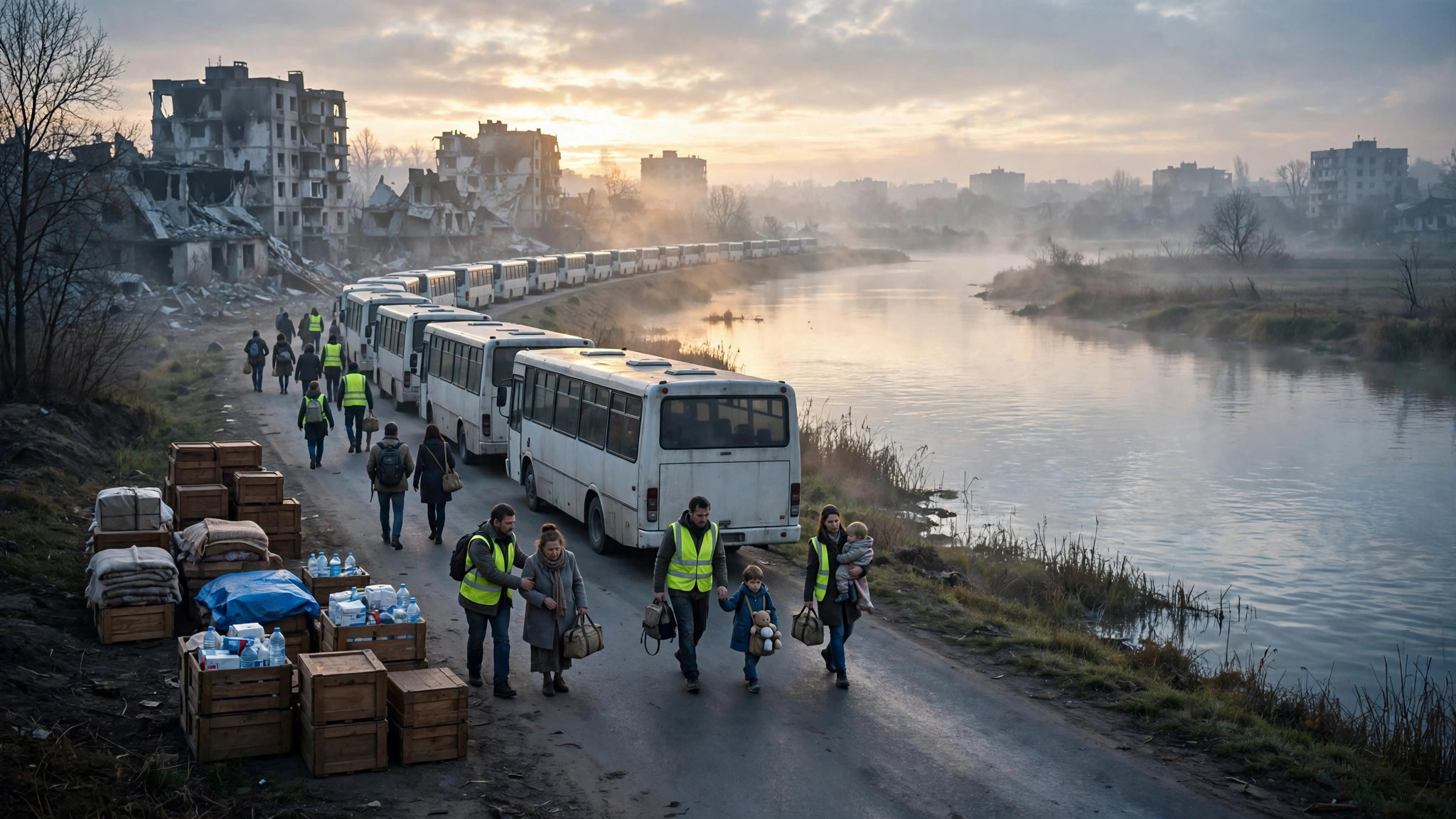
Buses began rolling into Oleshky on Friday afternoon, offering the roughly 2,000 people still living in the shattered, Russian-occupied Ukrainian town something they have not had in years: a way out. Under a local ceasefire brokered with the involvement of U.S. First Lady Melania Trump, Ukrainian and Russian officials jointly ran an evacuation and aid operation in the town on the Dnipro River — a rare moment of coordination between two governments still at war, in a place that has had no electricity, gas or medicine and ran out of food in September.
Residents who wished to leave could choose their destination: deeper into Russian-held territory, or a long journey through Crimea, Russia and Belarus to reach Ukrainian-controlled land. Those who stayed were promised deliveries of food, hygiene products, medical supplies and fuel once the buses departed. Both sides said the truce, in force since the early hours of Tuesday, had held without a violation for more than three days — an almost unheard-of stretch of quiet along this part of the front.
The operation was overseen in person by an extraordinary pairing: Ukraine’s human rights ombudsman, Dmytro Lubinets, travelled into Russian-occupied territory to escort evacuees — the first high-profile Ukrainian official to do so openly since the war began — appearing alongside Russia’s human rights commissioner, Yana Lantratova, whose office helped arrange the Russian side of the corridor.
A Town Cut Off From Food, Power and Medicine
Oleshky sits on the eastern bank of the Dnipro, directly across the river from the city of Kherson. It has been under Russian occupation since the opening phase of the full-scale invasion in 2022, and it has been steadily destroyed since — by shelling, by flooding after the destruction of the nearby Kakhovka dam, and by the slow collapse of every service a town needs to survive. Ukrainian authorities estimate that about 2,000 residents remain, among them some 50 children.
By this autumn, the situation had become desperate. Supplies of food and other essentials ran out in September, according to Ukrainian officials, and the town has been without electricity, gas and medicine. Residents who spoke to journalists through intermediaries described a community living in ruins, dependent on whatever could be brought across a front line that neither side would allow aid convoys to cross. It was that humanitarian emergency — visible, worsening and confined to a single small town — that made Oleshky the place where an unlikely diplomatic effort finally took hold.
How the Oleshky Ceasefire Came Together
The path to Friday’s buses ran through an unusual chain of intermediaries. Pope Leo XIV urged Russian President Vladimir Putin, in a phone call on October 16, and Ukrainian President Volodymyr Zelenskiy, in a call on October 19, to arrange a ceasefire that would let food and supplies reach Oleshky. In the end, officials on all sides credit Melania Trump with putting the agreement in place — the latest in a series of humanitarian interventions by the first lady, who earlier in the war pressed the case of Ukrainian children taken to Russia.
The ceasefire took effect at 4 a.m. Moscow time on Tuesday and was later expanded beyond the town to cover a wider stretch of the Kherson region, bringing relief as well to Kherson city itself, which has endured relentless drone attacks. It is scheduled to run until 10:59 p.m. on Sunday, November 1. By Friday, both governments agreed it had held. Lubinets described it as the first ceasefire across such an extensive stretch of front line to be maintained this long since 2022, and Kremlin envoy Kirill Dmitriev publicly praised what he called the humanitarian approach and the trilateral Russia-U.S.-Ukraine coordination behind it.
Ukrainian negotiator David Arakhamia announced the start of the evacuation on Telegram on Friday. Behind the announcements lay weeks of unglamorous preparation, including the dangerous work of clearing mines from the routes the buses would travel — work that, even under the umbrella of the truce, was not finished without cost.
Evacuation Day: Buses, Medics and a Choice of Direction
Friday’s operation was built on a large scale for a small town. Twenty-five buses, with about 750 seats between them, arrived early in the afternoon, supported by ambulances and some 50 medical personnel. Residents who wanted to leave had until 2 p.m. local time to board. Those heading for Ukrainian-controlled territory face a gruelling multi-day journey: south through Crimea, across Russia and Belarus, and finally to border crossings in the Kyiv and Chernihiv regions, where they are expected to arrive on Saturday.
The choice itself says much about the war’s divisions. Some residents have family, property or convictions pulling them toward Russia; others have waited years for a chance to reach Ukrainian soil. Ukrainian Prime Minister Sergiy Koretskyi told parliament that evacuees bound for Ukraine would travel the route through Russia to Belarus. At one point on Friday he posted that 527 residents planned to return to Ukrainian-controlled territory, then deleted the figure, saying no exact numbers were available — a small illustration of how fluid the operation remained even as it unfolded.
For those staying, the second half of the day mattered just as much: from 2:30 p.m., aid distribution began, bringing food, hygiene products, medical supplies and fuel into a town that has gone without all four. Whether the deliveries mark a one-off gesture or the start of a more regular humanitarian channel is one of the questions the weekend will answer, as the truce’s Sunday deadline approaches.
Friction Beneath the Calm
Neither side has accused the other of violating the ceasefire, but the days around it were not bloodless. According to Lantratova, two people were killed during the operation to demine the evacuation routes before the buses moved. Separately, Kherson’s Ukrainian governor reported that one person was injured by a Russian mine on Thursday. Both governments have treated those incidents as occurring outside the truce’s terms rather than as breaches of it — a fragile distinction, but one that has allowed the operation to continue.
There are disputes about the choreography, too. A Ukrainian volunteer, Kseniia Arkhipova, alleged that Russian forces moved some residents out of the town before the agreed Friday start — a claim that has not been independently verified and that Russian officials have not accepted. Such allegations, and the scramble over figures like the deleted 527, reflect how even a humanitarian corridor becomes contested ground in an information war: each side wants credit for mercy and none wants blame for departures that look like displacement.
What is not disputed is the central fact: for more than three days, guns along this stretch of the Dnipro have stayed silent by agreement, aid workers have moved openly, and civilians have been able to choose — many for the first time since 2022 — whether to stay or go.
Why a Small Local Truce Carries Outsized Meaning
Oleshky will not decide the war. U.S.-mediated peace talks are due to resume next month in Abu Dhabi, and the front lines elsewhere in Ukraine remain as violent as ever. But the operation matters for three reasons. First, it demonstrates that Moscow and Kyiv can still negotiate and honour a limited, verifiable arrangement when the objective is narrow and the intermediaries are trusted — a proof of concept diplomats will cite in the larger talks. Second, it has drawn an American first lady into the practical machinery of wartime humanitarian diplomacy, an unconventional channel that both capitals have publicly praised. Third, it has given roughly 2,000 people food, medicine and a choice, which — whatever the geopolitics — is not a small thing.
The ceasefire expires on Sunday night. Whether it is extended, replicated elsewhere along the front, or remembered as a brief and local exception will depend on decisions in Moscow, Kyiv and Washington in the coming days. For the families who boarded buses on Friday, the destination is Saturday’s border crossing and an uncertain future on one side of the line or the other. For everyone else watching, Oleshky has offered a glimpse of something the war has rarely produced: an agreement that held.
Sources
USN reviewed reporting from multiple outlets for this story. Read more from CNN, Reuters via ThePrint and Türkiye Today.
[…] buses began rolling, and readers who want the full sequence can read USN’s earlier report on the Oleshky evacuation buses. Saturday’s crossing was the completion of that journey for those who chose to leave: the […]