

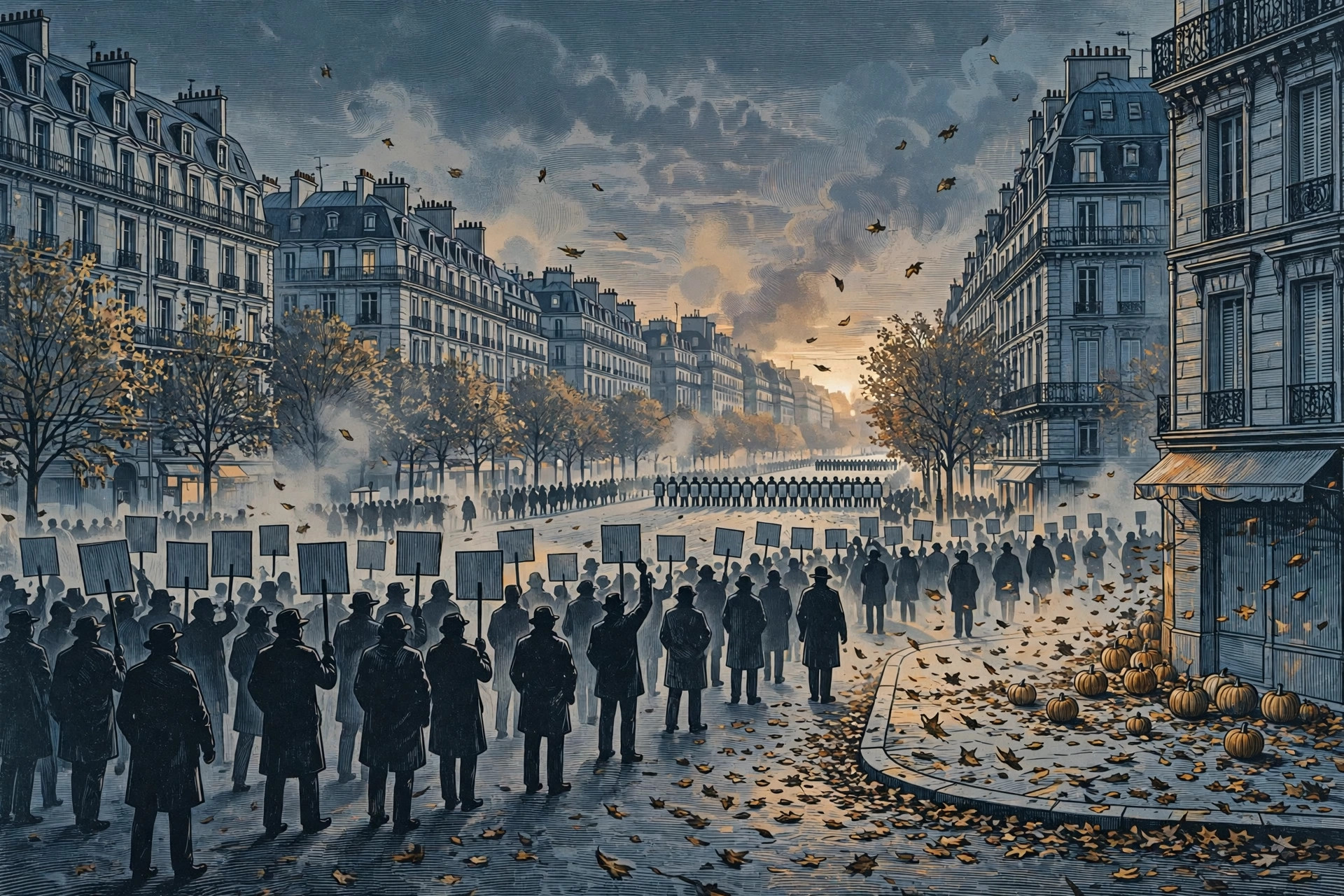
PARIS, 30 October 2026 — France will deploy 70,000 police officers and gendarmes across the country on Saturday as authorities brace for a new wave of demonstrations coinciding with Halloween, after Interior Minister Laurent Nunez warned that the day presents a very high risk of public disorder. The deployment matches the number mobilised for protests last Saturday and has been described by the minister as an exceptional measure. Armoured vehicles and water cannon introduced last week to protect shops will be strengthened, officials said, and demonstrations will be permitted but not in city centres where the government says there is a risk of disorder.
The warning, delivered at a news conference on Thursday, sets the tone for a weekend that French authorities fear could turn violent once more. Nunez said security forces had detected social media calls for gatherings on Saturday evening, starting at around 8 p.m. in many cities, accompanied by messages he described as quite radical, including appeals circulated by what he called radicalised far-left groups and some radicalised Yellow Vest websites. He said those evening gatherings, some of which have used the language of revolution, will be banned, and that the response of security forces to any violence would be extremely firm. He also warned demonstrators against using Halloween as what he called a legitimate reason to hide one’s face in order to cause disturbances in public areas. The message was aimed at two different audiences at once: at people planning peaceful marches, whom the government says it will protect, and at smaller groups it accuses of planning looting and vandalism after the main marches end.
That distinction — between a lawful protest and a violent fringe — has become the central argument of the French autumn. The government insists it is defending the right to demonstrate while preventing a repeat of the scenes that shocked the country on 17 October. Protesters and their supporters insist that heavy policing, bans on city-centre marches and a new damages law risk blurring that distinction in the opposite direction, by treating large crowds as a security problem first and a democratic expression second. Saturday will test which account the public finds more convincing, in the streets and in the polling that follows.
How France reached this Halloween flashpoint
The protests that now dominate French politics did not begin as a single national movement. They began over education reforms, with students mobilising against changes to learning conditions and university admissions, and they spread as other grievances attached themselves to the same streets: wages that have not kept pace with prices, public services under strain, fuel costs, housing costs and a broader sense that everyday life has become harder to afford. By 17 October, what had started as a student-led campaign had escalated into some of the worst street violence France has seen in years, with looting and vandalism in many cities, thousands of shops damaged or looted according to official accounts, and a fire that gutted the 19th-century city hall in Limoges. Police arrested 1,314 people during protests over the cost of living on that weekend according to interior ministry figures reported at the time, while 53 officers were reported injured.
Last Saturday, 24 October, offered a different picture, at least in the government’s telling. The interior ministry estimated that about 410,000 demonstrators took part in marches nationwide, although unions put the figure at roughly double that number, a familiar gap between official and organiser counts that itself reflects the mistrust between the two sides. With 70,000 police deployed, authorities said they had helped avert a repeat of the looting and vandalism of 17 October. Protest leaders read the same day differently: they pointed to the sheer scale of turnout as proof that anger over wages, living costs and public services had spread far beyond the student movement that first mobilised last month, and they argued that a peaceful mass march should not need an army of police to be safe. Both readings can be partly true. A large protest can be mostly peaceful and still contain violent incidents, and a large police presence can deter looting while also raising tensions at the edges of a crowd.
The calls for Saturday build directly on that history. Student unions and the Yellow Vest movement, which first emerged in late 2018 over fuel tax increases and became known for weekend demonstrations across France, have called for a new day of protests on 31 October. The Yellow Vest movement has announced what it calls a third act of its current campaign and has called for demonstrations outside the National Assembly in Paris and outside town halls across the country. Labour leaders and students have urged further protests on 31 October and a nationwide strike on 5 November, saying frustration over wages, living costs and public services is spreading. The choice of Halloween adds a layer of complication that the interior ministry has seized on: costumes and masks make it harder, police argue, to distinguish revellers from people seeking anonymity for violence, while protesters argue that a seasonal celebration should not become a pretext for sweeping bans.
Why the France Halloween police deployment is so large
A deployment of 70,000 officers and gendarmes is, by any measure, a major mobilisation of the French state. It is roughly the same force that was sent out last week, and officials present it as a proportionate response to a specific risk assessment rather than a permanent posture. The measures introduced last week to protect shops — including armoured vehicles, water cannon and reinforced protection for commercial streets — will be strengthened, Nunez said, and city-centre demonstrations will not be permitted where officials judge there is a risk of public disorder. Evening gatherings called on social media for Saturday night, after the main demonstrations have ended, will be banned outright, the minister said, because that is when, in the government’s analysis, the risk of disorder is highest.
Government supporters argue that this approach worked last Saturday and that the alternative — a lighter presence after 17 October — would invite a repeat of looting that harmed small businesses, workers and neighbourhoods far more than it harmed the government. They point to the scale of damage from the October violence, estimated at more than 1 billion euros, and to the arrests made in a single weekend, as evidence that the threat is not hypothetical. From this perspective, a firm, visible police presence is what allows peaceful protesters to march safely, because it deters the smaller groups that attach themselves to large crowds in order to break windows and steal goods.
Critics of the deployment make a different case. They argue that banning city-centre marches pushes protests into less visible locations, that evening bans sweep up revellers and peaceful demonstrators alongside any violent minority, and that describing the day in advance as very high risk can become self-fulfilling, raising fear among the public and tension among police and protesters alike. Human rights advocates and left-wing politicians have also warned, in the debate over the damages bill discussed below, that a security-first approach risks discouraging people from protesting at all, particularly young people and families who cannot afford a confrontation with the police or a fine. The government rejects that charge, saying lawful demonstrations remain permitted and that only gatherings judged to pose a risk of disorder are restricted. Saturday’s events, and how police handle the hours after the main marches, will provide the next evidence in that argument.
The Senate damages bill: who pays for a riot
Running alongside the policing debate is a legislative debate that may outlast the weekend. France’s Senate approved a measure this week by 229 votes to 105 that would make protesters financially liable for damage linked to demonstrations, with liability of up to 10,000 euros for people who knowingly join a group preparing violence, or who knowingly stay after police order a violent crowd to disperse, for damage done afterwards. The bill was originally drafted months ago in response to riots that followed Paris Saint-Germain’s victory over Arsenal in the Champions League final in May, but it has taken on new urgency after the October unrest. It now goes to the National Assembly, where no bloc holds a majority, so its final form is far from settled.
The most controversial provision concerns how the money would be collected. The Senate version would allow the state, once a court ruling is final, to deduct payments from family allowances and housing aid, and senators expanded the list of benefits that could be seized to include the RSA, France’s minimum-income benefit worth up to about 650 euros a month for a single person, as well as the back-to-school allowance and other family supplements. Communist Senator Fabien Gay cited an example of monthly deductions of 57 euros from a household receiving RSA, noting that at that rate repaying 10,000 euros would take nearly 15 years. Supporters of the bill argue that offenders often have little seizable income, a problem acknowledged in a Senate report, and that without access to benefits the liability would be meaningless. Critics, including left-wing parties and human rights groups, argue that seizing benefits punishes families who depend on state support, including parents held liable for damage caused by children under 18 under existing French law, and that joint liability for damage a person did not personally cause is unjust.
The bill would also give authorities a faster route against online calls to violence. It would let them demand removal of certain illegal calls to violence or looting without prior court approval, and if the content stays up for 24 hours, they could order the web addresses blocked, subject to later challenge in court. Supporters present that as a necessary response to social media mobilisation, including calls for Halloween protests found by fact-checkers in dozens of cities across Europe. Critics warn that rapid removal without a judge risks overreach and chills lawful speech about protests. The far right backed the bill in the conservative-led Senate, and the idea of seizing rioters’ benefits was long associated with Marine Le Pen, leader of the National Rally. The government has now made it its own, at a moment when Le Pen leads opinion polls for the presidential election due in April 2027, according to reports. That political context colours every part of the debate: the government wants to be seen as restoring order, its opponents accuse it of adopting far-right proposals, and voters will judge both claims in the months ahead.
Cost-of-living unrest spreads across Europe
France is the most dramatic case, but it is not alone. Across Western Europe, governments are reaching past the rioters themselves, to their parents and to the apps that carry the call to the streets, as they try to prevent the next riot and pay for the last one. A Spanish fact-checker, Maldita.es, has found calls for Halloween protests in 46 cities in at least nine European countries, some of which urge looting. That finding does not mean every call will produce a crowd, and officials in several countries stress that most protests remain peaceful, but it shows how quickly a national grievance can acquire a continental timetable.
In Spain, the spark was housing rather than education. The eviction of an 87-year-old woman from her lifelong Madrid home on 23 September, after a real estate firm that owned the apartment drastically increased the rent, triggered nationwide outrage and demonstrations on 26 September, with hundreds of people camping in Madrid’s Puerta del Sol square. The woman, María del Carmen Abascal, had lived in the flat for seven decades, and televised images of her removal on a stretcher became a symbol of a housing crisis in which average rents have almost doubled in a decade and more than a quarter of tenants spend about 40 percent of their income on housing and utilities, according to government figures. Her case, and the wider housing debate it ignited, helped push Spain toward a political crisis and a general election debate dominated by rents and evictions, with unions announcing a housing-related general strike for 11 November. The Spanish story is distinct from the French one in its trigger and its politics, but it shares the same underlying pressure: costs rising faster than incomes, and a sense among younger and poorer citizens that the system is not working for them.
Italy has seen youth-led protests over the cost of living, education and concerns about the future erupt into violence in several cities in mid-October, while demonstrations have also taken place in Germany, Portugal, Albania, Greece and Belgium, according to reporting on the continental spread. The grievances differ by country — in some places the focus is housing, in others wages, public services, fuel prices or university funding — but analysts point to a common backdrop of sluggish economic growth, higher prices and public services stretched by years of pressure. Geneviève Pons, president and director general of the Brussels-based think tank Europe Jacques Delors, has pointed to sluggish growth as one factor contributing to the discontent. With Spain heading to the polls in November and elections due in France, Italy and Greece next year, governments already grappling with economic and political challenges now face street movements that can change the electoral calculus in weeks.
What happens next in France will therefore be watched well beyond Paris. If Saturday passes largely peacefully, the government will claim its deployment and its bans worked, and the National Assembly debate over the damages bill will proceed in a calmer atmosphere. If violence returns, the government will face questions about why a second exceptional deployment did not prevent it, while protesters will face questions about whether their movement can control its fringes. Either way, the underlying grievances — wages, housing, education and the cost of everyday life — will not be settled by a single Saturday, a single bill or a single strike on 5 November. They will shape the French presidential campaign to April 2027 and, if the continental pattern holds, elections and governments across Europe after that.
Sources
USN reviewed reporting from multiple outlets for this story. Read more from Al Jazeera, Reuters and Daily Sabah.