

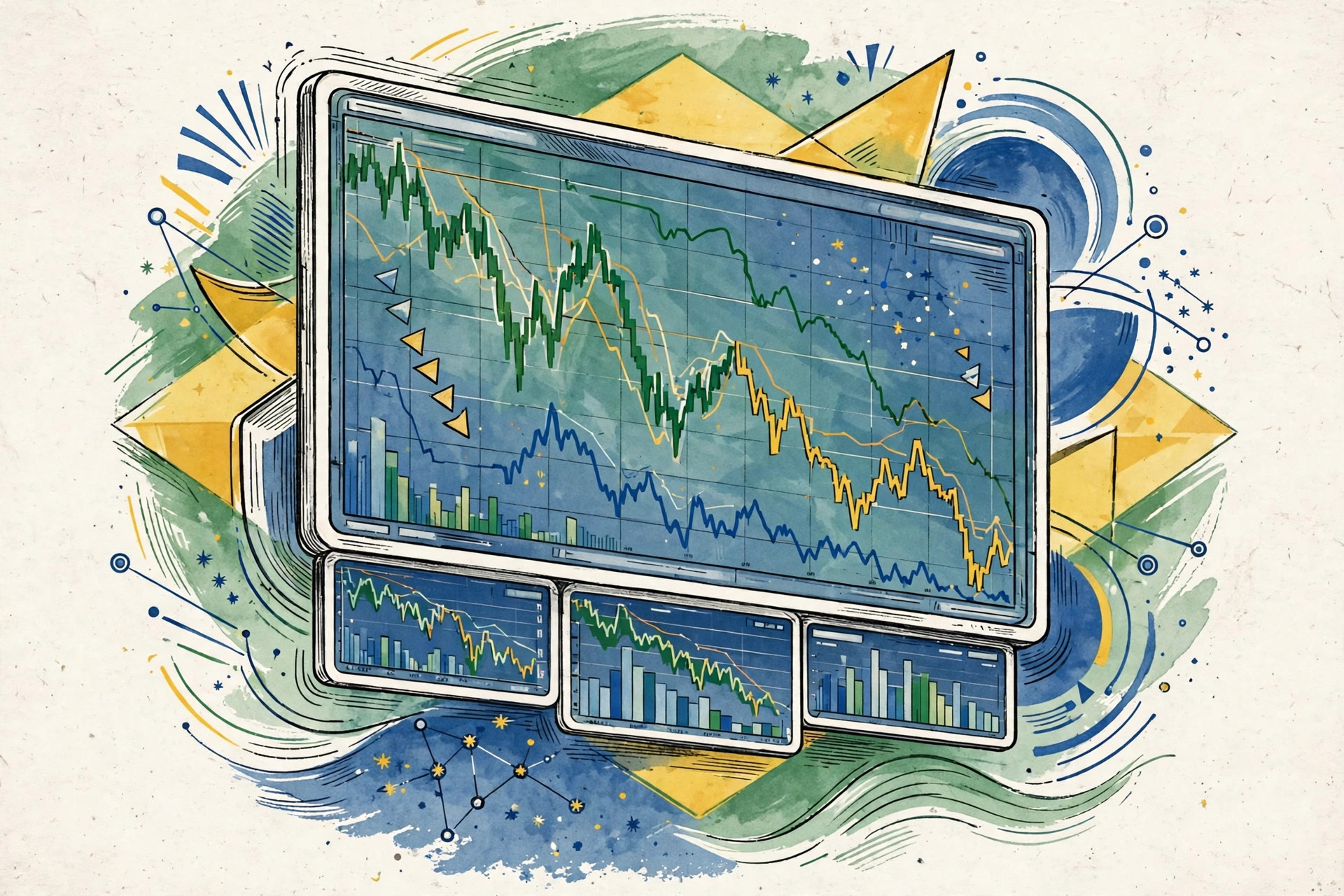
Brazil’s central bank walks into its 3–4 November 2026 policy meeting carrying a problem no central banker wants: a market shock that arrived after the last set of forecasts was already printed. President Luiz Inácio Lula da Silva won re-election on 25 October, taking 51.79 percent of valid votes against 48.21 percent for Flávio Bolsonaro, according to the Superior Electoral Court. The next trading day, São Paulo’s benchmark Ibovespa equity index plunged 13.9 percent, the real fell 8.1 percent against the US dollar at the close after an even steeper intraday drop, and interest-rate futures swung from pricing a rate cut to pricing a rate hike. Now the bank’s Monetary Policy Committee, known as Copom, must decide on 4 November whether to hold its benchmark Selic rate at 13.75 percent, resume cutting, or bow to a market that has begun betting on tighter policy.
The stakes go well beyond one meeting. Brazil is Latin America’s largest economy, a major exporter of food, energy and minerals, and a destination for billions of dollars of American and global investment. Its interest rate is among the highest in the world, its public debt stood at 82.9 percent of GDP in August 2026, and its currency moves ripple through emerging-market portfolios held by US pension funds, mutual funds and banks. When Brazilian markets fall this hard, the tremor is felt in New York and London as well as São Paulo. And because the Federal Reserve held its own target range at 3.75–4.00 percent on 28 October, with markets pricing a high chance of a December hike, Brazilian policymakers cannot count on easier global conditions to cushion the blow.
The election result itself surprised markets. Polling and positioning before the runoff had left many investors expecting a Bolsonaro victory, and bets on that outcome had helped support the real in the run-up to the vote. When Lula won an unprecedented fourth term instead, those positions unwound violently. Listed companies lost roughly 734 billion reais in market value on 26 October alone, trading in the cash equity market was halted for 30 minutes, and the National Treasury cancelled bond auctions as long-end yields surged. Finance Minister Dario Durigan told reporters in Brasília that the selloff was not a reaction to fundamentals — a remark that captured the government’s view that the market move was a positioning shock rather than a verdict on the economy’s underlying health. Markets, however, rarely accept that distinction for long. A currency that falls more than 11 percent intraday, as the real did at its worst, raises import prices, feeds inflation expectations, and forces a central bank to ask whether a one-day shock is becoming a durable trend.
Brazil Lula Reelection Market Selloff and the Partial Rebound
The panic did ease, at least partly, within a day. On 27 October the real regained ground, strengthening nearly 2 percent to around 5.31 reais per dollar, and the central bank’s official PTAX dollar rate closed the day at 5.3346 reais, down from 5.5007 at the previous day’s close. The bank’s PTAX series shows the rate rising from 5.0374 on 23 October to 5.5003 on 26 October — an 8.4 percent fall in the real’s dollar value across the election weekend — before the partial recovery. The Treasury resumed repurchases of inflation-linked NTN-B bonds, futures rates fell back from their most extreme levels, and some of the disorderly trading that had marked Monday gave way to something closer to normal two-way markets.
That rebound matters for Copom’s decision, because it gives the committee room to argue that the shock is fading rather than embedding itself. Analysts at Societe Generale, cited in market reporting, pointed to the next finance minister and the shape of fiscal policy as the decisive factors for the currency’s direction, rather than the election result alone. The logic is straightforward: investors can live with a president they did not expect if they believe the fiscal framework will hold, but they will keep selling if they believe spending will rise without a plan to pay for it. The rebound, on this reading, was less a vote of confidence in Lula’s fourth term than a pause while the market waits to see who runs economic policy and what they propose.
The fiscal question is the thread that runs through every part of this story. Durigan has said the government will propose changing the fiscal rule to pursue the centre of the fiscal target as a tool to speed budget adjustment, but he has not yet named the full economic team. Until that team is named and a quantified package is presented to Congress, investors are pricing uncertainty rather than policy. That uncertainty is expensive: every extra point of risk premium on Brazilian bonds raises the government’s borrowing costs, and every sustained bout of currency weakness pushes up the price of imported fuel, food and machinery. Copom’s dilemma is that it must set interest rates for an economy whose fiscal outlook is, for the moment, a blank page with a high-stakes author still to be announced.
The Copom Selic Decision and the Case for Holding at 13.75 Percent
Before the election, the path for Copom looked clear. The committee had cut the Selic from 14 percent to 13.75 percent in September, its fifth consecutive quarter-point cut, and the central bank’s Focus survey of market expectations — published on 26 October but compiled from responses gathered by 23 October — projected a year-end Selic of 13.25 percent, implying two more quarter-point cuts. In other words, the pre-election consensus expected easing to continue through November and December. The election selloff upended that consensus overnight: by late morning on 26 October, interbank rate futures implied roughly a 75 percent probability of a 25-basis-point hike on 4 November and only a 25 percent probability of an unchanged rate.
The case for holding at 13.75 percent, rather than following futures into a hike, rests on the difference between a shock and a trend. Copom has only a handful of trading sessions between the 26 October selloff and its 3–4 November meeting in which to judge whether exchange-rate and fiscal pressures will persist or fade. A hike in response to a few days of disorderly trading risks overreacting to positioning rather than to fundamentals, and it would reverse an easing cycle that the committee had pursued steadily for months. A hold, by contrast, preserves flexibility: it avoids endorsing either the pre-election easing path or the post-election panic, and it buys time until the final meeting of the year on 8–9 December, when the fiscal picture should be clearer and the October consumer-price data, due 12 November, will be in hand.
Inflation data complicates both arguments. The pre-election Focus survey projected 2026 inflation of 5.19 percent, already above the central bank’s 4.5 percent tolerance ceiling, and 2027 inflation of 4.34 percent, against a 3 percent target. Those forecasts predated the currency shock, so they likely understate the inflationary pressure a weaker real will create if it persists. That is why some analysts expect Copom to halt the easing cycle now even without hiking: holding at 13.75 percent is, in effect, a tightening relative to what markets expected a week earlier. Itaú Unibanco’s economists, led by former central bank director Diogo Guillen, went further, cutting their 2027 growth forecast from 1.2 percent to 0.5 percent, raising their 2027 inflation projection from 4.6 percent to 6.1 percent — well above the target ceiling — and expecting Copom to hold the Selic at 13.75 percent through the end of 2027. Those are forecasts, not facts, and other forecasters will differ. But they illustrate how quickly the election has rewritten the outlook: a year of expected easing has become, in some houses, a year of standing still.
The Rate Cap Proposal That Roiled Brazil’s Markets
If Copom’s decision were the only drama, the week would be tense enough. But a second controversy erupted over the weekend, when a proposal by economist André Lara Resende to cap the Selic rate dominated political and market debate. Lara Resende’s paper, titled “I Accuse: A Proposal to Eliminate Brazil’s Absurd Interest Rates,” had circulated for weeks, but it took on explosive political dimensions when Folha de S.Paulo revealed that members of the government wanted to present it to Lula. The proposal calls for gradually reducing the Selic to a range between the inflation target and the economy’s potential nominal growth — which today would mean bringing it down from 13.75 percent toward something close to 7.5 percent over a twelve-month horizon — with possible use of international reserves, exceeding 350 billion dollars, to contain currency depreciation.
Markets reacted with immediate apprehension, and the political reaction made matters worse before they got better. Former Workers’ Party president Gleisi Hoffmann publicly praised the paper on social media, a move that many investors read as a signal that the idea had political backing at the top of the governing party. Finance Minister Durigan then moved to contain the damage, telling Valor Econômico and Folha that no meeting was scheduled between Lula and Lara Resende, that interest-rate caps and the use of international reserves were not under consideration, and that the government was not weighing a ceiling on the Selic. The denial was unusually explicit, and it appears to have calmed the most acute fears. But the episode exposed a fault line that will outlast the weekend: a governing coalition that contains both market-friendly technocrats and voices who regard Brazil’s high real interest rates as a structural injustice, and a central bank whose independence depends on the government’s willingness to defend it in public.
The deeper question raised by the Lara Resende paper is one Brazil has debated for decades. Brazilian interest rates have been high for so long that many economists treat them as a feature of the country’s economic structure — a product of fiscal risk, indexation habits, and a history of inflation that makes savers and lenders demand a premium. Others, Lara Resende among them, argue that the level is a policy choice that can be changed, and that the cost of high rates — choked investment, heavy debt service, and slow growth — is itself a drag on the economy. Neither side can be settled by a single Copom meeting. What the weekend showed is that any attempt to resolve the debate by political intervention, rather than through the central bank’s own framework, will be read by markets as a threat to institutional independence, and will be punished accordingly. Durigan’s denial was, in that sense, as important as any rate decision: it reaffirmed that the Selic is set by Copom, not by political proposal.
Why American Readers Should Watch Brazil’s Week
Brazil’s turmoil matters for American readers for reasons that go beyond portfolio returns. The United States is Brazil’s second-largest trading partner, and Brazilian exports — soybeans, beef, iron ore, oil, aircraft parts — feed directly into American supply chains and grocery prices. A weaker real makes Brazilian exports cheaper in dollar terms, which can help American buyers in the short run but can also undercut American farmers and manufacturers competing with Brazilian goods. US tariffs on Brazilian products, already a live political issue, add another layer: any escalation in trade friction would compound the currency shock and complicate the fiscal arithmetic in Brasília.
The timing also matters. Brazil’s Copom decision arrives in the same week as the US midterm elections on 3 November, the October US jobs report on 6 November, and central bank decisions in Australia, Sweden and the United Kingdom. Global investors are therefore pricing Brazil not in isolation but as part of a crowded calendar in which every data point shifts expectations for the Federal Reserve’s December meeting. A Brazilian hike, hold or cut will be read partly as a signal about emerging-market resilience in a world where the Fed is still leaning hawkish, and a disorderly Brazilian market would add to the risk premium investors demand from emerging markets generally. For US savers with exposure to emerging-market funds, and for American companies with Brazilian operations, the Copom decision is not a distant foreign story but a line item in their own financial outlook.
There is also a political dimension that American readers will recognise. Lula’s fourth term begins with a Congress in which conservatives and centrists hold significant weight, a São Paulo governor, Tarcísio de Freitas, already in public dispute with Lula’s ministers over tax policy, and a consumption-tax reform whose 11.3 percent CBS rate will be debated in Senate hearings starting 11 November under rapporteur Renan Calheiros. Governing Brazil has always required coalition-building, and Lula’s fourth term will test whether a veteran president can assemble a majority for fiscal adjustment while holding together a party whose left wing is openly impatient with high interest rates. The market’s verdict on that balancing act will arrive in stages — first in the finance minister’s appointment, then in the fiscal package, then in Copom’s December meeting — and each stage will move the real.
What to Watch After the November 4 Decision
The first signal to watch is the decision itself and, just as importantly, the statement that accompanies it. Copom’s language on inflation expectations, exchange-rate pass-through, and fiscal risk will tell markets whether the committee sees the election shock as a temporary disturbance or as the start of a more persistent inflationary impulse. A hold accompanied by hawkish language — stressing upside risks to inflation and a readiness to tighten if the currency stays weak — would be a different message from a hold framed as patience while the fiscal outlook clarifies. Markets parse these statements word by word, and the difference between them can move the real by a percent or more in an afternoon.
The second signal is the appointment of the economic team. Durigan remains finance minister for now, but the composition of the wider team, and the fiscal package it presents to Lula and Congress, will determine whether the partial rebound of 27 October hardens into stability or unravels. A quantified consolidation plan capable of passing Congress would give Copom room to resume easing in December or early next year. A vague or politically blocked package would keep risk premia elevated and keep the Selic on hold, or worse, push futures back toward pricing a hike.
The third signal is data. Brazil’s October IPCA consumer-price index arrives on 12 November, and it will be the first hard evidence of whether the currency shock is feeding into prices. The US October jobs report on 6 November and the Federal Reserve’s December meeting will shape the global backdrop against which Brazilian assets are priced. And the Senate’s tax hearings from 11 November will show whether Lula’s coalition can deliver the revenue side of its fiscal plan. None of these events alone will settle Brazil’s outlook, but together they will determine whether the week of 3–4 November is remembered as a brief panic or as the moment Brazil’s easing cycle stalled.
For now, the most defensible summary is this. Lula won a fourth term by a margin of about three and a half percentage points. Markets, positioned for the opposite outcome, sold off violently, wiping hundreds of billions of reais from equity values and pushing the real to its weakest levels in years. The currency partially recovered, the government denied any plan to cap interest rates, and the central bank now faces a decision that will be read as a statement about its independence as much as about inflation. Holding at 13.75 percent is the outcome most analysts expect, but expectations have already been wrong once this month. What happens on 4 November, and in the fiscal announcements that follow, will decide whether Brazil’s post-election shock becomes a footnote or a turning point.
Sources
USN reviewed reporting from multiple outlets for this story. Read more from EconoTimes: https://econotimes.com/Brazil-s-Real-Rebounds-After-Election-Selloff-as-Fiscal-Outlook-Draws-Focus-1764491, 24 Econews: https://www.24econews.com/brazil/2026-11-02-lara-resendes-rate-cap-proposal-triggers-unprecedented-rift and EBC: https://www.ebc.com/forex/brazil-election-selic-rate-cut-november-2026.