

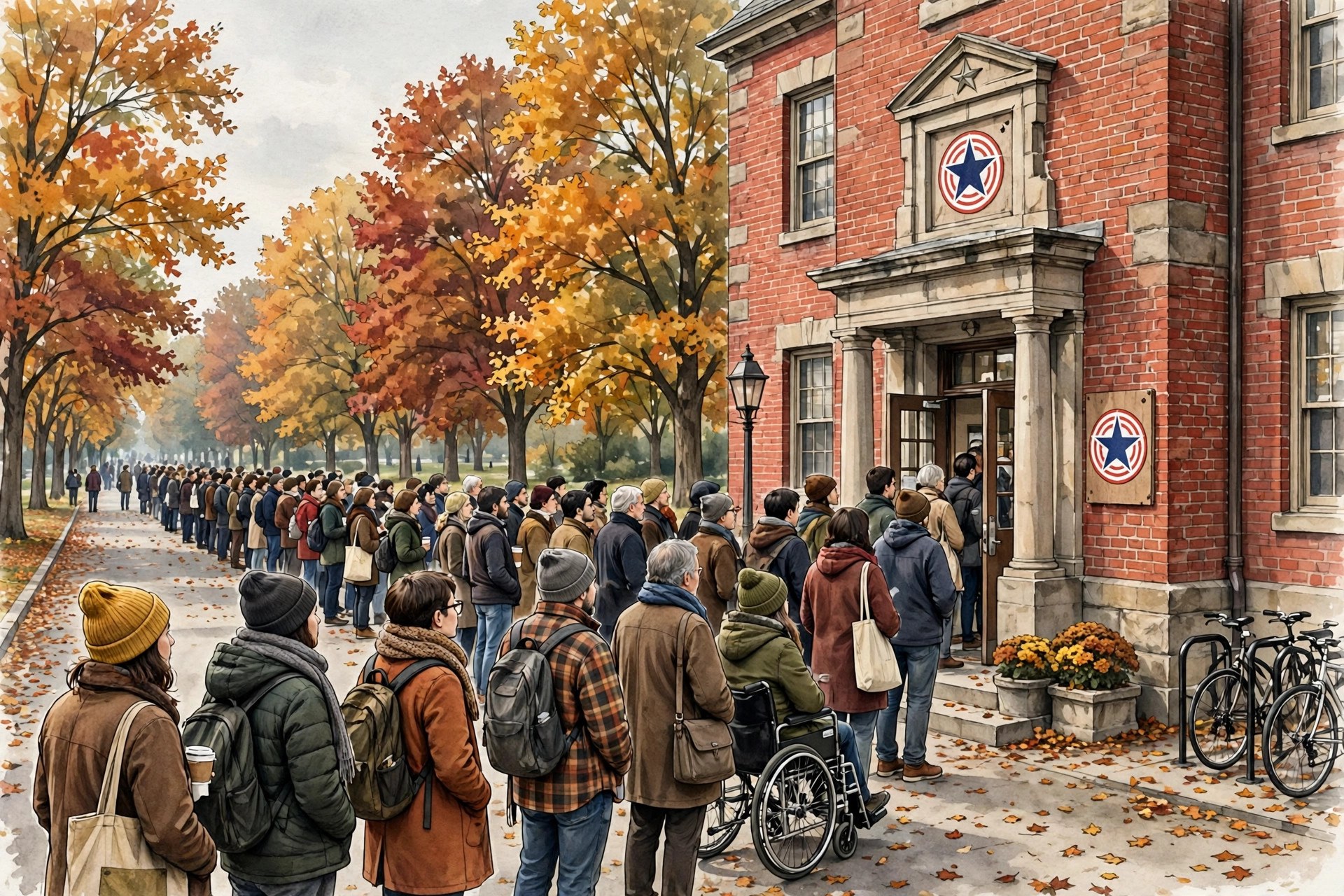
Before a single Election Day ballot was cast in the 2026 midterms, tens of millions of Americans had already voted. Early voting totals reported before November 3 pointed to an electorate that was engaged earlier, in larger numbers, and with more money spent to reach it than in the previous midterm cycle. Analysts cautioned that early votes alone do not reveal the final national turnout, because Election Day votes, mail ballots still in transit and the final canvass all add to the total. But the early-vote picture, combined with state-level records and exit-poll evidence about what motivated voters, already tells a clear story about a high-energy midterm in which the cost of living dominated the conversation.
The scale of early voting was striking. An Associated Press analysis put the pre-Election Day total at about 59.7 million votes, while the University of Florida’s Voting Lab reported more than 59 million early votes. Either figure sits above the roughly 58 million early votes recorded in the 2022 midterms. That comparison matters because 2022 itself was a high-turnout midterm by historical standards. Exceeding it in early voting alone suggested that 2026 would at least match, and possibly surpass, the overall engagement of four years earlier, even before Election Day turnout was added. It does not, by itself, prove a final national turnout percentage, and no final national percentage should be claimed until states certify their totals and researchers calculate turnout against the eligible voting population. What can be said now is that the early-vote surge was real, broad and measurable.
2026 midterm election voter turnout: early voting passed 2022 before Election Day
Early voting in the United States now takes several forms, and the 2026 totals combine them. In-person early voting at vote centres, mail ballots returned before Election Day, and absentee ballots cast by military and overseas voters all count toward the pre-Election Day figure. The growth of those options since 2020 has changed the rhythm of elections: the decisive period is no longer a single Tuesday, but a period of weeks in which campaigns chase early voters, parties track ballot returns daily, and news coverage follows the early-vote curve as a proxy for enthusiasm. In 2026, that curve rose faster than in 2022, which campaign strategists in both parties read as a sign of heightened motivation rather than mere convenience.
That reading is supported by state-level records that emerged before and on Election Day. Minnesota set a midterm early-vote record, with 886,427 early votes compared with 687,062 in 2022 — an increase of almost 200,000 votes, or close to 29 percent, in a state already known for high participation. Minnesota’s record is especially notable because it was set in a midterm, when turnout is traditionally lower than in a presidential year. It suggests that voters who might once have waited until Election Day, or skipped a midterm altogether, were instead voting weeks early, whether by mail or in person.
Iowa pointed in the same direction. The state’s Secretary of State, Paul Pate, said before Election Day that Iowa expected record turnout, a forecast that reflected both early-vote returns and Election Day preparations. Iowa is a state where midterm turnout has historically lagged presidential turnout, so a record expectation carried weight. It also reflected a competitive Senate contest in the state, where the projected Democratic flip added to voter interest, alongside competitive House and state races that gave voters in many districts a reason to participate.
Detroit offered a third local snapshot, this time from a major city rather than a statewide total. City officials anticipated turnout of about 45 percent, which would have been a possible midterm record for the city, and all 156 polling places were reported open on Election Day, according to CNN reporting that cited City Clerk Janice Winfrey. Detroit’s figure matters because urban turnout is often a bellwether for the broader electorate: when a large city with a history of lower midterm participation expects a record, it suggests that mobilisation efforts, competitive races and national issues are reaching voters who do not always vote in midterms. It also underscores the logistical achievement of keeping every polling place open, a detail that matters to voters who plan their day around a specific location.
What drove voters: cost of living first, direction of the country second
Exit polls conducted on and around Election Day point to a consistent hierarchy of concerns, with the cost of living at the top. A Reuters and SSRS consortium exit poll found that nearly nine in ten voters described the cost of living as crucial or a major factor in their vote. That is an exceptionally broad consensus in a polarised electorate. It cuts across party, region and income, because almost every household has felt price pressures in groceries, housing, transport and everyday services, even if voters disagreed sharply about who was to blame or what policy would fix it.
The cost-of-living story in 2026 had a specific, newer layer: the economic effects of the war with Iran. Moody’s Analytics estimated that the conflict had cost the typical American household about 2,147 dollars, a figure that captures higher energy costs, supply-chain disruption and the knock-on effects on prices. On Election Day itself, petrol prices underscored that pressure. AAA figures reported via CNN put the national average for regular petrol at 4.15 dollars per gallon, a record for an Election Day, with diesel at 6.29 dollars per gallon. For voters driving to work, heating a home or running a small business, those prices were not abstract statistics. They were visible every time they filled a tank, and they formed part of the backdrop against which voters judged the party in power.
A second exit-poll finding reinforced the sense of discontent. CBS exit polls found that about three-quarters of voters were dissatisfied with the direction of the country. Dissatisfaction of that magnitude does not automatically translate into a vote for the opposition — some dissatisfied voters may still support the incumbent party for other reasons, or may vote on a single issue — but in a midterm, where the president’s party historically loses seats, it creates a difficult environment for that party. The combination of broad cost-of-living concern and broad directional dissatisfaction helps explain why early voting surged and why the projected results favoured the opposition party in the Senate and, in projections, the House.
Other issues also shaped individual votes, including abortion rights, redistricting, immigration and the war itself, and ballot measures in several states gave voters a direct say on some of those questions. But the exit-poll evidence suggests that, for most voters, the election was first an economic referendum. Candidates who spoke directly to household costs, wages and prices, and who offered a concrete plan to address them, were speaking to the concern that nearly nine in ten voters said mattered most.
Record spending: nearly 12 billion dollars to reach voters
The 2026 midterms were also the most expensive midterms on record in spending terms, with campaign spending approaching 12 billion dollars. Political advertising alone accounted for about 11.6 billion dollars of that total, while so-called dark money — spending by groups that are not required to fully disclose their donors — exceeded 1.5 billion dollars. Those figures, reported in analyses of campaign finance data, reflect a contest in which both parties, outside groups and wealthy donors poured resources into a relatively small number of competitive Senate and House races, as well as into ballot-measure campaigns and state contests that could affect redistricting and future elections.
Record spending does not by itself cause record turnout, but it amplifies the reach of campaigns. In 2026, voters in competitive states were saturated with television, digital and mail advertising for weeks before Election Day, and the sheer volume of spending meant that even voters who do not follow politics closely were repeatedly exposed to campaign messages. That exposure can mobilise supporters, persuade undecided voters, and, in some cases, turn off voters who feel overwhelmed by negative advertising. The net effect in 2026 appears to have been mobilisation rather than suppression, given the early-vote totals, but researchers will need certified turnout data and post-election surveys to separate the effect of spending from the effect of the issues themselves.
The spending also raises longer-term questions about the role of money in American elections. Dark money in particular, because its sources are not fully disclosed, makes it harder for voters to know who is funding the messages they see. Supporters of current disclosure rules argue that transparency is essential for voters to judge credibility, while opponents argue that donor privacy protects free speech and prevents retaliation. That debate will continue regardless of the 2026 outcome, but the scale of dark-money spending in this cycle — more than 1.5 billion dollars — ensures that it will remain part of the post-election conversation about campaign finance reform.
Who turned out, and what remains unknown
Beyond the headline totals, the composition of the 2026 electorate will only become clear as states release certified voter files and researchers analyse them by age, race, party registration and voting method. Early-vote data can hint at composition — for example, whether older voters, who traditionally vote early by mail, turned out at higher rates, or whether younger voters, who often vote later, added to the Election Day total — but those hints are not a substitute for the certified record. What can be said now is that the early-vote surge was not confined to one region or one type of state. It appeared in a high-participation state like Minnesota, in a competitive state like Iowa, and in a large city like Detroit, suggesting a national pattern rather than a local anomaly.
It is also important not to over-read early votes as a predictor of the final result. Early voters tend to differ from Election Day voters in party, age and method, and in some states early votes are counted and reported before Election Day votes, which can create a misleading early lead for one party that narrows as the count proceeds. That phenomenon, sometimes called a red or blue mirage depending on the state, is a counting artefact, not evidence of fraud or error. It is one reason why election officials and analysts urge patience on election night and why the certified totals, not the early-vote curve, are the authoritative record.
For now, the safest summary of 2026 turnout is this: early voting exceeded 2022, Minnesota set a midterm early-vote record, Iowa expected a record, Detroit anticipated a possible record at 45 percent, and voters told exit pollsters that the cost of living and the direction of the country were their dominant concerns. The final national turnout percentage, and the detailed demographic breakdown, will follow certification. When those figures arrive, they will show whether 2026 was merely a high-early-vote midterm or a genuinely historic midterm in overall participation. On the evidence available before certification, it already looks like the former, and it may prove to be the latter.
Sources
USN reviewed reporting from multiple outlets for this story. Read more from USA Today, Nikkei Asia and The Hindu.