

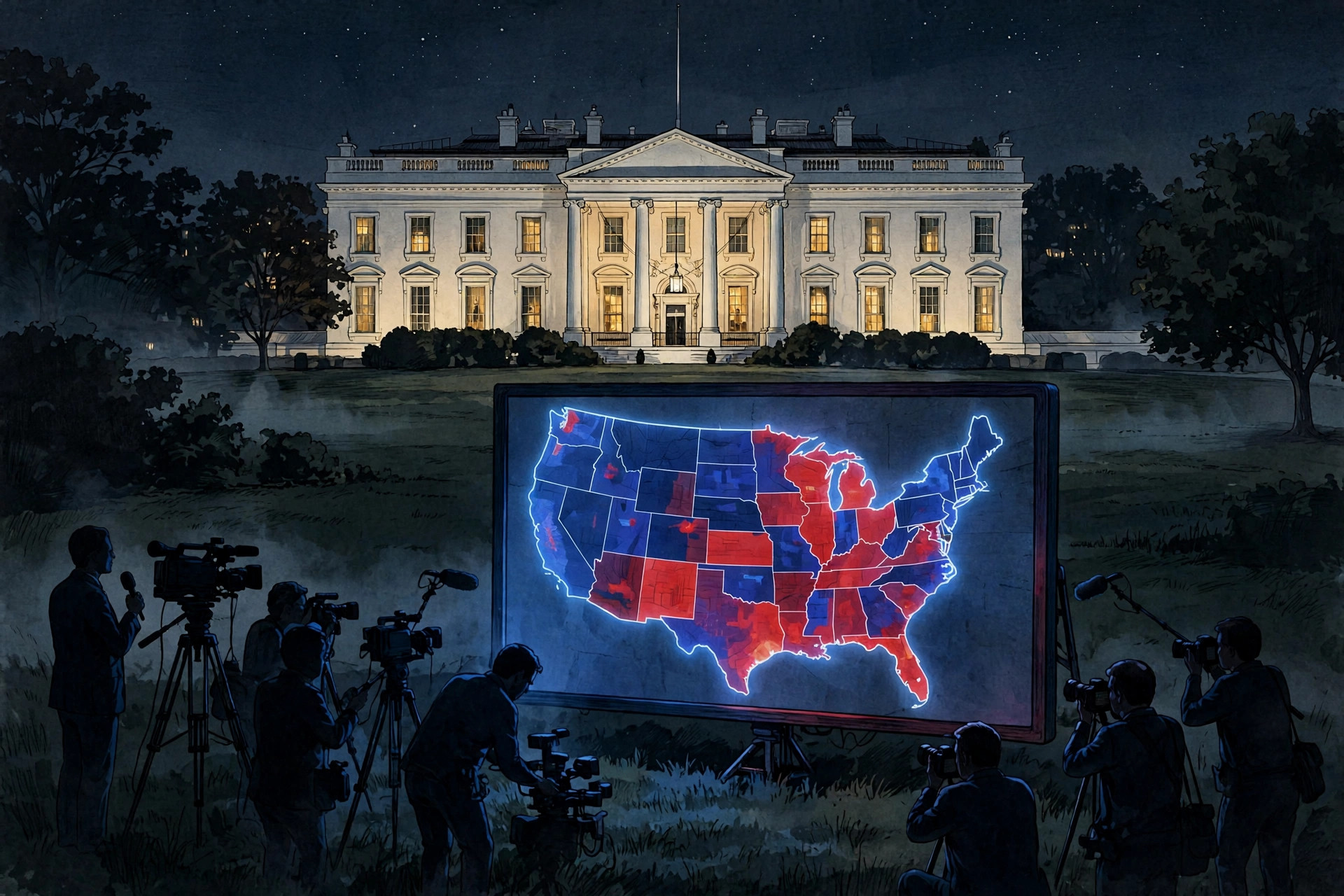
President Donald Trump spent election night in the White House East Room, surrounded by cabinet secretaries and political advisers at a reception arranged to watch the midterm returns come in. By the time the evening wore on, the mood described to reporters had shifted. An administration that had begun the night describing the president as cautiously optimistic was, by late evening, being described by a White House official as defiant. Democrats were projected by multiple news organisations to win control of the House of Representatives, a result that, if it holds as counting finishes, will strip the president of his legislative majority for the final two years of his term and hand his opponents the power to block new laws and to investigate his administration in ways a Republican-led chamber would not.
The House projection is the clearest single outcome of the November 3, 2026, midterm elections so far. CNN and CNBC projected a Democratic House majority on election night, and other outlets followed with the same projection as returns accumulated. The size of that majority was not yet known when this article was written, because many competitive districts were still counting ballots, and western states in particular were expected to take longer to report. A projection of control is not the same as a final, certified result: states will canvass and certify their counts in the days and weeks ahead, and the exact margin will only become clear when that process is complete. But the direction of the House result was no longer in serious doubt in the projections published overnight, and the White House was already responding as though the chamber had changed hands.
Control of the Senate, by contrast, was still being counted at the time of writing, and has since been projected for the Democrats. Democrats entered election night needing a net gain of four seats to take the chamber from a Republican majority of 53 to 47, counting two independents who caucus with Democrats in the Democratic total. Two Republican-held seats had flipped to Democrats in called or projected results: North Carolina, where former Governor Roy Cooper defeated the Trump-backed Republican Michael Whatley, and South Carolina, where Democrat Annie Andrews was projected to defeat Darline Graham. Democrats also held important seats in Georgia, where Senator Jon Ossoff won re-election, and in New Hampshire, where Chris Pappas won an open seat. Several other races that will decide Senate control, including contests in Alaska, Iowa, Kansas, Maine, Michigan and Ohio, were still uncalled late on election night, with millions of votes uncounted. Some live forecasting models leaned toward a Democratic Senate by the early hours of Wednesday, but a model projection is not a race call, and readers should treat the Senate as unresolved until the Associated Press or a major network decision desk formally calls control of the chamber.
White House midterm results reaction: defiance, blame and a ballot argument
The White House reaction unfolded in two registers at once. Publicly, the president turned his attention to the broadcaster Fox News in a series of angry social media posts as the first polls closed, criticising its coverage and its polling. He then went quiet on social media for about three hours as Democratic victories accumulated, before returning late in the evening with an argument that has since become the centrepiece of his response: that the outcome would have been very different had he personally been on the ballot. In his telling, his absence from the ballot, rather than his record or his endorsed candidates, explains the Republican setbacks. That framing sits uneasily alongside the campaign he actually ran, in which he spent weeks urging supporters to vote as though he were on the ballot and campaigned personally for many of the candidates who went on to lose or to struggle.
Privately, according to reporting of conversations with White House officials, the administration’s explanation pointed in a different direction: candidate quality. A White House official told the AFP news agency that the mood in the building was defiant, warned Democrats to prepare for a fight, and questioned the quality of some Republican House and Senate candidates, many of whom the president had endorsed and travelled across the country to support. Another line from officials held that the president had promoted many of the candidates on the ballot more effectively than the candidates had promoted themselves. Taken together, the two explanations point in opposite directions. One says the president’s personal appeal would have saved the night; the other says the candidates themselves were the problem. Both cannot fully explain the same result, and the tension between them is likely to shape the blame debate inside the Republican Party in the weeks ahead.
There was also a more conciliatory note. In an interview with The New York Times reported after the voting, the president said he would accept the outcome of the elections and was willing to work with Democrats, adding that the two sides might be able to reach a common vision on some questions. That statement matters because it sets the public terms on which the White House will deal with a chamber it no longer controls. Accepting results and working across the aisle is the conventional posture of a president facing divided government. Whether it survives contact with the first real legislative fight, or with the first oversight investigation, will be a test of how much of that posture was election-night positioning and how much of it is a governing plan.
Democrats, for their part, read the night as a verdict on the president’s second term. Ossoff described the Democratic victories as a rejection of the president’s approach, and Democratic campaign officials pointed to the breadth of the gains, which extended into districts and states the president had carried comfortably in 2024. Republicans who lost ground offered a different reading: that midterm elections historically punish the party in power, that local candidate factors mattered, and that the president’s own voters are simply less likely to turn out when his name is not on the ballot. Both readings contain something true. Midterms do usually go against the sitting president’s party. But the scale of the Democratic gains reported overnight, and the fact that they included seats in states as Republican-leaning as South Carolina, suggest something more than routine midterm gravity was at work, and that is the argument Democrats will make as they claim a mandate.
Why voters moved, as reported on election night
Polling and exit polling reported on election night pointed repeatedly to the same cluster of concerns: the cost of living, tariffs, and the war against Iran, which has driven fuel prices sharply higher. The White House dismissed those concerns during the campaign, arguing that its tariff policy, immigration enforcement and military campaign were strengths. Voters, on the evidence of the early results, were less convinced. In North Carolina, voter surveys found that most Senate voters regarded the Republican candidate as too supportive of the president, a finding that captures in one number the difficulty of running as a close ally of an unpopular incumbent. Nationally, exit polling reported by NBC News found a majority of voters viewing the Republican Party unfavourably, with the Democratic Party also viewed unfavourably by a majority, though by a smaller margin. That combination, a public unhappy with both parties but more unhappy with the governing one, is a familiar midterm pattern, and it helps explain why a wave can build even when the opposition party is not itself widely loved.
The White House also pointed to a specific grievance of its own in its election-night messaging: that voters who backed Democrats would come to regret it if fuel prices fell once the Iran conflict was resolved, while remaining stuck with what officials described as liberal Democratic policies. That argument assumes the conflict and its economic effects will fade quickly and that voters will then judge the new House majority on other grounds. It is a prediction, not a fact, and it depends on events the White House does not fully control. For now, the more concrete fact is that voters ranked affordability at or near the top of their concerns, and the party in power paid a price for it.
What a Democratic House actually changes
A Democratic House majority changes the president’s final two years in three concrete ways. First, it ends his ability to pass major legislation on Republican votes alone. Any bill will now need Democratic support in the House as well as in the Senate, whatever the Senate’s final composition turns out to be, and that gives the opposition a veto over the domestic agenda. Second, it hands committee chairmanships to Democrats, which means the power to set hearing agendas, demand documents and testimony, and investigate the administration’s conduct, including the Iran war, mass deportations and allegations of corruption raised by critics. Investigations do not by themselves change policy, but they can dominate news coverage, force disclosures the White House would prefer to keep private, and shape the political environment for the 2028 presidential race. Third, it changes the rhythm of government funding fights. Congress must keep the government funded, and a Democratic House will be able to insist on its own priorities in spending negotiations, including in the lame-duck session that begins when Congress returns on November 9 with a funding deadline on December 11.
What a Democratic House does not change is equally important. The president retains the executive branch, including the power to issue executive orders, direct federal agencies, conduct foreign policy and command the armed forces, subject to the courts and to Congress’s power of the purse. Recent court decisions have already shown the limits of executive action, notably in the tariff litigation that reached the Supreme Court, and a Democratic House could add legislative and legal challenges to that constraint. But the day-to-day machinery of government, from immigration enforcement to regulatory policy, remains in the president’s hands unless Congress passes a law to change it and can overcome a presidential veto, which requires a two-thirds majority in both chambers. That arithmetic means the likeliest shape of the next two years is not a Democratic legislative programme enacted over the president’s objections, but stalemate on major new laws, punctuated by funding fights and oversight battles.
The lame-duck session is the first test of that new reality. The outgoing Republican-led House and the current Senate will meet before the new Congress is seated in January, and the funding deadline on December 11 gives both parties a reason to negotiate rather than to posture. How the White House handles that session, whether it treats the incoming Democratic majority as a negotiating partner or as an adversary to be confronted, will set the tone for 2027. The president’s election-night defiance suggests confrontation. His reported willingness to work with Democrats suggests negotiation. The next few weeks will show which instinct governs.
What to watch next
Several questions remain open and should be followed before drawing final conclusions. The first is the Senate: with control now projected for the Democrats, the question is whether that projection holds through certification, and whether the president faces one opposition chamber or two, and that distinction matters enormously for confirmations, treaties and any legislation that does reach his desk. The second is the size of the House majority: a narrow majority constrains Democratic leaders, who must hold together a caucus that spans moderates in competitive districts and progressives in safe ones, while a larger majority gives them more room. The third is the internal Republican reckoning: whether the party concludes that its candidates, its message or its leader cost it the night, and whether that conclusion produces a change of strategy or a doubling down. The fourth is the president’s own behaviour: whether the defiance of election night hardens into a governing style, or whether the acceptance he expressed in his interview becomes the working approach.
For readers, the most useful discipline in the days ahead is to distinguish between three different kinds of statement that will all be presented as results. A race call by the Associated Press or a network decision desk is a conclusion that the trailing candidate cannot overtake the leader. A projection of chamber control is a judgement that enough such calls point one way. A forecast model is a probability, not a result. All three have appeared in coverage of this election, sometimes without clear labels, and the confusion has been greatest around the Senate, where models moved faster than calls. USN’s earlier outlook for the 2026 midterms had already flagged that pattern, favouring Democrats for the House while describing the Senate race as tight, and that distinction has held up well against the results so far.
The midterm elections were widely described before polling day as a referendum on the president’s turbulent second term, and on the evidence of the House result, the referendum went against him. That does not settle the argument about why, and it does not determine what happens next. It does, however, change the institutional facts of American government for the next two years: a president who governed with a friendly Congress will now govern against, or at least alongside, a hostile House, with the Senate projection still to be confirmed through certification. The defiance in the East Room on election night was, in that sense, both a mood and a preview. The question for the remainder of the term is whether defiance is a strategy, or simply the first reaction to a result the White House did not expect to have to absorb.
Sources
USN reviewed reporting from multiple outlets for this story. Read more from Gulf News, The New Indian Express and CNN.