

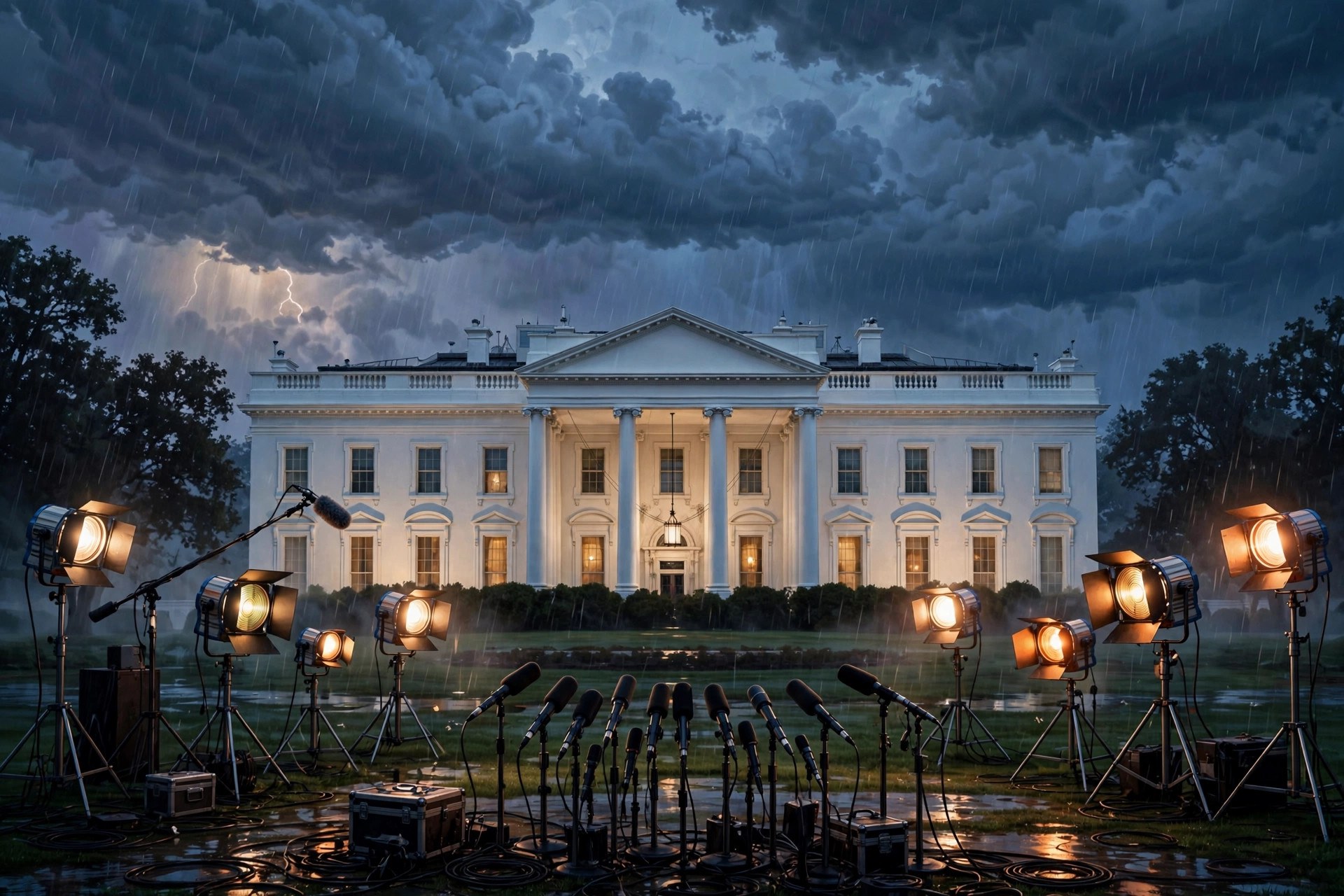
President Donald Trump has reacted to the 2026 midterm results with a message that tried to combine acceptance, defiance and a forward plan. He said he would accept the election results and work with Democrats, while also claiming that he would have won a landslide if he had been on the ballot himself. The reaction came as the country was still absorbing the scale of the Democratic gains, including the projected loss of the House, a Democratic Senate majority and several high-profile state results. In the days that followed, the debate moved quickly from what had happened on election night to what Trump would do next, what Congress would do next and whether any working relationship between the White House and a Democratic Congress was possible.
The most widely reported version of Trump’s immediate reaction came from his own social media. A report by the South China Morning Post said that Trump said he would accept the election results and work with Democrats, in a post on Truth Social. The report also noted that his post claimed he would have won a landslide if he had been on the ballot, and that he said he would have performed well in the elections. Those two ideas, acceptance and a claim of personal electoral strength, are not contradictory in Trump’s political style. He has often framed elections in personal terms, presenting his own popularity as a separate question from the performance of other Republican candidates, and presenting cooperation as a practical choice while maintaining that his own record would have produced a different result.
That framing matters because it shaped how both parties read the result. Democrats could point to Trump’s acceptance as a sign that the transfer of power in Congress would proceed normally, and to his willingness to work with them as an opening for legislation, even if that opening proves narrow. Republicans, by contrast, could point to the landslide claim as a way of separating Trump from the losses, arguing that the problem was not Trump himself but the candidates, the campaign environment or the issues that dominated the midterms. Both readings were present in the first coverage, and both will influence how the next two years are negotiated.
The broader context was a midterm result that many analysts described as a major setback for the Republican Party. The Associated Press and other outlets projected that Democrats would take control of the House, and that Democrats had also won a Senate majority. That outcome would end unified Republican control of Washington and create a divided government for the final two years of Trump’s second term. In that setting, the president’s ability to pass legislation would depend on Democratic votes, and Democrats would gain the ability to set the agenda in both chambers, to hold hearings, to issue subpoenas and to block or reshape administration priorities. The reaction therefore carried weight beyond rhetoric: it was the first signal of how Trump intended to handle a political environment in which he no longer had a friendly Congress to advance his programme.
At the same time, Trump’s reaction was not limited to a single social media post. His party’s defeat prompted a round of commentary from allies, critics and political pundits about what the result meant for his remaining time in office and for the Republican Party’s future. One of the most striking pieces of commentary came from a political pundit who suggested that Trump should consider a very different approach to his final years: instead of fighting a Democratic Congress at every turn, the pundit argued, Trump could work with Democrats on selected issues, use executive power strategically and focus on legacy-building measures that do not require Congress. That suggestion, reported in coverage of the post-election debate, framed the final years not as a period of inevitable gridlock, but as a period in which a president facing divided government could still shape policy through negotiation, appointments, foreign policy and the use of the bully pulpit.
The pundit plan, as it was described, did not suggest that Trump would become a different politician. It suggested that the political incentives had changed. With Democrats in control of Congress, Trump could no longer expect his legislative programme to pass in its original form. He could veto Democratic bills, as he has said he will do in other contexts, but vetoes alone do not build a legacy. They prevent action, rather than creating it. A strategy of selective cooperation, by contrast, would allow Trump to claim credit for bipartisan deals, to shape legislation from the inside and to present himself as a president who could govern even without a friendly Congress. Whether Trump adopts that approach in practice remains to be seen, and his own statements have often emphasised confrontation as much as cooperation.
Criticism of Trump’s election-night performance also formed part of the reaction. Reporting noted criticism of Trump’s handling of election night, including from voices within the broader conservative media environment. A report by the Daily Beast described criticism from Fox News figures and others who questioned aspects of Trump’s response, while other coverage focused on the broader Republican debate about whether the party’s messaging on the economy, on health care and on other issues had failed to connect with voters. That internal debate is normal after a midterm defeat, but it was sharpened by the scale of the Democratic gains and by the fact that Trump himself had been a central figure in the campaign, even though he was not on the ballot.
Trump midterm results reaction: what acceptance means when Congress changes hands
Acceptance of election results has a specific meaning in American politics. It means recognising the outcome as legitimate, allowing the transition of power in Congress to proceed, and not using the powers of the presidency to obstruct the seating of newly elected members or the organisation of the new Congress. Trump’s statement that he would accept the results, as reported, therefore mattered for institutional reasons, even if it was accompanied by a claim about what would have happened if he had been on the ballot. It signalled that the process of organising the new Congress, electing its leaders and beginning its work would not face a challenge from the White House on legitimacy grounds.
That signal does not, by itself, resolve the policy conflicts that divided government creates. Democrats in Congress are likely to pursue an agenda that includes oversight of the administration, legislation on health care, voting rights, climate, gun safety and other issues, and investigations into executive actions. Trump is likely to oppose much of that agenda, to use the veto, and to pursue his own priorities through executive orders and foreign policy. The question is not whether there will be conflict, because there will be, but whether there will also be areas of cooperation, and whether that cooperation will be presented as a strength or as a concession by either side.
The cost-of-living issue also ran through the reaction, even when it was not the headline. Exit polling reported by Reuters and SSRS found that around nine in ten voters called the cost of living crucial or a major factor in their vote, and Democrats argued that this concern drove their gains. Trump and his allies, by contrast, have argued that the economy is stronger than critics claim, pointing to growth, employment and other indicators. That disagreement about the economy is not just a messaging dispute: it affects what legislation Congress will consider, what voters will judge in 2028 and how both parties frame their records. If voters continue to feel pressure on household costs, the party in the White House will face a difficult argument, regardless of macroeconomic indicators. If costs ease, the White House will be able to argue that its policies worked, even if the midterm result suggested otherwise at the time.
For Democrats, the reaction also raised a strategic question: how to use a new majority without overreaching. A Democratic Congress that pursues only confrontational oversight may satisfy its base but fail to produce legislation that voters can see and feel. A Congress that seeks deals with Trump on selected issues may produce results, but may also face criticism from its own supporters for cooperating with a president they oppose. The balance between those approaches will be set by Democratic leaders in the House and Senate, by the priorities of their members and by the reaction of voters to the first months of divided government. Trump’s statement that he would work with Democrats, if taken at face value, gives those leaders a starting point for negotiation, even if the negotiations themselves are difficult.
For Republicans, the reaction raised a different strategic question: how to rebuild after a defeat that many in the party had not expected to be so large. Some Republicans argued that the party needed to focus more on the cost of living, on health care costs and on practical issues that affect voters’ daily lives. Others argued that the party needed to double down on its core messages on immigration, crime and cultural issues, and that the midterm result was a temporary setback caused by turnout patterns and by the normal tendency of voters to punish the party in the White House. Trump himself, by claiming a landslide if he had been on the ballot, offered a third explanation: that the problem was not the message or the messenger in general, but the specific candidates and circumstances of the midterms. That explanation protects Trump’s own standing within the party, but it does not by itself solve the party’s challenge in 2028, when Trump will not be on the ballot as a presidential candidate in the same way.
The pundit plan for Trump’s final years, whatever its details, therefore sits at the intersection of these questions. It asks whether a president in the final years of a second term, facing a Congress controlled by the opposition, can still leave a lasting mark. History offers examples in both directions. Some presidents in divided government have achieved significant legislation through negotiation, while others have relied on executive action and foreign policy to shape their legacy. Trump has already shown a willingness to use executive orders extensively, and to pursue foreign policy initiatives that do not require Congress. Those tools will remain available, even if legislation is harder to pass. The question is whether he will also seek legislative deals, and whether Democrats will be willing partners in those deals.
In the short term, the most concrete test of Trump’s reaction will be the organisation of the new Congress and the first legislative fights. If Trump and Democratic leaders can agree on a government funding deal, on disaster aid or on other must-pass legislation, that will suggest that the acceptance and cooperation language was more than rhetoric. If the first months are defined by veto threats, by stalled funding and by confrontational hearings with no legislative output, that will suggest that divided government is functioning as many expected: as a period of gridlock in which each side prepares for the next election rather than governing together. Both outcomes are possible, and the reaction in the first days after the midterms does not by itself determine which will occur.
What is clear is that the 2026 midterms changed the political landscape in Washington in a fundamental way. A president who began his second term with unified Republican control now faces a Democratic House and Senate, a set of state results that favour Democrats, and a public debate about whether his party’s message connected with voters on the cost of living. His reaction, combining acceptance, a landslide claim and an openness to working with Democrats, was an attempt to navigate that new landscape without conceding that his own popularity had diminished. Whether that navigation succeeds will be judged not by the reaction itself, but by what happens in the final two years of his presidency, by the legislation that passes or fails, and by the verdict voters deliver in 2028.
Sources
USN reviewed reporting from multiple outlets for this story. Read more from South China Morning Post, Daily Beast and USN.