

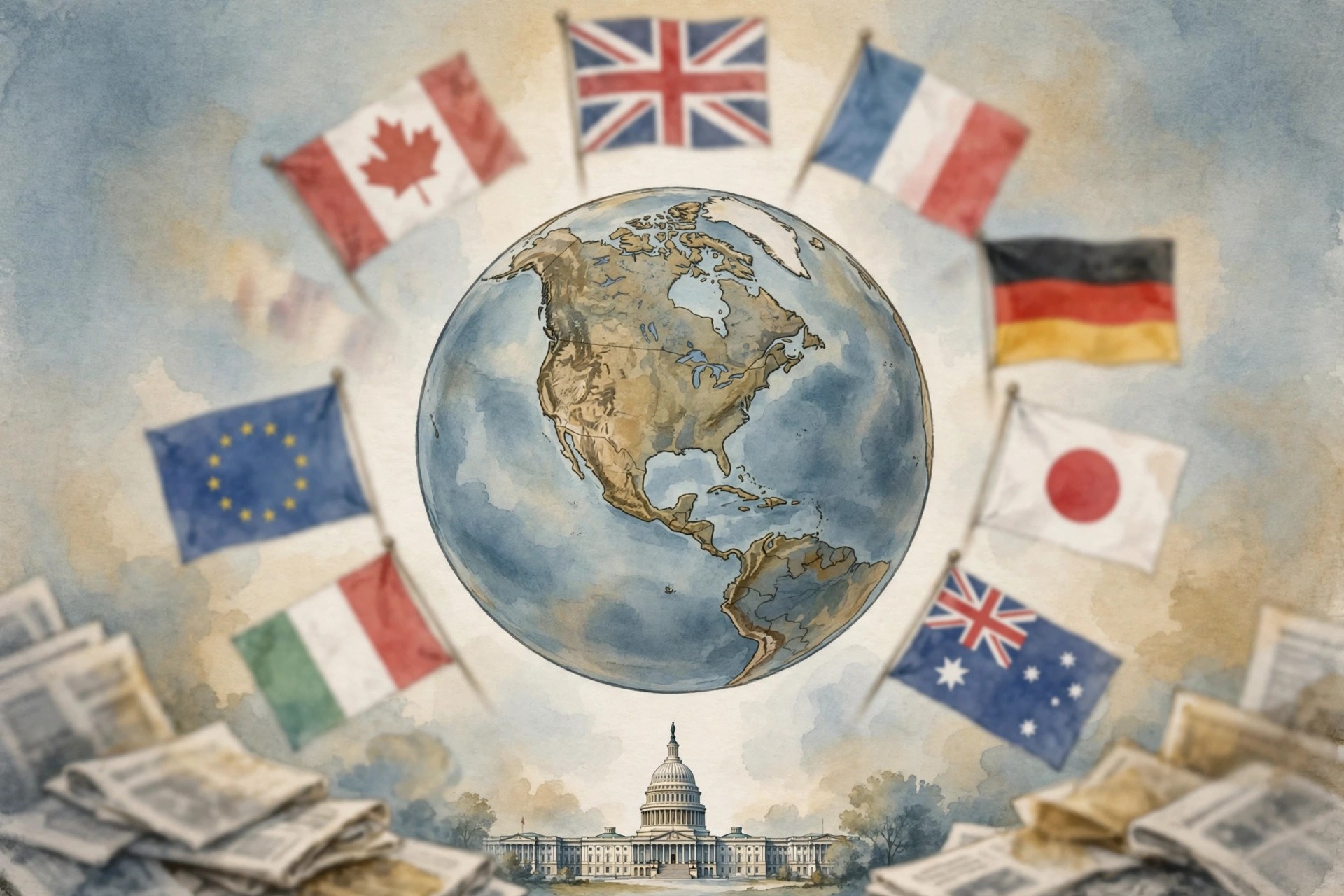
The world’s reaction to the 2026 United States midterm results has been a study in caution, calculation and divided expectations. Allies who depend on American security guarantees, rivals who watch American politics for signs of weakness, and trading partners who fear the return of tariffs and trade wars have all responded to the same projected outcome — a Democratic Congress facing a Republican president — in very different ways. For some, divided government promises restraint on a president they have found unpredictable. For others, it promises paralysis, uncertainty and a United States that is less able to act decisively on the world stage. For almost all, the reaction has been provisional, because the results themselves remain projected in some respects and subject to certification, and because the practical consequences will depend on what the new Congress actually does.
The broadest reaction came from Europe, where the prospect of a Democratic Congress was greeted with a mixture of relief and realism. European governments have spent much of the past two years trying to manage a transatlantic relationship strained by tariffs, by disagreements over Ukraine and by questions about the United States’ commitment to NATO. A Democratic House and Senate, in European eyes, might be more supportive of NATO, more willing to fund Ukraine and more inclined to work through alliances than a Republican Congress aligned with President Donald Trump. At the same time, European officials know that the president retains control of foreign policy, that he can veto legislation, and that a Democratic Congress cannot by itself reverse tariffs or restore previous policies without his signature or a veto-proof majority. Relief, therefore, has been tempered by an awareness of the limits of divided government.
Ukraine’s reaction was among the most consequential, and the most closely watched. Ukrainian officials, who depend on American military and financial aid, have followed the midterms with particular attention, because the composition of Congress affects the prospects for future aid packages. A Democratic Congress is, in general, more supportive of continued aid to Ukraine than a Republican Congress divided between supporters and sceptics. That support matters not only for the volume of aid, but for its continuity: a Congress that can pass aid bills, even if the president is reluctant, creates a different political environment from a Congress that blocks them. Ukrainian leaders have therefore welcomed the projected result, while also recognising that aid will still need to navigate a divided government, a president who has questioned aid levels, and a debate in the United States about the costs and benefits of continued support.
The reaction from Russia, by contrast, has been more muted and more strategic. Russian officials and state media have framed the midterms as evidence of American political division, and have suggested that a divided United States will be less able to sustain a coherent policy on Ukraine, on sanctions or on NATO. That framing serves a purpose: it presents American democracy as chaotic, it undermines confidence in American commitments, and it suggests to other countries that aligning with the United States carries risks. Whether that framing reflects Russian expectations or Russian hopes is difficult to separate. What is clear is that Moscow will watch the new Congress for signs of internal disagreement, for delays in aid, and for any signal that American support for Ukraine is weakening, and will use those signals in its own calculations about the war.
China’s reaction has been shaped by trade as much as by security. Chinese officials and analysts have watched the midterms for clues about whether tariffs on Chinese goods will ease, tighten or remain a point of contention between Congress and the White House. A Democratic Congress might be more sceptical of broad tariffs than a Republican Congress aligned with Trump, but it is not necessarily more supportive of China on other issues, including technology restrictions, Taiwan and human rights. Beijing’s calculation is therefore complex: divided government might reduce the risk of a sudden escalation in trade policy, but it is unlikely to produce a fundamental reset in the United States-China relationship, which has become more adversarial across both parties in recent years.
Iran, and the wider Middle East, present another set of reactions. The United States’ approach to Iran — including sanctions, nuclear negotiations and regional security — has been a source of tension, particularly in the context of the Iran war and its economic effects, which Moody’s Analytics estimated cost the typical household about 2,147 dollars. A Democratic Congress might push for a different approach to Iran, including greater emphasis on diplomacy and on congressional oversight of military action, while a Republican president might resist those pressures. Regional allies, including Israel and Gulf states, will watch that tension closely, because it affects their own security calculations. For Iran itself, divided government may be seen as an opportunity to exploit American divisions, or as a source of unpredictability that makes negotiation harder. Either way, Tehran, like other capitals, will wait to see whether Congress and the White House can agree on a coherent policy, or whether they pull in different directions.
Trading partners in Asia, Latin America and elsewhere have reacted with a focus on tariffs and on the stability of American economic policy. Many countries have been affected by tariffs imposed during Trump’s second term, and they have sought to negotiate exemptions, to diversify their trade relationships, or to wait out the political cycle. A Democratic Congress that is more sceptical of tariffs could, in theory, provide relief, but only if it can pass legislation and overcome a presidential veto, or if it can use oversight and appropriations to influence trade policy indirectly. In practice, most trading partners expect tariffs to remain a feature of American policy for the foreseeable future, regardless of who controls Congress, and they are planning accordingly, by building alternative supply chains and by strengthening trade relationships with other countries.
World reacts US midterm results: what divided government means for Ukraine, NATO and tariffs
The most immediate practical question for the world is Ukraine aid. The next aid package, if one is proposed, will need to pass both chambers and be signed by the president, or pass with a veto-proof majority. A Democratic Congress is more likely to propose and pass such a package, but the president’s position remains central. If Trump opposes a package, Congress would need to find a way to overcome his veto, which requires a two-thirds majority in both chambers — a high bar in a narrowly divided Congress. If Trump supports a package, even reluctantly, it is more likely to pass. The world will therefore watch not just the composition of Congress, but the interaction between Congress and the White House on this specific issue, because it will set the tone for American foreign policy in 2027.
NATO presents a similar dynamic. A Democratic Congress can pass resolutions supporting NATO, can fund American commitments to the alliance, and can hold hearings that reinforce the importance of collective defence. It cannot, however, by itself guarantee that the president will prioritise NATO in his foreign policy, or that he will not pursue bilateral deals that bypass the alliance. European allies, who have been reassured by congressional support for NATO in the past, will therefore look for concrete actions — funding, deployments, joint exercises — rather than statements alone, to judge whether the new Congress has changed the reality of the alliance or merely its rhetoric.
Tariffs present a similar test. A Democratic Congress can hold hearings on the effects of tariffs, can propose legislation to limit presidential tariff authority, and can use the appropriations process to influence trade policy. It cannot, however, easily override a presidential veto on a major trade bill, particularly when some members of its own party support tariffs in specific sectors. Trading partners will therefore judge the new Congress not by its statements on tariffs, but by whether it can actually change tariff policy, or whether tariffs remain a presidential tool that Congress can criticise but not control.
For the United States itself, the world’s reaction is a reminder that midterm elections are not only a domestic event. They are watched abroad because they affect alliances, trade, aid and the credibility of American commitments. A divided government, in that sense, is not just a domestic arrangement. It is a signal to the world about how the United States will act, how reliably it will keep its promises, and how much other countries can count on American leadership. That signal will be interpreted differently in different capitals, but it will be interpreted everywhere, and it will shape decisions about defence spending, trade policy, diplomatic alignment and investment for years to come.
In the end, the world reacts to United States midterm results not with a single voice, but with a chorus of interests, hopes and anxieties. Allies hope for restraint and reliability, rivals hope for division and paralysis, trading partners hope for stability and predictability, and aid recipients hope for continuity. Divided government, as projected in 2026, offers something to each of those hopes and anxieties, but it guarantees none of them. What it guarantees is a period of negotiation, of vetoes and compromises, of hearings and legislation that may or may not become law, and of a United States that must govern itself before it can govern its role in the world. The world’s reaction, therefore, is best understood not as a verdict on the midterms, but as a question: can a divided America still act as a reliable partner, a credible rival and a stable trading nation, or will division at home become division abroad?
Sources
USN reviewed reporting from multiple outlets for this story. Read more from Al Jazeera, BBC, USN and USN.