

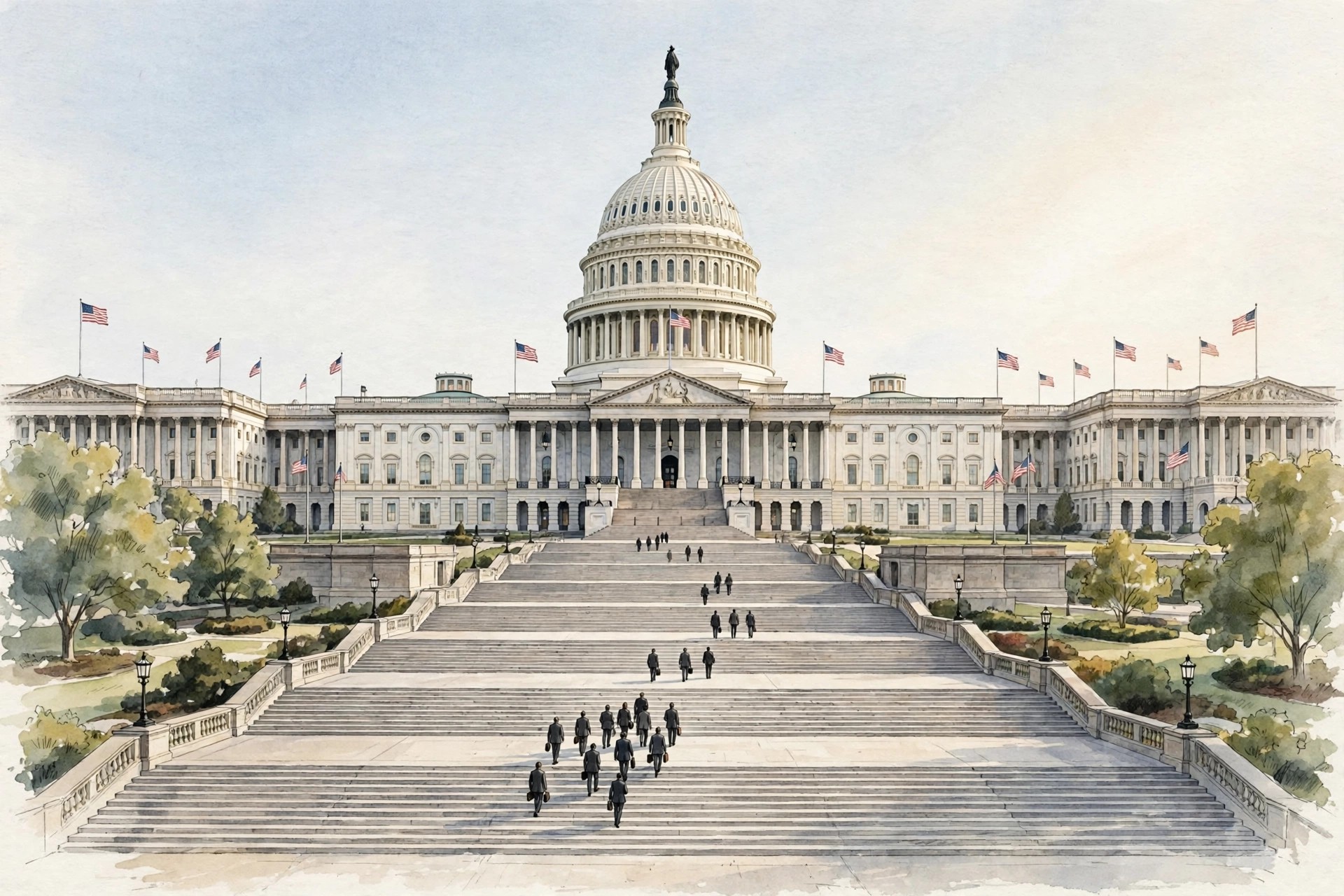
On the morning of November 8, 2026, a group of people who have never held a seat in Congress will walk into Washington as members-elect of the House of Representatives, even though not one of their victories has yet been certified. That is not a contradiction. It is how the American system handles the weeks between an election and the start of a new Congress, and it is the first lesson the incoming freshman class of the 120th Congress will have to learn: in Washington, preparation begins on projections, while legitimacy waits for the canvass.
The projected Democratic victories in the House on November 3 mean the incoming class will arrive in a city that is already arguing about what it should do first. Orientation, which runs from November 8 through November 18, according to a Republican aide quoted by Bloomberg Government, is supposed to be the practical part of the transition. New members draw numbers in the freshman room lottery that will determine the order in which they choose offices in the Capitol complex. They hire staff, learn floor procedure, and sit through briefings on ethics, security, office budgets and the structure of a congressional office.
None of this makes a projected winner a certified member. Between election night and the swearing-in, mail ballots, overseas ballots and provisional ballots are still being counted in many states, local officials canvass the results, and state officials certify them through November and December. The outgoing 119th Congress remains in power throughout that period, including for any lame-duck session. A member-elect who attends orientation is preparing to serve. The certificate of election, and the oath itself, come later. Readers should keep that distinction in mind whenever a news report describes a new member as if the seat were already settled, because in the closest races it is not.
The reason this particular freshman class matters more than most is that it arrives with a rules fight already under way inside the party that is projected to control the House. Before the new members have cast a single vote, they will be asked to decide how the House itself should be run: how long committee chairs may serve, whether lawmakers should be barred from trading individual stocks, and whether those changes belong in the opening rules package or in separate bills. Those questions sound procedural. In practice, they will reveal how much discipline the new majority has, and how much patience its newest members have for the institution they have just joined.
New Congress Freshman Class 2027: What Orientation Actually Teaches
Orientation is often described as a welcome week, but for a new member it is closer to a crash course in running a small organisation under intense public scrutiny. A House office is, in effect, a workplace of a dozen or more staff, a budget, a casework operation for constituents, and a legislative operation that must track bills, amendments and votes, all at once. The briefings cover floor procedure, so that a new member understands what happens when a bill is called up, how amendments are offered, and what a motion to recommit actually does. They cover ethics rules, so that a member knows what gifts, travel and outside income are permitted and what must be disclosed. They cover security, a subject that has grown more serious in recent years, and they cover the unglamorous mechanics of office management: payroll, hiring, correspondence systems and the franking rules that govern official mail to constituents.
The Senate runs its own bipartisan orientation in the same period, and the Harvard Kennedy School has run a bipartisan conference for new House members since 1972, giving incoming members from both parties a shared introduction to the institution before the partisan work of the session begins. That shared experience matters, because the freshmen who will disagree most fiercely on the floor in January will first meet one another in briefing rooms in November, learning the same procedures and, often, swapping notes about the practical problems of setting up an office in a city where housing, staff and office space are all in short supply.
The room lottery is the part of orientation that gets the most attention, and it is worth understanding why. Office selection is not a perk in the ordinary sense. A member’s office location affects how easily constituents, colleagues and staff can reach them, and how much space they have for the team they need. Drawing a number is a deliberately random process, designed to avoid the appearance that seniority or favouritism decides who gets which room. For a freshman, the lottery is also a first taste of an institution that runs on rules that can seem arbitrary until you understand that the rule exists precisely to settle a question without a fight. The rules-package debate that follows in January is, in a sense, the same question on a larger scale: which rules should govern the House, and who gets to write them?
Swearing-In on January 3, 2027: The Sequence That Makes a Congress
The new Congress convenes at noon Eastern Time on January 3, 2027, as required by the Twentieth Amendment. That date is fixed, and it does not move because counting is slow in a particular state or because a particular race is contested. What happens on that day follows a sequence that has been repeated for generations, and it is worth setting out because it explains why the Speaker election comes first and why the rules vote matters so much.
New House members are sworn in first, and then they elect the Speaker by a roll-call vote that requires a majority of those present and voting. That is a real vote, not a formality, and in a narrow majority it is a genuine test of party discipline. A Speaker candidate who cannot command a majority of those present cannot take the gavel, and the House cannot proceed to its other business until the Speakership is settled. New senators take office at the same moment, joining a chamber whose leadership and committee arrangements are settled by separate processes. Only after the House has a Speaker does it adopt its rules package, the document that will govern how bills move, how committees are structured, and what limits apply to members themselves.
Committee Chair Term Limits: A Break With Seniority
Inside the Democratic caucus, according to CNN reporting on November 3 and 4, plans are under discussion to enact new term limits for committee chairs in the rules package, with current chairs potentially grandfathered for a short time. That proposal, if adopted, would be a major break with seniority practice in the House. For most of the modern era, committee chairs have been chosen largely by seniority within the majority party, and a chair who kept winning re-election could hold a gavel for many years, accumulating expertise, relationships and influence over a policy area.
The argument for term limits is straightforward, and it is the argument reform-minded incoming members are most likely to make. Long-serving chairs, in this view, can become bottlenecks, slowing legislation that newer members want to advance and concentrating power in a small number of hands. Term limits would force rotation, open leadership opportunities for newer members, and signal to voters that the new majority intends to police itself rather than simply inherit the privileges of the old one. For a freshman class that campaigned, in many cases, on change and on responsiveness to voters frustrated by high costs, a term-limits rule is a visible way to say that the House itself will change, not just its party label.
The argument against term limits, or at least against imposing them abruptly, is equally serious, and it is the argument long-serving members are most likely to make. Committee work is technical. A chair who understands the details of tax law, health-care financing or defence procurement, and who has built working relationships with the agencies and stakeholders in that area, cannot be replaced overnight without a loss of institutional knowledge. Forcing rotation, critics say, could weaken the House relative to the executive branch, whose officials stay in place for years, and relative to lobbyists and outside experts, who would fill the knowledge gap. There is also a political argument: changing the rules in a way that appears to target particular sitting chairs risks splitting the caucus before its first legislative votes, and a divided caucus in a narrow majority is a caucus that cannot pass much of anything.
The Stock-Trading Ban: Rules Package or Standalone Bill?
The second rules fight is whether a ban on stock trading by lawmakers should go into the January House rules package or become a standalone bill next year, and whether that bill should also cover officials in the Trump administration. Neither version is law yet, and readers should be wary of any report that describes the ban as passed. What exists is a debate about the vehicle, and the vehicle matters because it determines how quickly a ban could take effect, how broad it would be, and how hard it would be to change later.
Putting a trading ban in the rules package has a clear advantage for its supporters: the rules package is adopted on the first day, by a simple majority of the House, without needing Senate agreement or a presidential signature. It would therefore take effect quickly and would be entirely within the House’s control. Its disadvantage is that House rules bind only the House. A rules-based ban would not, by itself, cover senators or executive-branch officials, and it could be changed by a future House majority with another rules vote. Supporters of the standalone route argue that a statute, passed by both chambers and signed into law, would be more durable and could be written to cover a wider set of officials, including administration officials whose financial holdings have drawn scrutiny.
The standalone route has its own disadvantage, which is that it must survive the Senate, where most bills need 60 votes to end debate, and must survive a presidential veto, which requires two-thirds of each chamber to override. A standalone trading ban that includes administration officials would face a particularly uncertain path to a signature. That is why some members prefer the rules route even though it is narrower: a narrower ban that actually takes effect, they argue, is better than a broader ban that never becomes law. Others argue the opposite: that a rules-only ban would let the House claim a reform while leaving the wider problem untouched, and that voters would see through the distinction.
CNN has noted scepticism from each side about the other’s preferred vehicle, which is a polite way of saying that the debate is not only about procedure but about trust. Members who want the ban in the rules worry that a standalone bill will be delayed, weakened or killed. Members who want a standalone bill worry that a rules ban will be used as an excuse not to pass a real law. For freshmen, the choice is uncomfortable, because both arguments have force and because the first vote they cast on the subject will be read, fairly or not, as a statement about how seriously they take ethics reform. A freshman who votes for a rules ban may be accused of settling for half a reform. A freshman who votes against it, in favour of waiting for a statute, may be accused of delaying a reform voters want now.
What the New Majority Says It Will Do First
Beyond the rules fight, the projected Speaker, Hakeem Jeffries, has set out an opening programme in interviews before and just after the election, centred on a cost-of-living and health-care drive. That programme includes reversing Republican Medicaid cuts and renewing lapsed Affordable Care Act tax credits, alongside a higher minimum-wage push, stricter Supreme Court ethics rules and tighter oversight of artificial intelligence. A Democratic working-group blueprint organised proposals into first-100-hours, first-100-days and first-year buckets, a structure that is useful for understanding the party’s ambitions but that should not be mistaken for an adopted floor schedule. A blueprint is a set of recommendations. The floor schedule is decided by the leadership and by the votes available, and the two are not the same thing.
The cost-of-living emphasis is not accidental. The election was fought, to a large extent, on prices, health-care costs and the sense among many voters that their household budgets were under pressure. A new majority that arrives promising relief on those issues will be judged quickly on whether it can pass legislation that addresses them, or at least force votes that clarify where each party stands. That is a harder test than it sounds, because any House bill must still pass the Senate and survive a presidential veto, and the Senate’s 60-vote threshold for most bills remains in place regardless of which party holds the majority. The House can pass a bill. It cannot, by itself, make it law.
That constraint shapes the freshman experience in a way that new members sometimes find frustrating. A member who campaigned on a specific promise may discover that the promise requires not only a House majority but a Senate supermajority and a presidential signature, or a veto-proof majority in both chambers. The rules package, by contrast, is one of the few things the House can do entirely on its own, which is another reason it attracts so much attention. It is a place where a new majority can act decisively without needing anyone else’s permission, and where its newest members can see, immediately, whether the institution they have joined is willing to change its own habits.
Illustrative new faces show how varied the incoming class is expected to be, though every name in this paragraph is projected or expected, not certified, and should be read that way. Jamie Ager, a fourth-generation farmer, flipped North Carolina’s 11th District, according to the American Ag Network. Haaretz reported five likely Jewish freshmen: Daniel Biss of Illinois, Brad Lander of New York, Micah Lasher of New York, Scott Wiener of California and Jeremy Moss of Michigan, with Lander having challenged an incumbent from the left. Those pre-election likelihoods are not certified wins, and the full composition of the class cannot be stated until the remaining races are called and certified. The task deliberately avoids giving a total class size, because no reliable total existed at the time of writing, and inventing one would mislead readers about how settled the House picture really is.
What to Watch Between Orientation and the Oath
For readers following the transition, the useful sequence is chronological. First, watch orientation itself, from November 8 to 18, and note which projected winners attend and which races remain uncalled while they do. Attendance is preparation, not certification, and a race that is still being counted in November may still change, even if the projected winner is already choosing office furniture. Second, watch the state canvass and certification calendar through November and December, because certification is the point at which a projected winner becomes the official winner, and because any recount or legal challenge will run from the canvass, not from election night.
Third, watch the Democratic caucus discussions on the rules package, and in particular whether the term-limits proposal survives in its reported form, whether grandfathering is included, and whether the trading ban is placed in the rules or deferred to a standalone bill. Those three decisions will tell you more about the character of the new majority than any single policy announcement, because they concern the majority’s willingness to limit its own power. Fourth, watch the Speaker election on January 3, not only for the result but for the margin, because a Speaker elected with votes to spare enters the session with room to manoeuvre, while a Speaker elected narrowly enters it knowing that a handful of defections could block any bill.
Finally, watch the first legislative votes after the rules are adopted, and compare them with the first-100-hours blueprint. The gap between a blueprint and a floor schedule is where governing happens, and it is where freshmen learn the difference between campaigning and legislating. A freshman class that arrives in November full of reform energy will, by February, have learned whether that energy can survive contact with the Senate, the veto, and the internal disagreements of its own party. That education is the real orientation, and it begins long after the briefing rooms in November have emptied.
For related USN coverage of how the House itself decides who is seated, readers can also see Contested Election Results 2026: Congress Has the Final Say on Who Gets Seated After the Midterms.
Sources
USN reviewed reporting from multiple outlets for this story. Read more from Bloomberg Government, CNN and NewsNation.