

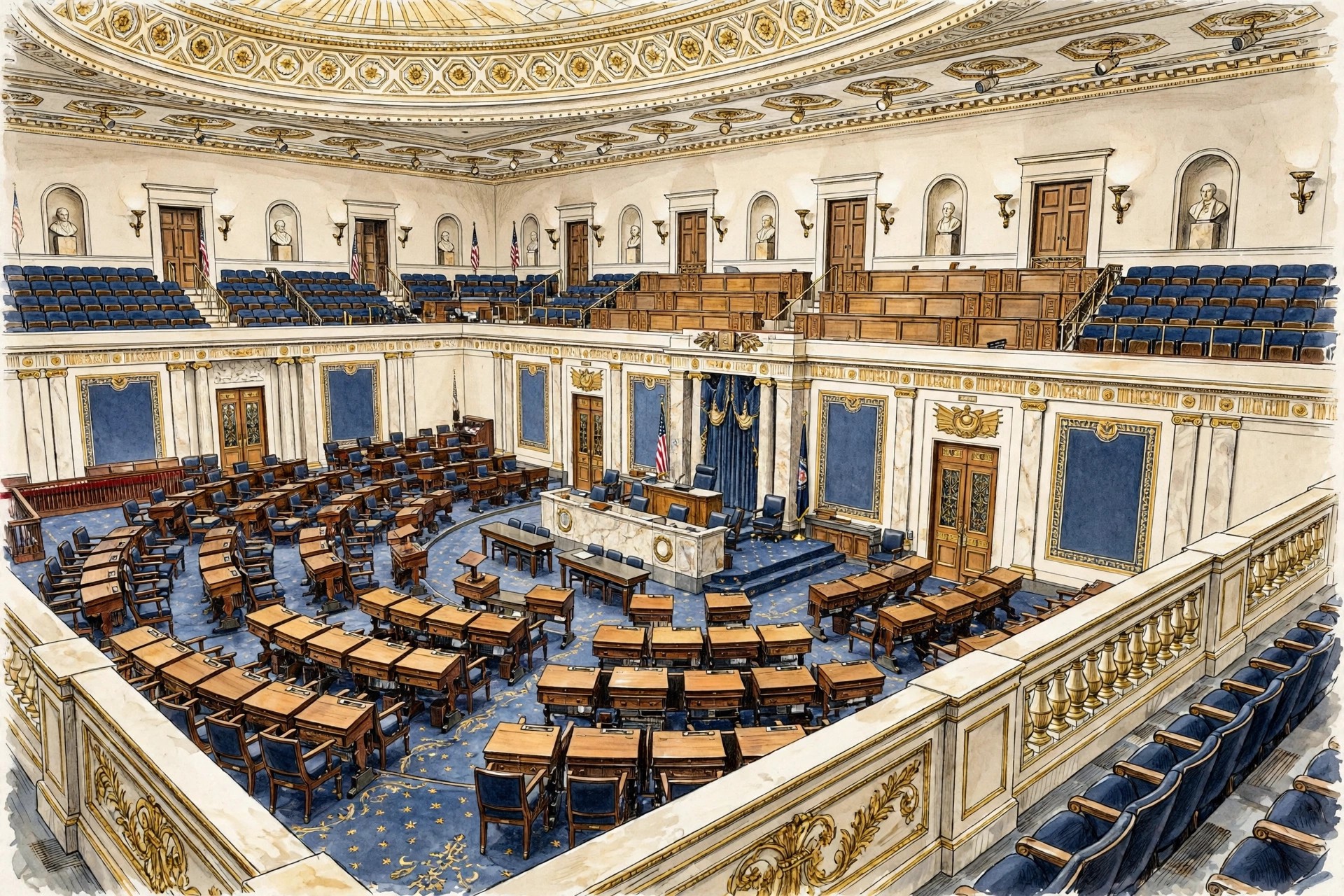
The headline about the Senate after the 2026 midterms is easy to state and hard to make precise. The Associated Press, NBC News, Decision Desk HQ and Fox News projected that Democrats would win control of the Senate, with the AP call coming late on November 3 after the Iowa race was called. That projection is the starting point for everything that follows. What is not settled, and what this article leads with rather than smoothing over, is the final margin. On November 4, different outlets at different hours reported different tallies, different counts of flipped seats, and different numbers of races still uncalled. None of those tallies is certified. State certification runs through November and December, and the new Senate does not take its seats until the 120th Congress convenes at noon Eastern Time on January 3, 2027. This article is therefore not a re-announcement of projected control. It is the arithmetic underneath that projection: which seats flipped, which races are still uncalled, why the tallies conflict, and what a projected majority can and cannot do on the Senate floor in 2027.
The pre-election arithmetic sets the baseline. Before the election, the Senate stood at 53 Republicans and 47 in the Democratic caucus, made up of 45 Democrats and 2 independents who caucus with them. Democrats therefore needed a net gain of four seats to reach 51, the threshold for outright control, because a 50-50 Senate would leave Vice President JD Vance breaking ties in favour of Republicans. A net gain of four is the minimum; anything above it widens the margin and gives the majority more room for defections on any given vote. The question after election night is not whether Democrats cleared that bar in the projections, they did, according to every major decision desk, but by how much, and whether the final certified margin matches the early projections.
Senate Projected Flips: Six Seats, Then a Seventh After Midnight
Six flips were projected by AP and others on election night. In North Carolina, Roy Cooper beat the Trump-backed Michael Whatley for the seat held by retiring Senator Thom Tillis, with Cooper shown at 58.3 percent with about 97 percent counted at 10:23 p.m. Eastern Time, according to NBC figures. In South Carolina, Annie Andrews beat Senator Darline Graham, who had been appointed after her brother Lindsey Graham’s death, the first Democrat to win a South Carolina Senate seat since 1998. In Texas, James Talarico beat Attorney General Ken Paxton by about 58.2 percent to 40.2 percent with about 57 percent counted, the first Democrat to win a Texas Senate seat since 1988. In Ohio’s special election, Sherrod Brown beat Senator Jon Husted in a race that drew about 63 million dollars in crypto-industry spending. In Kansas, Adam Hamilton beat Senator Roger Marshall, the first Democrat to win a Kansas Senate seat since 1932. And in Iowa, Josh Turek beat Ashley Hinson, the call the AP used to project Democratic control late on November 3.
A seventh flip was projected after midnight. In Maine, Troy Jackson beat Senator Susan Collins, who conceded after 30 years in the Senate, according to NBC News and Fox News projections reported on November 4. That timing explains why some tallies say six flips and others say seven: the Maine call landed later than the others, so an article written at 1 a.m. and an article written at 8 a.m. could honestly report different numbers. This article date-stamps that distinction rather than choosing one count and hiding the other. If Maine is included, the flip count is seven. If the count is taken before the Maine call, it is six. Both numbers were correct at the hour they were reported, and neither is certified.
Two holds mattered as much as the flips, because a majority is built by holding what you have as well as gaining new seats. In Georgia, Jon Ossoff won re-election over the Trump-endorsed Mike Collins. In New Hampshire, Chris Pappas won the open seat. No Democratic-held seat was reported flipped to Republicans in the sources reviewed for this story, but that negative claim must be verified against the final AP list, because the arithmetic in some early tallies does not reconcile cleanly. Six flips from a 53-47 starting point would imply 53 Democratic seats if no seat was lost, yet some early tallies reported only 51. That mismatch is itself evidence that tallies were still moving, that some races were counted differently by different desks, or that the caucus count, including independents, was handled differently. Readers should treat any early tally that does not show its working as provisional.
Conflicting Tallies: Why 51, 53 and 54 All Appeared on November 4
The conflicting tallies on November 4 are not a sign that one outlet is lying and another is telling the truth. They are a sign that decision desks call races at different times, count independents differently, and update at different hours while some races remain uncalled. Fox News at about 1:10 a.m. Eastern Time reported Democrats at 53, Republicans at 41, with six races uncalled. NBC News Decision Desk at a similar hour reported Democrats at 51, Republicans at 40, with nine races uncalled. A later Guardian and AP-based tally reported Democrats at 53 including 2 independents, Republicans at 42, with 30 of the 35 Senate races called. The Statesman reported early projections of Democrats at 54 to Republicans at 42. Each of those tallies is a snapshot, and a snapshot without a time stamp is incomplete information.
The reason the snapshots differ is mechanical. A decision desk does not count a race until it calls it. If one desk has called Maine and another has not, their totals differ by one. If one desk counts the two independents inside the Democratic total and another lists them separately, the headline number differs even though the underlying seats are the same. If one desk has called a close race on a statistical model and another is waiting for more ballots, their uncalled counts differ. None of that means the final certified result will match any single early tally. Certification, not a decision desk, determines the official result, and certification happens state by state over the following weeks.
Two races were still uncalled at the last AP check reviewed for this article, and both illustrate why a Senate margin can take weeks to settle. Alaska and Mississippi were both listed by AP as too early to call. Mississippi was described as separated by about a hundredth of a percentage point with 96.6 percent reporting at 1:10 a.m. Eastern Time, a margin so narrow that further counting, and possibly a recount or contest, could matter. Alaska’s count was expected to take more than two weeks, in part because of its counting calendar for absentee and questioned ballots and its ranked-choice tabulation if no candidate wins a majority of first-choice votes. Until those races are called and certified, the final margin cannot be stated, and any article that states it as fact is jumping ahead of the count. USN previously covered the Texas Senate race before Election Day, and the North Carolina race that became one of the night’s flips.
Michigan and the Limits of What Is Known
One further caution applies to a race that readers may expect to see named in a list of results. In the latest AP list crawl reviewed for this article, Michigan appeared as called, but the winner was not named in the excerpt read. This article therefore treats Michigan’s winner as unconfirmed, and it does not name a winner. That may seem overly cautious, but it is the correct discipline for a results article written while tallies are still moving. Naming a winner from an incomplete excerpt would risk publishing a name that a fuller check contradicts, and a correction after publication does less good than a clear statement of what is not yet confirmed. When the AP list is checked in full, Michigan can be added to the flip or hold count with a proper citation. Until then, it stays in the unconfirmed column.
The same discipline applies to the overall margin. The honest statement on November 4 is a range, not a point: projected Democratic seats in the low fifties, with tallies ranging from 51 to 54 depending on the hour, the desk and whether Maine and the uncalled races are included. That range is wide enough to matter for governing, because the difference between 51 and 54 is the difference between a majority that can afford almost no defections and one that can afford three. It is also narrow enough to show that the direction of the result is not in doubt in the projections, even though the exact size is. Both halves of that sentence are true, and both need to be kept together.
Senate 2027 Floor Agenda: What a Projected Majority Changes, and What It Does Not
What does a projected Democratic majority change on the Senate floor from January? The most important change is control of the calendar. The Democratic leader sets the Senate’s schedule and decides which nominees receive votes, including for any Supreme Court vacancy that arises. That power matters even when the majority cannot pass a bill, because confirmations require only a simple majority under current Senate rules, and a majority leader who controls the floor can bring nominees to a vote that a minority leader could block by simply not scheduling them. Democrats also gain leverage over appropriations and the debt limit, because spending and borrowing bills must pass the Senate, and a Democratic majority can shape those bills before they reach the president, even if the president can still veto them.
Aid and sanctions bills can also reach the floor without Republican leadership consent, which matters for foreign-policy measures that might otherwise never receive a vote. That does not mean such bills become law. They must still pass the House, survive a presidential veto or be passed over it, and, for most bills, clear the 60-vote threshold to end debate in the Senate. The 60-vote rule is the single most important limit on a new majority, and it is unchanged by the election. A majority of 51, 53 or 54 can confirm nominees and set the agenda, but it cannot, by itself, pass most legislation over unified opposition. Any bill that needs 60 votes still needs Republican support, and any bill the president vetoes still needs two-thirds in each chamber, 67 in the Senate, to become law over his objection.
Within those limits, the floor agenda that Democratic leaders have signalled includes relief on affordability, health-care measures such as reversing Medicaid cuts and renewing Affordable Care Act tax credits, and oversight of the executive branch. Those priorities overlap with the House agenda, which increases the chance that bills pass both chambers, but it does not remove the Senate’s 60-vote hurdle or the veto. The practical agenda for 2027 is therefore likely to be a mix: confirmations and must-pass spending and debt-limit bills, where the majority’s leverage is real; messaging bills that pass one or both chambers but are vetoed, where the point is to force a public choice; and negotiations on a smaller set of measures where both parties see a shared interest, such as cost-of-living steps that can attract votes from both sides.
Two Views of the Result, and What Happens Next
Democrats present the map as a voter rebuke on prices, tariffs and the Iran war, and Senate Democratic leader Chuck Schumer called the result a generational remake of the Senate map while promising relief on affordability. Republicans present it as a midterm headwind compounded by candidate problems, and argue that their record on taxes, the border and confirmations, plus the presidential veto, still checks the new majority. Senate Republican leader Mitch McConnell’s successor as leader, John Thune, in an X post on November 4 reported by AP, defended the Republican record and said Senate Republicans would work with Trump to block what he called Democratic extremism. Both framings will be tested by the governing record: if the new majority passes popular measures that the president signs, the Democratic framing gains force; if it is blocked by the filibuster and the veto, the Republican framing gains force.
What happens next, in order, is procedural before it is political. The remaining races, including Alaska and Mississippi, will be called as counting completes. States will canvass and certify through November and December. The outgoing Senate will continue in a lame-duck session until January 3. New senators will take office at noon Eastern Time on that day, and the Senate will organise itself, elect its officers and begin its floor work. Only at that point will the projected margin become a certified majority with a known size. Until then, the most useful habit for readers is to check the time stamp on any tally, to ask whether a race is called, uncalled or certified, and to treat the difference between 51 and 54 not as a contradiction to be resolved by picking a favourite outlet, but as a range that will narrow as the count finishes.
Sources
USN reviewed reporting from multiple outlets for this story. Read more from Nikkei Asia, USA Today and Nacionale.