

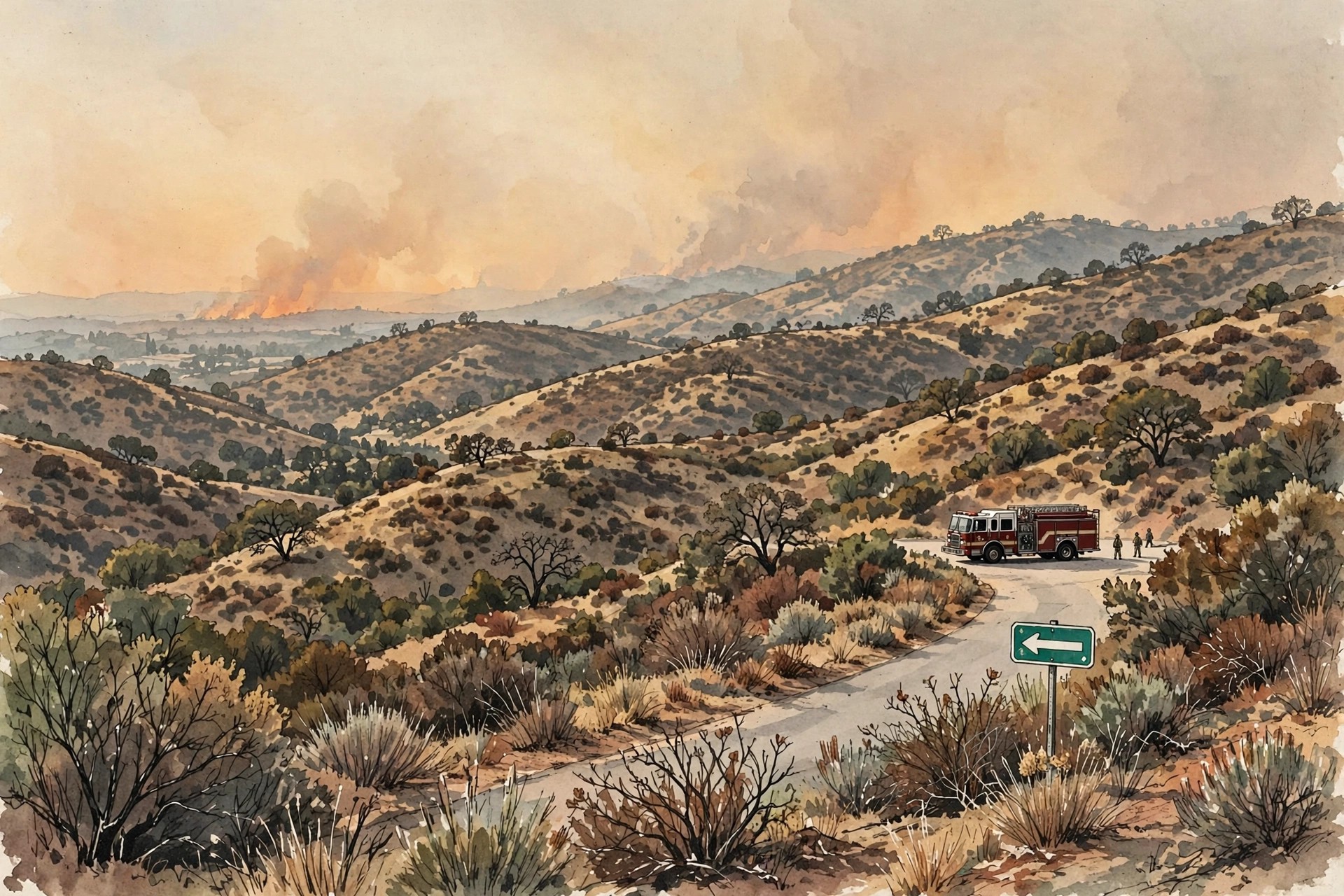
Los Angeles and Orange County are not facing a new major wildfire as of November 4, 2026, and this article does not claim otherwise. What residents of Southern California are facing, right now, is the dangerous weather that makes a fast fire possible: strong Santa Ana winds, very low humidity, and red-flag warnings across parts of the region. The difference between those two situations matters, because the first is an emergency and the second is a warning, and confusing them in either direction is dangerous. Treating a warning as if a fire were already burning causes panic. Treating it as if nothing could happen causes the delay that, in October, turned a small brush fire into an evacuation of about 16,000 people in a matter of hours.
The fire that taught that lesson most recently is the Norte Fire, which began at about 11:30 a.m. on October 16, 2026, near Portico Del Norte and Eminencia Del Norte on the northern edge of San Clemente, in Orange County. Driven by Santa Ana winds through brush, it grew from about 10 acres to about 250 acres within roughly an hour, and reached 570 acres by that evening, crossing into San Juan Capistrano. At its peak, evacuation orders covered about 16,000 residents and roughly 6,000 homes across San Clemente and San Juan Capistrano, including zones identified as San Clemente 12 and 13 and San Juan Capistrano 4, 5 and 10. Shelters opened in community centres in both cities. Orders were lifted on the evening of October 17 for most areas, the fire reached 60 percent containment on October 18, 80 percent on October 19, and full containment on October 23.
Those numbers are worth pausing over, because they describe a timeline that is now the central fact of Southern California fire preparedness. A resident who waited an hour to see whether the Norte Fire would grow would have watched it grow twenty-five times larger. A resident who waited until smoke was visible from their street might already have been under an evacuation order. The first hour of a Santa Ana-driven fire is not the time to assemble a kit, find a pet carrier, or work out which road out of the neighbourhood is still open. It is the time to already be leaving, or to already be ready to leave. Everything in this article follows from that single, uncomfortable fact.
Los Angeles Red Flag Warning: What the Forecast Actually Means
A red-flag warning is a forecast, not a fire and not an evacuation order. The National Weather Service issues it when it expects a combination of strong winds, low relative humidity and dry vegetation that would allow a fire, if one starts, to spread rapidly and resist control. On November 2, the weather service had red-flag warnings in parts of Northern and Central California and fire-weather alerts across parts of Los Angeles, Ventura, Santa Barbara and San Luis Obispo counties, with strong Santa Ana winds and very low humidity, in a report updated on November 3. In October, some mountain areas faced forecast gusts of 50 to 70 miles per hour, several brush fires prompted evacuations, and utilities used precautionary shutoffs in some areas.
Santa Ana winds are the engine of this danger, and understanding them helps explain why a forecast for Los Angeles can look alarming even on a day when the sky is clear. Santa Ana winds typically run from September through May, carrying dry inland air toward the coast. As that air descends toward sea level it warms and dries further, so vegetation that may already be dry from months without significant rain becomes even more ready to burn. A spark that on a calm, humid day might smoulder and die can, under Santa Ana conditions, become a running fire in minutes. The winds also push a fire in a predictable direction, usually toward the coast and toward the communities built along the wildland edge, which is why evacuation planning in Southern California is so closely tied to wind forecasts.
Residents should also understand the two evacuation terms that cause the most confusion. An evacuation warning means prepare to leave: gather people, pets, medicines and documents, load the car, and be ready to go at short notice. An evacuation order means leave immediately: do not wait to gather more belongings, do not wait to see whether the fire turns, and do not assume that because your street looks clear, the route out will stay clear. Fire agencies stress that residents should not wait for an official notice if they feel threatened. If smoke, heat or falling embers make you feel unsafe, leaving early is not overreacting. It is the correct response, and it is the response that keeps roads clear for firefighters and for neighbours who may need more time.
Knowing your zone in advance is the single most practical step a Southern California resident can take, and it is the step most often skipped. Los Angeles County publishes evacuation zones through Genasys Protect, and Orange County uses a similar zone system, as the Norte Fire zone numbers show. When an order is issued, it is usually issued by zone, not by street name, and a resident who does not know their zone will waste precious minutes trying to work out whether the order applies to them. Look up your zone now, while there is no fire, write it down where every member of the household can find it, and check it against the zones of schools, workplaces and relatives you might need to collect. That one piece of information, learned in calm conditions, can save the most time in an emergency.
The Norte Fire in San Clemente: An Hour That Changed the Evacuation
The Norte Fire’s first hour deserves a closer look, because it illustrates every element of Santa Ana fire behaviour at once. The fire began late in the morning, at a time when many residents were at work, at school, or running errands, and when the people at home may have been the least mobile members of a household. It began in brush on the northern edge of San Clemente, in terrain where homes meet open land, and the wind pushed it quickly through that brush. Within roughly an hour it had grown from about 10 acres to about 250 acres. By evening it covered 570 acres and had crossed a city boundary into San Juan Capistrano, which meant two cities’ emergency systems, two sets of shelters, and two sets of evacuation zones were involved in a single incident.
The response was large. At one stage, 583 personnel, 11 helicopters and 67 engines were assigned to the fire. That scale is normal for a Santa Ana fire threatening homes, and it is a reminder that a fire that threatens a community does not stay a local incident for long. Aircraft drop water and retardant, engines protect structures, and crews cut lines in brush, all while evacuation traffic moves in the opposite direction on the same roads. The coordination required is immense, and it works best when residents leave promptly, because every car that leaves late is a car that may meet a fire engine coming in, on a road that is already narrowed by smoke and by parked vehicles.
The damage and injury figures from the Norte Fire also need to be reported carefully, because they were revised as the incident developed, and the revision itself is informative. Seven homes were damaged or destroyed in the final count, but early updates from the Orange County Fire Authority said six. This article reports the revised figure of seven and notes the earlier figure of six, rather than silently picking one, because a reader who saw the early number and then the later number deserves to know that the count changed as damage assessment teams reached properties that were initially inaccessible. Two firefighters were hospitalised with heat-related injuries. No deaths were reported. Those outcomes, given the speed of the fire and the number of homes evacuated, reflect both the speed of the evacuation and the work of the crews who protected structures under dangerous conditions. They should not be read as a guarantee that the next fast fire will end the same way.
The cause of the Norte Fire remains under investigation as of the last updates available at the time of writing. A later lawsuit allegation points to a utility-circuit outage minutes before the fire report, but that is an allegation in litigation, not an official cause finding, and no person, utility or company has been officially identified as responsible. This article does not assign blame for the Norte Fire, and readers should be sceptical of any account that does, because the official investigation has not concluded. The legal aftermath of a fire, including questions of liability, is contested and unresolved, and it is separate from the preparedness question, which is what residents should do regardless of how a fire starts. A fire caused by lightning, by equipment, or by human activity behaves the same way once it is running in Santa Ana winds, and the evacuation response is the same.
Orange County Evacuation Zones and the Preparedness Checklist
Preparedness, in the official guidance cited by fire agencies and readiness sources, is not a single action but a short list of actions taken before a warning exists. The first is an emergency kit: water, food, medicines, important documents, a phone charger, and supplies for pets, kept where they can be grabbed in minutes rather than assembled from cupboards. The second is fuel: keep at least half a tank in the car during fire season, because evacuation traffic and road closures can turn a short drive into a long one, and a car that runs out of fuel on an evacuation route becomes an obstacle for everyone behind it. The third is a plan: an evacuation route, a meeting point if family members are separated, and an out-of-area contact who can relay messages if local phone networks are congested.
The fourth item on the checklist is behaviour during red-flag conditions, and it is the one most people underestimate. During a red-flag warning, avoid spark-risk activity: do not mow dry grass, do not use equipment that can throw sparks, and do not burn anything outdoors. A fire that starts during red-flag conditions does not need a dramatic cause. A mower blade striking a rock, a chain dragging on a road, or a discarded cigarette can be enough, and the wind will do the rest. Utilities may also use precautionary shutoffs during the worst wind events, cutting power to reduce the risk of equipment-caused ignitions. Those shutoffs are disruptive, and residents who depend on powered medical equipment should have a backup plan and should register, where available, with their utility’s medical baseline or access-and-functional-needs programme.
For households with children, older relatives, or people with mobility needs, the plan needs extra detail. Who will collect a child from school if roads are closed? Who will help an older relative who cannot drive? Where will pets go if a shelter does not accept animals? Those questions are difficult to answer under stress and easy to answer in advance, and the difference between the two is often the difference between an orderly evacuation and a panicked one. Schools and care facilities have their own evacuation plans, and parents should know them before fire season, not discover them on the day a warning is issued.
Communication during a fire also deserves planning. Official information comes from fire agencies, county emergency management, and the National Weather Service, and residents should follow those sources rather than relying solely on social media, where rumours about evacuation zones and road closures spread quickly. Sign up for county emergency alerts, keep a battery-powered radio or a charged phone with a portable charger, and be aware that power shutoffs can affect both internet and mobile service. A plan that depends entirely on a phone app will fail if the phone dies or the network is congested, so a paper copy of zone information, routes and contact numbers is a sensible backup.
What Los Angeles Residents Should Do This Week
For residents reading this during the current red-flag period, the practical steps are immediate and simple. First, check your evacuation zone today, through Genasys Protect for Los Angeles County or the equivalent system for your county, and confirm that every adult in the household knows it. Second, check your emergency kit and your fuel level, and replace anything that has expired or been used. Third, review your evacuation route and your meeting point, and make sure everyone in the household knows both, including children old enough to understand them. Fourth, avoid spark-risk activity until the red-flag warning expires, and report any smoke or fire promptly rather than assuming someone else has already called it in.
It is also worth saying plainly what this article is not. It is not a report of a new fire on November 4, and no new major fire or evacuation order dated November 4 was confirmed in the sources available at the time of writing. It is a preparedness article, built on a verified October fire and on current warnings, and it will need a fresh top if a new fire breaks out. Readers who hear of a new fire should check official agency updates for that incident, rather than treating the Norte Fire details in this article as current information about a different fire. Each fire has its own zones, its own evacuation orders, and its own containment timeline, and mixing them up is a real risk when several incidents are discussed in the same news cycle.
One final caution concerns older fire figures that sometimes resurface in search results and in aggregated articles. Figures from the January 2025 Palisades and Eaton fires, which belong to a different fire season and a different set of incidents, should not be imported into a discussion of the October 2026 Norte Fire or of current Southern California warnings. Those earlier fires caused extensive loss, but their casualty and structure figures describe different events, in different places, under different conditions, and using them here would mislead readers about both the scale of the Norte Fire and the current risk. This article deliberately excludes them, and readers who encounter them in other coverage should check which fire they refer to before drawing any conclusion about the present situation.
The lesson of the Norte Fire, in the end, is not that Southern California is helpless in the face of Santa Ana winds. It is that the window for effective action is short, and that the people who use that window well are the people who prepared before it opened. A zone known in advance, a kit packed in advance, a route chosen in advance, and a decision to leave early rather than late: those four things, taken together, are what turn a fast fire from a disaster into an evacuation that, as in San Clemente and San Juan Capistrano in October, ends with homes damaged but no lives lost. That is the standard to aim for, and the reason a red-flag warning, even without a fire, deserves to be taken seriously.
For related USN coverage of an earlier California evacuation, readers can also see California Wildfire Evacuations Ordered as Santa Ana Winds Drive Fast-Moving Fire.
Sources
USN reviewed reporting from multiple outlets for this story. Read more from Nature World News, Catria Attorneys and Rio Dell Times.